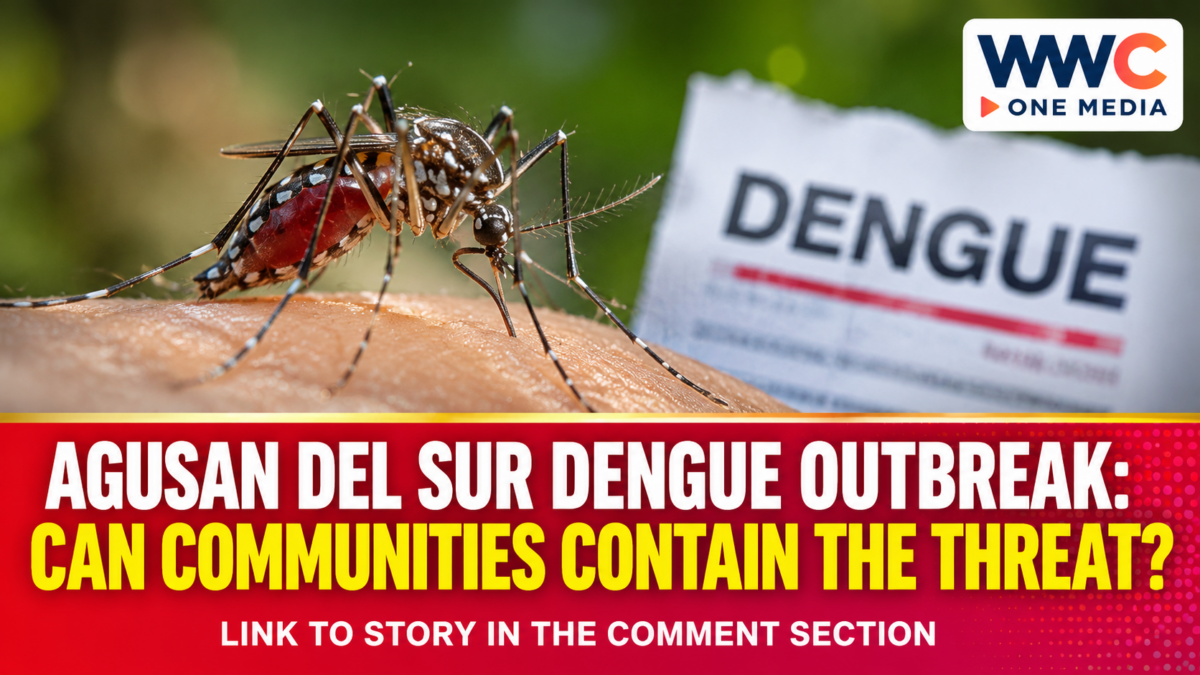
PROSPERIDAD, Agusan del Sur — The Agusan del Sur dengue outbreak remains a public-health challenge after the provincial government declared a province-wide outbreak in September 2026. Official provincial information published on Oct. 6 placed the cumulative burden at 2,185 reported cases and 15 deaths as of Oct. 5.
The figures show why a dengue response cannot depend on emergency announcements alone. Reducing infections requires households, barangays and health facilities to keep prevention, case detection and patient care working at the same time.
Agusan del Sur dengue: What the official record establishes
The Provincial Health Office issued its outbreak advisory on Sept. 29, citing rising infections, hospitalisations, severe cases and deaths. The provincial government subsequently published the declaration, explaining that it relied on disease surveillance and the legal framework for reporting and responding to health threats.
Earlier Department of Health regional figures documented 206 cases during the first half of 2026, 492 by July 25 and 674 by Aug. 8. These were cumulative totals for different reporting dates, not separate groups of patients to be added together.
The next official provincial update described 2,185 cumulative cases and 15 deaths by Oct. 5. It also reported 1,640 hospital admissions and identified children aged 10 to 14 as the most affected age group at that reporting point.
These dated snapshots establish the seriousness of the outbreak, but they do not establish the number of infections or deaths on Nov. 21. Fresh, dated surveillance data would be necessary to describe the current total accurately.
Why an outbreak declaration matters
A formal outbreak declaration is more than a public warning. It gives health agencies and local governments a clear basis for coordinating case investigations, mosquito-control work, communications and clinical preparedness.
In its outbreak notice, the province described surveillance activity in Rosario, including checks of potential breeding sites in Barangays Sta. Cruz and Bayugan 3 on Sept. 23. Such investigations focus attention on areas where infections have already been identified rather than treating every neighbourhood as having the same immediate risk.
The provincial response also called for health facilities to review their capacity to handle dengue patients, improve referral pathways and use dengue fast lanes where appropriate. These steps matter because timely assessment helps clinicians identify patients who need closer monitoring.
The wider regional picture provides useful context. A previous WWC ONE MEDIA examination of Caraga’s dengue surveillance explored how a lower regional total can coexist with a serious outbreak in one province. A regional average therefore cannot replace local case monitoring.
What families can do before mosquitoes multiply
Dengue spreads primarily through bites from infected Aedes mosquitoes. The practical prevention priority is to reduce places where these mosquitoes can breed, especially containers that hold standing water.
Agusan del Sur health officials promoted the household routine known as taob, taktak, tuyo at takip: turn over containers, remove trapped water, dry possible breeding sites and cover water storage. Repeating these actions is more useful than conducting a one-off clean-up and assuming the risk has passed.
Residents can also reduce mosquito exposure through repellents, appropriate clothing, window screens and mosquito nets. The World Health Organization notes that dengue-transmitting mosquitoes are active during the day, making daytime protection important.
The province’s 4S approach combines searching for and destroying breeding places, self-protection, early consultation and support for targeted spraying when health authorities indicate it is needed. Spraying should complement, not replace, removing mosquito breeding sites.
Recognising symptoms and warning signs
Fever, headache, body pain, nausea, vomiting and rash can occur with dengue. The symptoms overlap with other illnesses, so a medical assessment is more reliable than trying to diagnose the cause of a fever at home.
Dengue may become dangerous as the fever subsides. Warning signs include severe abdominal pain, persistent vomiting, rapid breathing, bleeding from the gums or nose, unusual weakness and cold or pale skin. Anyone developing these signs needs immediate medical attention.
There is no specific antiviral cure for dengue. Care focuses on appropriate monitoring and supportive treatment, with decisions about fluids and hospital care based on clinical assessment. The WHO advises avoiding aspirin and ibuprofen when dengue is suspected because they can increase bleeding risk.
A related WWC report on dengue trends and hospital preparedness examined why fast assessment and local capacity matter when infection patterns change. The central lesson applies to households as well: do not delay consultation until symptoms become severe.
Why local patterns matter more than comparisons
The October provincial figures identified hospital admissions and a substantial burden among school-aged children. Those details are relevant for schools, families and barangay health workers planning prevention messages, recognising symptoms and arranging access to care.
However, a high cumulative count alone cannot tell readers whether transmission is accelerating or slowing this week. That requires successive reporting periods, a consistent case definition and local breakdowns that allow health workers to see where new infections are occurring.
Other provinces may face different thresholds and patterns. A separate WWC report on Cebu’s dengue response illustrates why a rising case count and a formal province-wide outbreak declaration should not be treated as interchangeable descriptions.
What this could mean: In Agusan del Sur, the most meaningful measure of progress will be sustained reductions in new infections, prompt treatment of suspected cases and continued prevention work in identified hotspots. An outbreak declaration starts a coordinated response; it does not, by itself, demonstrate that transmission has been controlled.
What happens next
Residents should watch for updated surveillance figures and official notices identifying areas requiring intensified action. Local authorities will need to keep mosquito-control activities aligned with fresh case information while health facilities maintain clear routes for assessment and referral.
The province has already described the measures it intends to use. The unanswered question is how consistently those measures can be maintained across communities over time. For families, the immediate priorities remain routine removal of standing water, protection from mosquito bites and early consultation when illness develops.
FAQ
Has Agusan del Sur declared a dengue outbreak?
Yes. The Provincial Health Office issued an outbreak advisory on Sept. 29, 2026, and the provincial government publicly documented the province-wide declaration.
How many dengue cases have been officially verified?
The provincial government’s Oct. 6 publication reported 2,185 cumulative cases and 15 deaths as of Oct. 5, 2026. This is a dated official figure, not a claim about the total on Nov. 21.
What are the warning signs of severe dengue?
Severe abdominal pain, repeated vomiting, bleeding, rapid breathing, pronounced weakness and pale or cold skin are warning signs that require urgent medical assessment.
How can households reduce dengue risk?
Regularly empty, clean and cover water containers, remove rubbish that collects water, use mosquito repellent and protective clothing, and seek medical advice promptly when symptoms appear.