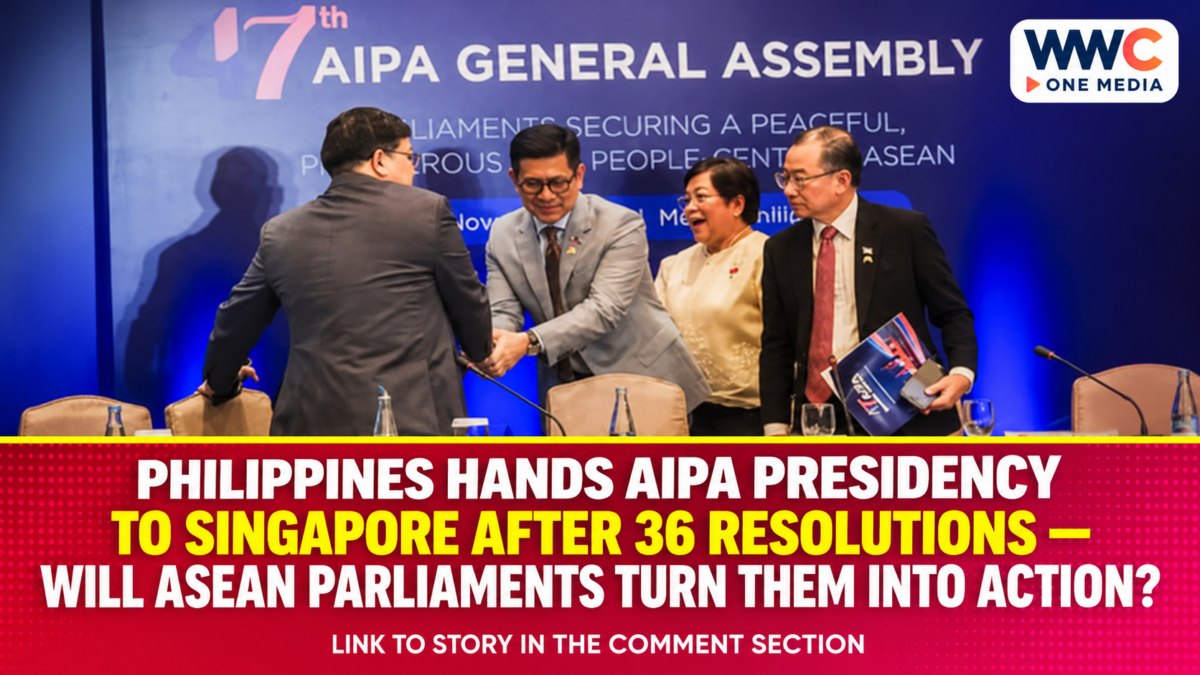
The Philippines concluded its leadership of the ASEAN Inter-Parliamentary Assembly (AIPA) on Nov. 20, 2026, handing the organisation’s presidency to Singapore after hosting its 47th General Assembly in Manila.
The gathering ended with 36 adopted resolutions covering regional security, food and energy security, artificial intelligence, climate change, healthcare, migrant workers, and the protection of women and children. Timor-Leste also formally joined AIPA as its 11th member parliament, marking an important expansion of the organisation.
The outcome gives the Philippines a substantial diplomatic and parliamentary milestone. However, the more important question now is whether the resolutions adopted in Manila will influence legislation, government priorities and regional cooperation after the delegates return home.
AIPA General Assembly marks a leadership transition
The 47th AIPA General Assembly took place in Manila under the theme, Parliaments Securing a Peaceful, Prosperous, and People-centred ASEAN.
The official AIPA programme identifies the House of Representatives of the Philippines as host of the assembly from Nov. 16 to 22, 2026. The opening ceremony was held on Nov. 18, with Faustino “Bojie” G. Dy III serving as AIPA President and Speaker of the Philippine House of Representatives.
The first plenary session considered the assembly’s agenda, programmes and other organisational matters.
The meeting brought together representatives of AIPA member parliaments, observer parliaments, the ASEAN Secretariat, development partners and other invited participants.
The Philippine presidency provided an opportunity for lawmakers to discuss issues that extend beyond individual national borders. These included political stability, economic development, social protection and emerging technological challenges.
The assembly’s conclusion on Nov. 20 also marked the end of the Philippines’ immediate leadership responsibility within the organisation.
Thirty-six resolutions put regional priorities on the table
One of the most significant outcomes was the adoption of 36 resolutions.
The Philippine House of Representatives identified several areas covered by the resolutions, including:
- Regional security and political cooperation
- Food and energy security
- Artificial intelligence
- Climate change
- Healthcare
- Migrant workers
- Protection of women and children
These subjects reflect the range of issues confronting Southeast Asian governments.
Food and energy security, for example, affect household expenses, industrial operations and economic stability. Climate change also creates challenges for countries dealing with extreme weather, vulnerable coastal communities and agricultural disruption.
Artificial intelligence presents another policy challenge. Legislatures must consider how existing laws address emerging technologies, including their implications for employment, privacy, education and public services.
The inclusion of migrant workers and social protection also highlights the importance of legislative coordination in a region where people, businesses and economic activities increasingly cross national boundaries.
However, adopting resolutions should not be confused with immediately implementing regional policies.
AIPA resolutions provide a framework for parliamentary cooperation and recommendations. Their practical effects depend on how individual member parliaments examine, translate and act on the commitments.
That distinction will determine whether the Manila meeting becomes more than a successful diplomatic gathering.
Timor-Leste becomes AIPA’s 11th member parliament
Another important development was Timor-Leste’s formal admission as AIPA’s 11th Member Parliament.
The Philippine House announced the development on Nov. 18, with House Speaker and AIPA President Dy welcoming the country’s parliamentary institution into the organisation.
The expansion gives Timor-Leste a formal place in AIPA’s parliamentary discussions.
It also reflects the organisation’s broader regional significance. AIPA was established in Manila in 1977 as the ASEAN Inter-Parliamentary Organization and adopted its present name in 2007.
Its role is to provide national legislatures with a platform for exchanging views, developing common positions and contributing a parliamentary perspective to ASEAN cooperation.
The addition of Timor-Leste is particularly relevant because it brings the organisation’s membership to 11 parliaments.
For the newest member, participation offers an opportunity to contribute to regional discussions rather than relying exclusively on observer involvement.
For existing members, the expansion creates another channel for discussing shared legislative and development concerns.
Singapore takes over ahead of AIPA’s 50th anniversary
The leadership transition was formalised during the assembly’s closing ceremony.
Dy handed the AIPA gavel and flag to Singapore Parliament Speaker Seah Kian Peng. Both leaders signed the Instrument of Transfer, formally transferring the presidency.
Singapore will host the 48th AIPA General Assembly in 2027.
The timing carries institutional significance because AIPA will mark its 50th anniversary next year. The organisation traces its establishment to Manila in 1977, when five founding parliaments came together.
The transition therefore gives Singapore responsibility for leading AIPA into a milestone year.
It also creates continuity between the Philippine and Singaporean presidencies, particularly in carrying forward the resolutions and priorities agreed upon in Manila.
The leadership change is not simply ceremonial. It places responsibility on the incoming presidency to maintain engagement among member parliaments and sustain the organisation’s legislative agenda.
Why the resolutions matter beyond diplomacy
The AIPA meeting’s significance extends beyond the number of delegates, speeches or adopted documents.
Parliamentary cooperation can help governments identify areas where national legislation may benefit from shared approaches.
For example, discussions on migrant workers can help legislators examine protections, employment conditions and cross-border concerns. Cooperation on energy security can encourage the exchange of legislative approaches to supply resilience and investment.
Artificial intelligence is another area where cooperation could prove useful. Different national approaches to data protection, accountability and technological development may create challenges for businesses operating across Southeast Asia.
The regional diplomatic environment also makes continued communication important.
WWC has previously examined the role of ASEAN diplomacy in efforts to advance peace discussions in Myanmar. That wider regional challenge illustrates why parliamentary and diplomatic channels remain relevant even when political differences are difficult to resolve.
Likewise, Thailand and Cambodia’s continuing border disagreements demonstrate the importance of peaceful dialogue and established mechanisms for managing regional tensions.
These issues are not necessarily resolved through parliamentary assemblies. However, legislative dialogue can complement the work of governments and regional institutions.
The wider ASEAN context is also important, as regional leaders’ diplomatic engagements in Manila have placed renewed attention on the country’s role in regional discussions.
WWC Analysis: The Philippines has completed the organisational task of hosting the assembly and transferring the presidency. Its longer-term contribution will be better assessed through the implementation of the resolutions and the continuity of cooperation among participating legislatures.
A successful meeting is a starting point, not proof that regional problems have been solved.
What happens next?
Singapore will assume the AIPA presidency and host the 48th General Assembly in 2027, coinciding with the organisation’s 50th anniversary.
The next stage will involve carrying forward the commitments made in Manila.
Member parliaments will need to consider which resolutions require legislative attention, further consultations or changes to national policy.
The implementation of those commitments will also require cooperation between lawmakers, government agencies and relevant regional institutions.
For the Philippines, the immediate presidency has ended, but its parliamentary participation continues as a member of AIPA.
The 36 resolutions provide a basis for measuring future progress. Whether they produce meaningful changes in the lives of Southeast Asian citizens will depend on what happens after the assembly.