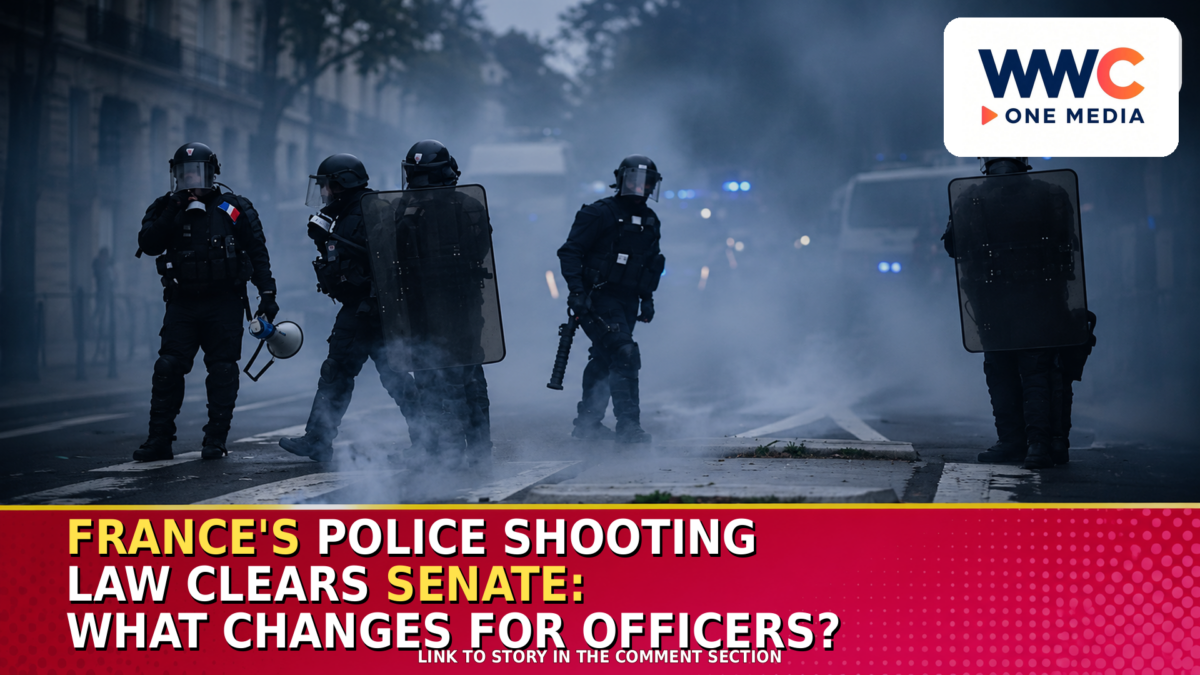
France’s proposed French police law on the use of firearms has cleared its final parliamentary vote, introducing a significant change in how the legality of police and gendarmerie shootings will be assessed.
The French Senate approved the legislation on November 20, 2026, by 205 votes to 110, with 27 abstentions. The measure was adopted without modification after previously passing the National Assembly, leaving presidential promulgation as the next formal step before it can become law. Sénat+2
The legislation does not give officers unrestricted permission to shoot. Instead, it establishes a rebuttable presumption that national police officers and gendarmes who use their firearms have acted within the legal framework governing the use of weapons.
That distinction is central to the debate. While supporters argue that the change provides greater legal protection to officers facing dangerous situations, critics question whether shifting the burden of proof could make accountability more difficult when a shooting results in injury or death.
The proposal therefore raises a broader question about the balance between protecting law enforcement personnel and preserving effective judicial scrutiny.
What France’s Police Law Actually Changes
The legislation introduces a new presumption into Article L.435-1 of France’s Internal Security Code.
Under the provision, national police officers and members of the national gendarmerie who discharge their firearms will be presumed to have acted within one of the legally authorised circumstances, while respecting the requirements of absolute necessity and strict proportionality.
However, this presumption is not conclusive.
The adopted text expressly provides that the presumption may be overturned at any time by contrary evidence. This means investigators and prosecutors can still establish that an officer’s actions did not comply with the law. Sénat+1
The practical difference concerns the starting point of the legal assessment.
Under the existing framework, the legality of a firearm discharge must be established through the available evidence. Under the proposed change, the officer initially benefits from a presumption of lawful conduct, placing greater importance on evidence capable of rebutting that presumption.
The measure applies to the national police and national gendarmerie. It should not be described as automatically extending the same presumption to municipal police officers.
The Existing Rules on Police Firearms Remain Important
France established a unified legal framework for police and gendarmerie firearms use in 2017 through Article L.435-1 of the Internal Security Code.
The existing rules require officers to demonstrate absolute necessity and strict proportionality when using their weapons.
They identify five authorised circumstances, including situations involving threats to life or physical integrity, protecting occupied locations or people under their responsibility, stopping certain dangerous fleeing individuals or vehicles, and preventing the repetition of a series of murders or attempted murders. Légifrance+1
The new legislation does not simply remove these conditions.
Instead, it changes how compliance with those conditions is presumed and subsequently challenged during legal proceedings.
Another important provision concerns officers responding to a continuing deadly attack. The legislation removes the requirement that national police officers and gendarmes must wear their uniforms or visible identification when using firearms to prevent the repetition of recently committed murders or attempted murders.
The provision still requires real and objective reasons to believe another killing is likely, based on information available at the time.
This is a specific operational exception, not a general authorisation for officers to use firearms while off duty. Sénat+1
Why Supporters Say the Change Is Necessary
The Senate’s legislative report presents officer safety and legal uncertainty as central reasons behind the measure.
Data included in the report show that the number of gendarmes assaulted with a weapon annually doubled between 2016 and 2025.
It also records that nearly 3,200 gendarmes had been injured following assaults since the beginning of 2026, representing a 25% increase compared with the same period in 2025.
For national police officers, the report recorded 6,625 physical assaults in 2024, including 1,289 involving weapons. Sénat
The report also presents a different picture of firearm use.
Between 2017 and 2025, operational shots by national police officers targeting vehicles or people fell from 338 to 176, nearly halving over the period.
The gendarmerie recorded an average of 63 firearm-use incidents annually between 2017 and 2025, without a clear upward trend. Sénat
These figures matter because the debate is not simply about increasing police powers.
Supporters argue that officers need confidence that lawful decisions made during dangerous interventions will not automatically place them in the position of criminal suspects.
The legislation is intended to reduce uncertainty without removing the underlying legal requirements.
The Accountability Debate Is Far From Settled
The most consequential disagreement concerns the burden of proof.
Opponents argue that establishing a presumption of lawful firearm use could make it harder to scrutinise shootings, particularly when victims cannot provide their own accounts.
The concern is especially significant in incidents involving fatalities, where forensic findings, witness testimony, surveillance footage and body-camera recordings may become essential to reconstructing what happened.
The Senate’s own legislative proceedings record these objections alongside the arguments supporting the measure. The debate also addressed whether investigations and custodial procedures could be affected by the change. Sénat+1
The distinction between an investigation and a presumption of legality is particularly important.
The Senate commission’s position is that judicial investigations remain possible and evidence must continue to be assessed both for and against the officer concerned.
However, the legislation could influence how prosecutors initially assess a firearm discharge and whether an officer is treated as a suspect or questioned under a different procedural status.
For readers following wider discussions about law enforcement accountability, WWC has also examined police accountability during the ASEAN Summit demonstrations.
The underlying issue is relevant across jurisdictions: protecting officers performing their duties must be balanced against the public’s right to transparent investigations when state officials use force.
France’s debate also connects with WWC’s coverage of the investigation into competing claims following a police-protester confrontation in Cebu.
These are separate legal situations, but both illustrate why clear rules and credible accountability mechanisms matter.
What the Legislation Means for Police Oversight
The new presumption does not eliminate the importance of independent evidence.
The Senate report specifically highlights the importance of body-worn cameras and the preservation of recorded footage.
It recommends more systematic use of body cameras and longer retention of collected images to help investigators determine the circumstances surrounding firearm use. Sénat
This is an important practical consideration.
If the law gives officers an initial presumption of compliance, the quality and availability of evidence become particularly significant when that presumption is challenged.
Investigators must still be able to establish the sequence of events, assess whether the threat was real, and determine whether firearm use was necessary and proportionate.
For law enforcement institutions, stronger legal protection should not mean weaker documentation.
The wider importance of institutional discipline is also reflected in WWC’s reporting on police disciplinary action and accountability within the Philippine National Police.
That coverage concerns a different country’s police system, but it highlights the continuing importance of transparent procedures and public confidence in law enforcement.
What Happens Next?
The French National Assembly approved the legislation on July 7, 2026. The Senate subsequently approved the same text without modification on November 20, completing the parliamentary adoption process. Sénat+1
The next formal step is presidential promulgation.
Article 10 of the French Constitution provides that the President promulgates definitively adopted laws within 15 days after transmission to the Government. It also allows the President to request another parliamentary deliberation before the deadline expires. Légifrance
As of November 21, the Senate’s published provisional adopted text is available, but the reviewed records do not establish that presidential promulgation has already occurred.
The distinction matters: parliamentary adoption is not the same as a law already in force.
Once promulgated and published, the legislation will establish a new starting presumption for assessing firearm use by the covered national police and gendarmerie personnel.
Its real impact will depend on how prosecutors, investigators and courts apply the provision in individual cases.