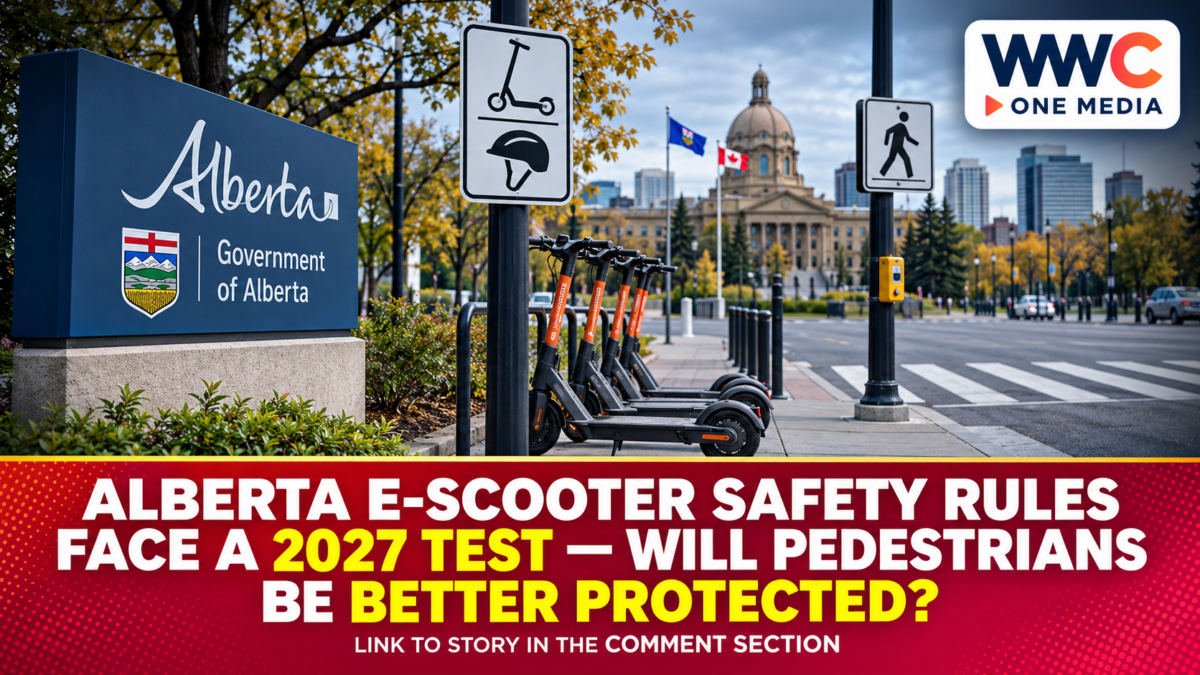
Alberta has introduced legislation that could change how electric scooters and other small electric mobility devices are regulated across the Canadian province. Bill 43, introduced on Nov. 19, 2026, would establish authority for provincewide safety standards while allowing municipalities to develop additional local protections.
The proposal comes as cities face a difficult balancing act: making room for newer transport options without compromising the safety of people walking, cycling or using public pathways.
The central question is whether a common regulatory framework can resolve confusion over where electric scooters may operate, who can use them and how authorities should respond to unsafe riding.
Alberta E-Scooter Safety Rules Could Reshape Local Transport
The proposed Transportation (Safe and Sensible Roads) Statutes Amendment Act, 2026, would change Alberta’s Traffic Safety Act to recognise personal micromobility devices within its regulatory structure.
These devices include privately owned and rented electric scooters, Segways, one-wheel electric devices and comparable forms of personal transportation.
The amendments would give the provincial government authority to define minimum requirements and allow municipalities to regulate device use within their communities.
The distinction is important. A provincial framework would establish common legal foundations, but individual cities could impose requirements that meet or exceed provincial safety standards.
That could make compliance more straightforward for riders travelling between municipalities while preserving local flexibility.
However, the government has not yet released the complete standards. Specific provincewide requirements for matters such as speed limits, operating locations and rider eligibility should not be treated as final.
The legislation is targeted to take effect on April 1, 2027, subject to legislative approval.
Red Deer Collision Figures Highlight the Safety Challenge
Municipal records show why the regulatory debate matters.
The City of Red Deer has documented an increase in reported collisions involving electric scooters and other electric mobility devices.
Its published figures show one reported incident in 2021, two in 2022, four in 2023, four in 2024 and 23 in 2025.
That represents a substantial increase in reported incidents, although the figures alone cannot establish whether the change resulted from greater device use, more reporting or other factors.
The available municipal figures also do not establish how many incidents involved pedestrians rather than riders or other road users.
These distinctions matter when assessing the seriousness of the problem and identifying appropriate responses.
Red Deer already differentiates between approved shared scooters and privately owned devices.
The city’s published guidance states that personal e-scooters are not permitted on its public roads or pathways, while scooters offered through authorised rental programmes operate under specific conditions.
Its shared mobility programme requires users to be at least 16 years old and limits each shared scooter to one rider.
The city’s programme guidance also states a maximum shared-scooter operating speed of 20 kilometres per hour.
These are local operating conditions, not proof that equivalent standards have been adopted across Alberta.
Why Provincial Rules Have Become a Priority
Alberta’s regulatory challenge did not emerge overnight.
Under the existing framework, municipalities have relied on provincial authorisations and exemptions to introduce shared electric scooter programmes.
That arrangement has allowed approved services to operate while leaving privately owned scooters subject to different restrictions.
Alberta Municipalities, an organisation representing local governments, previously called for changes that would clarify how both shared and personally owned scooters should be regulated.
The organisation identified the need to modernise provincial transport law while preserving municipal authority.
Its earlier advocacy also reflected the administrative complications created when communities must obtain provincial authorisation before implementing certain local scooter programmes.
Bill 43 would address part of that problem by establishing authority for a broader regulatory framework.
For riders, the potential benefit is clearer guidance. For municipalities, it is a more consistent legal basis for managing transport technology that is already present in their communities.
A comparable regulatory challenge appears in other transport sectors: regulators must determine how innovative services fit within established safety and accountability systems.
WWC ONE MEDIA has previously examined the regulatory requirements facing motorcycle taxi operators in the Philippines, where public safety and operating authorisation also influence transport policy.
Why Pedestrian Protection Remains the Critical Test
A clearer law does not automatically guarantee safer streets.
The practical test will be whether enforceable operating rules reduce conflicts between pedestrians and faster-moving devices.
Red Deer’s guidance tells shared scooter riders to yield to pedestrians, maintain safe speeds and provide sufficient passing space.
The city also advises riders to avoid obstructing public access when parking their devices.
These basic precautions are particularly relevant in areas where walking routes, public spaces and electric mobility services overlap.
The provincial government’s forthcoming regulations could provide an opportunity to clarify expectations concerning vehicle standards, permitted riding areas and local enforcement.
However, their effectiveness would depend on the final requirements, public understanding and actual compliance.
WWC ONE MEDIA’s earlier coverage of a mobility scooter fire in Singapore illustrates a separate dimension of electric mobility safety: the need to consider equipment risks alongside everyday operating behaviour.
The two issues require different safeguards, but both demonstrate why authorities must assess more than the convenience of electric transport.
What This Could Mean for Cities and Riders
For municipalities, the proposed framework could provide more control over where devices operate and what conditions apply.
For rental operators, clearer rules could simplify compliance expectations, although municipal differences would remain possible.
Privately owned scooter users could also gain greater legal clarity if the final framework authorises local operation under defined conditions.
None of these potential benefits should be mistaken for a guarantee of unrestricted scooter access.
Municipalities would still have authority to establish local requirements consistent with the provincial framework.
The broader policy challenge is similar to other road safety questions: effective regulation depends on identifying risks, communicating rules clearly and enforcing them consistently.
WWC ONE MEDIA has also explored driver accountability and road safety enforcement in the Philippines, highlighting a related principle: compliance with transport rules matters regardless of the vehicle involved.
What Happens Next?
Bill 43 must complete the legislative process before its proposed amendments can take effect.
Alberta’s government has indicated that the full provincial micromobility framework and minimum safety standards are expected in early 2027, ahead of the targeted April 1 implementation date.
Municipalities will then need to assess how their existing bylaws and operating programmes fit within the final framework.
The most important questions concern how provincial and municipal responsibilities will work together, what practical safety requirements will be introduced and how those requirements will be enforced.
For pedestrians, the outcome will not be determined by the existence of legislation alone.
It will depend on whether the final rules make shared public spaces safer while allowing responsible electric mobility services to operate.