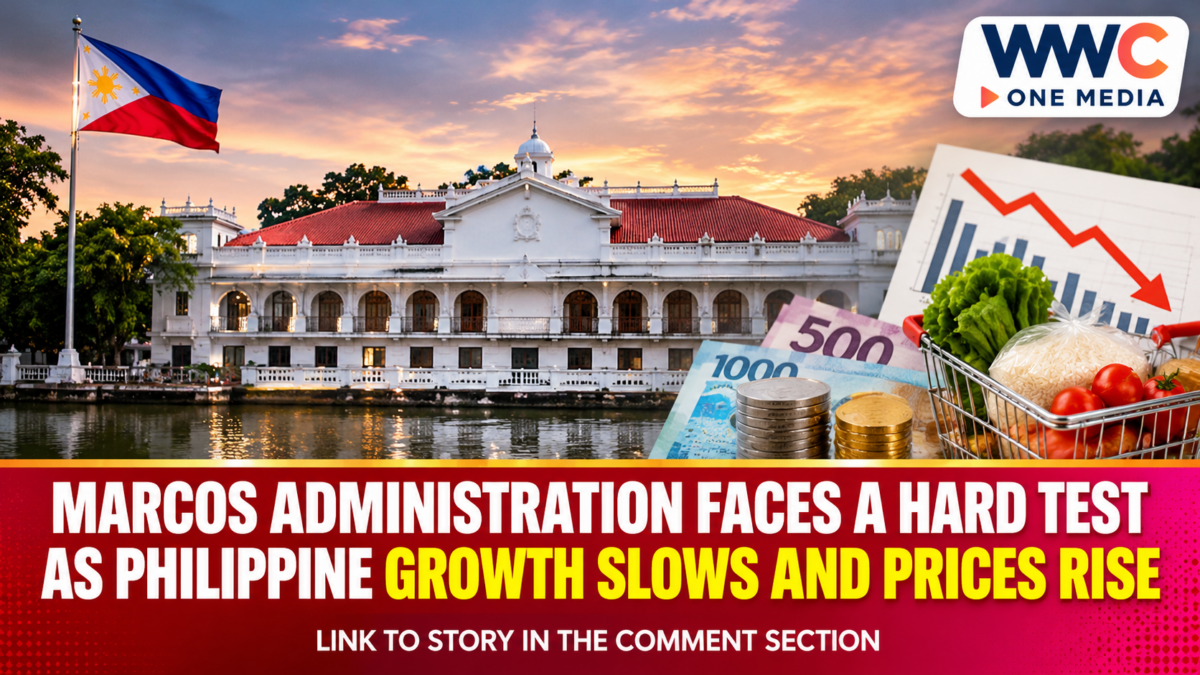
The Marcos administration is approaching the final stretch of its term with a mixed economic record: official poverty statistics show significant improvement, but economic growth has weakened, inflation has accelerated and national government debt continues to increase.
President Ferdinand R. Marcos Jr. has spent four years pursuing his administration’s Bagong Pilipinas agenda, promising improvements in public services, economic opportunities, infrastructure and government accountability. However, the latest official economic indicators present a more complicated picture of how those commitments are translating into results.
The challenge is no longer simply announcing new programmes or securing larger national budgets. It is demonstrating that economic improvements are reaching ordinary households while government institutions deliver measurable and sustainable results.
What the Marcos Administration Has Delivered So Far
Marcos outlined his administration’s priorities during his fifth State of the Nation Address on July 27, 2026.
His address focused on accountability, economic transformation, social protection, food and energy security, education and national sovereignty. He also said the government would complete unfinished reforms during the remaining two years of his presidency.
The speech included an account of the administration’s response to alleged irregularities in flood control projects, assistance programmes for vulnerable households and measures intended to address rising living costs.
One significant development was the government’s commitment to strengthen public spending transparency.
Executive Order No. 126, signed on September 28, 2026, institutionalised the Centralized Open Monitoring Platform for Appropriations and Spending Statistics, or COMPASS, as a unified platform for government budget and expenditure disclosures.
The measure establishes an official framework for making budget information more accessible.
However, creating a transparency platform and achieving effective accountability are different things. Its value will ultimately depend on the completeness, accuracy and timeliness of the information made available, as well as whether irregularities identified through public scrutiny lead to appropriate action.
Philippine Economy Faces a Difficult Growth Environment
One of the most significant challenges confronting the administration is the weakening pace of economic expansion.
The Philippine Statistics Authority reported that gross domestic product grew by only 2.1% year-on-year in the third quarter of 2026.
The services sector expanded by 3.7%, but agriculture, forestry and fishing contracted by 4.8%. Industry also recorded a marginal decline of 0.003%.
Household final consumption expenditure, an important measure of consumer spending, increased by 2.4%. Meanwhile, gross capital formation, which measures investment in fixed assets and inventories, declined by 0.2%.
These figures suggest that the economy is facing difficulties in generating stronger momentum from household demand and investment.
For businesses, weaker investment can signal caution about expansion and future demand. For workers, slower economic activity can make the creation of additional employment opportunities more difficult.
The administration therefore faces a challenge that cannot be resolved simply by increasing government expenditure. Stronger private investment, agricultural productivity and household purchasing power will also matter.
Inflation Is Putting More Pressure on Filipino Households
The cost of living presents another major test.
The PSA reported that headline inflation accelerated to 7.8% in October 2026, up from 7.2% in September. The January-to-October average reached 5.6%.
Transport prices were among the major contributors, with the transport index increasing by 20.1% year-on-year. Housing, water, electricity, gas and other fuels recorded a 9.3% increase.
Food and non-alcoholic beverages registered 6.1% inflation during October.
These increases matter because households cannot easily avoid spending on transportation, food, electricity and housing.
Even when salaries increase, families may experience little improvement in their financial situation if essential expenses rise faster than their available income.
This is particularly important for lower-income households, which generally have less flexibility to adjust their spending.
WWC ONE MEDIA has also examined the broader pressure from food, fuel and labour costs in its report on the Philippines’ increasingly persistent inflation pressures.
The administration’s response will need to address both immediate household assistance and the structural factors that make food, transportation and electricity expensive.
Poverty Statistics Show Progress, but Millions Remain Vulnerable
The country’s poverty figures provide an important counterpoint to the weaker economic indicators.
The PSA’s 2025 Full Year Official Poverty Statistics, released in August 2026, recorded poverty incidence among individuals at 9.7%, equivalent to approximately 11.08 million Filipinos.
Among families, poverty incidence declined to 6.4%, representing approximately 1.90 million families.
This was an important improvement compared with the 2023 estimates, when poverty incidence among individuals stood at 15.5%.
The figures demonstrate measurable progress in reducing income poverty.
However, poverty statistics should not be interpreted as proof that financial hardship has disappeared.
The official poverty threshold for a family of five averaged ₱14,634 per month in 2025. Households earning below the applicable threshold are classified as poor because their income is insufficient to meet basic food and non-food requirements.
Furthermore, millions of Filipinos remain below that threshold despite the improvement in the national figures.
WWC previously examined the decline in official Philippine poverty incidence and the 11 million people still classified as poor.
The next challenge is ensuring that poverty reduction becomes sustainable through better-paying employment, accessible education, improved public services and stronger regional economic opportunities.
National Debt and Government Spending Demand Greater Scrutiny
The administration’s development ambitions also come with substantial fiscal responsibilities.
The Bureau of the Treasury’s September 2026 debt indicators placed outstanding national government debt at approximately ₱19.66 trillion.
For comparison, the same official series recorded outstanding debt at approximately ₱13.42 trillion in 2022.
Debt growth does not automatically mean government finances are unsustainable. Borrowing can support infrastructure, public services and economic development when funds are properly allocated and generate lasting benefits.
Nevertheless, higher debt increases the importance of disciplined spending, efficient revenue collection and responsible fiscal management.
The government’s enacted 2026 national budget amounted to ₱6.793 trillion, 7.4% higher than the ₱6.326-trillion budget for 2025.
Education received the largest allocation among the listed priority sectors at ₱1.345 trillion, followed by public works at ₱530.9 billion and health at ₱448.1 billion.
The scale of these allocations makes implementation especially important.
A large education budget, for example, must translate into better learning conditions, sufficient classrooms, improved facilities and stronger educational outcomes.
Likewise, infrastructure funding must produce completed and useful projects rather than simply appear as approved appropriations.
The wider debate over government expenditure is also relevant to WWC’s previous examination of public infrastructure spending and scrutiny of the proposed flood control budget.
For taxpayers, the central issue is whether public money produces measurable benefits.
What the Numbers Say About Bagong Pilipinas
Taken together, the official records show an administration with both measurable achievements and significant unresolved challenges.
Poverty incidence has declined. The government has introduced additional transparency mechanisms and allocated substantial resources to education, infrastructure and health.
At the same time, economic growth has slowed, inflation has accelerated and government debt has increased.
These indicators should not be treated as proof that every policy has failed. Nor should individual improvements be used to suggest that the country’s economic difficulties have been resolved.
The more useful assessment is whether the government can turn its announced priorities into sustained improvements in household income, employment opportunities, productivity and public services.
For a country with a large population and significant regional economic differences, national averages are only part of the picture.
Progress must also be visible in communities where employment opportunities are limited, agricultural productivity remains weak and families continue to struggle with essential expenses.
What Happens Next
With two years remaining in Marcos’ presidency, the administration has a limited period to demonstrate that its development programme can produce lasting results.
The immediate economic priorities include addressing inflation, supporting productive investment, improving agricultural output and ensuring that government spending reaches its intended beneficiaries.
The implementation of COMPASS will also be worth monitoring as a mechanism for improving public access to budget and expenditure information.
Ultimately, the success of the administration’s final stretch will depend on more than announcements, budget allocations or presidential speeches.
Filipinos will judge the results through the cost of everyday necessities, the availability of decent employment, the quality of public services and whether government institutions can be held accountable.
The Bagong Pilipinas agenda remains a stated government objective. Whether its promised improvements become a lasting reality will depend on what the administration delivers before its term ends.