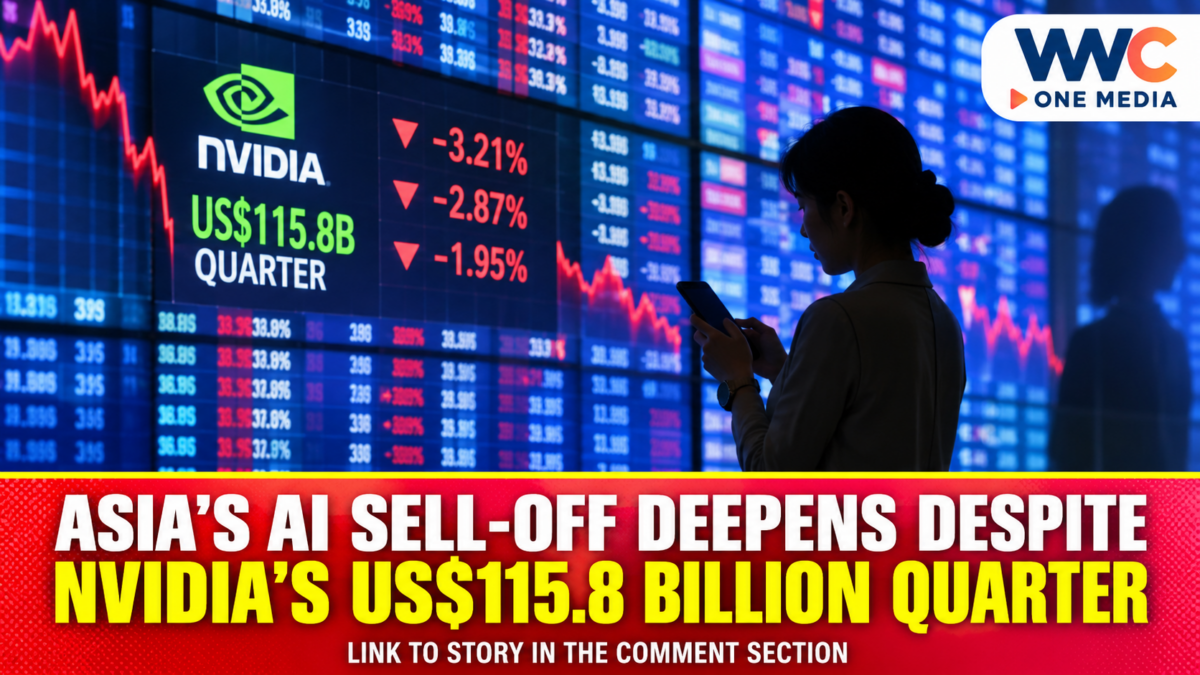
Asian technology markets are facing renewed pressure as investors reassess the cost, financing and potential returns of the artificial intelligence boom, even after Nvidia reported another quarter of exceptional growth. The latest official trading figures from Taiwan show how sharply sentiment has shifted in one of the region’s most important semiconductor markets.
The Taiwan Stock Exchange Weighted Index (TAIEX) closed at 38,426.89 on Nov. 19, losing 1,768.02 points in a single session. That followed a 2,635.04-point decline on Nov. 16 and a further 947.97-point fall on Nov. 17. After a modest recovery on Nov. 18, the benchmark suffered another substantial drop.
From its Nov. 13 close of 43,675.12 to Nov. 19, the index lost 5,248.23 points, or approximately 12%. The figures show that the pressure has extended beyond a single trading session.
The bigger issue is that the AI investment story is being judged on more than demand for chips. Investors are also examining whether the enormous sums committed to data centres, computing infrastructure and advanced processors can generate returns that justify their costs.
Taiwan’s market decline puts the AI supply chain in focus
Taiwan occupies a central position in the global semiconductor industry, making its stock-market performance an important indicator of investor sentiment toward technology manufacturing.
The official exchange figures show that the TAIEX experienced consecutive losses during the week. On Nov. 16, it fell 2,635.04 points to 41,040.08. It declined another 947.97 points the following session before recovering 102.80 points on Nov. 18.
That rebound proved short-lived. On Nov. 19, the index dropped to 38,426.89.
The exchange’s published figures establish the scale of the decline, but they do not identify a single cause for every transaction or movement. It would therefore be inaccurate to attribute the entire fall to Nvidia, artificial intelligence or any one policy announcement.
Nevertheless, the market’s exposure to semiconductor manufacturing makes the AI investment cycle an important part of the wider picture. Companies supplying chips, components and manufacturing services depend on continued demand from the businesses building and operating AI systems.
If major technology customers slow their infrastructure expansion, the consequences could eventually reach suppliers throughout the chain.
Nvidia’s results show that demand remains substantial
Nvidia’s latest financial results provide an important counterpoint to the market weakness.
For the third quarter of fiscal 2027, which ended Oct. 25, the company reported revenue of US$115.8 billion, an increase of 103% from the same period a year earlier. Its Data Centre business generated US$107.6 billion, up 110% year-on-year.
Net income under generally accepted accounting principles reached US$65.3 billion, compared with US$31.9 billion a year earlier. Diluted earnings per share increased to US$2.70 from US$1.30.
The company also forecast fourth-quarter revenue of US$130 billion, plus or minus 3%. However, its outlook specifically assumes no Data Centre compute revenue from China.
These results demonstrate that demand for Nvidia’s products remains significant. They do not guarantee that every company investing in AI infrastructure will earn an attractive return or that semiconductor shares will continue rising.
That distinction matters. A company can report strong sales while investors question whether its valuation already reflects even higher future growth.
The Federal Reserve has identified risks in AI financing
The concerns surrounding AI investment are not limited to share prices.
Minutes of the Federal Open Market Committee’s Oct. 27–28 meeting, released on Nov. 18, show that policymakers discussed the financial-stability implications of the AI infrastructure expansion.
The Federal Reserve staff highlighted the rapid growth of debt associated with AI development. It also raised concerns about off-balance-sheet leasing commitments and circular financing arrangements among AI-related companies.
The minutes noted that these structures could amplify losses if returns on AI investments disappoint.
Participants also discussed the possibility of an AI-related asset-price reassessment. Several observed that AI-related debt had expanded rapidly, with much of the growth taking place through complex financing structures.
This does not mean the Federal Reserve has declared an AI financial crisis imminent. The minutes also recorded that the staff considered the financial system resilient, with banks well capitalised and able to withstand the severe scenarios examined.
The significance is that policymakers are monitoring the relationship between technology investment, borrowing and financial-market stability.
Anthropic’s IPO adds another test for investor appetite
The public listing of artificial intelligence company Anthropic has added another major event to an already unsettled market environment.
Anthropic announced on Nov. 18 that it had priced its initial public offering at US$83 per share. The offering comprises 980 million Class A common shares, including 956,351,354 shares sold by the company and 23,648,646 shares sold by existing stockholders.
The shares were scheduled to begin trading on the Nasdaq Global Select Market on Nov. 19 under the symbol ANT. The offering was expected to close on Nov. 20, subject to customary closing conditions.
The IPO is significant because it gives public-market investors another direct opportunity to assess a major AI business. However, the pricing announcement alone does not establish whether the listing has strengthened or weakened confidence in the broader technology sector.
An individual company’s debut and the performance of the wider AI market are different measures. A successful listing would not automatically resolve concerns about infrastructure costs, borrowing or the profitability of other AI businesses.
Why the AI investment story is becoming more complicated
The latest developments reveal a market trying to reconcile two realities.
On one side, Nvidia’s results show substantial revenue growth and continued demand for advanced computing products. The company is also expanding its production and supply-chain commitments to support the infrastructure market.
On the other, the Federal Reserve’s minutes show that financing risks, elevated valuations and the possibility of disappointing returns have become matters of financial-stability discussion.
For Asian technology companies, this creates a more demanding environment. Strong demand for chips may continue, but investors could become more selective about which businesses can convert that demand into sustainable earnings.
Companies that rely heavily on future infrastructure spending may face greater scrutiny over their borrowing, capital requirements and expected returns. Semiconductor manufacturers and suppliers could also experience greater share-price volatility as investors reassess the timing and scale of future orders.
This is analysis, not evidence that the AI expansion has ended. The available company results point to continuing demand, while the market data show that investors are no longer treating that demand as the only factor that matters.
What happens next
Investors will be watching subsequent trading sessions for signs of whether the regional sell-off stabilises or spreads further across technology and semiconductor stocks.
Nvidia’s next quarterly results will provide another measure of demand and business performance. Its current fourth-quarter revenue forecast of US$130 billion will also be closely watched, particularly because the company has excluded China Data Centre compute revenue from that outlook.
The Federal Reserve’s next scheduled policy meeting is Dec. 8–9. Its future communications may provide further insight into how policymakers assess financial risks associated with AI financing and broader market conditions.
For now, the central question is not whether artificial intelligence has commercial demand. Nvidia’s results provide strong evidence that it does. The more difficult question is whether the industry’s investment commitments can produce returns large enough to justify the cost of building the infrastructure behind the AI boom.