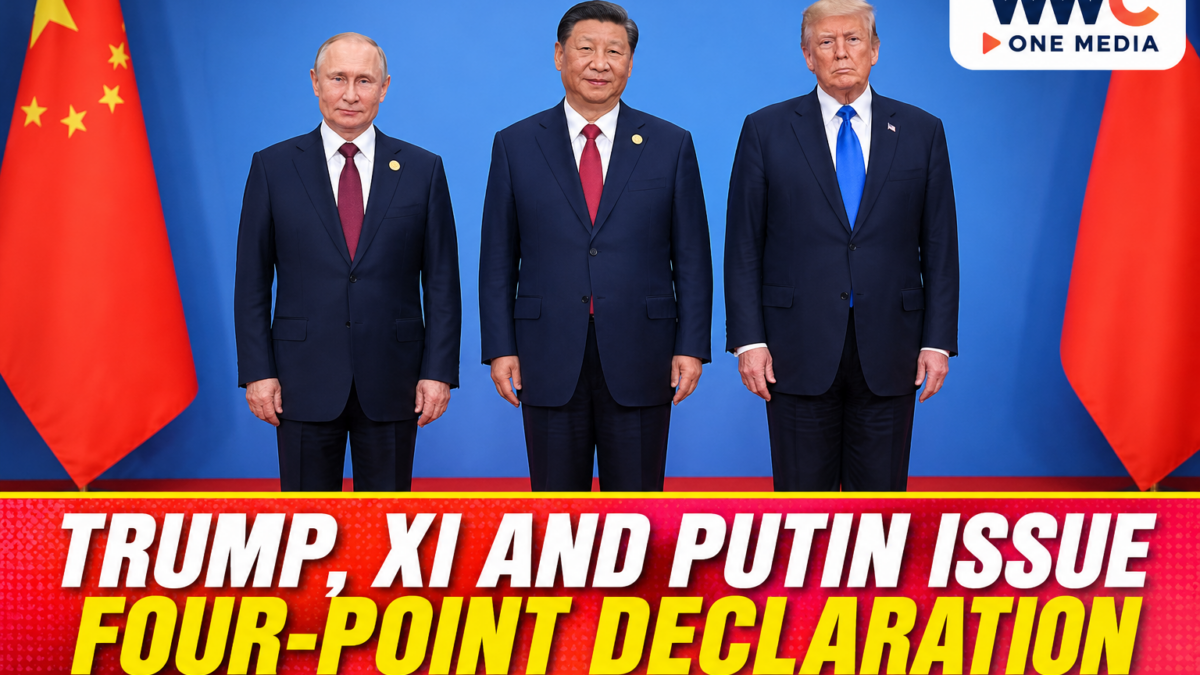
US President Donald Trump, Chinese President Xi Jinping and Russian President Vladimir Putin met in Shenzhen on Nov. 19, 2026, for a historic three-country summit held alongside the Asia-Pacific Economic Cooperation (APEC) Economic Leaders’ Meeting. The three governments subsequently published a joint declaration outlining cooperation on United Nations reform, energy supplies, state sovereignty and nuclear risks.
The declaration establishes a shared political position on four international issues, but it does not announce a new nuclear arms treaty, a settlement of the war in Ukraine or a comprehensive agreement on trade. Its importance lies in bringing the leaders together and documenting areas where their governments say they intend to cooperate.
For Asia-Pacific economies, including the Philippines, the question is whether this high-level engagement can translate into greater stability in energy markets, international security and regional economic relations.
What the Trump-Xi-Putin summit actually produced
The Chinese Foreign Ministry confirmed that Xi, Putin and Trump held the China-Russia-United States summit in Shenzhen on the afternoon of Nov. 19.
The meeting was organised around the theme of safeguarding world peace and promoting strategic stability in relations among major powers. The White House and China’s Foreign Ministry subsequently published the same four-point declaration.
The document is important because it records commitments expressed by all three governments. However, its wording also shows the difference between agreeing on broad objectives and establishing detailed programmes with deadlines, funding and implementation procedures.
The declaration does not identify a new organisation, monitoring mechanism or timetable for carrying out the four points. It therefore provides a framework for continued political engagement rather than a detailed operational agreement.
United Nations reform is one of the four priorities
The three countries said they would work towards reforming the United Nations so that it can respond more effectively to global challenges and fulfil its central role in international peace and security.
The commitment reflects the position of three permanent members of the UN Security Council. The United States, Russia and China all hold permanent seats and possess veto power over substantive Security Council resolutions.
That gives their cooperation particular significance. Agreement among the three can influence the prospects for action on international security, although the declaration does not specify which UN reforms they will support or how those changes would be negotiated.
Any substantial reform would also involve other UN member states and the organisation’s established procedures. A statement by three permanent members does not, by itself, change the UN Charter or its institutional structure.
For countries such as the Philippines, the issue matters because the Security Council remains a central forum for international peace and security discussions, including issues affecting the wider Indo-Pacific.
Energy cooperation could matter to regional markets
The second commitment concerns refined petroleum products.
The three governments said they plan to increase production and supply for the benefit of all nations. They also reaffirmed the importance of stable energy flows.
The wording is broad. The declaration does not identify specific refineries, companies, buyers, shipment volumes, prices or delivery schedules. It also does not announce a new petroleum supply contract involving the Philippines or any other Southeast Asian country.
Nevertheless, the energy commitment deserves attention because the three countries occupy influential positions in global energy production, refining, consumption and trade.
A sustained increase in refined petroleum supply could matter to import-dependent economies if it eventually results in additional products reaching international markets. But the practical effect will depend on actual production, export availability, shipping arrangements and commercial terms.
Vietnam’s separate discussions with Russia show how energy cooperation is also being pursued through bilateral channels. WWC previously examined the Vietnam-Russia push involving nuclear power, wind energy and gas-fired electricity, which remains distinct from the three-country declaration.
The declaration takes a position on international legal jurisdiction
The third point concerns state consent and the immunities of government officials.
The three leaders recognised these principles as important and stated that the International Criminal Court and similar bodies must not abuse their jurisdiction.
This is a significant political statement because the authority of international courts, the jurisdiction of international institutions and the legal protections afforded to state officials remain contentious issues in international relations.
However, the declaration does not identify a particular court case, individual or investigation. It also does not change the Rome Statute, the legal framework governing the International Criminal Court, or the obligations of countries under international law.
The statement should therefore be read as the three governments’ declared position, not as a judicial ruling or a change in the legal powers of international institutions.
Nuclear risks are on the agenda, but no arms treaty was announced
The fourth point addresses nuclear weapons.
Trump, Xi and Putin reaffirmed that a nuclear war cannot be won and must never be fought. They also committed their countries to conducting dialogue on reducing nuclear risks and preventing the proliferation of nuclear weapons.
That commitment is relevant because the three countries possess major nuclear arsenals and have significant influence over international arms-control discussions.
But the declaration does not announce a new arms-reduction treaty, specific limits on warheads, inspection arrangements or a timetable for negotiations.
Dialogue can create opportunities to manage tensions and reduce misunderstandings. It does not automatically produce verified reductions in weapons or legally enforceable restrictions.
The practical test will be whether the governments establish sustained discussions and eventually publish concrete proposals or agreements.
What the separate Trump-Xi meeting adds
The trilateral summit was not the only major diplomatic engagement in Shenzhen.
Xi also held a separate bilateral meeting with Trump on Nov. 19. China’s official account described discussions involving economic and trade relations, counternarcotics cooperation, repatriation of illegal immigrants, telecom and cyber fraud, and artificial intelligence security.
Xi called for stronger communication to prevent AI-related security risks and ensure that artificial intelligence remains under human control.
The Chinese account also recorded discussion of Taiwan and the need to avoid developments that could cause major setbacks in China-US relations. Trump, for his part, expressed support for continued cooperation in areas including agricultural products, energy and advanced intelligence technologies.
These bilateral discussions should not be confused with the four-point trilateral declaration. The separate meeting involved issues specific to the US-China relationship, while the joint document set out positions shared by all three governments.
The economic dimension is especially relevant to Asia. WWC has previously examined Xi’s APEC call for more open trade and the continuing questions surrounding US-China negotiations. The Shenzhen declaration does not establish a new comprehensive trade agreement or announce changes to tariffs.
Why the outcome matters to the Philippines
The Philippines is not a party to the three-country declaration, but the decisions and diplomatic positions of Washington, Beijing and Moscow can affect the environment in which Southeast Asian economies operate.
Energy supply is one direct concern. The Philippines imports much of its petroleum requirements, making international prices, shipping conditions and supply availability important to domestic costs.
Security is another. The declaration refers to international peace and nuclear risks but does not address the South China Sea, maritime disputes or the Philippines’ territorial concerns.
That omission matters. The summit should not be interpreted as a new agreement on maritime security or as a change in the positions of the three governments regarding the Philippines.
The wider APEC programme also has its own economic agenda. Japan’s priorities, for example, include trade, investment, energy security and resilient supply chains. WWC has examined Japan’s economic priorities as it moved from Manila to the Shenzhen APEC meetings.
For Manila, the practical priority is to assess any future policy changes through official agreements and actual market developments rather than assuming that a high-profile summit will immediately alter regional conditions.
What happens next
The next test is implementation.
The three governments will need to turn their stated positions into concrete diplomatic initiatives if the declaration is to produce measurable results. That could include further discussions on nuclear risks, proposals for UN reform, energy-sector cooperation and continued engagement on international legal questions.
Businesses and governments across Asia should watch for published agreements, formal policy changes, supply contracts and implementation schedules.
The Shenzhen summit has produced a joint declaration and established areas for further cooperation. Whether it becomes a turning point in international relations will depend on what the three governments do after the meeting.
Frequently asked questions
Did Trump, Xi and Putin meet in Shenzhen?
Yes. The three leaders held a China-Russia-United States summit in Shenzhen on Nov. 19, 2026, during the APEC Economic Leaders’ Meeting.
What did the three leaders agree on?
Their joint declaration covered four areas: United Nations reform, increased production and supply of refined petroleum products, state consent and immunity of officials, and dialogue on nuclear risks and proliferation.
Did the summit produce a nuclear arms reduction treaty?
No. The declaration commits the three countries to dialogue on reducing nuclear risks and preventing nuclear proliferation. It does not announce a new arms-reduction treaty or specific weapons limits.
Did Trump, Xi and Putin discuss the war in Ukraine?
The published four-point declaration does not mention Ukraine. It does not provide a detailed account of every subject discussed during the meeting.
Will the summit affect the Philippines?
Potentially, through developments in energy supply, international security and relations among major powers. However, the declaration does not announce a specific Philippine agreement or a new arrangement concerning the South China Sea.