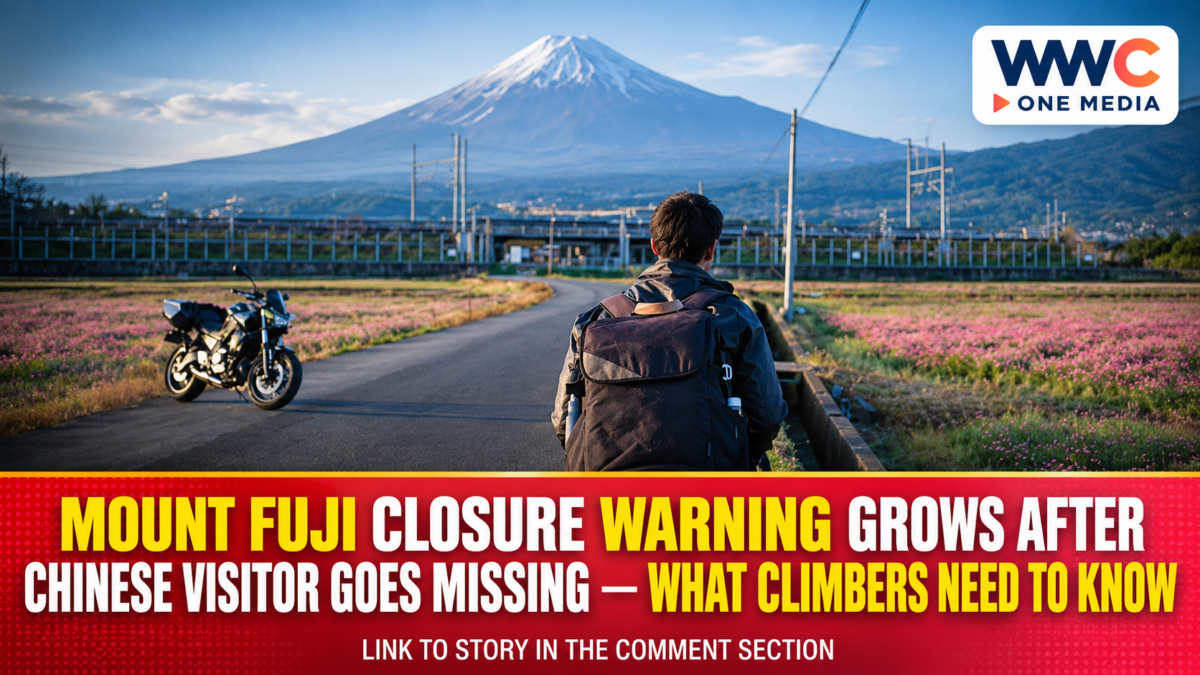
Japan’s Mount Fuji has entered its winter closure period, and China’s embassy in Tokyo has confirmed that a Chinese visitor went missing while attempting to climb the mountain outside the permitted season. In a notice dated Nov. 17, the embassy said it had contacted Japanese police, urged authorities to organise a search and provided assistance to the visitor’s family.
The case has renewed attention on a rule that can be easy for international visitors to overlook: Mount Fuji is not open for ordinary summit climbing throughout the year. Its official summer season has ended, and authorities have closed routes and access roads as winter conditions set in.
The immediate concern is the missing visitor. The wider issue is whether tourists understand that a famous and heavily visited destination can become a hazardous mountain environment once its official climbing period ends.
Mount Fuji closure: what authorities have confirmed
The Chinese embassy’s statement confirms that one Chinese visitor went missing while climbing Mount Fuji during the closure period. It said the embassy contacted Japanese police, repeatedly urged the organisation of search-and-rescue efforts and offered necessary assistance to the family.
The notice did not identify the visitor, state the person’s age or provide a precise location or date of disappearance. It also did not report whether the person had been found.
That distinction matters. The embassy’s statement confirms the missing-person case and its diplomatic response, but it does not provide a detailed account of the incident or establish the circumstances surrounding the climb.
The embassy also urged Chinese citizens in Japan not to climb mountains during closure periods. It highlighted the frequency of strong winds and snowstorms and warned that facilities such as rest areas and first-aid centres are shut during the off-season.
The official climbing season ended in September
Mount Fuji’s 2026 climbing season was scheduled to run from July 1 to Sept. 10 under Yamanashi Prefecture’s published guidance for the Yoshida Route. The prefecture also set a ¥4,000 climbing fee per person per entry, a daily limit of 4,000 climbers, and a gate closure period from 2 p.m. to 3 a.m. for climbers not staying in mountain huts.
Those rules were part of the official summer-season arrangements, not permission to climb after the season ended. The prefecture’s current winter notice says routes from the fifth station to the summit are closed outside the official climbing period.
The distinction is important for visitors planning trips around Japan’s most recognisable mountain. Seeing the mountain, travelling around its foothills or visiting open tourist facilities is not the same as being permitted to use closed summit trails.
WWC has previously covered the risks of a Mount Fuji climb involving a child who was left behind during a family ascent. That incident occurred during the summer climbing period, but it also showed why decisions on the mountain must prioritise safety over reaching the summit.
Winter conditions change the mountain dramatically
Yamanashi Prefecture warns that Mount Fuji’s upper slopes can experience temperatures below freezing for extended periods, along with powerful winds and snowfall. During winter closure, snow and ice can make trails difficult to distinguish.
The prefecture also lists several practical limits: mountain huts, first-aid stations and toilets are unavailable, mobile-phone reception may be unreliable, and weather can make rescue operations difficult or impossible.
It says temperatures can fall below minus 10 degrees Celsius and that sudden gusts can be strong enough to make it difficult to remain standing. The warning applies even to experienced climbers with appropriate equipment.
These conditions help explain why the closure is more than a seasonal tourism measure. It is a safety restriction intended to keep people away from routes where the usual support infrastructure is not operating and where conditions can change rapidly.
The risk is not limited to the summit itself. Shizuoka Prefecture’s road information, updated Nov. 17, lists winter closures affecting roads serving the Fujinomiya, Gotemba and Subashiri trailheads. It also states that the relevant closed mountain routes are prohibited under Japan’s Road Act.
WWC has also reported on a landslide near a Mount Fuji climbing access point in September, a reminder that access conditions around the mountain can be affected by hazards beyond the hiking trail.
Closed trails can carry legal consequences
Yamanashi Prefecture says that routes between the fifth station and the summit are prohibited outside the climbing season under Article 46 of the Road Act. It warns that violations may carry a penalty of up to six months’ imprisonment or a fine of up to ¥300,000.
Shizuoka Prefecture publishes a similar warning for its closed routes, including the possibility of up to six months’ imprisonment or a fine of up to ¥300,000 for entering prohibited sections.
The rules are not simply recommendations to avoid bad weather. They are formal restrictions on access to closed routes.
For international visitors, this means checking the status of the exact route and access road before travelling to the mountain. A trail that appears on a map or in an old travel video may not be legally accessible during the winter period.
Japan’s wider visitor numbers make clear why clear safety information matters to tourism. WWC’s coverage of Japan’s record October visitor arrivals provides context for the scale of international travel, although visitor totals do not indicate how many people attempt mountain climbs outside the official season.
Why the warning matters to international travellers
Mount Fuji is both a cultural landmark and a demanding high-altitude mountain. Its popularity can create the impression that climbing is a routine tourist activity, but the official notices describe a very different environment once the summer season ends.
The closure also removes some of the support visitors might expect during a normal climb. With huts, first-aid facilities and toilets unavailable, and phone coverage potentially unreliable, a person who encounters difficulty may have fewer options for assistance.
For travellers, the practical lesson is to distinguish between visiting the Mount Fuji area and attempting a summit climb. Visitors should follow current prefectural notices, respect barriers and closure signs, and avoid entering routes that authorities have prohibited.
What happens next
The Chinese embassy’s Nov. 17 statement confirms that it was seeking Japanese police assistance and supporting the missing visitor’s family. It does not provide a later search update or confirm the visitor’s condition.
Any further account of the search, the missing person’s identity or the circumstances of the climb should be based on an official update from the relevant authorities or the embassy.
For now, the public safety message is clear: Mount Fuji’s winter closure is in effect, and authorities warn that off-season conditions can be life-threatening even for experienced climbers.
Frequently asked questions
Is Mount Fuji open for climbing in November 2026?
No. The official summer climbing season has ended. Yamanashi and Shizuoka prefectures list summit routes and relevant access sections as closed during the winter period.
What happened to the Chinese visitor?
China’s embassy in Japan said a Chinese visitor went missing while climbing Mount Fuji during the closure period. Its Nov. 17 notice did not provide the person’s identity or a confirmed search outcome.
How dangerous is Mount Fuji during winter?
Yamanashi Prefecture warns of temperatures below minus 10 degrees Celsius, powerful winds, snowfall, icy or obscured trails, closed mountain huts and first-aid facilities, unreliable mobile reception and difficult rescue conditions.
Can climbers enter closed Mount Fuji trails?
The prefectures state that closed routes are prohibited under the Road Act. Violations may carry up to six months’ imprisonment or a fine of up to ¥300,000.
When does Mount Fuji’s official climbing season usually take place?
For the 2026 Yoshida Route season, Yamanashi Prefecture published a period from July 1 to Sept. 10, subject to possible delays due to weather or remaining snow.