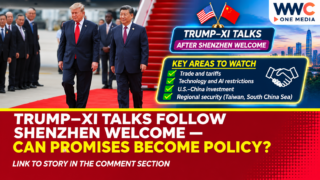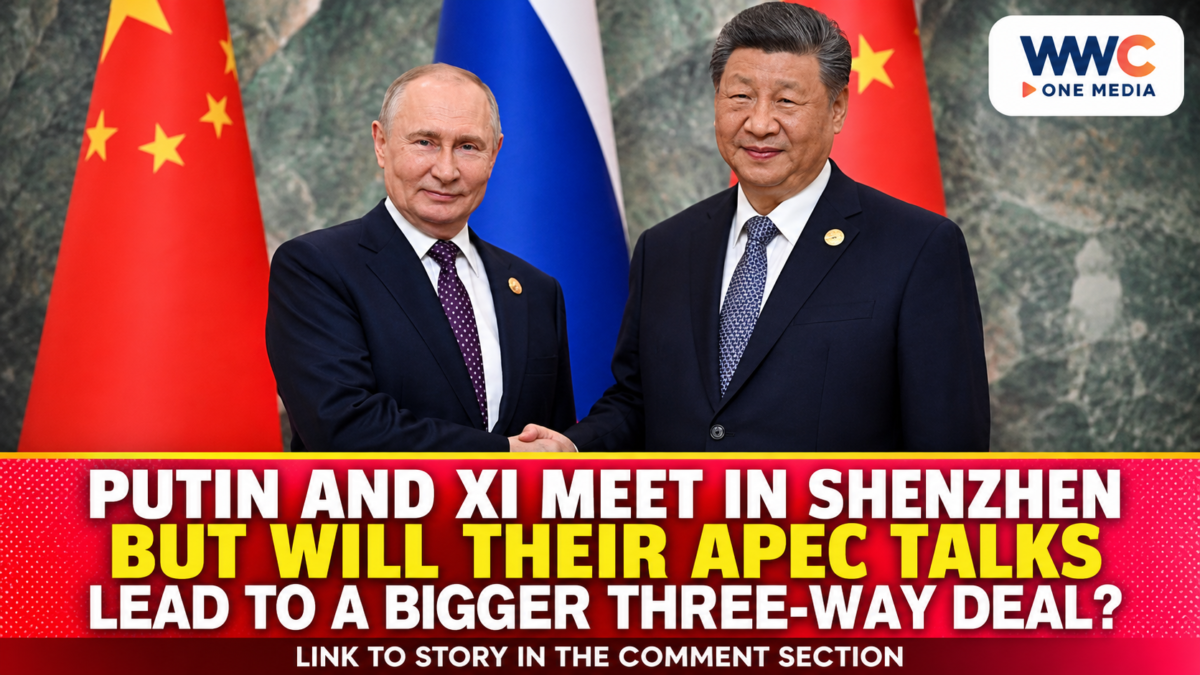
Russian President Vladimir Putin and Chinese President Xi Jinping met in Shenzhen on Nov. 18, 2026, ahead of the Asia-Pacific Economic Cooperation (APEC) leaders’ meeting. Their discussions focused on expanding bilateral cooperation, while a separate China-Russia-United States summit involving US President Donald Trump was scheduled for Nov. 19. China Foreign Affairs+1
The distinction matters: the Putin-Xi meeting has already taken place, but the three-leader summit was still pending as of Nov. 18. Beijing described the planned gathering as the first face-to-face meeting involving the leaders of the three countries. State Council of China
The diplomatic activity in Shenzhen moved beyond preparations on Nov. 18, when Xi Jinping held a bilateral meeting with Vladimir Putin ahead of the APEC Economic Leaders’ Meeting.
In its official account, China’s Foreign Ministry said the two leaders discussed strengthening cooperation across government, legislative, military and political-party channels. Xi also called for deeper cooperation in existing and new areas, including efforts to provide a more stable and predictable environment for businesses in both countries.
Putin said Russia was ready to expand cooperation with China in trade, energy and education, while also developing people-to-people exchanges. He described the two countries’ recent high-level contacts as productive and said bilateral trade had reached a new high, although the statement did not provide a specific trade value.
The meeting also carried historical significance for the two governments. Xi noted that 2026 marks 30 years since the establishment of the China-Russia comprehensive strategic partnership of coordination and 25 years since the signing of the China-Russia Treaty of Good-Neighborliness and Friendly Cooperation.
The bilateral meeting took place one day before the China-Russia-United States summit announced for Nov. 19. China’s Foreign Ministry confirmed that Xi would meet Putin and US President Donald Trump in Shenzhen, describing the gathering as a China-Russia-U.S. summit. That announcement confirms the planned meeting, but it does not establish that the three governments have reached a common position on security, trade or other international disputes.
For the Philippines and other Asia-Pacific economies, the important question is whether the diplomatic engagement produces practical changes in trade, energy cooperation and regional stability. The Nov. 18 meeting provides evidence of continued China-Russia coordination; any broader three-country agreement must be assessed separately against the official statements and commitments released after the Nov. 19 meeting. China Foreign Affairs+1