
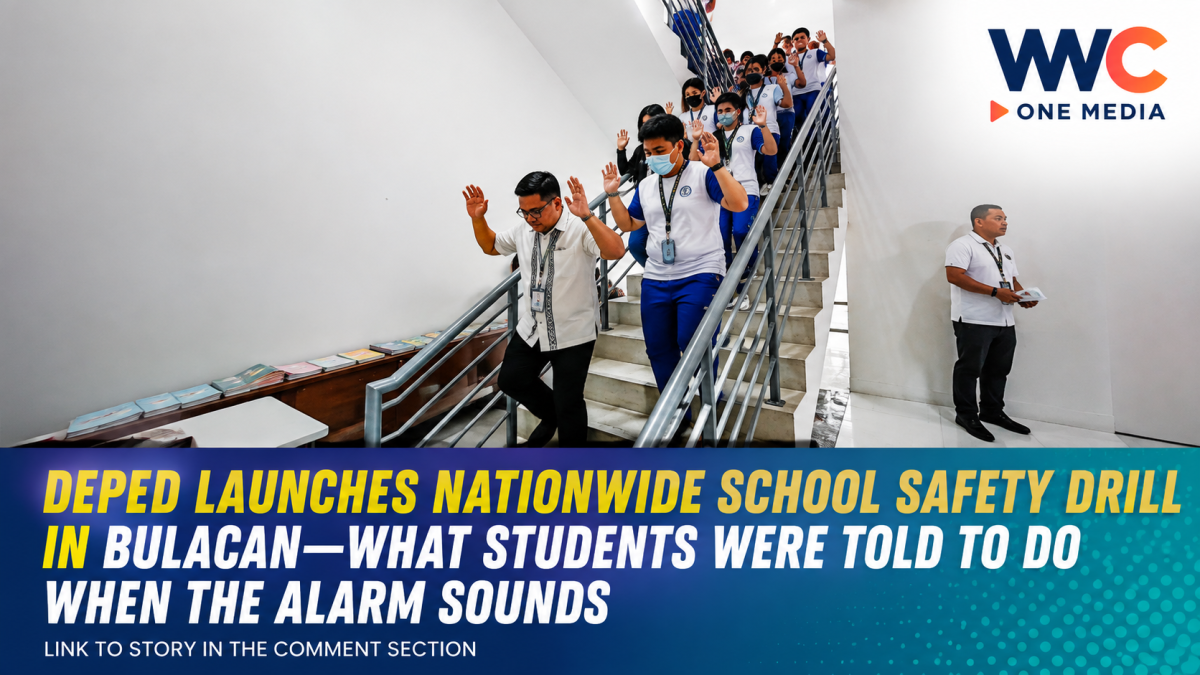
SAN RAFAEL, BULACAN — The Department of Education (DepEd) is putting school emergency preparedness to the test as schools nationwide participate in a simultaneous safety drill today, September 3, with the national kickoff taking place at Carlos F. Gonzales High School in San Rafael, Bulacan.
The nationwide exercise comes amid renewed concerns over school safety following recent fatal shooting incidents involving students. Authorities say the objective is not to frighten learners but to build the ability of students, teachers and school personnel to respond calmly and quickly during an emergency.
The drill was originally scheduled for August 25 but was postponed because of inclement weather and concerns raised by medical and mental-health experts over the use of highly realistic violence simulations.
DepEd subsequently redesigned the exercise to emphasize age-appropriate, trauma-informed preparedness.
Education Secretary Sonny Angara said the goal is to develop what he described as “calm operational confidence” and emergency-response muscle memory rather than create fear among students.
No fake gunman, no graphic reenactment
One of the biggest changes to the drill is the decision to eliminate the use of a person portraying an active shooter or attacker.
DepEd Undersecretary Malcolm Garma said the alarm itself will trigger the exercise. Students and personnel will then carry out previously discussed protective procedures instead of being exposed to a simulated attack.
The move followed calls from the Philippine Psychiatric Association and the Philippine Society for Child and Adolescent Psychiatry to avoid hyper-realistic simulations, which the groups said could cause psychological distress without demonstrated safety benefits.
Instead, participating schools are expected to concentrate on practical measures such as securing classrooms, remaining quiet and out of sight when appropriate, communicating with authorities, accounting for students and staff, and knowing evacuation and reunification procedures.
What happens when the alarm sounds?
At the Bulacan kickoff site, the exercise includes a scenario briefing, a full-scale lockdown drill and a post-drill evaluation.
Reuters reported that students and teachers at Carlos F. Gonzales High School practiced lockdown procedures during a simulated active-threat scenario, including securing classroom doors, switching off lights, drawing curtains and taking cover. Emergency responders also rehearsed coordination, evacuation, headcounts, first aid for simulated casualties and psychosocial support.
The exercise is also designed to test what happens after the immediate danger—not simply what students do during a lockdown.
DepEd has incorporated post-incident response measures, including a family reunification component where parents can eventually collect their children at a designated location.
The department has also incorporated the “run-hide-fight” framework into preparedness discussions, with evacuation and hiding prioritized according to the circumstances and confrontation treated only as a last resort.
Parents get a bigger role
Another significant change is the emphasis on parental consent.
DepEd said participating learners should receive advance, age-appropriate orientation, while schools are expected to secure informed written parental consent and learner assent. Students whose parents request an exemption, or who require accommodations, should instead be given safe alternative activities without being penalized or stigmatized.
This approach reflects DepEd’s broader effort to balance physical preparedness with students’ psychological well-being.
Nationwide coordination
The drill is being carried out with the participation of agencies involved in public safety and emergency response, including the Philippine National Police, Bureau of Fire Protection, Department of the Interior and Local Government, Office of Civil Defense and local disaster risk-reduction offices.
According to Radyo Pilipinas, the national exercise runs from 9 a.m. to 11:30 a.m., with the Bulacan kickoff featuring a 30-minute full-scale lockdown exercise followed by evaluation. Schools across Regions I to XII, the National Capital Region, Cordillera Administrative Region, Caraga and the Negros Island Region are participating.
The exercise is intended to determine whether schools can coordinate effectively with police, fire authorities, local governments and emergency responders—and whether their existing contingency plans actually work under pressure.
Why the drill matters now
The initiative follows two fatal school shooting incidents in the Philippines in recent months.
Reuters reported that a June 22 shooting at a school in Tacloban City and another attack on August 18 in Zamboanga City intensified concerns over emergency preparedness in Philippine schools.
DepEd had initially ordered schools to prepare for active-attack incidents in response to increasing reports of school violence in the Philippines and abroad. The August 25 exercise was subsequently postponed following bad weather and calls for stronger safeguards for children’s physical and psychological welfare.
The department has stressed that the exercise is not a one-time event. Garma said the drills will need to be repeatedly practiced so that appropriate responses become familiar to students and school personnel.
For DepEd, the larger test is therefore not simply whether students can follow instructions during today’s alarm.
It is whether schools can build a reliable system of prevention, response, communication, accountability and recovery—without exposing children to unnecessary fear.
And as today’s nationwide drill unfolds, that balance between preparedness and protecting students’ well-being may become one of the most closely watched aspects of the exercise.
WWC ONE MEDIA MJE



Leave a Reply