
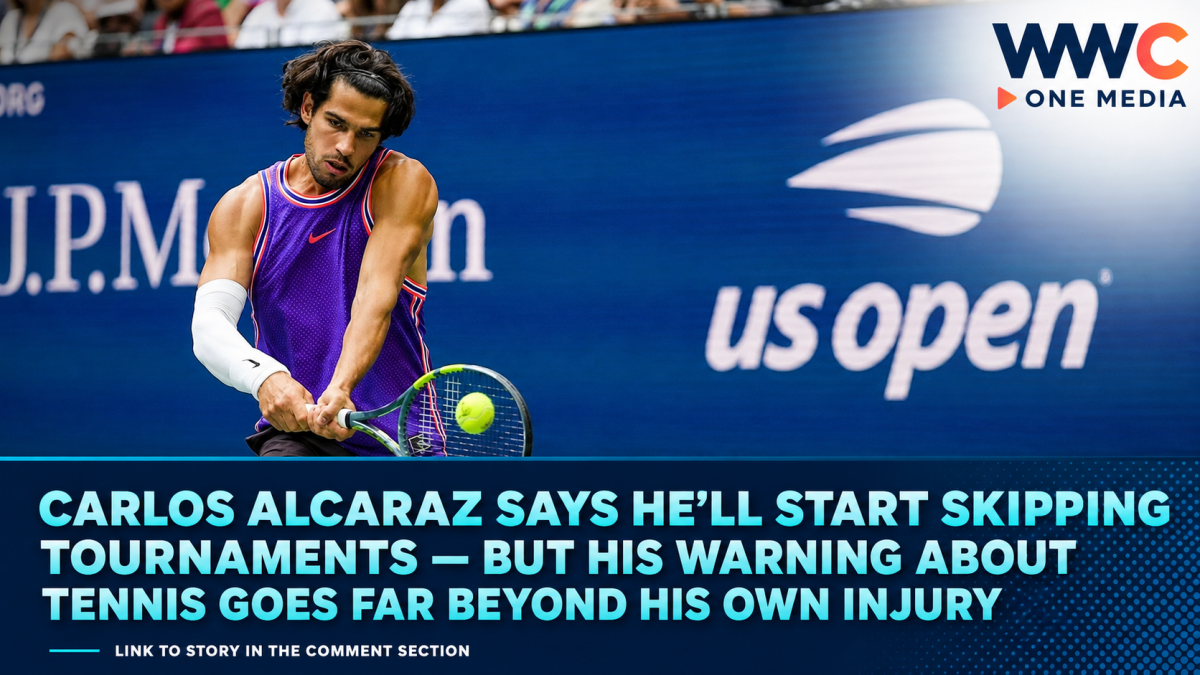
NEW YORK — Carlos Alcaraz is back winning matches at the US Open, but after spending months away from competition with a wrist injury, the Spanish superstar says his comeback has convinced him of something bigger: playing nearly everything on the modern tennis calendar may no longer be worth the risk.
The 23-year-old, currently ranked world No. 3, said he expects to deliberately schedule extended breaks from competition in future seasons, even if that means missing tournaments.
His warning came after Alcaraz recovered from a slow start to beat Portugal’s Jaime Faria 4-6, 6-0, 6-3, 6-2 in the second round of the US Open on Wednesday, continuing his title defence after the longest injury absence of his career.
This time, however, the discussion after his victory was about much more than the score.
Alcaraz said the break forced on him by injury was far longer than he wanted. But rather than trying to compensate by squeezing more tournaments into future seasons, he plans to do the opposite.
“In the future, I’m going to take some long breaks. Maybe not four months, but one month, two months, missing some tournaments.”
He added that, in his view, trying to play every significant event has become practically impossible.
Alcaraz’s injury changed the calculation
Alcaraz’s concerns carry additional weight because of what he has just experienced.
A right wrist injury suffered during the Barcelona Open in April kept him away from competition for more than four months. He missed the French Open, Queen’s Club, Wimbledon and major North American hard-court events while recovering. ATP records show he also withdrew from Cincinnati before ultimately deciding he was fit enough to defend his US Open crown.
When he finally played his first US Open singles match, the official tournament site noted that it was his first competitive match in 139 days.
Alcaraz admitted the layoff was so long that even his familiar match-day routines initially felt unfamiliar.
Yet the injury did not merely interrupt his season. It appears to have changed how one of tennis’ biggest stars intends to manage the rest of his career.
Why the ATP calendar is becoming a bigger issue
Alcaraz’s complaint comes as the sport continues to expand many of its most important tournaments.
The ATP’s official 2026 calendar contains 59 tour-level tournaments across 29 countries, in addition to the four Grand Slams. Seven of the nine Masters 1000 tournaments now use expanded 12-day formats rather than the traditional one-week schedule.
Those longer events can provide more rest between individual matches, larger draws and additional commercial opportunities. But from a player’s perspective, they can also occupy considerably more space on an already crowded calendar.
Alcaraz argued that players technically have the freedom to choose when they compete, but that the rankings system, mandatory events and importance of Grand Slams and Masters tournaments make the decision considerably more complicated.
ATP rules designate top players as “commitment players” and impose participation requirements covering Masters 1000 and ATP 500 events, although exemptions and injury provisions exist.
The ATP says players still have scheduling flexibility
There is another side to the dispute.
ATP chairman Andrea Gaudenzi has previously defended the structure of the men’s calendar, arguing that players have more control over their schedules than athletes in many other professional sports.
The ATP has also made changes for 2026 intended to provide additional flexibility. The number of results counted toward the rankings was reduced from 19 to 18, while the ATP 500 commitment was reduced by one tournament.
New injury protection rules also allow players who miss two consecutive automatic-entry events because of injury to replace certain zero-point Masters results with later performances, subject to limits.
So the dispute is not simply about whether players can skip tournaments.
The real question is how much competitive and financial pressure elite players face when they do.
Alcaraz points to the US Open injury list
And Alcaraz does not have to look far for evidence supporting his concerns.
World No. 1 Jannik Sinner withdrew from this year’s US Open because of a right knee injury. Jack Draper, Holger Rune and rising Brazilian Joao Fonseca also missed the tournament through injury, while Casper Ruud and former champion Marin Cilic were among additional players forced out around the start of the event.
For Alcaraz, that growing list represents more than unfortunate timing.
He warned that unless the sport finds a better balance between tournaments, player obligations and recovery, fans could increasingly see the biggest names unavailable for the events that matter most.
The irony: Alcaraz is winning again
The timing of his comments makes them particularly striking.
Alcaraz is not issuing this warning after another withdrawal. He is issuing it while mounting a successful comeback at one of tennis’ biggest tournaments.
After dropping the opening set against Faria, the defending champion responded emphatically, winning the second set 6-0 before closing out the match in four sets. He advanced to face China’s Wu Yibing in the third round.
Earlier in 2026, Alcaraz had already completed the Career Grand Slam by winning the Australian Open, another milestone in a career that has progressed at extraordinary speed.
But his latest comments suggest the next phase of that career may be defined as much by when he chooses not to play as by the trophies he pursues.
For the ATP, that could become an uncomfortable trend.
If one of the sport’s most valuable and successful young players believes missing major tournaments voluntarily is the best way to stay healthy, other stars may eventually reach the same conclusion.
And that leaves professional tennis facing a difficult question:
What is the value of adding more premium tennis to the calendar if the players fans most want to watch increasingly decide they need to stay home?
WWC ONE MEDIA MJE




Leave a Reply