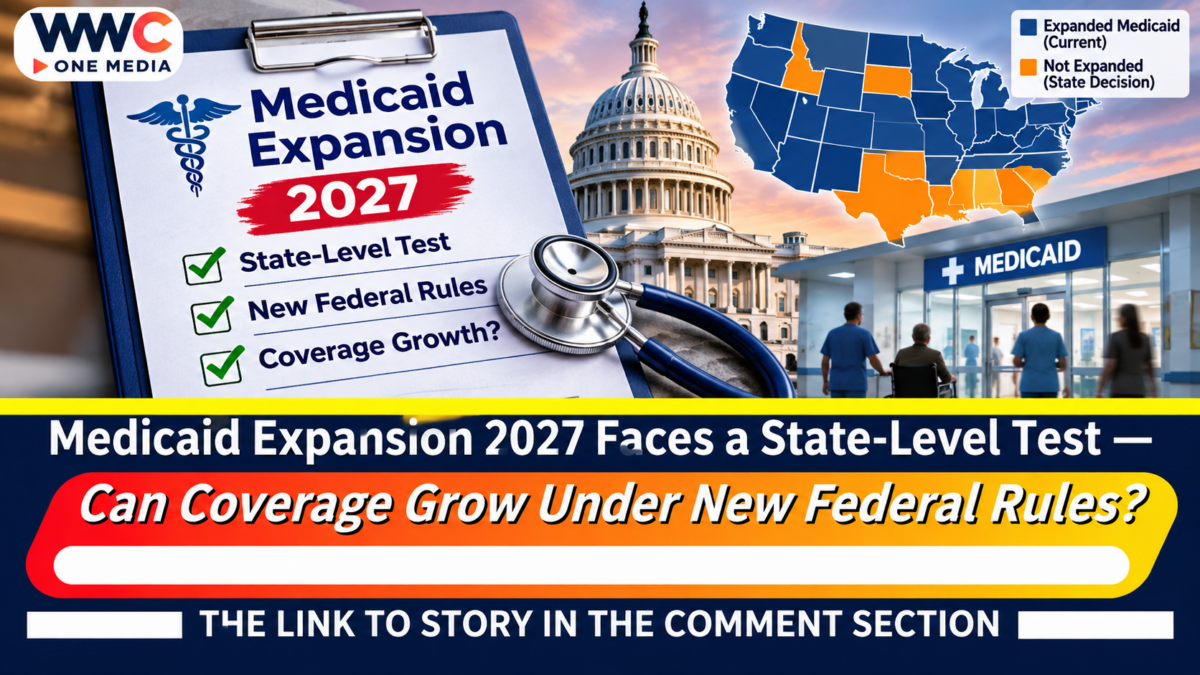
WASHINGTON — American state governments will enter 2027 with ten states still outside the Affordable Care Act’s broad adult Medicaid expansion, even as new federal eligibility requirements approach. The Medicaid expansion 2027 debate therefore involves two separate decisions: whether additional states make coverage available to more low-income adults, and how states administer federal conditions for people already eligible.
The latest federal guidance adds an immediate complication. Starting Jan. 1, 2027, certain adults must meet community-engagement requirements, but a Nov. 13 announcement gives states an optional transition through June 30 before enforcing coverage losses solely for noncompliance.
Medicaid expansion 2027: The coverage gap remains
The federal Medicaid programme’s July 2026 reporting distinguishes 41 expansion jurisdictions, including Washington, DC, from 10 non-expansion states. The same report counted 72,946,510 people enrolled in Medicaid and the Children’s Health Insurance Program, or CHIP, across the reporting states and DC.
That national enrollment figure includes children and other people who qualify under different rules. It is not a count of uninsured adults who would gain eligibility through future expansion.
Under the Affordable Care Act framework, participating states generally cover qualifying adults with incomes up to an effective 138% of the federal poverty level. Federal guidance explains that some lower-income adults in non-expansion states may fall between their state’s existing Medicaid limits and the income threshold for marketplace premium assistance.
Analysis: An expansion decision could reduce that coverage gap, but it would not automatically enroll everyone or override other eligibility conditions. State implementation, individual circumstances and the applicable federal rules would still matter.
Why the funding arrangement matters
Medicaid is financed jointly by the federal government and states. For qualifying adults in the Affordable Care Act’s expansion group, federal guidance establishes a 90% matching rate from 2020 onward, with states financing the remaining eligible costs.
A high federal share can make expansion more attractive, but the state contribution is not zero. Governments also need to consider administrative capacity, provider participation and how enrollment could change over time.
Analysis: Supporters of broader eligibility can point to federal financing and the potential for additional residents to obtain coverage. Fiscal conservatives can reasonably ask whether the state budget can support its share and whether programme administration will work effectively. Neither question is answered merely by the existence of the 90% match.
This financing issue is distinct from WWC’s earlier examination of rising US healthcare costs, which covers wider insurance and provider spending rather than a state’s legal decision to expand Medicaid.
The January work rules change the calculation
Section 71119 of Public Law 119-21 establishes community-engagement requirements for specified adults beginning Jan. 1, 2027, unless a state implements them sooner. The June 2026 implementing framework generally calls for 80 hours a month of qualifying work, community service or other approved activity, with alternatives and exceptions.
The requirement is not universal. It applies to defined adults, generally ages 19 to 64, within designated eligibility categories, and the published regulations describe exclusions and ways to meet the standard through education or other qualifying activity.
An applicant meeting the income threshold does not necessarily meet every condition for coverage. Conversely, a person qualifying for an exclusion should not automatically be treated as failing a work requirement.
WWC has already reported separately on the Medicaid community-engagement deadline and state implementation questions. The question here is how these requirements affect any new expansion decision, rather than whether the existing rule has been repealed. It has not.
CMS has offered temporary enforcement flexibility
On Nov. 13, 2026, the Centers for Medicare & Medicaid Services announced an optional hold-harmless period through June 30, 2027. States choosing this route must still evaluate whether people satisfy the requirement or qualify for an exclusion, but may refrain from denying applications or ending otherwise eligible coverage solely for failure to demonstrate community engagement during that period.
That is an administrative transition, not a blanket cancellation of the statute. CMS says the time can help states improve verification systems and eligibility notices before enforcement begins.
Analysis: A state weighing expansion faces two different implementation questions: who should qualify under a broader programme, and how efficiently the government can verify continuing eligibility. Data-matching failures or confusing notices could undermine either objective even when a person’s substantive entitlement is unchanged.
What federal and state lawmakers can actually change
Federal law sets the broad framework, while states decide whether to adopt the optional ACA adult expansion. A state considering a change would need its own lawful authorisation and an approved implementation route.
Congress could also pursue amendments to federal eligibility rules, but a proposal is not an enacted repeal. Any substantial federal law change would have to pass the legislative process and confront the president’s constitutional powers.
The political debate has already appeared in WWC’s coverage of the incoming Congress and healthcare priorities. That wider contest should not be mistaken for a signed expansion statute in any particular state.
Analysis: The first practical test in 2027 will be documentary: proposed state legislation, enacted budgets, submitted state plans and CMS approvals. Campaign pledges alone cannot establish that coverage has expanded.
What happens next
The immediate dates are Jan. 1, 2027, when the federal community-engagement requirement generally takes effect, and June 30, 2027, the end of CMS’s newly announced optional hold-harmless period. Individual states may take different permitted implementation steps.
For expansion, the strongest evidence will be a state law or other legally effective action, followed by federal approval and an announced enrollment start date. The public records reviewed do not establish that the ten non-expansion states will all adopt expansion in 2027.
The central distinction remains: broader eligibility is a policy choice; accurate administration of existing eligibility rules is a separate obligation. Both will shape what affordable coverage actually looks like next year.
FAQ
How many US states have not expanded Medicaid?
The federal July 2026 Medicaid report lists ten non-expansion states and 41 expansion jurisdictions, counting Washington, DC.
What income level qualifies for ACA Medicaid expansion?
The general adult expansion threshold is an effective 138% of the federal poverty level, subject to other applicable eligibility rules.
Do Medicaid work requirements start in January 2027?
Federal law generally requires qualifying adults to demonstrate community engagement from Jan. 1, 2027, with defined exclusions and state implementation provisions.
Did CMS delay the entire work-requirement law until July?
No. CMS announced an optional hold-harmless enforcement period through June 30, 2027. It is not a repeal or automatic postponement for every state.
Has Congress already expanded Medicaid nationwide for 2027?
No nationwide expansion law was established by the official records reviewed. States continue to make decisions about the existing optional adult expansion.