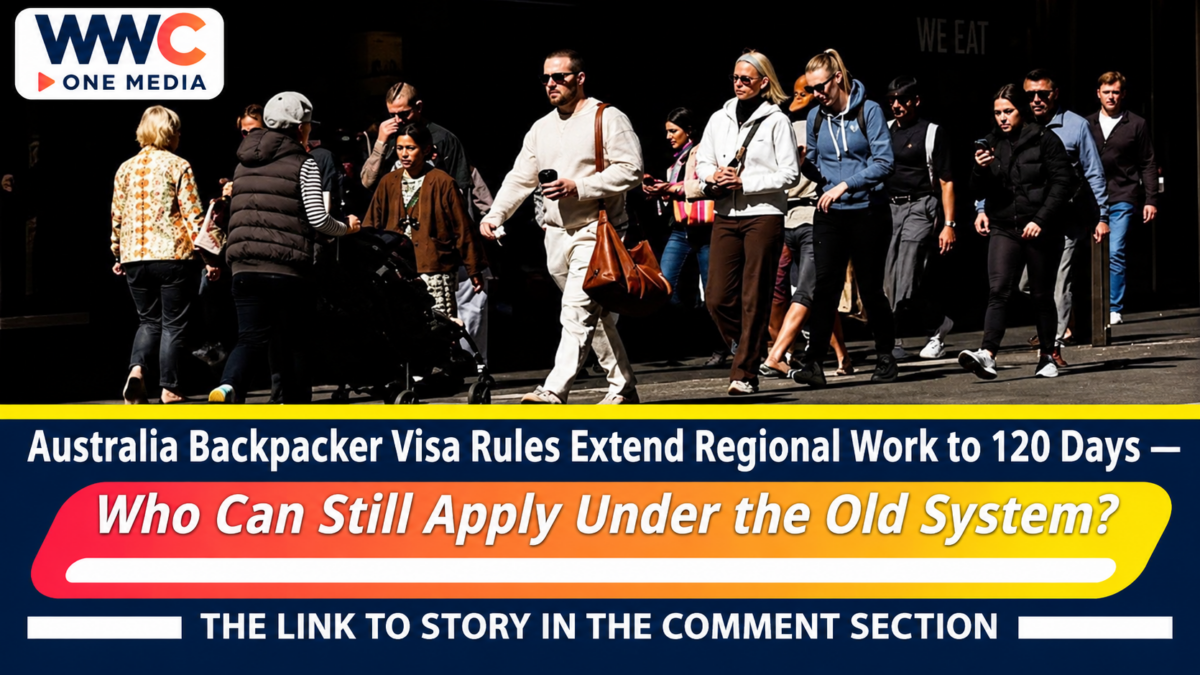
CANBERRA, Australia — Australia announced revised working-holiday visa arrangements on Nov. 17, 2026, increasing the regional-work requirement for a second-year visa from 88 to 120 days from March 1, 2027. The Australia backpacker visa changes also introduce a registration-and-invitation process for most applicants seeking a second or third year, while allowing a transitional pathway for eligible people already preparing applications.
The revised approach combines stricter conditions for extending a stay with more third-year places than the government had originally proposed. For applicants, the central questions are when the new rules begin, whether earlier work still counts and whether receiving an invitation means a visa is guaranteed. It does not.
Australia backpacker visa: What changes in March
From March 1, 2027, the specified-work requirement for a second Working Holiday Maker visa will rise to 120 days, up from 88 days, for people to whom that requirement applies. The specified-work period required for a third visa remains six months.
The change affects the Working Holiday Maker programme’s two visa subclasses: Working Holiday (417) and Work and Holiday (462). Applicants must still satisfy the conditions relevant to their subclass, nationality and individual circumstances.
Home Affairs also announced 45,000 second-year places and 25,000 third-year places for the 2026–27 programme year. These are programme allocations, not a promise that every person who registers will receive an invitation or a visa.
That is a material revision to the September policy described in WWC’s earlier coverage of Australia’s migration overhaul, which discussed a much lower proposed third-year limit. Readers should use the Nov. 17 official arrangements when considering the updated policy.
A deadline protects some applicants under the existing process
The department has established a transitional application pathway through Feb. 28, 2027. To use it, an eligible applicant must complete the existing specified-work requirement and lodge a valid further-visa application by that deadline, as well as satisfy other eligibility conditions.
Completing work alone is not enough if the application is not validly lodged by the deadline. Conversely, eligible specified work performed before March 1 can still count towards the new 120-day requirement for applicants who enter the later process.
Analysis: This distinction gives workers already close to completing their required period a clear reason to check their records early. The date is an application cut-off for the transitional arrangement, not an automatic extension of an existing visa.
The immigration department says an invitation or registration does not extend a person’s current lawful stay. Applicants who do not secure permission to remain must comply with their existing visa expiry dates.
How the new invitation system will operate
Registration for the Next Year Regional Work Guarantee is scheduled to open on Dec. 1, 2026. People may register while in Australia or overseas, even before finishing the relevant specified work.
The first invitation round is expected in mid-January 2027, with further rounds planned monthly. A selected applicant receives an invitation valid for 12 months to lodge an application, provided the applicant meets the other visa requirements, including specified work.
The system introduces an important distinction between three steps: registering an interest, being selected and ultimately obtaining a visa. They are not equivalent outcomes.
The department explicitly says registration does not ensure selection and an invitation does not guarantee a visa grant. It also does not override the requirement to hold a valid visa while staying in Australia.
Why regional employers are central to the policy
The immigration minister’s announcement identifies agriculture, tourism and hospitality as sectors where Working Holiday Makers make an important contribution, particularly outside Australia’s largest cities.
The revised settings follow government consultation with industry groups after a September policy announcement. They seek to increase the amount of time participating working holidaymakers spend in eligible work while retaining greater control over the number of extension visas issued.
Analysis: A longer qualifying period may provide some employers with more worker-days, but the final labour benefit depends on how many applicants are selected, where they actually work and whether vacancies match their skills and travel plans. A larger third-year allocation also does not guarantee that every regional business can fill seasonal roles.
Australian workplace laws continue to matter. Government guidance says visa holders generally have the same minimum employment protections as other workers, including applicable minimum pay rates. The new visa framework does not remove those protections.
Why UK applicants and Filipinos need to check separately
UK passport holders are exempt from the new registration-and-invitation requirement. The revised announcement also preserves the existing exception from specified regional work under the Australia–UK arrangements. It would therefore be inaccurate to say every nationality must complete 120 days.
For Philippine readers, a different distinction is essential. Australia’s official programme page records an Australia–Philippines Work and Holiday agreement signed on Sept. 8, 2023, contemplating up to 200 participants from each country per year. But that same page says administrative steps remain unfinished and a launch date will be published later.
The Nov. 17 rule change does not independently establish that Filipino passport holders can already apply under that proposed bilateral arrangement. Eligibility should be checked against the department’s current country-specific instructions, rather than inferred from a general policy announcement.
This sits alongside broader changes already discussed in WWC’s reporting on Australian student and family visa restrictions. Student visas and Working Holiday Maker visas are separate pathways with different eligibility rules.
A further regional perspective appears in WWC’s analysis of Australia’s people-to-people ties with Southeast Asia. Those relationships help explain the wider significance of migration policy but do not change the requirements of an individual visa application.
What happens next
The first practical milestone is the registration portal’s planned opening on Dec. 1, followed by the expected first invitation round in mid-January 2027. The existing direct-application transition ends on Feb. 28, and the 120-day requirement begins March 1 where applicable.
Applicants should check their subclass, eligible work type and postcode, retain employment evidence and confirm the rules on the day they apply. Government policy announcements establish the intended framework; applicants must still meet the operative immigration requirements and obtain an actual visa grant.
FAQ
How many regional work days will Australia require for a second working-holiday visa?
The announced requirement increases from 88 to 120 days on March 1, 2027 for applicants subject to specified-work requirements.
Can existing backpackers still use the old 88-day rule?
Eligible applicants can use the transitional process if they complete the required work and lodge a valid further-visa application by Feb. 28, 2027, while satisfying other requirements.
When does registration open for the new system?
Registration is scheduled for Dec. 1, 2026. The first invitation round is expected in mid-January 2027.
Are UK passport holders required to enter the new invitation process?
No. UK passport holders are exempt from the announced registration-and-invitation process.
Can Filipino passport holders apply for Australia’s proposed bilateral Work and Holiday programme now?
The official Australian programme page still says launch preparations are under way. It does not yet announce an application opening date for that agreement.