
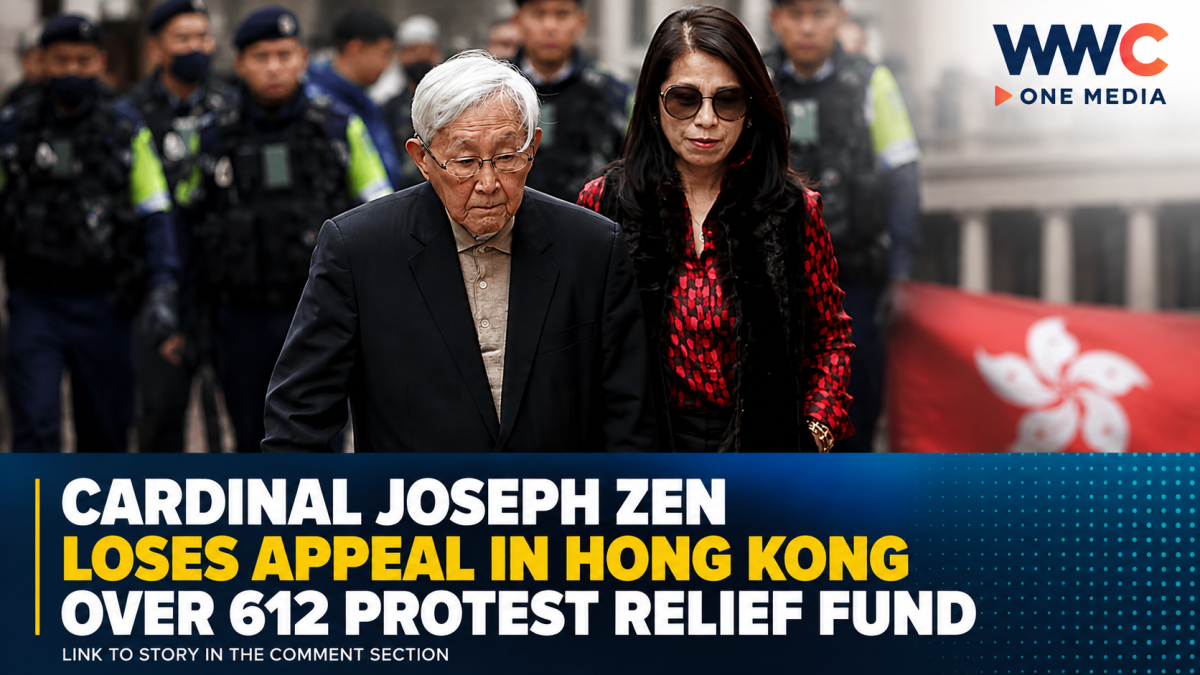
HONG KONG — Retired Catholic Cardinal Joseph Zen and four other trustees of Hong Kong’s now-defunct 612 Humanitarian Relief Fund have lost their appeal against convictions for failing to register the fund under the city’s Societies Ordinance.
The Court of Appeal on September 3, 2026, upheld the convictions, rejecting the argument that the fund was simply a charitable trust rather than a society subject to registration requirements. The five trustees were each fined HK$4,000 (about US$510) in 2022.
The ruling keeps alive one of Hong Kong’s most closely watched cases involving civil society and the legal consequences of supporting people caught up in the city’s 2019 pro-democracy protests.
What did the court decide?
The central legal question was surprisingly narrow:
Was the 612 Humanitarian Relief Fund legally a “society” that had to be registered?
The Court of Appeal said yes.
According to the court’s ruling, the fund was more than simply money held in trust. Its five trustees had entered into trust deeds that established their respective rights and obligations and created a structure for governing the organisation.
Because the fund fell within the definition of a society under the Societies Ordinance, the trustees were required to apply for registration or seek an exemption within the legally prescribed period.
They did not do so.
The appeals court therefore upheld the original convictions.
Who is affected by the ruling?
The five trustees who appealed are:
- Cardinal Joseph Zen Ze-kiun, retired bishop of the Catholic Diocese of Hong Kong
- Margaret Ng Ngoi-yee, barrister and former legislator
- Cyd Ho Sau-lan, former legislator
- Denise Ho Wan-see, singer and activist
- Hui Po-keung, scholar and former Lingnan University academic
All five were convicted in November 2022 and fined HK$4,000 each.
A sixth defendant, Sze Ching-wee, the fund’s secretary, was fined HK$2,500 and did not appeal his conviction.
The fund was created during the 2019 protests
The 612 Humanitarian Relief Fund was established in 2019 during the massive protests that began over a proposed extradition bill and later developed into a broader movement demanding political reforms and greater democratic accountability.
The fund provided financial assistance for people who were arrested, injured or otherwise affected by the unrest.
According to the fund’s own published information, its assistance included legal representation, medical expenses, psychological counselling and emergency financial relief.
The fund eventually ceased operations in October 2021.
Why was the fund controversial?
Authorities argued that the fund was not simply a charitable organisation providing humanitarian assistance.
During the original trial, prosecutors alleged that some of its activities supported political objectives connected to the 2019 protest movement.
Reuters reported during the 2022 proceedings that prosecutors said the fund had collected approximately HK$270 million from about 103,000 donations between June 2019 and October 2021. Prosecutors also alleged that some funds were used for activities they regarded as political.
The defence rejected the characterisation of the fund as a political organisation and argued that its purpose was to provide assistance to people affected by the protests.
The court’s current ruling, however, concerns the registration question under the Societies Ordinance, rather than establishing that the trustees committed a national-security offence.
Zen was initially arrested under the national security law
The case attracted international attention partly because of the circumstances surrounding the trustees’ arrests in 2022.
Zen and several other trustees were initially arrested on suspicion of colluding with foreign forces under Hong Kong’s Beijing-imposed National Security Law.
They were ultimately not charged under the National Security Law in this case.
Instead, prosecutors pursued the lesser offence of failing to register the 612 Fund as a society.
That distinction is important.
The current convictions are therefore not convictions for espionage, foreign collusion or another national-security offence. They concern failure to comply with the registration requirements under the Societies Ordinance.
What does the latest ruling mean?
The Court of Appeal’s decision confirms the lower court’s interpretation that the 612 Fund constituted a society under the ordinance.
The judges also rejected the argument that applying the registration requirement violated the defendants’ freedom of association.
The South China Morning Post reported that the appeals court found the registration regime constitutional and said it did not impose an unacceptably harsh burden on freedom of association.
The ruling could therefore have significance beyond the five defendants themselves.
It provides further judicial guidance on what types of organisations can fall within Hong Kong’s Societies Ordinance, particularly where groups are established through trust arrangements but have a governing structure and common objectives.
The defendants plan to continue the fight
The legal battle may not end with Thursday’s ruling.
Margaret Ng said outside court that the five trustees intend to seek permission to appeal to Hong Kong’s Court of Final Appeal, according to local reporting.
That means the Court of Appeal decision may become another step in a case that has already lasted several years.
Whether the Court of Final Appeal agrees to hear the matter will be a separate question.
Why the case matters beyond Cardinal Zen
At 94, Zen remains one of the most prominent Catholic figures associated with Hong Kong’s democracy movement.
His involvement has given the case an unusual international profile.
The Vatican expressed concern when Zen was arrested in 2022, while governments including the United Kingdom and United States criticised the arrests and broader developments affecting civil liberties in Hong Kong.
Hong Kong and Chinese authorities have consistently defended their legal measures, arguing that national-security and public-order laws are necessary to maintain stability.
The 612 Fund case sits at the intersection of those competing narratives.
For authorities, it is fundamentally a question of whether organisations operating in Hong Kong must comply with registration laws.
For critics, the case raises broader questions about whether legal and regulatory requirements are being applied in ways that can constrain civil society, freedom of association and support networks for protesters.
A case shaped by Hong Kong’s post-2019 transformation
The ruling comes against the backdrop of sweeping changes in Hong Kong since the 2019 protests.
Beijing imposed the National Security Law in June 2020, criminalising acts including secession, subversion, terrorism and collusion with foreign forces.
Since then, numerous prominent pro-democracy activists have been arrested, prosecuted or imprisoned.
The government says the law restored stability following the unrest of 2019. Critics argue that it has significantly narrowed the space for political dissent and civil society.
The 612 Fund case is different from the major National Security Law prosecutions because Zen and his fellow trustees were convicted under the Societies Ordinance, but its political context remains impossible to separate from Hong Kong’s broader post-2019 crackdown.
What happens next?
For Cardinal Zen and the other four trustees, the immediate result is clear: their convictions remain in place.
But the case may now move to another court.
If the defendants secure permission to appeal to the Court of Final Appeal, Hong Kong’s highest court could eventually be asked to consider whether the 612 Fund properly fell within the legal definition of a society and whether its trustees were required to register it.
WWC ONE MEDIA G.A



Leave a Reply