
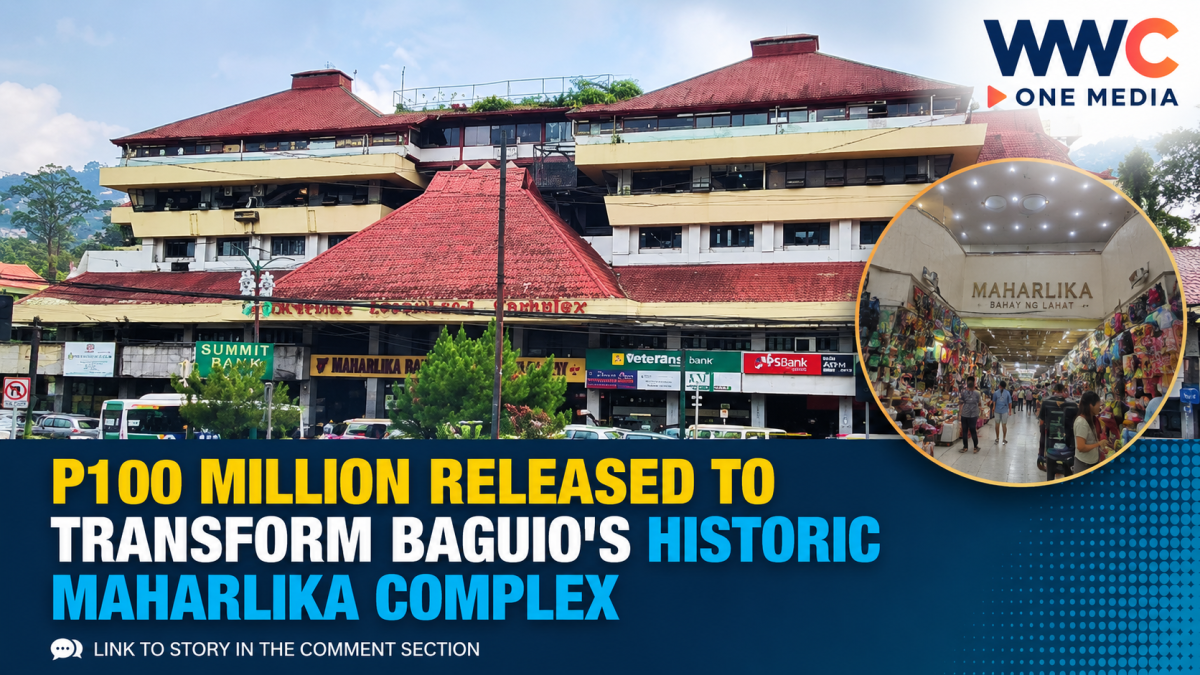
BAGUIO CITY — A major facelift is coming to one of Baguio City’s most recognizable commercial landmarks after the Office of the President released ₱100 million for the rehabilitation of the Maharlika Livelihood Complex.
The funding is expected to accelerate the city’s efforts to modernize the decades-old trading center while preserving its role as a livelihood hub for small businesses and entrepreneurs.
From aging complex to modern livelihood hub
The Maharlika Livelihood Complex sits at the foot of Session Road, beside Baguio’s public market, and has served generations of vendors and shoppers.
The property was turned over to the Baguio City Government by the Department of Agriculture in May 2025, following the expiration of its 50-year lease arrangement. The city subsequently began reorganizing the facility and preparing a long-term redevelopment plan.
Earlier plans identified several problems requiring attention, including congested walkways, aging facilities, comfort-room improvements and the need to reorganize spaces occupied by tenants and sublessees.
Why the ₱100-million funding matters
The new national government funding comes as Baguio seeks to turn Maharlika into a more sustainable local economic enterprise.
City officials previously estimated that the complex could generate around ₱72 million annually from rentals and parking once its operations and redevelopment are fully established.
From June to December 2025 alone, the city recorded about ₱59.45 million in gross rental-related collections and another ₱7.15 million from parking fees, according to figures cited by PNA.
The figures underscore why the property is important not only as a historic commercial center but also as a potential revenue-generating asset for Baguio.
Hundreds of businesses are tied to Maharlika
The complex covers roughly 5,000 square meters and consists of the Maharlika and Marbay buildings.
Previous government reports described the facility as housing hundreds of businesses, including restaurants, beauty establishments, clothing and souvenir shops, and other small enterprises.
The Department of Agriculture has described Maharlika as a long-standing cultural and economic cornerstone of Baguio, while the city government has been working to establish clearer rules on leasing, management and revenue use.
But redevelopment also brings challenges
The transformation is not without controversy.
Recent local reporting has highlighted concerns from some Maharlika tenants over higher rental rates and changes in leasing arrangements, while city officials have been working on amendments and consultations surrounding the complex’s management.
That means the rehabilitation will have to balance two objectives: modernizing the aging facility while protecting its livelihood function for legitimate tenants and small businesses.
The city has also previously adopted a no-subleasing policy, saying the move was intended to prevent excessive rental markups and make the facility more accessible to actual entrepreneurs.
A landmark enters a new chapter
Maharlika’s future is now being shaped by a combination of national funding, city management and redevelopment plans.
What began decades ago as a trading and livelihood facility is being positioned for a new role in Baguio’s economy — potentially generating significantly more revenue while remaining a center for local commerce.
The bigger question now is whether the ₱100-million rehabilitation can deliver a modern, safer and more organized Maharlika without pushing out the small businesses that made the complex an institution in the first place.
That balance could determine whether Maharlika’s next chapter becomes one of Baguio’s biggest urban-renewal successes.
WWC ONE MEDIA G.A



Leave a Reply