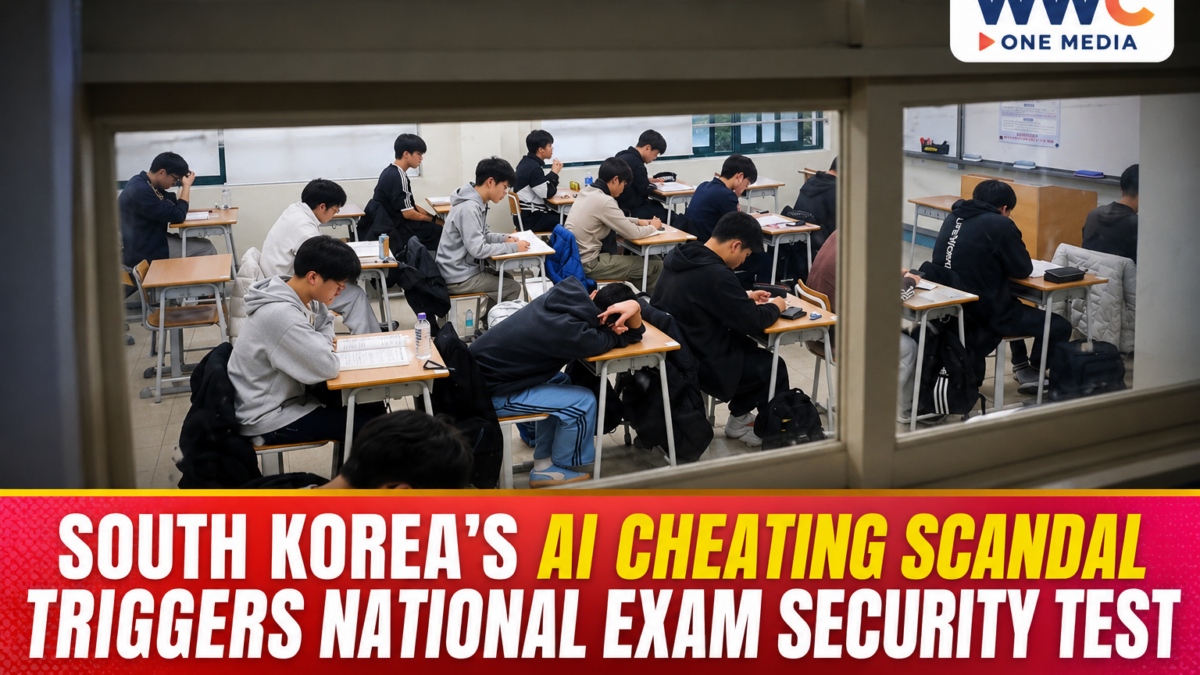
South Korea’s response is now broader than tighter checks at one examination. The government has ordered a review of suspected AI-assisted cheating across national qualification tests held this year, while education officials prepare additional safeguards for the 2027 College Scholastic Ability Test (CSAT), scheduled for November 19. The immediate challenge is to protect honest candidates without turning exam-day security into an indiscriminate search of students. 대한민국 청와대+3
South Korea’s artificial intelligence cheating controversy is forcing authorities to examine the integrity of the country’s entire professional qualification system, not just its university entrance test.
The Ministry of Employment and Labor and the Human Resources Development Service of Korea (HRD Korea) have launched a review of every national qualification examination administered in 2026. The move follows an AI-device cheating case involving the 63rd Certified Tax Accountant Examination and comes just two days before the 2027 College Scholastic Ability Test (CSAT) on November 19. Ministry of Employment and Labor+2
The scale of the review is significant. HRD Korea said it covers 491 national technical qualification categories and 37 national professional qualification categories. Investigators will analyse examination data, refer suspicious answer sheets to experts for closer review and seek police involvement when misconduct appears sufficiently substantiated. webzine.hrdkorea.or.kr
The government now faces two connected challenges: identifying candidates who may have used prohibited technology and ensuring that stronger controls do not unfairly affect people who followed the rules.
South Korea’s AI Cheating Probe Expands to 528 Qualification Categories
The national review covers examinations conducted by HRD Korea during 2026, including 491 technical qualification categories and 37 professional qualification categories.
Authorities outlined a staged process rather than an automatic presumption of guilt. They will first analyse examination data to identify results that warrant closer attention. Selected candidates’ first- and second-round answer sheets will then be examined by multiple scoring specialists, with review meetings used to assess whether there are sufficient grounds to suspect misconduct. Cases raising clear concerns may be referred to investigative authorities. webzine.hrdkorea.or.kr
The criteria include unusually high scores compared with a candidate’s average performance over the previous three years, substantial differences between candidates’ rankings, changes in pass rates compared with earlier examinations, unusual gaps between a candidate’s subject scores and allegations raised through online communities.
These indicators are intended to identify cases for further examination. They are not proof that a candidate cheated.
That distinction is essential. A high score, an unusual result or an online accusation cannot independently establish that someone used an unauthorised device. Expert review and appropriate investigation remain necessary before an allegation can be treated as established misconduct.
The Tax Accountant Examination Case Has Triggered Administrative Action
The immediate catalyst is the controversy surrounding the 63rd Certified Tax Accountant Examination.
In a November 15 statement, HRD Korea acknowledged the seriousness of AI-device misconduct connected to the examination. The agency said it would file a complaint against the examinee for obstruction of business and cooperate with investigative authorities.
It also said it would coordinate with the Ministry of Economy and Finance and the National Tax Service to move forward with procedures concerning cancellation of the final qualification result. webzine.hrdkorea.or.kr
The Ministry of Employment and Labor separately announced that the examination result should be invalidated, the pass cancelled and the person responsible barred from taking the examination for five years. It also said it would pursue a complaint and assist the police investigation. Ministry of Employment and Labor
These are announced administrative and investigative measures. They should not be confused with a final criminal conviction.
The distinction matters because examination authorities determine eligibility and qualification status under their own rules, while criminal responsibility is a separate question for the investigative and judicial process.
The official response also acknowledges an institutional concern: the examination operator must protect candidates who prepared legitimately and maintain public confidence in the value of the qualification.
Authorities Say Smart Glasses Have Already Been Detected in Other Tests
The concern is not limited to the latest tax-accountant controversy.
HRD Korea disclosed that it had detected 12 cases of cheating involving smart glasses in examinations this year, including tests for Fire Protection System Engineers and Information Processing Engineers. The cases had been referred to police for investigation. webzine.hrdkorea.or.kr
That figure provides an important measure of the challenge facing examination administrators. It is an official count of detected cases in the examinations identified by the agency, not evidence that the same practice is widespread across all professional tests.
The agency is now considering additional safeguards. Its announced measures include expanding the deployment of personnel known as AI inspectors, strengthening checks of glasses and examining the possible introduction of radio-frequency detection equipment.
The Ministry of Employment and Labor also said it would establish online and offline reporting channels for suspected misconduct involving AI devices. A joint task force with HRD Korea is expected to review the broader qualification-testing system and prepare a comprehensive prevention plan within the year. Ministry of Employment and Labor+1
The proposed detection technology is still under development. Its mention in the government’s plan should not be interpreted as confirmation that every examination site already has equipment capable of identifying concealed electronic devices.
The November 19 University Entrance Exam Faces a Separate Security Test
The professional qualification investigation is unfolding alongside preparations for South Korea’s highly consequential university entrance examination.
The 2027 CSAT is scheduled for Thursday, November 19. The Ministry of Education has published guidance distinguishing between bringing prohibited electronic devices into an examination venue and actually wearing or using them during the test.
Under the ministry’s November 6 guidance, bringing or simply possessing prohibited smart devices can invalidate the current examination. Using or wearing such devices during the test can also result in disqualification from the following year’s examination. Refusing a supervisor’s request to inspect suspected smart glasses can lead to further sanctions following review. Ministry of Education Korea
The restrictions cover smart glasses and other prohibited electronic devices. They do not mean that ordinary prescription glasses are banned.
The President’s Office also instructed relevant agencies to strengthen inspection procedures and supervisor training ahead of the examination. Its November 15 statement specifically called for measures that would avoid intimidating candidates who wear ordinary glasses or use medical devices. 대한민국 청와대
That safeguard is important. A security policy that creates confusion or treats ordinary eyewear as suspicious could disrupt the examination for candidates who have no intention of breaking the rules.
For students, the immediate priority is to understand the official list of prohibited items and follow instructions on surrendering devices before the examination begins.
Why the AI Cheating Issue Matters Beyond South Korea
The controversy highlights a difficult problem for education and professional testing systems worldwide: technology that can assist learning can also be misused when an examination requires independent work.
South Korea is also preparing to use artificial intelligence more extensively in formal assessment. Its planned modernisation of the Test of Proficiency in Korean (TOPIK), for example, includes AI-supported question generation and scoring, alongside human review. WWC previously examined South Korea’s plan to rebuild the TOPIK examination with AI.
That is not the same as candidates secretly using AI during a closed examination. One involves an institution designing an assessment system; the other involves a test-taker using assistance that examination rules prohibit.
The distinction is relevant to Philippine schools and universities as they develop their own approaches to artificial intelligence. WWC has reported on the challenge of ensuring working students receive fair access to AI-supported education.
The issue also has a broader connection to South Korea’s competitive university admissions environment. The pressure surrounding the CSAT is one reason examination integrity matters so deeply to students pursuing different routes into higher education. WWC previously explored why more Korean teenagers are leaving conventional school pathways to prepare for college entrance examinations.
For institutions in any country, the lesson is not that AI should be excluded from education. It is that the permitted use of technology must be clearly defined for each type of assessment.
What Happens Next?
The immediate focus is the November 19 CSAT, where education authorities are preparing to enforce existing restrictions on smart devices and strengthen inspection procedures.
For professional examinations, HRD Korea’s nationwide review will move through data screening, expert examination of selected answer sheets and possible referrals to investigative authorities. The government has also committed to preparing a broader prevention plan before the end of 2026. webzine.hrdkorea.or.kr+2
The results of the review will matter as much as the new restrictions. Authorities must show that suspicious cases are examined fairly, that proven violations receive appropriate consequences and that legitimate candidates are not penalised because of unusual but honest performances.
South Korea’s challenge is no longer simply detecting smart glasses or other concealed devices. It is demonstrating that its examinations can remain credible as artificial intelligence makes unauthorised assistance harder to identify.
The technology may continue to change. The standard of fairness, however, must remain clear.