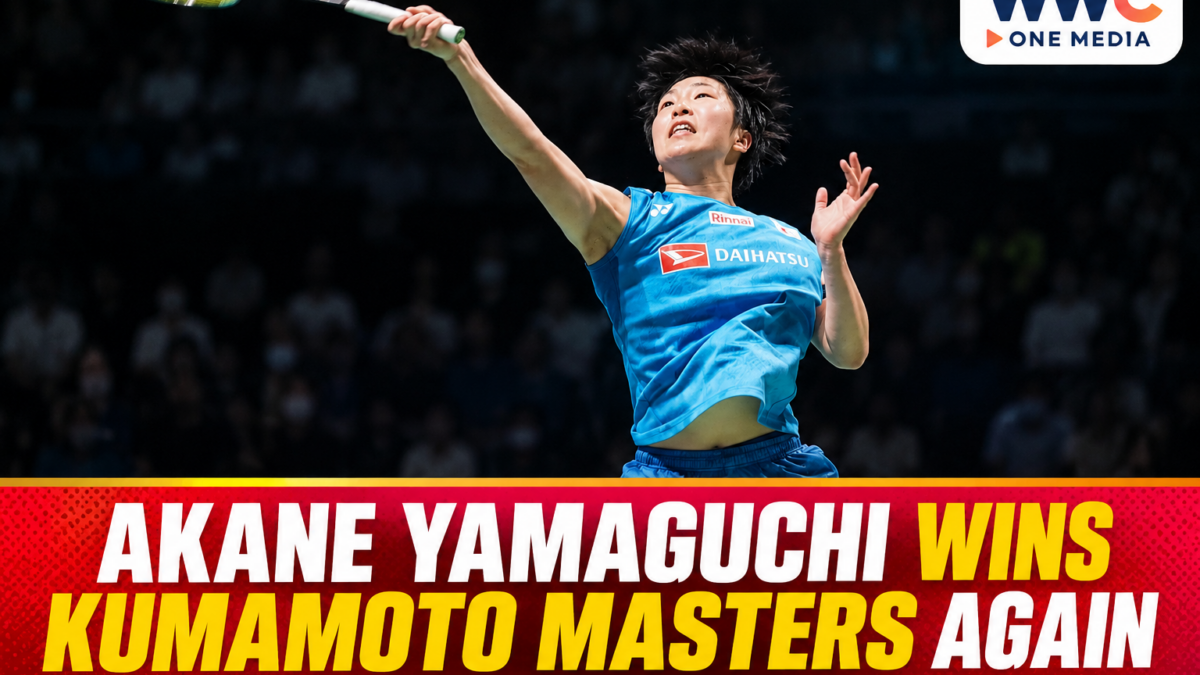
Akane Yamaguchi secured the women’s singles championship at the Kumamoto Masters Japan 2026 on November 15, defeating China’s Wang Zhiyi in straight games at the Kumamoto Prefectural Gymnasium. Her 21-14, 22-20 victory delivered another major home-court result for Japan, but the tournament’s final day also produced a second Japanese title in women’s doubles.
The result gave Yamaguchi her second Kumamoto Masters women’s singles crown, following her previous victory in 2024. It also highlighted the strength of Japan’s badminton programme across more than one event, with domestic players reaching finals in both singles and doubles.
For the host nation, the tournament was therefore about more than one player lifting a trophy. Japan finished the competition with two championships, while several other Japanese representatives reached the podium or came close to winning their respective finals.
Kumamoto Masters: Yamaguchi Delivers in the Women’s Singles Final
The women’s singles final brought together Yamaguchi of Japan and Wang Zhiyi of China. Yamaguchi took the opening game 21-14 before facing a much closer contest in the second.
Wang pushed the match to 20-20, leaving both players two points away from taking control of the game. Yamaguchi eventually secured the final two points to win 22-20 and complete a straight-games victory.
The Japanese Badminton Association’s official tournament report confirmed the score and described the result as Yamaguchi’s second Kumamoto Masters title in two years, following her 2024 success. スポーツナビ+1
The scoreline also gives a clearer picture of how the final unfolded. Yamaguchi controlled the first game more comfortably, but the second required her to maintain her composure through a close finish.
Winning in straight games meant she avoided a deciding third game. Against an opponent capable of extending the contest, that mattered: the final was settled before Wang could force another game.
The victory was particularly meaningful because the event took place in Kumamoto, where Yamaguchi’s badminton base is located. The tournament gave her the opportunity to compete for an international title in a familiar setting, rather than travelling overseas for another stop on the circuit.
A Second Japanese Title Comes From Women’s Doubles
Japan’s success did not end with Yamaguchi.
The women’s doubles final featured two Japanese pairings: Rin Iwanaga and Kie Nakanishi against Chiharu Shida and Riko Gunji. Iwanaga and Nakanishi won 21-19, 21-15 to claim the championship.
The result gave Japan another title on the tournament’s final day and made the women’s doubles event an all-Japanese championship match.
Shida and Gunji finished as runners-up, but their appearance in the final also meant Japan had both competing pairs represented in the title match. The Badminton Association of Japan confirmed that Iwanaga and Nakanishi won their first Kumamoto Masters championship. スポーツナビ
This result matters because success in doubles requires a different combination of skills from singles. Players must coordinate positioning, cover the court together and respond quickly to changing exchanges. Having two home pairs reach the final demonstrated that Japan had more than one competitive combination in the women’s event.
It also gave the local crowd another reason to celebrate after Yamaguchi’s singles victory.
Japan’s Other Finalists Faced Tough International Opposition
The tournament was not an all-Japanese sweep. Other finals showed how international competition remained a significant test for the host nation.
In men’s singles, Japan’s Koki Watanabe faced India’s Lakshya Sen. Watanabe took the opening game 21-13, but Sen recovered to win the next two, 21-18 and 21-14.
That comeback denied Japan another singles championship.
The men’s doubles final also ended in defeat for a Japanese pairing. Takuro Hoki and Yugo Kobayashi won the first game 21-16 against Malaysia’s Aaron Tai and Yap Roy King, but the Malaysian pair turned the match around with 21-13 and 21-15 wins in the next two games.
Those results underline an important point: playing at home does not guarantee a title. Japanese players reached several finals, but opponents from India and Malaysia demonstrated that the competition remained open across the different categories. スポーツナビ
For readers following badminton across Asia, the contest reflects the depth of the regional field. Malaysia’s younger singles players, for example, have also been preparing to test themselves against leading Asian opponents, as explored in WWC’s coverage of Malaysia’s men’s singles badminton challenge.
What the Tournament Says About Japan’s Badminton Programme
The Kumamoto Masters Japan 2026 was held from November 10 to 15 at the Kumamoto Prefectural Gymnasium in Kumamoto City. The Japanese Badminton Association identified it as a BWF World Tour Super 500 event in its official announcement of the national team entries. 公益財団法人日本バドミントン協会+1
Before the competition, the association’s October 16 announcement listed Yamaguchi among Japan’s women’s singles representatives. It also named other Japanese players and pairs entered across men’s singles, women’s singles, men’s doubles, women’s doubles and mixed doubles.
That entry list provides useful context for the final results. Japan was represented across the tournament’s five categories, rather than relying on one star player to carry its hopes.
The final-day outcomes reflected that spread of participation. Yamaguchi won women’s singles, Iwanaga and Nakanishi claimed women’s doubles, while Japanese representatives finished runners-up in men’s singles and men’s doubles. Shida and Gunji also finished second in women’s doubles. 公益財団法人日本バドミントン協会+1
This breadth is relevant to the wider development of badminton in Asia. International tournaments give national players regular opportunities to face opponents with different playing styles and competitive strengths. They also allow emerging pairings and established athletes to measure their performance against a field beyond domestic competition.
WWC has also followed the wider regional badminton scene, including the recent UAAP badminton championships in the Philippines, where collegiate teams competed for national-level recognition. The levels of competition are different, but both events show how the sport depends on a broad base of players and teams.
Japan’s wider sporting ambitions have also been visible through its hosting of major regional competitions, including the Aichi-Nagoya Asian Games. International events can give athletes valuable exposure while bringing fans closer to sports that often receive less attention than football or baseball.
Why Yamaguchi’s Victory Matters Beyond One Trophy
Yamaguchi’s latest title is a significant result in its own right, but its importance should be understood in proportion.
It confirms that she remains capable of winning a major international tournament on home soil. It also adds another championship to her record at an event held in the city where she trains.
However, one tournament cannot establish how the rest of her season will unfold. The result does not guarantee future titles, nor does it settle the competitive balance among the leading women’s singles players.
What it does provide is a concrete performance to build on: a straight-games final victory against Wang, including a close second game that required Yamaguchi to finish strongly.
For Japan, the wider takeaway is that the home tournament produced two titles and several other finalist appearances. That is a stronger measure of the event’s national impact than focusing exclusively on the women’s singles trophy.
What Happens Next?
The Kumamoto Masters concluded on November 15, so attention now turns to the next stages of the international badminton calendar.
The Japanese Badminton Association’s published schedule listed the Hong Kong Open 2026, another BWF World Tour Super 500 tournament, for November 17–22. The association’s tournament calendar provides the next scheduled competition window, although it does not by itself confirm which players will participate. 公益財団法人日本バドミントン協会
For Yamaguchi, the immediate achievement is clear: she has won the Kumamoto Masters women’s singles title for a second time. Whether she can carry that form into subsequent tournaments will depend on her performances against the next field of opponents.
Japan, meanwhile, can take encouragement from a tournament in which its players won both women’s titles and reached additional finals. The home crowd had more than one champion to celebrate, and the results offered a broader snapshot of the country’s competitive strength.
Frequently Asked Questions
Who won the women’s singles title at the 2026 Kumamoto Masters?
Japan’s Akane Yamaguchi won the women’s singles championship after defeating China’s Wang Zhiyi in straight games.
What was the score in the Yamaguchi-Wang final?
Yamaguchi won 21-14, 22-20 on November 15, 2026.
Was this Yamaguchi’s first Kumamoto Masters title?
No. The Japanese Badminton Association confirmed that the 2026 victory was her second title at the tournament, following her 2024 win.
Which other Japanese players won a title?
Rin Iwanaga and Kie Nakanishi won the women’s doubles championship, defeating fellow Japanese players Chiharu Shida and Riko Gunji, 21-19, 21-15.
Where was the 2026 Kumamoto Masters held?
The tournament took place at the Kumamoto Prefectural Gymnasium in Kumamoto City, Japan, from November 10 to 15, 2026.