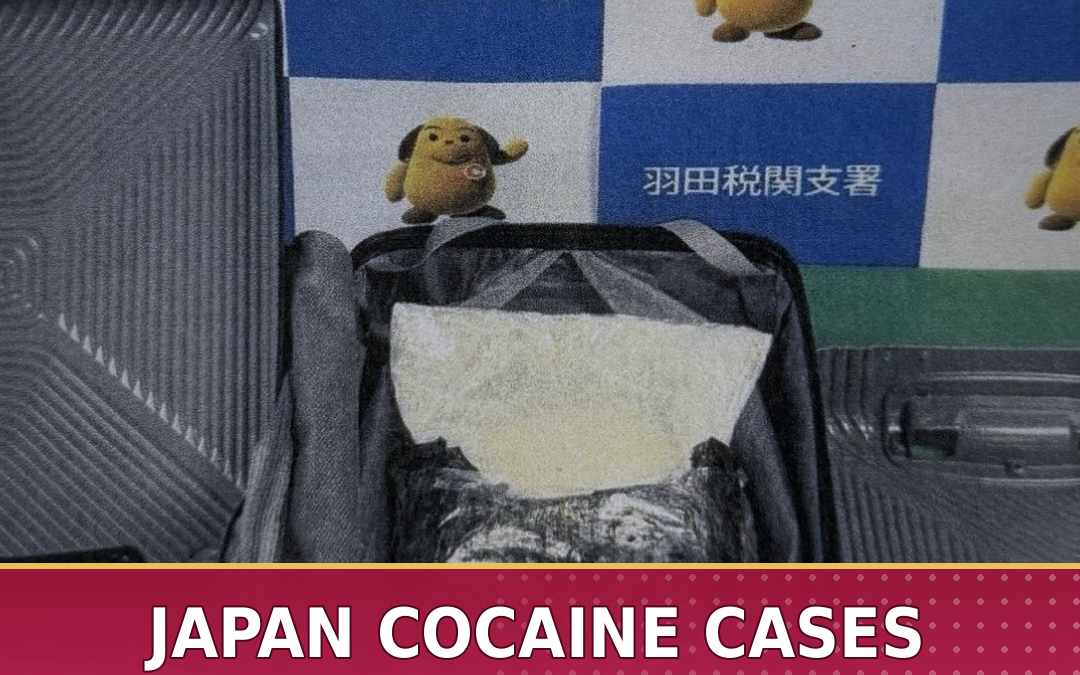
Japan’s cocaine enforcement picture is drawing attention as official national statistics show cocaine-related arrests reaching a record in 2025. Tokyo’s own police figures also reveal a substantial increase in drug-related arrests overall, although the publicly available metropolitan statistics do not separate cocaine cases from other narcotics.
The distinction matters. The national cocaine figure cannot automatically be treated as a Tokyo total, and the broader Tokyo figures should not be presented as cocaine arrests alone. Read together, however, the records show why authorities are facing a wider challenge in monitoring illegal drugs, investigating supply routes and responding to changing patterns of drug offences.
Japan’s cocaine arrests reached a national record
Japan’s National Police Agency recorded 804 people detected in cocaine-related offences in 2025, the highest figure in its published series. The number was substantially higher than the 586 recorded in 2024 and the 160 recorded in 2021. 警察庁+1
Cocaine accounted for 5.5% of all drug-related offenders recorded nationally in 2025, according to the agency’s annual assessment. The same report identified a high proportion of people in their 20s or younger among those detected in cocaine cases. 警察庁
The figures are significant, but they require careful interpretation. An arrest or police detection does not mean a person has been convicted, while an increase in recorded offenders does not by itself establish how many people are using cocaine across the country.
The national figures also cover Japan as a whole. They do not establish how many of the 804 cases were handled by Tokyo police.
Tokyo’s wider drug figures show a sharp increase
The Metropolitan Police Department’s official annual statistics recorded 2,910 people detected in drug-related cases in Tokyo in 2025, compared with 2,459 in 2024. That represents an increase of 451 people, or approximately 18.3%. Tokyo Metropolitan Police Department
The figures cover several drug categories, not cocaine alone.
In 2025, Tokyo police recorded 1,139 people in cannabis-related cases, compared with 856 in 2024. Stimulant-related cases accounted for 1,102 people, up from 1,006. The category for narcotics recorded 590 people, compared with 523 in the previous year. Tokyo Metropolitan Police Department
These categories should not be confused with a cocaine-specific count. The Tokyo table groups cocaine within a broader narcotics classification and does not provide a separate cocaine total in the published annual breakdown.
That limitation is important for readers trying to understand the precise scale of the problem in the capital. The official data confirm a rise in overall drug-related enforcement, but they do not independently establish the exact number of cocaine offenders in Tokyo.
The national seizure figures reveal another part of the problem
Arrest figures tell only part of the story. The quantity of drugs seized can offer another measure of enforcement activity, although it cannot show the full volume of drugs entering or circulating in a country.
Japan’s national statistics recorded 226,877 grams of seized cocaine in 2025, equivalent to approximately 226.9 kilograms. The figure was lower than the 247,164 grams seized in 2024, but remained substantially higher than the 10,044 grams recorded in 2021. 警察庁
This creates an important contrast: the number of people detected in cocaine cases rose to a record in 2025, while the recorded quantity seized declined from the previous year.
Neither measure should be used alone to claim that cocaine availability is increasing or decreasing. Seizure totals can be affected by the size and number of intercepted shipments, enforcement operations and the timing of investigations. Arrest totals measure people detected by authorities, not the entire market.
The National Police Agency’s assessment says cocaine seizures had exceeded 200 kilograms for two consecutive years and were about 23 times the 2021 level. It also identified younger people as a significant group among those detected in cocaine cases. 警察庁+1
Why international trafficking remains a concern
Japan’s national police assessment also recorded an increase in drug importation cases involving several types of illegal substances. In 2025, authorities recorded 464 drug-importation cases and 536 people detected in connection with those offences, increases of 41.9% and 35.7%, respectively, from the previous year. These figures cover drug imports generally, not cocaine alone. 警察庁
The scale of international drug movement is also relevant to other countries in the region.
WWC ONE MEDIA has previously examined how cocaine can be concealed aboard commercial vessels in its report on more than 28 kilograms of cocaine discovered on a ship transiting Singapore.
In the Philippines, the recovery of suspected cocaine packages along Quezon’s coastline has highlighted the importance of maritime monitoring and community reporting. The issue was covered in WWC’s report on PDEA’s effort to enlist fisherfolk as coastal watchdogs.
These cases are not evidence of a direct connection to Japan’s investigations. They illustrate a broader regional enforcement challenge: illegal drugs can move through international shipping routes, ports and coastal areas, requiring authorities to coordinate across jurisdictions.
What the figures mean for Tokyo and Japan
The official records point to two developments that should be considered together.
First, Japan recorded a national high of 804 people detected in cocaine-related offences in 2025. Second, Tokyo recorded a rise in the total number of people detected in drug-related cases, with increases across several categories.
For policymakers and law-enforcement agencies, the figures underline the need to distinguish between street-level offences, supply networks and international importation. Arresting individuals is one part of enforcement, but identifying the sources of illegal substances and the networks responsible for moving them is another.
The National Police Agency has also described the involvement of organised criminal groups and other networks in drug smuggling and distribution as an ongoing concern. Its annual assessment says drug-related activity can provide revenue for criminal organisations, reinforcing the importance of investigating not only individual cases but also the structures behind supply. 警察庁
For Tokyo, the published statistics provide evidence of a wider rise in drug-related enforcement. A separate cocaine-only breakdown would be needed to establish the precise contribution of cocaine cases to that increase.
What happens next?
The next important reference point will be the release of updated official police statistics. These can show whether the national increase in cocaine-related cases continued beyond 2025 and whether Tokyo publishes a more detailed breakdown of its narcotics cases.
Until then, the available records support a clear but measured conclusion: cocaine-related cases reached a national record in Japan in 2025, while Tokyo’s overall drug-related detections also increased. The two figures point to a serious enforcement issue, but they should not be merged into a single Tokyo cocaine count.
The central question is whether future police data will show that the national cocaine trend is continuing—and how much of that pattern can be established specifically in Tokyo.