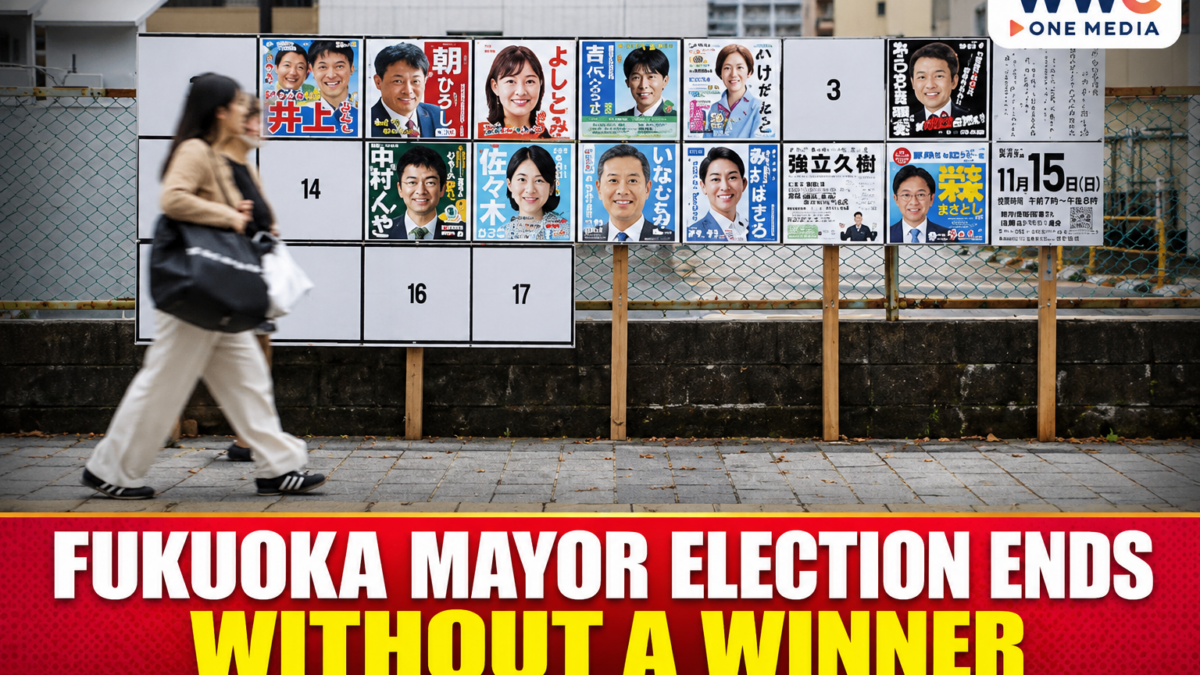
Fukuoka’s mayoral election has produced an unusual result: the candidate who received the most votes still cannot take office. Shuji Inatomi finished first in the Nov. 15, 2026, contest with 137,667 votes, but his total fell short of the legal minimum required to win, forcing the city towards a new election.
The outcome followed a crowded race involving 13 candidates, the highest number in the city’s mayoral election history. Instead of settling who would lead one of Japan’s major regional economic centres, the vote has created another campaign and another decision for residents to make.
The central issue is not simply who attracted the most support. Japan’s election law sets a minimum vote requirement for a candidate to be declared elected in a local government chief executive race. In Fukuoka, the leading candidate did not reach that threshold.
The leading candidate fell short of the legal requirement
The official citywide count published by Fukuoka City’s election authorities shows Inatomi received 137,667 votes. Independent candidate Masaru Niimura placed second with 93,824, while Kentaro Mori of the Conservative Party received 93,206. 福岡市
The city recorded 592,723 votes across the 13 candidates. Inatomi therefore secured approximately 23.23% of the total, below the 25% minimum identified in the legal provision governing the election.
That left him about 10,514 votes short of the minimum needed to qualify. The calculation illustrates why finishing first was not enough: the law requires more than simply outperforming the other candidates.
Fukuoka Prefecture’s official statement on Nov. 16 confirmed that no candidate obtained at least one-fourth of the total valid votes, despite the record number of people contesting the position. 福岡県庁ホームページ+1
The result means the election did not produce a successful candidate under the applicable rules. It does not mean that the candidate with the second-highest number of votes automatically becomes mayor.
Why Japan requires more than a plurality
In many elections, the candidate with the largest number of votes wins, even without receiving more than half of all ballots. This is commonly known as a plurality system.
Japan’s rule for local government chief executives adds a minimum threshold. Article 95 of the Public Offices Election Law requires a candidate in this category to receive at least one-fourth of the total valid votes to be declared elected.
The requirement is intended to prevent a candidate from taking office with an exceptionally small share of the electorate’s support when votes are divided among numerous contenders.
In Fukuoka, the effect was decisive. Inatomi had a clear lead over the second-place candidate, but his share of the vote remained below the statutory minimum.
This distinction is important because the result is not a conventional defeat in which the runner-up wins. The legal condition for declaring any candidate elected was not satisfied.
Japan has other examples of how technical election rules can influence political outcomes. WWC ONE MEDIA previously examined a mayoral election dispute in Kamisu involving two disputed handwritten ballots. That case concerned the validity of individual votes, while Fukuoka’s problem arose from the overall distribution of support.
Thirteen candidates changed the shape of the contest
The number of candidates was a defining feature of the Fukuoka race.
The official prefectural statement described the 13 contenders as the highest number in the city’s mayoral election history. Their participation created a much broader field than a contest dominated by only two or three candidates. 福岡県庁ホームページ+1
The final count shows how widely the votes were distributed. Inatomi received 137,667, but Niimura and Mori each secured more than 93,000. Takashi Shirabe placed fourth with 71,964, followed by Genki Jinno with 48,195 and Keiko Yoshitomi with 46,156.
The remaining candidates also received votes, adding to the fragmented result.
It would be premature to conclude that the number of candidates alone caused the failure to reach the threshold. The official count establishes that no one crossed the legal minimum; it does not establish why individual voters chose particular candidates or whether a smaller field would have produced a different result.
Still, the figures demonstrate the practical difficulty of winning when support is spread across a large group of contenders. A candidate can lead the field and remain far from the minimum required by law.
Voter turnout rose, but the election remained inconclusive
The election attracted more participation than the previous mayoral contest.
Fukuoka City’s official voting report recorded turnout at 45.58%, compared with 34.31% in the 2022 election. That represents an increase of 11.27 percentage points. The report counted 600,024 voters from an electorate of 1,316,515. 福岡市
The higher turnout is notable because the election still failed to produce a successful candidate.
More people participating did not automatically translate into a decisive mandate. Instead, the votes were divided among the 13 candidates, and the leading contender remained below the statutory threshold.
For residents, the result creates a practical challenge. They have already spent time participating in one election, but the process must continue before the city can settle on its next elected leader.
Fukuoka is also not an isolated example of local elections drawing attention beyond their immediate boundaries. WWC previously examined Okinawa’s gubernatorial contest and the competing priorities shaping its electorate. The issues in that race were different, but both contests illustrate how local elections can become important tests of public priorities.
What the result means for Fukuoka’s leadership
The immediate consequence is that the mayoral contest remains unresolved. The election authorities must follow the legal process for a re-election rather than simply award the position to the candidate who finished first.
Fukuoka Prefecture Governor’s Nov. 16 statement acknowledged that the outcome could raise concerns among residents about a possible interruption in city administration. It also stressed the importance of selecting a new mayor through an election that reflects the public’s choice. 福岡県庁ホームページ
The result also leaves the candidates with a new political calculation. Inatomi enters the next contest as the leading vote-getter, but his first-place finish does not guarantee victory in another round.
Other candidates may decide whether to run again, while voters will have another opportunity to assess the choices before them. The next campaign could therefore look different from the first, particularly if candidates adjust their strategies or the field changes.
The key question is whether the next vote will produce a candidate capable of crossing the required threshold.
What happens next
Fukuoka’s election authorities must proceed with the re-election process under Japan’s election law. As of the official announcements reviewed for this report, a new voting date had not been confirmed in the records cited here.
The prefectural governor’s statement referred to a re-election if one is conducted, but did not announce a specific timetable. Residents should therefore wait for the city’s election authorities to publish the formal schedule rather than rely on unconfirmed dates circulating elsewhere. 福岡県庁ホームページ+1
The next contest will not simply be a repeat of the first. Candidates will know the vote distribution, and residents will have another chance to decide which contender can secure enough support to meet the legal requirement.
For now, Fukuoka has a clear first-place candidate but no successful winner. The election has demonstrated that under Japan’s rules, leading the count and earning the right to take office are not always the same thing.
Frequently asked questions
1. Who received the most votes in the 2026 Fukuoka mayoral election?
Shuji Inatomi finished first with 137,667 votes in the Nov. 15 election.
2. Why was there no winner in the Fukuoka mayoral election?
No candidate reached the legal minimum of one-fourth of the total valid votes. Inatomi received approximately 23.23%, leaving him below the required threshold.
3. How many candidates ran for Fukuoka mayor?
There were 13 candidates, the highest number in the city’s mayoral election history.
4. What was the voter turnout in Fukuoka?
Turnout was 45.58%, up from 34.31% in the previous mayoral election in 2022.
5. When will Fukuoka hold its next mayoral election?
A new election is required because no candidate met the legal threshold, but the official records reviewed for this report had not confirmed a new voting date as of Nov. 17, 2026.