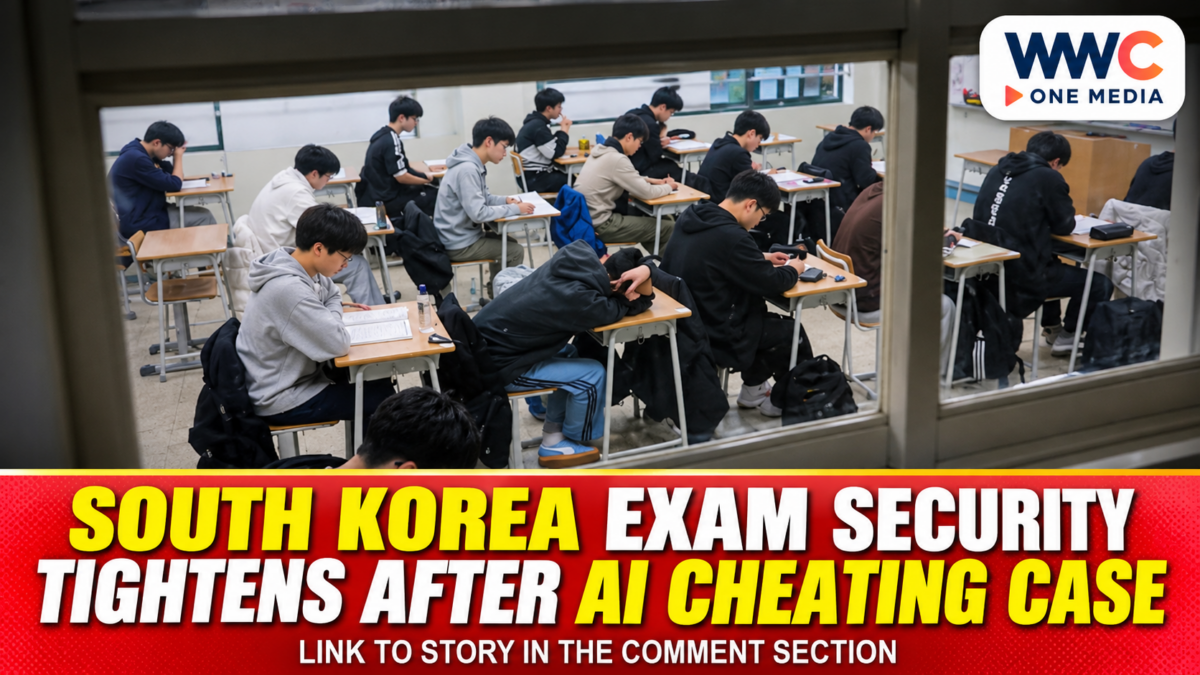
South Korea is tightening examination security ahead of its Nov. 19, 2026 College Scholastic Ability Test (CSAT) after concerns over artificial-intelligence-enabled devices prompted new government measures and a wider review of national examinations.
The response includes specialist personnel to assess suspected smart glasses, stronger checks on prohibited electronics and a government plan to examine possible AI-assisted misconduct across national qualification tests. The measures put the country’s examination safeguards under pressure to adapt to devices that can connect test-takers with outside information while protecting candidates who follow the rules. 국무조정실 국무총리비서실+2
The issue extends beyond one pair of glasses. South Korea’s published rules already prohibit a broad range of electronic devices in the CSAT examination venue, while the separate certified tax accountant case has led authorities to consider stronger procedures across other state-administered tests.
South Korea exam rules already prohibit smart glasses
The Ministry of Education’s examination guidance lists smart glasses among the electronic devices that candidates cannot bring into the CSAT test venue. The prohibited category also covers mobile phones, smartwatches, tablets, earphones, electronic devices with LCD or LED displays and other rechargeable items.
The rules apply regardless of whether a candidate intends to use the device during the examination. Candidates who inadvertently bring a prohibited item must hand it to a supervisor before the first examination session begins. The item is returned after the candidate has completed all examination subjects. moe.go.kr
The ministry’s Nov. 6 explanation separates possession from use. Bringing or simply possessing a prohibited smart device can invalidate the current examination. Wearing or using a prohibited smart device during the test can also lead to the candidate losing eligibility to sit the following year’s CSAT.
Refusing a supervisor’s request to check suspected smart glasses may also result in serious sanctions after the case is reviewed. The ministry says deliberate cheating using smart glasses can prompt a complaint or referral for investigation, with possible criminal consequences. moe.go.kr+1
That distinction is important for candidates who wear ordinary prescription glasses. The restriction concerns prohibited electronic devices, not eyewear as a category. The President’s Office has also instructed officials to prevent the inspection process from unnecessarily intimidating candidates who use ordinary glasses or medical devices. 대한민국 청와대
Inspectors and response teams are being added
The government’s Nov. 13 explanation confirmed that dedicated personnel would be assigned at examination sites to assess smart glasses. It also described a rapid-response arrangement connecting the Ministry of Education with provincial and metropolitan education offices.
The purpose is to give examination supervisors a clearer route for handling suspected devices. Instead of relying only on a general invigilator’s familiarity with unfamiliar technology, the system is intended to provide specialist assessment and coordination with education authorities. 국무조정실 국무총리비서실
The President’s Office reinforced that approach on Nov. 15. Its published statement said authorities would prepare procedures to check AI devices among CSAT candidates, assign personnel at test sites to assess suspected devices, and strengthen guidance for both candidates and examination supervisors.
It also said police and other investigative agencies would respond promptly to reported examination misconduct. Serious cases involving new methods or organised activity could be handled by dedicated investigative teams. 대한민국 청와대
These steps do not mean that every candidate will automatically be treated as a suspect. The official guidance focuses on prohibited items, inspection procedures and the handling of suspected violations. Fair enforcement will depend on applying those rules consistently and distinguishing electronic smart glasses from ordinary eyewear.
Tax accountant examination case expands the government response
The separate controversy involves the 63rd certified tax accountant examination. In a Nov. 15 statement, the Ministry of Employment and Labor said it and the Human Resources Development Service of Korea had held an emergency meeting to discuss alleged AI-assisted misconduct connected to that examination.
The ministry announced that the examination result would be invalidated and the qualification pass cancelled for the person found responsible, with a five-year restriction on taking the examination again. It also said it would pursue a complaint and cooperate with police investigations. These are announced administrative steps; they should not be described as a final criminal conviction. moel.go.kr
The response is not limited to that one examination. The ministry said it would immediately examine all national qualification tests conducted in 2026, using the suspected case pattern to identify possible AI-assisted misconduct.
It also announced plans for online and offline reporting channels, more training for supervisors on identifying devices and responding to suspected violations, and additional dedicated inspection personnel at examination sites. A radio-frequency detection device was also mentioned as a measure under development. moel.go.kr
A joint task force involving the ministry and the Human Resources Development Service of Korea is expected to review the wider qualification-testing system and prepare a comprehensive prevention plan within the year.
The scale of that review matters because national qualifications are used to demonstrate professional competence. If examination controls cannot keep pace with connected devices, the credibility of the qualification process may be questioned even when most candidates have complied with the rules.
Why AI assessment and AI-assisted cheating are different
Artificial intelligence is not prohibited in every educational or testing context. Its use depends on the purpose of the assessment and the rules established by the institution.
South Korea’s plans to modernise the Test of Proficiency in Korean (TOPIK), for example, have involved discussion of AI-supported question generation and assessment. That is a different policy question from a candidate secretly using an unauthorised device during a closed examination. WWC previously examined the proposed AI-supported TOPIK examination changes.
The distinction is also relevant to the country’s wider approach to testing. South Korea has separately announced tougher sanctions for serious TOPIK violations, including longer bans for certain forms of cheating. Those rules apply to that language examination and should not be confused with the CSAT’s own penalties. WWC One Media
The issue is not whether AI should be present in education. It is whether candidates use tools that the rules expressly prohibit in an assessment designed to measure their own knowledge and performance.
The fairness test for schools and examination authorities
South Korea’s response raises a difficult practical question: how can officials detect concealed technology without creating unnecessary disruption for candidates who are following the rules?
Specialist inspectors and clearer procedures may improve consistency, but they also need to be communicated before examination day. Candidates should know which items are prohibited, how to surrender devices and what to do if they need ordinary or medically necessary equipment.
The wider education environment adds context. WWC has reported on the pressure experienced by South Korean teenagers preparing for university entrance examinations, including students who leave conventional schooling to pursue alternative preparation routes. That pressure makes consistent examination standards particularly important, because candidates must be able to trust that results are earned under equal conditions. Read our report on South Korean teenagers leaving school to prepare for college entrance exams.
There is also a lesson for other education systems. Philippine institutions are developing policies for responsible AI use in classrooms, a subject covered in WWC’s report on AI access and support for working students in Philippine education. Classroom use, permitted learning assistance and unauthorised examination help need clear boundaries.
The central challenge for South Korea is therefore twofold: stop prohibited technology from undermining examinations, while ensuring that enforcement does not unfairly penalise ordinary candidates.
What happens next
The 2027 academic year CSAT is scheduled for Nov. 19, 2026. The government has confirmed specialist assessment arrangements and a coordinated response involving education authorities. The President’s Office has also said that police and other investigative agencies will respond to reported cases of suspected misconduct. 국무조정실 국무총리비서실+1
Separately, the Ministry of Employment and Labor and the Human Resources Development Service of Korea are due to examine national qualification tests conducted in 2026 and prepare broader prevention measures.
The key test will be whether the new procedures can identify genuine violations while protecting candidates’ rights and maintaining confidence in the results. Until investigations and administrative reviews are completed, allegations in individual cases must remain distinct from findings established by the authorities.
Frequently asked questions
Are smart glasses banned in South Korea’s 2026 college entrance exam?
Yes. The Ministry of Education lists smart glasses among prohibited electronic devices for the CSAT examination venue. Candidates who inadvertently bring prohibited devices must surrender them before the first session. moe.go.kr
Can a candidate be penalised for wearing smart glasses without using AI?
The ministry’s guidance says wearing or using a prohibited smart device during the examination can invalidate the current test and affect eligibility for the following year. The rules are not limited to proving that AI generated an answer. moe.go.kr
When is South Korea’s 2026 college entrance exam?
The CSAT for the 2027 academic year is scheduled for Nov. 19, 2026. 대한민국 청와대
What action is being taken over the tax accountant examination case?
The Ministry of Employment and Labor announced plans to invalidate the examination result and cancel the qualification pass for the person found responsible, impose a five-year examination restriction, pursue a complaint and cooperate with police. moel.go.kr
Will South Korea review other national examinations?
Yes. The ministry announced an examination of all national qualification tests conducted in 2026, using the suspected case pattern to check for possible AI-assisted misconduct.