MANILA, Philippines — November 12, 2026 — The Philippine economy is facing an increasingly difficult economic situation as rising prices collide with weakening growth, forcing the Bangko Sentral ng Pilipinas (BSP) to confront one of its most challenging monetary-policy decisions in recent years.
The latest figures paint a troubling picture for Filipino households and businesses.
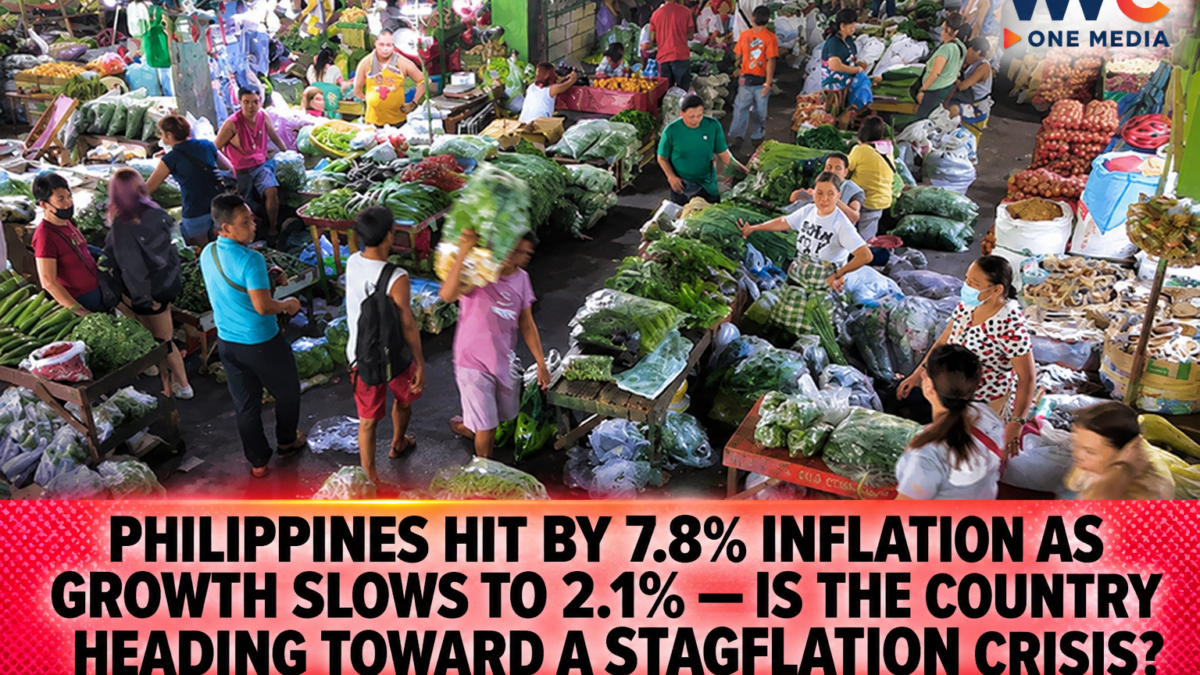
Inflation accelerated to 7.8% in October 2026, its highest level since February 2023, while the country’s gross domestic product (GDP) expanded by just 2.1% in the third quarter.
The combination of expensive necessities and slowing economic activity has raised concerns about the possibility of stagflation—a situation characterized by high inflation and weak economic growth.
The BSP has already raised its benchmark interest rate by a cumulative 125 basis points in 2026, including a larger-than-expected 50-basis-point increase in October that brought the policy rate to 5.50%.
But the central bank now faces a difficult balancing act: control inflation without putting even more pressure on an economy that is already losing momentum.
In its latest assessment, the BSP said it is monitoring the second-round effects of global supply shocks, weak aggregate demand and the risk of eroding public confidence.
The central bank stressed that restoring price stability and purchasing power is essential to rebuilding confidence in the economy.
For ordinary Filipinos, the consequences are becoming increasingly visible in food budgets, transportation expenses, electricity bills and borrowing costs.
The bigger concern is whether the Philippines can bring inflation under control without sacrificing even more economic growth.
Inflation Climbs to 7.8% as Transportation and Utility Costs Surge
The Philippine Statistics Authority (PSA) reported that headline inflation accelerated to 7.8% in October, up from 7.2% in September and 1.7% during the same month last year.
The latest reading was the highest since February 2023, when inflation reached 8.6%.
The average inflation rate from January to October 2026 reached 5.6%, already above the BSP’s 2% to 4% target range.
Transportation costs were among the biggest contributors to the increase.
The transport index accelerated to 20.1% in October from 14.6% in September, reflecting pressure from higher fuel and transportation expenses.
Housing, water, electricity, gas and other fuels also recorded faster inflation, reaching 9.3% from 8.4% in the previous month.
Core inflation, which excludes selected volatile food and energy items, climbed to 5.4% from a revised 4.8%.
That increase suggests that price pressures are not limited to fuel and food alone.
Food inflation, however, eased to 6.4% from 6.8% in September, providing some relief. Rice inflation remained a concern, accelerating to 20.7% from 20.3%.
The figures show why households continue to feel financial pressure even when some food prices improve: transportation, utilities and other essential expenses are also becoming more expensive.
For consumers, higher inflation means that the same amount of money buys fewer goods and services than before.
Philippine Economy Slows to Just 2.1% in the Third Quarter
While prices continue rising, economic growth is weakening.
The PSA reported that the country’s GDP grew by only 2.1% year over year in the third quarter of 2026, down from a revised 2.4% in the second quarter and 4% during the same period in 2025.
The latest result represents the weakest quarterly expansion outside the pandemic period since the fourth quarter of 2009.
On the production side, the services sector grew by 3.7%.
Agriculture, forestry and fishing contracted by 4.8%, while industry posted a marginal decline of 0.003%.
The contraction in agriculture is particularly concerning because weaker production can affect rural incomes, food availability and future price movements.
On the expenditure side, household final consumption expenditure grew by only 2.4%.
Gross capital formation, which measures investment in fixed assets and inventories, declined by 0.2%.
Government consumption increased by 6.8%, while exports grew by 8.6%.
However, stronger government spending and exports were not enough to offset weakness in other areas of the economy.
The slowdown also means the government faces a more difficult path toward meeting its 2026 economic growth target of 3.5% to 4.5%.
BSP Faces a Difficult Decision: Raise Interest Rates or Protect Economic Growth?
The central bank’s main challenge is that its most important inflation-control tool can also create additional pressure on economic activity.
The BSP raised its benchmark policy rate by 50 basis points on October 22, bringing it to 5.50%.
The move was larger than the 25-basis-point increase many market participants had anticipated.
The October decision marked the fourth consecutive rate increase and brought the cumulative tightening in 2026 to 125 basis points.
Higher interest rates are intended to discourage excessive borrowing and spending, help contain inflation expectations and prevent price increases from becoming more persistent.
However, they also make financing more expensive.
Businesses may delay expansion projects when borrowing costs rise. Households may postpone major purchases, while borrowers with variable-rate loans could face higher repayment expenses when their rates are repriced.
This creates a difficult situation for an economy already experiencing weak consumer spending and investment.
The BSP must therefore assess whether additional tightening is necessary to prevent inflation from becoming entrenched or whether the slowdown is becoming severe enough to warrant greater caution.
The central bank’s next scheduled Monetary Board meeting is December 17, 2026.
No decision on another rate increase has been confirmed.
Economists Expect More BSP Rate Hikes Despite Weak Growth
The latest GDP slowdown has not eliminated expectations of further monetary tightening.
Economists from HSBC, Bank of America and the Bank of the Philippine Islands have warned that inflation remains sufficiently persistent to justify additional interest-rate increases.
HSBC economist Aris Dacanay expects a smaller 25-basis-point increase in December, which would bring the benchmark rate to 5.75%.
Bank of America also expects another 25-basis-point increase in December, followed by a possible adjustment in February 2027.
BPI lead economist Emilio Neri Jr. has likewise warned that pausing monetary tightening too early could allow inflation to become more deeply embedded in the economy.
However, the forecasts are not unanimous, and they are not official BSP decisions.
The weaker GDP result has complicated the outlook because aggressive monetary tightening could further reduce domestic demand.
The central bank must consider inflation, economic growth, the peso and global developments before making its next decision.
S&P Global Warns That the Philippines May Be Experiencing Stagflation
The country’s economic combination has intensified discussion about stagflation.
S&P Global Ratings senior economist Vishrut Rana recently described the Philippines as already experiencing stagflationary conditions.
His assessment was based on growth falling significantly below the country’s longer-term trend while inflation remained elevated.
S&P has pointed to high energy costs, weaker public spending and subdued household demand as important contributors to the slowdown.
The ratings firm expects Philippine economic growth of 2.9% in 2026, according to its November assessment, with a recovery projected for 2027.
However, it has also warned that prolonged weakness in consumer demand and agricultural risks could complicate the recovery.
Not all economists and officials use the term stagflation in the same way.
The Philippines is still recording positive economic growth, so it is important not to describe the economy as being in a confirmed recession.
Stagflation is also more than one disappointing GDP figure. It generally refers to a sustained combination of weak economic activity and persistent inflation, often accompanied by labor-market weakness.
Nevertheless, the latest Philippine data show why the concern is gaining attention.
Why a Weak Peso and Higher Global Oil Prices Matter
External economic developments are adding another layer of difficulty.
The Philippines relies heavily on imported petroleum and other internationally traded commodities.
When global oil prices increase, the effects can spread through transportation, manufacturing, electricity generation and the cost of delivering goods.
A weaker peso can make imported products and energy more expensive because businesses need more pesos to purchase the same amount of foreign currency.
That can increase operating costs and eventually put additional pressure on consumer prices.
Reuters reported that the peso had come under pressure amid geopolitical tensions and higher global energy costs.
The BSP’s October rate increase was partly intended to address worsening inflation risks and help anchor expectations.
However, interest-rate increases cannot directly control global oil supply or eliminate geopolitical disruptions.
This is why the government must also consider measures involving energy security, transportation efficiency, agricultural productivity and supply-chain resilience.
Agriculture’s Contraction Could Create Another Inflation Problem
One of the most worrying details in the third-quarter GDP report was the 4.8% contraction in agriculture, forestry and fishing.
Agriculture is important not only because it contributes to economic output but also because it affects food supply and the incomes of millions of Filipinos.
When agricultural production weakens, farmers may earn less, food supplies can become tighter and prices may face additional upward pressure.
The problem is particularly serious when households are already dealing with expensive transportation and utilities.
The Department of Agriculture and other government agencies will need to monitor production conditions, weather developments and food supply to prevent additional disruptions.
The risk of El Niño also remains an important factor in the outlook.
Prolonged dry conditions can affect irrigation, crop yields and water availability, potentially increasing pressure on food prices.
However, the actual effects will depend on the severity and duration of weather conditions, the crops affected and the effectiveness of government interventions.
What the Economic Slowdown Means for Filipino Families
For households, the combination of high inflation and weak growth can create pressure from several directions.
Food and daily necessities: Higher prices reduce the amount families can purchase with the same budget.
Transportation: Rising fuel and transport expenses increase the cost of commuting, deliveries and business operations.
Electricity and utilities: Higher utility expenses leave households with less money for other needs.
Loans and credit: Higher interest rates can increase financing costs, depending on the type of loan and its repricing terms.
Employment and income: Slower economic activity may discourage business expansion and weaken job creation.
Small businesses: Higher operating expenses combined with cautious consumer spending can squeeze profit margins.
Low-income families are particularly vulnerable because they generally spend a larger share of their income on necessities.
If inflation remains elevated, households may be forced to reduce discretionary spending, postpone purchases or rely more heavily on borrowing.
Those decisions can further weaken domestic demand and make economic recovery more difficult.
Can the Philippines Still Recover in 2027?
Despite the difficult outlook, the Philippine economy is not without opportunities for recovery.
Services and exports continue to provide support, while improvements in infrastructure implementation and investment confidence could help stimulate economic activity.
A stronger agricultural performance could also improve food supply and support rural incomes.
However, the recovery will depend on whether the government can address the factors weakening economic momentum.
Economists have called for faster implementation of infrastructure projects, stronger investment conditions and measures to improve household purchasing power.
The government must also ensure that public spending is transparent, efficient and directed toward projects that deliver measurable economic benefits.
The BSP, meanwhile, must continue evaluating whether monetary policy is sufficiently restrictive to bring inflation back toward its target range.
The central bank has emphasized that price stability and purchasing power are essential to restoring confidence.
Its objective is to bring inflation back toward the 2% to 4% target range over time, rather than allowing elevated prices to become a lasting feature of the economy.
What Happens Next? All Eyes on the BSP’s December Decision
The next major monetary-policy decision is scheduled for December 17, when the BSP’s Monetary Board will assess the latest economic and inflation developments.
Policymakers will be watching several indicators:
- Whether inflation continues accelerating or begins to ease;
- Whether the peso remains under pressure;
- Whether global fuel and energy prices stabilize;
- Whether household spending and business investment recover;
- Whether agricultural production improves; and
- Whether inflation expectations remain elevated.
The BSP’s final monetary policy report for 2026 is scheduled for release on December 23.
Those developments will help determine whether another interest-rate increase is necessary or whether the central bank can begin considering a less restrictive approach.
For now, the possibility of additional tightening remains open.
The Bigger Question: Can the Government Stop Inflation Without Deepening the Slowdown?
The Philippines is confronting an economic challenge that cannot be solved by one policy decision.
Raising interest rates may help contain inflation, but it cannot repair agricultural supply chains, lower global oil prices or immediately restore business confidence.
Increasing government spending may support growth, but poorly targeted or inefficient spending could create additional economic and fiscal problems.
The government and the BSP therefore need coordinated action that addresses both price stability and the country’s productive capacity.
For President Ferdinand Marcos Jr.’s administration, the challenge is to improve investment conditions, strengthen agriculture, accelerate legitimate infrastructure projects and protect vulnerable households.
For the BSP, the priority is to prevent inflation from becoming entrenched without imposing unnecessary pressure on economic activity.
For millions of Filipinos, the consequences are much more immediate: higher grocery bills, more expensive transportation, rising household expenses and uncertainty about employment and income.
With inflation at 7.8% and economic growth slowing to just 2.1%, the Philippines is facing a defining economic test. Can policymakers bring prices under control while reviving growth—or will another round of interest-rate increases make an already difficult situation even harder for Filipino families?