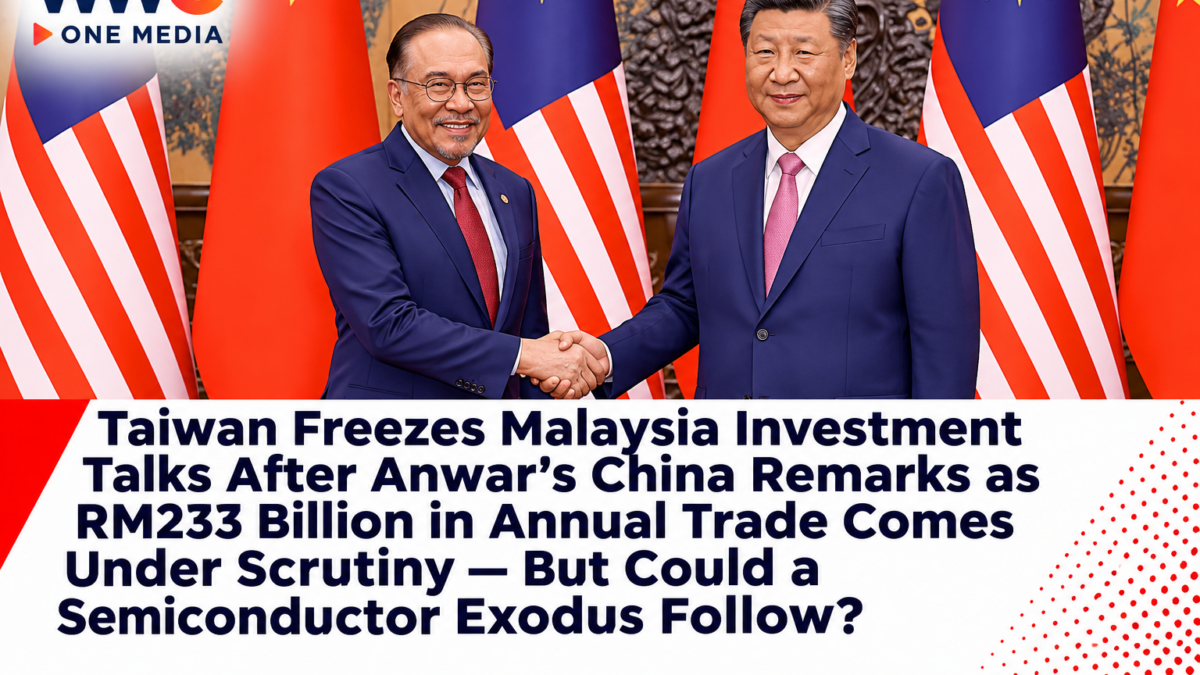
KUALA LUMPUR, MALAYSIA / TAIPEI, TAIWAN / MANILA, PHILIPPINES — November 12, 2026 — Malaysia is moving to protect its multibillion-dollar economic relationship with Taiwan after Taipei suspended bilateral investment negotiations over Prime Minister Anwar Ibrahim’s controversial remarks concerning China’s sovereignty claims over the self-governed island.
The diplomatic dispute has raised concerns about the future of Taiwanese semiconductor investments in Malaysia, one of Southeast Asia’s most important electronics manufacturing centers.
But Kuala Lumpur is refusing to change its longstanding One China policy.
Instead, Malaysian officials are attempting a delicate balancing act: maintaining political relations with Beijing while assuring Taiwanese businesses that Malaysia remains a dependable destination for investment.
The stakes are enormous.
Malaysia and Taiwan recorded RM233.02 billion, or approximately US$54.49 billion, in bilateral trade in 2025, an increase of 32.3% from the previous year.
Taiwan has also become one of Malaysia’s most important sources of manufacturing investment, especially in electronics and semiconductors.
According to Malaysia’s Ministry of Foreign Affairs, Taiwanese investors were associated with 2,719 approved manufacturing projects carrying approximately US$16.7 billion in investment commitments between 1980 and March 2026.
Those projects were associated with more than 407,000 potential employment opportunities.
Now, the commercial relationship faces one of its most uncomfortable political tests in years.
The central question is whether Malaysia can preserve its valuable semiconductor partnership with Taiwan while maintaining a diplomatic position that Taipei considers damaging to its sovereignty and security.
Taiwan Suspends Investment Talks With Malaysia
Taiwan’s Ministry of Foreign Affairs confirmed on November 10 that it had suspended bilateral investment negotiations with Malaysia.
Foreign Ministry spokesperson Hsiao Kuang-wei said the decision followed concerns about statements made by Prime Minister Anwar Ibrahim during an August interview with Al Jazeera.
The suspended discussions were associated with efforts to strengthen or update investment arrangements between the two sides.
Reports indicated that meetings planned for late October had been postponed.
The decision was intended to protect Taiwan’s sovereignty, economic security and the interests of Taiwanese investors, according to Taipei.
But the suspension does not mean Taiwan has prohibited all trade with Malaysia.
Existing commercial relationships remain in place.
Taipei has also indicated that communication channels remain open.
The disagreement therefore concerns the political conditions surrounding future investment cooperation rather than a comprehensive trade embargo.
Anwar Ibrahim’s One China Remarks Spark Diplomatic Backlash
The controversy began with Anwar’s August interview, during which he expressed unusually explicit support for Beijing’s position on Taiwan.
Anwar described the island as part of China and compared the issue of Taiwan’s separation from Beijing with a hypothetical attempt by a Malaysian state to break away from the federation.
Taiwan’s government rejected that comparison.
Taipei maintains that the People’s Republic of China has never governed Taiwan and that the island’s future should be determined by its own people.
China, meanwhile, claims Taiwan as part of its territory and has not renounced the use of force to establish control.
Anwar’s statements were welcomed by Beijing but criticized by Taiwanese officials.
The controversy intensified because his comments appeared to go beyond the more cautious diplomatic language often used by Southeast Asian governments.
Malaysia has long recognized the People’s Republic of China as the sole legal government of China while maintaining extensive unofficial economic relations with Taiwan.
Anwar subsequently emphasized that Malaysia’s policy had not changed and that he favored a peaceful resolution.
However, Taiwan remained dissatisfied.
The dispute eventually affected investment negotiations.
Malaysia Says Its One China Policy Will Not Change
Malaysia’s government has reiterated that its One China policy dates back to 1974, when Kuala Lumpur established diplomatic relations with Beijing under Prime Minister Abdul Razak Hussein.
The policy remains central to Malaysia’s relationship with China.
Anwar has repeatedly said that Malaysia does not intend to abandon it.
Malaysia’s formal diplomatic statements with Beijing recognize the People’s Republic of China as China’s sole legal government and express support for China’s position regarding Taiwan.
At the same time, Malaysia continues maintaining unofficial trade, investment and cultural relations with Taipei.
That distinction is important.
Supporting the One China policy does not mean Malaysia has ended commercial engagement with Taiwanese businesses.
Many countries that maintain formal diplomatic relations with Beijing also have substantial economic relationships with Taiwan.
The challenge is balancing those arrangements without triggering disputes over political recognition or sovereignty.
Malaysia’s Trade Minister Moves to Reassure Taiwanese Investors
Investment, Trade and Industry Minister Johari Abdul Ghani has sought to reassure Taiwanese companies.
In comments reported by the South China Morning Post on November 11, Johari emphasized Malaysia’s longstanding economic relationship with Taiwan, particularly the contribution of Taiwanese businesses to electronics and semiconductor manufacturing.
The message was designed to protect Malaysia’s reputation as a stable investment destination.
Malaysian officials recognize that technology companies make investment decisions based on more than labor costs or tax incentives.
Political stability, regulatory predictability, supply-chain security and international market access can be equally important.
Taiwanese businesses must also consider their relationships with customers in the United States and Europe.
Those customers increasingly scrutinize geopolitical and technology-security risks.
For Malaysia, the challenge is demonstrating that the disagreement with Taipei will not undermine the operating environment for Taiwanese companies.
However, Johari’s assurances do not establish that investment negotiations have resumed.
As of November 12, the suspension remained unresolved.
Malaysian Representative Clarifies the Investment Talks Suspension
Malaysia’s representative in Taipei, Bong Yik Jui, has also addressed the disagreement.
According to Taiwanese reporting summarized by Malaysian media on November 12, the postponement concerned a planned virtual meeting of an investment working group.
The discussions were connected to the Malaysia–Taiwan Economic Cooperation Committee.
Other working groups involving trade and small and medium-sized enterprise development had already met.
That distinction suggests that not every channel of economic communication has been suspended.
Malaysia continues to welcome Taiwanese investment, including in the semiconductor sector.
But the unresolved investment negotiations remain a concern.
Future agreements could influence investment protections, technology cooperation and companies’ willingness to expand.
For businesses considering major new factories, uncertainty surrounding investment agreements can affect planning.
RM233 Billion in Trade Shows What’s at Stake
Official Malaysian trade statistics illustrate why neither side can easily dismiss the economic relationship.
In 2025, bilateral merchandise trade reached RM233.02 billion.
That represented an increase of 32.3% compared with 2024.
Malaysia’s exports to Taiwan climbed 31.2% to RM87.95 billion.
Imports from Taiwan increased 32.9% to RM145.07 billion.
Electronics and electrical products were among the leading traded categories.
Machinery, equipment, chemicals and petroleum-related products also contributed.
Taiwan became Malaysia’s fourth-largest trading partner in 2025.
The expansion continued during the first half of 2026.
Official trade figures show that bilateral commerce increased 34.7% to approximately RM147.75 billion.
These figures demonstrate the depth of the commercial relationship before the latest diplomatic dispute escalated.
However, the statistics do not establish how trade will perform in the coming months.
Any actual disruption would need to be measured using subsequent trade, investment and company-level data.
Malaysia’s Semiconductor Industry Faces Its Biggest Political Test
The greatest concern involves Malaysia’s semiconductor industry.
Malaysia is a major center for semiconductor assembly, testing and packaging.
These activities are essential stages in manufacturing chips used in consumer electronics, vehicles, telecommunications equipment and artificial intelligence systems.
Taiwanese companies play important roles in that ecosystem.
Their investments help connect Malaysian production facilities with international semiconductor customers and technology supply chains.
Penang is particularly important.
The state has spent decades building an electronics manufacturing cluster around Bayan Lepas and other industrial areas.
Major international semiconductor businesses operate facilities in the region.
For Taiwan, Malaysia offers manufacturing capacity, skilled workers and access to regional markets.
For Malaysia, Taiwanese investment brings capital, technology and supply-chain connections.
A deterioration in relations could complicate future investment decisions even if existing factories continue operating normally.
Taiwanese Semiconductor Giant ASE Has Expanded in Penang
One example of the relationship is Advanced Semiconductor Engineering, or ASE.
The Taiwanese semiconductor packaging and testing company has established manufacturing operations in Penang.
In February 2025, it opened its fifth facility in the Bayan Lepas Free Industrial Zone.
The expansion was intended to support growing semiconductor manufacturing demand.
Facilities like these operate within international production networks.
They rely on equipment, components, customers and technical expertise from multiple countries.
Relocating such operations is not as simple as shifting a small office.
Factories require expensive equipment, trained personnel, supplier relationships and regulatory approvals.
That makes an immediate mass departure of Taiwanese semiconductor companies unlikely without stronger evidence.
Nevertheless, political uncertainty could influence where companies place their next round of investment.
The more realistic near-term risk may involve delayed or redirected expansion plans rather than sudden factory closures.
Penang’s $18 Billion Semiconductor Ambition Could Face Added Uncertainty
Malaysia is pursuing an ambitious effort to expand beyond conventional semiconductor assembly and testing.
Penang’s Silicon Island development is one example.
The proposed 2,300-acre reclaimed island includes plans for industrial facilities and advanced manufacturing.
The development is intended to attract businesses involved in semiconductor design, advanced packaging, precision engineering and related technologies.
As WWC ONE MEDIA reported in its coverage of Malaysia’s Silicon Island project, developers estimate that the project could attract approximately RM75 billion in investment over time.
That is a forecast rather than capital already invested.
The project illustrates Malaysia’s determination to capture more value from the global artificial intelligence industry.
But attracting international semiconductor manufacturers requires more than industrial land.
Investors must believe the country will remain a reliable long-term production base.
Diplomatic uncertainty could make that task more difficult.
Why Taiwan’s Chip Industry Matters to Southeast Asia
Taiwan sits at the center of the international semiconductor industry.
Its companies manufacture advanced chips and supply equipment, components and specialized services used in technology production around the world.
The growth of AI computing has increased the importance of these supply chains.
As WWC ONE MEDIA examined in its coverage of Taiwan’s booming cleanroom engineering industry, major investments in semiconductor factories are creating opportunities for specialized engineering companies.
These businesses provide critical manufacturing infrastructure.
Malaysia participates in related parts of the semiconductor supply chain.
Its packaging, testing and electronics operations help support production networks extending across East and Southeast Asia.
The relationship is commercially complementary.
Taiwan’s manufacturing capabilities and Malaysia’s industrial ecosystem can reinforce one another.
That is why the diplomatic dispute matters even without an immediate interruption to trade.
It introduces uncertainty into an industry where long-term investment commitments can involve hundreds of millions or billions of dollars.
China–Taiwan Tensions Add Another Layer of Supply-Chain Risk
The Malaysia dispute is unfolding amid heightened tensions between Beijing and Taipei.
China has expanded export controls on several critical materials used in advanced manufacturing.
Taiwanese companies have also reported concerns about access to certain strategically important materials.
As WWC ONE MEDIA previously reported in its investigation into China’s reported restrictions affecting critical-metal shipments to Taiwan, delays in acquiring specialized inputs can complicate production planning.
These developments are separate from Malaysia’s current diplomatic disagreement.
However, they illustrate why technology companies pay close attention to geopolitical uncertainty.
Semiconductor manufacturing requires reliable access to materials, equipment, technical specialists and customers.
Unexpected restrictions or political disputes can influence investment decisions.
For Malaysia, maintaining confidence among Taiwanese investors is therefore part of a broader effort to position itself as a secure technology manufacturing center.
Taiwan Has Suspended Negotiations, Not Ended Its Malaysia Business
One of the most important distinctions in this story concerns what Taipei has actually done.
Taiwan has suspended bilateral investment negotiations.
It has not announced a general prohibition on trading with Malaysian companies.
It has not ordered all Taiwanese manufacturers to close their Malaysian facilities.
Nor has it announced a comprehensive withdrawal of existing investments.
The suspension is nevertheless significant.
Negotiations over investment agreements can influence future business protections and cooperation.
Taiwan’s representative office previously expressed interest in updating a bilateral investment agreement dating from 1993.
The existing agreement was considered outdated in areas including intellectual property, technology transfers and contemporary investment protections.
A prolonged negotiating freeze could delay progress toward stronger investment arrangements.
That would be especially relevant for companies making long-term semiconductor investment decisions.
Business Groups Warn Malaysia Could Lose Future Investment
Malaysian industry representatives have raised concerns about the dispute.
According to local reporting, representatives of Taiwanese businesses have warned that political uncertainty could cause some companies to reassess planned expansion.
Other business groups have expressed concern that competing Southeast Asian economies could benefit.
Vietnam, Thailand and other regional manufacturing centers are actively seeking semiconductor investment.
For companies deciding where to locate future factories, the availability of alternative destinations can increase competition among governments.
However, concerns expressed by business groups should not be treated as evidence that a mass exodus has already occurred.
There is no independently verified figure showing how much Taiwanese investment has been canceled specifically because of Anwar’s remarks.
The risk is real, but its financial impact remains uncertain.
Analysts Say Deep Industrial Links Could Limit the Damage
Not every financial analyst expects the dispute to produce major economic disruption.
In August, APEX Securities said Malaysia–Taiwan commercial ties were unlikely to be materially affected in the near term.
The brokerage highlighted the close integration of the two economies within semiconductor supply chains.
It noted that Malaysia holds a significant role in global chip assembly, testing and packaging.
Replacing established suppliers or factories can be expensive and time-consuming.
Companies must consider technical requirements, qualified workers and customer relationships.
Those barriers can help preserve trade even during diplomatic disagreements.
However, the brokerage’s August assessment was published before Taiwan confirmed the suspension of investment negotiations in November.
Its earlier conclusion should not be treated as a definitive forecast of the latest dispute.
The current situation requires continued monitoring.
Malaysia’s One China Policy Dates Back More Than Five Decades
Malaysia’s One China policy is not new.
The country established diplomatic relations with the People’s Republic of China in 1974.
Since then, successive Malaysian governments have maintained formal diplomatic relations with Beijing while preserving unofficial economic engagement with Taiwan.
This arrangement has allowed Malaysian companies to trade with Taiwanese businesses and benefit from Taiwanese investment.
Malaysia also maintains the Malaysian Friendship and Trade Centre in Taipei.
Established in 1987, the office promotes economic cooperation, tourism, education and other forms of engagement.
Taiwan maintains its own representative office in Kuala Lumpur.
These institutions support practical relationships despite the absence of formal diplomatic recognition.
The current controversy shows how sensitive the arrangement can become when political statements directly address Taiwan’s status.
Beijing and Taipei Have Fundamentally Different Positions
The dispute cannot be understood without recognizing the disagreement between Beijing and Taipei.
Beijing maintains that Taiwan is part of China and that reunification is a national objective.
Taiwan’s government rejects Beijing’s claim of sovereignty.
The island has its own elected leadership, armed forces, institutions and legal system.
The People’s Republic of China has never governed Taiwan.
Countries that recognize Beijing do not necessarily use identical diplomatic formulations concerning Taiwan.
Some explicitly endorse Beijing’s territorial claims.
Others acknowledge China’s position without adopting every aspect of its interpretation.
Malaysia’s official statements have included language recognizing Taiwan as part of the People’s Republic of China.
Taiwan’s government considers that position unacceptable.
This disagreement is unlikely to be resolved simply through commercial negotiations.
For Malaysia, the practical challenge is maintaining its diplomatic commitments while preventing unnecessary damage to trade and investment.
What the Dispute Means for the Philippines
The disagreement also carries lessons for the Philippines.
Like Malaysia, the Philippines maintains diplomatic relations with Beijing while conducting substantial trade and investment activities with Taiwan.
Taiwanese companies participate in regional electronics manufacturing networks.
The Philippines is also seeking to attract more advanced technology investment.
As WWC ONE MEDIA reported in its coverage of a Taiwanese company’s proposed US$1-billion manufacturing investment in New Clark City, Philippine authorities are working to build a stronger advanced manufacturing ecosystem.
That proposed project is separate from the Malaysia–Taiwan dispute.
There is no verified evidence that the planned New Clark City investment resulted from Malaysia’s political controversy.
However, the example demonstrates why Taiwanese capital matters to Southeast Asian industrial development.
Countries competing for semiconductor investment must offer infrastructure, skilled workers, regulatory stability and an attractive business environment.
Diplomatic predictability can also influence investor confidence.
Could Vietnam, Thailand or the Philippines Benefit?
A prolonged disagreement between Malaysia and Taiwan could create opportunities for competing manufacturing destinations.
Taiwanese companies evaluating new facilities may consider several countries before making investment commitments.
Vietnam has attracted significant electronics manufacturing investment.
Thailand offers an established industrial and automotive supply-chain base.
The Philippines is developing advanced manufacturing opportunities, including in Central Luzon.
But investment decisions depend on more than diplomatic positioning.
Companies evaluate labor skills, electricity costs, logistics, regulatory requirements and proximity to suppliers.
Malaysia retains substantial advantages through its established semiconductor ecosystem.
A single diplomatic dispute does not automatically erase decades of industrial development.
For now, claims that Taiwan’s semiconductor industry is relocating from Malaysia remain speculative.
The decisive evidence would be actual project cancellations, new investment approvals and announced factory expansions in alternative locations.
Can Malaysia Repair Relations Without Changing Its Policy?
The central diplomatic challenge is whether Malaysia and Taiwan can restore investment discussions without requiring Kuala Lumpur to abandon its existing One China position.
Taiwan has indicated that communication remains possible.
Malaysia has continued expressing support for Taiwanese investment.
That leaves room for practical dialogue.
Possible steps could include clarifying investment protections, reaffirming commercial cooperation and establishing arrangements to address business concerns.
However, no publicly verified agreement to resume the suspended negotiations had been announced by November 12.
The dispute remains unresolved.
For businesses, the most important developments will be whether the investment working group reconvenes and whether Taiwanese companies continue committing funds to Malaysian projects.
Political statements will matter.
But investment decisions and official negotiations will provide a clearer measure of whether the relationship is recovering.
What Happens Next?
Several developments will determine whether the disagreement becomes a prolonged economic problem.
The first is whether Taipei agrees to resume investment negotiations.
The second is whether Malaysian officials provide further assurances addressing Taiwan’s concerns.
The third is whether Taiwanese semiconductor companies announce changes to their Malaysian investment plans.
The fourth is whether Malaysia’s trade with Taiwan continues growing despite the dispute.
The fifth is how wider China–Taiwan tensions affect regional supply-chain decisions.
There is still a meaningful difference between diplomatic friction and economic separation.
Existing business networks may continue operating even while new investment negotiations remain suspended.
But prolonged uncertainty could influence decisions about future factories, production lines and technology partnerships.
The Bottom Line: Malaysia Is Trying to Protect Two Different Relationships
Malaysia faces a difficult diplomatic and economic balancing act.
Its government remains committed to the One China policy and its formal relationship with Beijing.
At the same time, its manufacturing economy benefits enormously from Taiwanese technology, investment and commercial partnerships.
Taiwan’s suspension of investment negotiations shows that the political disagreement now has a tangible diplomatic consequence.
The dispute affects a relationship that generated RM233 billion in merchandise trade during 2025.
But it has not yet resulted in a verified collapse of bilateral trade or a mass withdrawal of Taiwanese companies.
The more immediate danger is uncertainty surrounding future investments.
For Malaysia, protecting its semiconductor ambitions will require convincing Taiwanese businesses that the country remains a reliable long-term partner.
For Taiwan, the issue involves both investment security and political objections to statements about its sovereignty.
The challenge is preserving economic cooperation between two deeply connected manufacturing partners without pretending that their political disagreement has disappeared.
As Malaysia refuses to abandon its One China policy and Taiwan keeps investment negotiations on hold, can Kuala Lumpur protect billions of dollars in semiconductor trade—or could this diplomatic standoff drive the next wave of high-tech investment toward rival Southeast Asian economies?