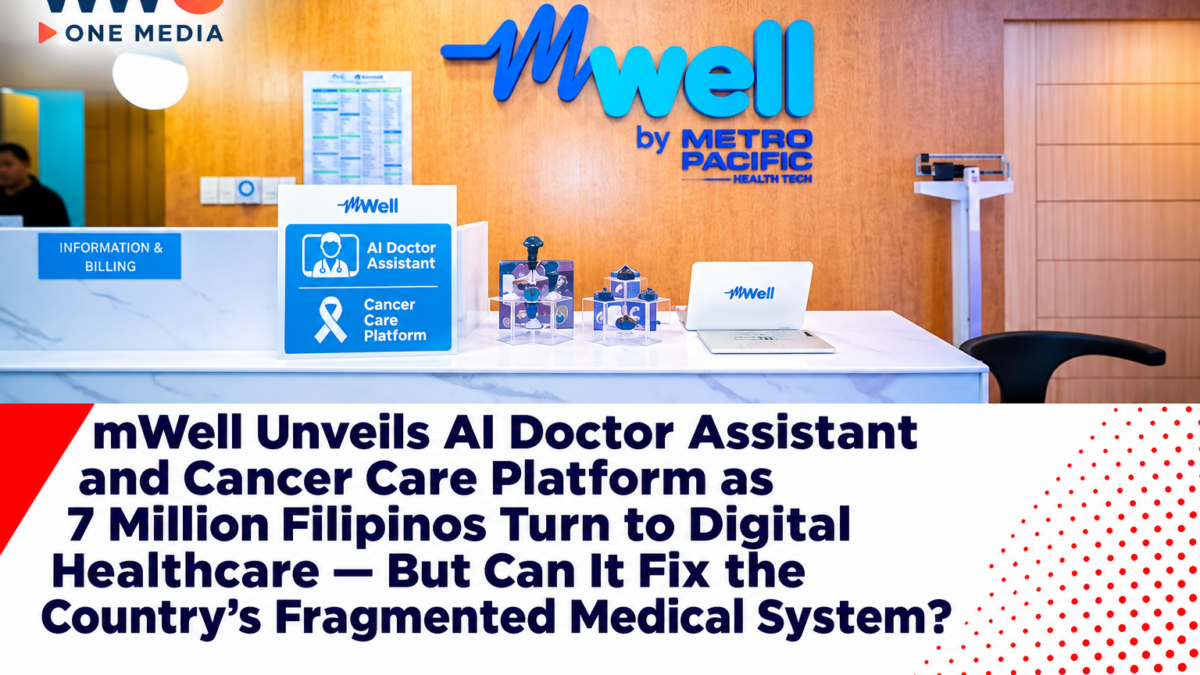
MANILA, PHILIPPINES — November 12, 2026 — Philippine healthcare could be entering a new phase of digital transformation as Metro Pacific Investments Corporation’s healthcare technology arm, mWell, introduces an artificial intelligence-powered ecosystem designed to connect patients, doctors, clinics and hospitals through integrated digital services.
Unveiled during the company’s mWell NEXT event on November 11, the expanded platform goes beyond conventional online medical consultations.
It introduces AI-assisted clinical documentation, interconnected medical records, hospital and clinic management systems, and a patient-support platform designed to help people navigate cancer treatment, chronic conditions and senior care.
The initiative includes three major solutions: mWellMD, mWell HealthSuite and HealthPal.
Together, they are intended to address a longstanding problem in Philippine healthcare: fragmented information, disconnected systems and repetitive administrative processes that can complicate treatment and waste valuable time.
The announcement comes as mWell continues expanding its digital health presence.
Related BusinessWorld reporting cited company executives saying the platform had an existing user base of more than 7 million, although that figure does not represent users of the newly showcased AI capabilities.
For patients, the potential benefits include more organized medical records and easier coordination among healthcare providers.
For doctors and hospitals, the technology could reduce paperwork and simplify certain administrative tasks.
But as artificial intelligence becomes more deeply integrated into Philippine medicine, can these systems improve access and efficiency without compromising patient privacy, medical accuracy or the human relationship between doctors and patients?
mWell NEXT Introduces a More Connected Healthcare System
According to InsiderPH, mWell presented its expanded healthcare ecosystem during the NEXT event on November 11.
The initiative reflects the company’s evolution from a primarily consumer-oriented telemedicine application into a broader technology platform serving medical professionals and healthcare institutions.
The company’s goal is to connect different stages of the patient journey.
A person might begin with an online consultation, proceed to laboratory testing, receive prescriptions, attend follow-up appointments and require treatment from different specialists.
In many healthcare settings, those steps involve separate record systems and repeated paperwork.
Patients may need to provide the same medical history multiple times.
Doctors may have limited access to earlier test results.
Hospital administrators may also struggle to coordinate scheduling, billing and clinical documentation.
mWell’s expanded platform seeks to reduce those gaps through digital records and integrated workflows.
The company describes the system as an interconnected healthcare ecosystem rather than a collection of separate apps.
However, the ability to connect participating systems does not mean every Philippine hospital or clinic is already integrated.
Actual benefits will depend on adoption, implementation and the willingness of different providers to exchange relevant information securely.
AI Doctor Assistant Helps Physicians Prepare Medical Records
One of the most important developments is the introduction of the mWellMD AI Doctor Assistant.
The system is designed to help physicians manage clinical documentation.
During consultations, it can transcribe conversations and prepare draft medical notes.
These may include SOAP documentation, a standard format used by healthcare professionals to organize patient information.
SOAP stands for Subjective, Objective, Assessment and Plan.
The format helps physicians document symptoms, observations, clinical assessments and intended treatment plans.
Preparing these records can take substantial time.
By generating a draft, the AI tool may reduce the amount of manual documentation required.
That could allow doctors to devote more attention to patient conversations and clinical work.
But there is an essential safeguard.
AI-generated documentation must be reviewed and approved by the attending physician.
mWell’s official terms make clear that the AI-assisted documentation feature is a productivity tool.
It does not independently diagnose patients, prescribe medication or exercise medical judgment.
Doctors remain responsible for the accuracy and appropriateness of information entered into official patient records.
The distinction is critical because automated systems can produce errors, omit information or misinterpret conversations.
Could AI Reduce the Time Doctors Spend on Paperwork?
Healthcare professionals frequently balance patient consultations with documentation, referrals, prescriptions and administrative tasks.
Digital systems can help organize these responsibilities.
For example, a physician using an integrated electronic medical records platform may be able to review previous consultations, update notes and prepare referrals without repeatedly entering the same information.
The potential advantage is continuity.
When medical information is properly recorded and made available to authorized professionals, patients may experience fewer administrative interruptions.
However, mWell has not published independently verified results from the November 11 demonstration establishing a specific percentage reduction in physician workload.
The platform should therefore be described as designed to improve efficiency, rather than proven to save a fixed number of hours or produce guaranteed medical outcomes.
Hospitals and clinics considering the technology will need to evaluate its performance under actual operating conditions.
Training, technical support, integration costs and patient consent will also influence its effectiveness.
HealthPal Introduces Digital Support for Cancer Patients
Another major feature is HealthPal, a patient-care organization tool built into the mWell application.
The platform is intended to help individuals managing serious or chronic conditions keep track of important healthcare information.
Its capabilities include medication reminders, appointment tracking, symptom logs, treatment-plan organization and coordination with caregivers.
For patients undergoing cancer treatment, HealthPal provides tools for following different stages of their care journey.
These can include screening, diagnosis, active treatment and long-term monitoring.
The system is designed to help patients understand where they are in the care process and what tasks or appointments require attention.
Users may also share selected information with family members, caregivers and healthcare professionals.
mWell says its cancer-care feature is the first of its kind among Philippine health applications to receive an official endorsement from the Philippine Cancer Society.
That endorsement concerns the patient-support feature.
It does not establish that HealthPal can diagnose cancer or determine an appropriate treatment independently.
Medical decisions must remain with qualified healthcare professionals.
Why Cancer Patients Need Better Care Coordination
Cancer treatment can involve multiple healthcare providers.
Patients may consult oncologists, surgeons, laboratory specialists, radiologists and other medical professionals over extended periods.
They may also need to organize prescriptions, appointments, test results and follow-up visits.
For patients and families, managing these details can become challenging.
A digital care organizer may help reduce confusion by keeping relevant information in one location.
This can be particularly useful when different relatives or caregivers share responsibility for supporting a patient.
However, a care-management application cannot guarantee improved survival, faster recovery or more effective treatment.
Those outcomes depend on clinical care, the patient’s condition and many other factors.
The role of HealthPal is organizational and supportive.
The platform is not a substitute for medical consultations, professional diagnosis or emergency treatment.
HealthPal Also Supports Chronic Illness and Senior Care
The benefits of coordinated records may extend beyond cancer treatment.
People managing chronic conditions often require repeated appointments, medication monitoring and ongoing communication with healthcare providers.
These needs can become more complicated when patients receive care from multiple clinics or specialists.
HealthPal allows users to record symptoms, medications and selected health measurements.
It also provides tools for coordinating information with authorized caregivers.
For older patients, such features may support family members helping organize appointments and treatment routines.
But the system’s usefulness depends on accurate and updated information.
Patient-entered records and wearable-device readings are not automatically equivalent to clinically validated measurements.
mWell also states that HealthPal does not generate independent diagnoses or personalized treatment recommendations.
The application should therefore support healthcare decisions made with qualified professionals rather than replace them.
mWell HealthSuite Connects Clinics and Hospitals
For healthcare institutions, mWell introduced a broader set of solutions under mWell HealthSuite.
The platform includes clinic management, hospital information systems, patient engagement and appointment-booking capabilities.
These services aim to help healthcare organizations digitize activities that may otherwise depend on paper forms or separate software systems.
At the NEXT event, mWell demonstrated how information could move through a clinic visit.
A patient’s record could be identified at registration and then used during consultations, laboratory requests, medication processing and billing.
The system is also designed to support different staff roles and permission levels.
This approach could reduce repeated data entry and help authorized healthcare professionals access the information relevant to their responsibilities.
But hospitals have complex operational requirements.
Successful deployment depends on compatibility with existing systems, staff training, cybersecurity safeguards and reliable technical infrastructure.
An integrated platform must also account for the different needs of small community clinics and large hospitals.
PhilHealth-Certified YAKAP Claims Processing Adds Another Advantage
One of mWell’s most practical institutional features concerns claims processing for PhilHealth’s Yaman ng Kalusugan Program, or YAKAP.
The program forms part of the Philippine government’s primary-care initiatives.
mWell HealthSuite includes a claims-management solution designed to help participating clinics document and submit the information required for YAKAP claims.
The company introduced a dedicated YAKAP Claims Platform in April 2026.
Its stated objective is to simplify documentation, reduce administrative errors and support clinics adapting to updated claims requirements.
Importantly, PhilHealth’s official electronic medical records registry lists mWell HealthSuite as a YAKAP-certified service provider, with certification dated December 16, 2025.
That confirms the platform’s certification status for the relevant system.
However, it does not mean every clinic using mWell automatically becomes PhilHealth-accredited.
Healthcare providers must still satisfy applicable accreditation, eligibility and program requirements.
Nor does certification guarantee that every claim submitted through the platform will be approved.
Digital Health Technology Meets the Philippines’ Universal Healthcare Challenge
The introduction of mWell’s integrated ecosystem comes as the Philippines continues working to strengthen its healthcare system.
Improved access to primary care, medical records and efficient healthcare administration remains important to the implementation of universal healthcare.
As WWC ONE MEDIA reported in its coverage of approximately ₱48 billion in Asian Development Bank financing for Philippine healthcare reforms, the country is pursuing changes involving health financing, service delivery and information systems.
That government financing is separate from mWell’s commercial platform.
But both developments address the broader challenge of improving healthcare accessibility and administrative effectiveness.
Better information systems can potentially support more coordinated care.
However, technology alone cannot resolve shortages of healthcare professionals, inadequate facilities or unequal access to medical services.
Digital transformation must be accompanied by investment in the underlying healthcare system.
PhilHealth’s Financing Pressure Makes Administrative Efficiency Important
Another challenge concerns the cost of healthcare.
PhilHealth has faced questions about the financing required to support its expanding programs and future claims.
As WWC ONE MEDIA examined in its report on PhilHealth’s proposed 2027 funding and projected claims requirements, the national insurer has sought additional government resources to meet anticipated obligations.
Digital claims processing may help healthcare providers improve documentation and reduce certain administrative burdens.
But operational efficiency should not be confused with solving PhilHealth’s overall funding requirements.
An electronic system cannot independently create additional insurance resources.
Its possible contribution is in improving how records, submissions and administrative workflows are managed.
This is especially important for smaller healthcare facilities that may have limited administrative staff.
Microsoft Research Shows Both the Promise and Limits of Medical AI
Artificial intelligence is attracting growing attention across healthcare.
Researchers are exploring whether AI systems can assist with medical reasoning, diagnostics, clinical documentation and treatment planning.
As WWC ONE MEDIA previously reported in its coverage of Microsoft’s experimental AI diagnostic technology, controlled research has produced promising results for certain complex diagnostic tasks.
However, experimental diagnostic systems and mWellMD serve different purposes.
Microsoft’s research examined diagnostic performance under specified testing conditions.
mWellMD’s newly showcased AI Doctor Assistant focuses on documentation and clinical workflow support.
The results of one technology cannot be used to claim that another has achieved the same diagnostic accuracy.
This distinction is especially important when discussing healthcare AI.
Tools should be assessed according to their intended functions, clinical validation and real-world performance.
Could AI Change Healthcare Employment?
The expansion of AI-powered administrative systems also raises questions about healthcare jobs.
Hospitals and clinics employ workers responsible for scheduling, billing, documentation, patient registration and other support tasks.
Automation may change how these responsibilities are performed.
Some tasks could become faster or require less manual input.
At the same time, healthcare institutions may need additional workers with skills in digital records management, cybersecurity and information-system support.
As WWC ONE MEDIA reported in its coverage of IHH Healthcare’s restructuring affecting approximately 380 employees across Singapore, Malaysia and Hong Kong, large healthcare organizations are reassessing certain business support operations while investing in more integrated systems.
The IHH restructuring is unrelated to mWell’s launch.
It does not establish that mWell will cause job losses at Philippine hospitals.
Nevertheless, it illustrates how administrative modernization can raise workforce questions.
For healthcare providers, the priority should be using technology to improve services while preparing employees for changing responsibilities.
Patient Privacy Could Become the Biggest Test
Healthcare records contain some of the most sensitive information organizations manage.
They may include diagnoses, prescriptions, laboratory results and personal information.
As more hospitals and clinics adopt digital systems, protecting those records becomes increasingly important.
Integrated platforms can improve information availability for authorized professionals.
But connecting systems also creates potential cybersecurity risks.
Unauthorized access, compromised accounts, configuration errors and improper sharing arrangements can expose patients to harm.
mWell states that its systems include privacy and security safeguards.
Its product terms also distinguish between identifiable patient data and information that may be anonymized for certain purposes.
However, compliance claims and security features do not guarantee that a system is immune to breaches.
Healthcare providers must maintain appropriate access controls, staff training, monitoring and incident-response procedures.
Patients should also understand what information is collected, who can access it and how sharing permissions can be managed.
Remote Communities Could Benefit From More Connected Healthcare
The Philippines’ geography creates additional challenges for healthcare delivery.
People living in remote islands and geographically isolated communities may need to travel substantial distances to access specialist consultations.
mWell has previously developed portable telemedicine clinics intended to extend healthcare access.
According to InsiderPH’s earlier reporting, the company deployed 179 mWell OnTheGo units and reported supporting nearly 891,000 people through associated initiatives.
These figures concern earlier outreach programs and should not be attributed directly to the November 11 AI launch.
They nevertheless illustrate how mWell has sought to connect digital services with community healthcare.
For remote patients, stronger record management and coordination could be valuable when care involves multiple locations.
However, connectivity, equipment availability and access to licensed health professionals remain essential.
A digital platform is only useful when patients and providers can reliably access and operate it.
Metro Pacific’s Broader Healthcare Strategy
mWell is part of Metro Pacific’s larger investment ecosystem.
Metro Pacific Investments Corporation has interests in infrastructure and healthcare-related businesses.
The group’s healthcare network includes institutions providing hospital and medical services.
Through mWell, the group is seeking to connect digital platforms with healthcare providers and patient services.
The strategy could support more consistent coordination between online consultations, clinics and hospital-based care.
However, integrating a digital platform across different institutions requires practical implementation agreements.
The announcement does not establish that every Metro Pacific-connected hospital has adopted every HealthSuite feature.
The company must demonstrate that its solutions work effectively across facilities with different operating systems, clinical needs and staffing structures.
Commercial adoption, patient satisfaction and healthcare outcomes will be important measures of progress.
What mWell Needs to Prove Next
The NEXT announcement demonstrates the range of technology mWell wants to offer.
But several questions remain important.
How many doctors and clinics will actively use mWellMD?
Will AI-assisted documentation meaningfully reduce administrative workloads?
Can HealthPal help patients organize complex treatment schedules without introducing confusion or privacy problems?
Will hospital information systems improve coordination while maintaining reliable data protection?
And how widely can these services reach communities that have historically had limited access to healthcare?
The available reports do not provide independently validated results answering all those questions.
Future adoption and performance data will be essential.
The Bottom Line: Philippine Healthcare Is Becoming More Connected
mWell’s November 11 announcement represents a significant expansion of its digital healthcare strategy.
The company is moving beyond telemedicine by introducing tools intended to connect doctors, clinics, hospitals and patients through shared digital workflows.
mWellMD provides AI-assisted clinical documentation under physician supervision.
HealthPal helps patients and caregivers organize chronic illness and cancer-care information.
HealthSuite supports clinic management, hospital systems and patient engagement, including PhilHealth-certified YAKAP claims processing.
Together, these tools could help address fragmentation in healthcare delivery.
But meaningful improvement will require reliable implementation, accurate medical records, strong privacy protections and continued involvement of licensed healthcare professionals.
Artificial intelligence may reduce administrative friction, but it cannot replace the clinical judgment, empathy and accountability essential to quality healthcare.
As mWell expands its AI-powered healthcare ecosystem across the Philippines, could connected records and smarter medical workflows finally make healthcare easier for millions of Filipinos—or will the challenges of cost, privacy and uneven access prevent the technology from delivering its full potential?