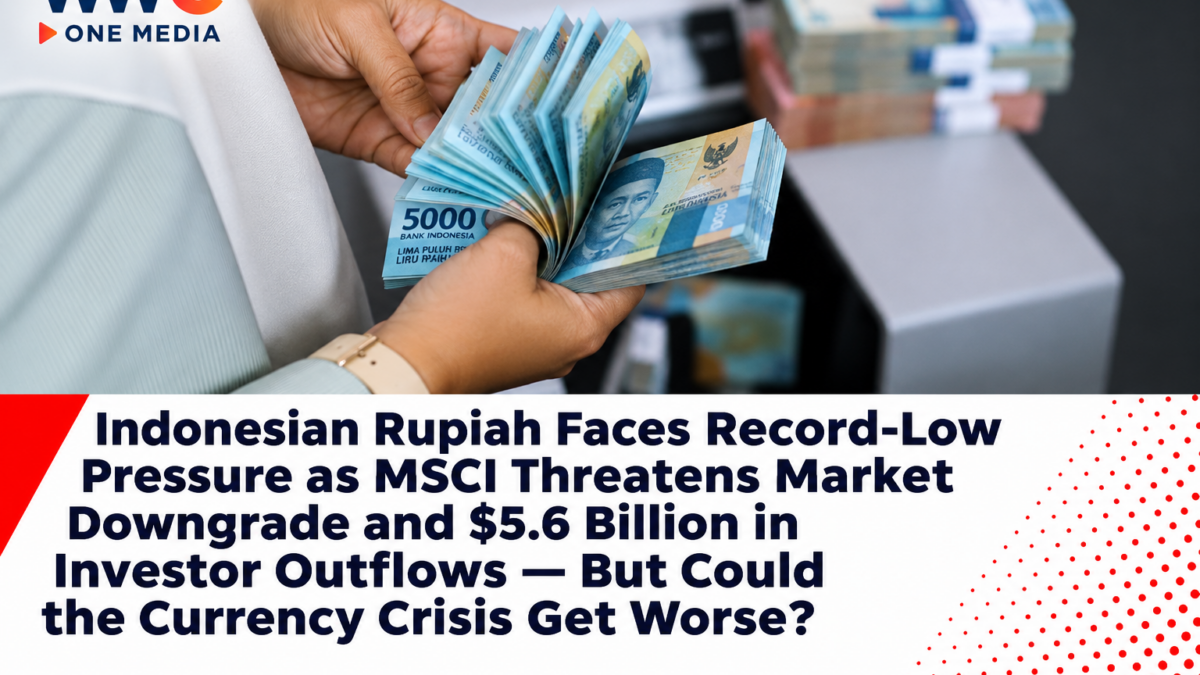
JAKARTA, INDONESIA / MANILA, PHILIPPINES — November 12, 2026 — Indonesia’s financial markets are facing another wave of turbulence as the rupiah comes under renewed pressure against the US dollar, with fears of a historic MSCI downgrade, global interest-rate uncertainty and volatile oil prices shaking investor confidence in Southeast Asia’s largest economy.
Bloomberg reported on November 12 that the Indonesian currency had fallen to a record low, adding to a difficult year for the country’s financial markets.
Independent reporting from the preceding trading session showed the rupiah closing at approximately 18,149 per US dollar on November 11, weakening 0.48% as investors responded to a stronger American currency and renewed concerns about Indonesia’s stock-market outlook.
The currency had previously reached a record low near 18,190 per dollar in June.
The precise new record cited in Bloomberg’s November 12 report could not be independently established from the accessible market quotations reviewed.
But the direction of pressure is clear.
Indonesia is confronting several threats simultaneously: uncertainty over its international stock-market classification, declining foreign investment in equities, renewed expectations of higher US interest rates and vulnerability to energy-price shocks.
The biggest concern is MSCI’s warning that Indonesia could lose its emerging-market classification and be moved to standalone-market status.
Such a decision could force index-tracking investment funds to sell Indonesian shares.
Goldman Sachs estimates that a complete removal could trigger approximately US$5.6 billion in passive investment outflows.
That is a potential future consequence, not an amount already withdrawn because of a finalized downgrade.
The central question is whether Indonesian authorities can restore investor confidence before currency weakness, capital outflows and higher financing costs reinforce one another.
Indonesian Rupiah Weakens as Investors Return to the US Dollar
The rupiah’s latest difficulties reflect broader pressure across Asian currency markets.
On November 11, the Indonesian currency weakened as stronger-than-expected US inflation data encouraged investors to anticipate additional Federal Reserve interest-rate increases.
Bloomberg Technoz reported that the rupiah closed around 18,145 per US dollar.
Separately, market data cited by Kontan placed the spot closing rate at 18,149.
The small difference reflects separate market-data and quotation conventions.
Both indicated a weakening currency.
The US dollar index also strengthened, making dollar-denominated assets more attractive to some international investors.
When American interest rates rise relative to rates elsewhere, investors may shift funds toward US securities offering higher yields.
That can reduce demand for emerging-market currencies.
Indonesia is particularly vulnerable when global capital becomes more cautious because foreign investors participate in its equity, bond and currency markets.
However, US monetary policy is only one influence.
Domestic investment confidence, trade flows, fiscal policy and commodity prices also affect the rupiah’s value.
MSCI Threatens Indonesia With an Extraordinary Downgrade
The most serious country-specific pressure comes from MSCI, one of the world’s leading providers of stock-market indexes.
In October, MSCI warned that it could move Indonesia from emerging-market classification to standalone-market status.
The proposal represents a much more severe outcome than the previously discussed possibility of a downgrade to frontier-market status.
MSCI raised concerns about concentrated share ownership, insufficient transparency and suspected coordinated trading activity.
These issues affect whether international investors can reliably buy and sell Indonesian shares.
For investment funds, market accessibility and transparent pricing are fundamental requirements.
A country can have large and profitable companies but still face index-eligibility problems if its stock market does not meet investability standards.
Indonesia has been part of MSCI’s emerging-market universe since 1989.
Losing that classification could significantly reduce its representation in international investment portfolios.
As WWC ONE MEDIA previously reported in its coverage of Indonesia’s stock-market collapse and MSCI’s downgrade threat, investors began reassessing exposure to Indonesian assets even before a final downgrade decision.
The outcome remains uncertain.
MSCI is expected to make its final classification decision no later than June 30, 2027.
Could $5.6 Billion Leave Indonesia’s Stock Market?
The potential financial consequences are substantial.
Goldman Sachs estimates that full removal from major MSCI emerging-market benchmarks could trigger approximately US$5.6 billion in passive fund outflows.
Passive funds typically track indexes according to established rules.
If Indonesian stocks lose eligibility, funds following those benchmarks may need to reduce or eliminate their holdings.
That can create selling pressure even when the operating performance of individual companies has not changed.
Active investment funds may also reconsider their exposure.
But their decisions are not necessarily automatic.
The amount of capital that ultimately leaves Indonesia would depend on MSCI’s final decision, fund mandates and investor responses.
Reuters reported that foreign investors had already withdrawn approximately US$5.4 billion from Indonesian equities during 2026.
Those earlier withdrawals reflect broader market activity.
They should not be added to the projected US$5.6 billion and described as an amount already lost because of a completed MSCI downgrade.
The risk is that further equity selling could weaken confidence in the rupiah and increase demand for foreign currency.
Indonesia’s Stock Market Has Fallen More Than 40%
The currency pressure comes after one of Indonesia’s most severe stock-market downturns in decades.
On October 16, the Jakarta Composite Index plunged approximately 11.6%.
It was the benchmark’s worst single-day decline since the 1998 Asian financial crisis.
Selling continued on October 19, when the index reached a six-year low.
The selloff followed MSCI’s warning about potential changes to Indonesia’s market classification.
As WWC ONE MEDIA documented in its report on Indonesia’s 43% stock-market decline during October, the losses reflected investor concerns extending beyond individual companies.
These included market transparency, governance, regulatory credibility and economic policy.
The market has experienced intermittent rebounds, but uncertainty has persisted.
By November 11, the Jakarta Composite closed at approximately 5,115.04 points, falling 0.21% during the session.
However, a stock-market decline of more than 40% does not mean Indonesia’s economy has contracted by the same amount.
Stock prices reflect changes in company valuations and investor expectations.
They are not equivalent to gross domestic product.
MSCI Removes Barito Pacific From a Major Index
The latest index review has added to the uncertainty.
Reuters reported that MSCI will remove Barito Pacific from its global standard index and move Bumi Resources Minerals into its small-cap index.
The changes are scheduled to take effect following the November 30 trading close.
Such changes can affect demand from funds required to replicate specific benchmarks.
They do not mean the companies are being removed from the Indonesian stock exchange.
Nor do they mean Indonesia has already lost its emerging-market classification.
The countrywide classification review remains a separate process.
The distinction matters because the immediate index adjustments and the potential 2027 downgrade have different consequences.
The November changes affect particular stocks and benchmark weights.
A downgrade to standalone status could affect Indonesia’s representation across major international equity benchmarks more broadly.
Why Investors Are Worried About Stock Ownership Transparency
MSCI’s concerns focus partly on whether publicly traded shares are sufficiently available to ordinary investors.
Some Indonesian companies have substantial blocks of shares controlled by a small number of shareholders.
When the genuinely available public float is limited, trading can become more volatile.
A relatively small amount of buying or selling may move prices significantly.
Opaque ownership structures can also make it difficult for investors to determine who controls a company.
MSCI has raised concerns about suspected coordinated trading and whether existing enforcement measures adequately address those risks.
The concerns do not establish that every Indonesian listed company has engaged in improper trading.
But they do create questions about market integrity.
International institutional investors generally require confidence in shareholder disclosures, liquidity and regulatory enforcement.
For Indonesia, demonstrating improvements in those areas will be essential to maintaining investor confidence.
Regulators Introduce Reforms After the Market Rout
Indonesian financial authorities have announced measures intended to address the concerns.
The Indonesia Stock Exchange has changed index-screening rules involving highly concentrated share ownership.
Regulators have also proposed stronger public-float requirements and tighter shareholder disclosures.
Authorities have imposed sanctions in cases involving alleged market manipulation.
After the October selloff, the exchange temporarily reduced its daily share-price decline limit from 15% to 7%.
These measures were intended to stabilize markets and improve oversight.
However, restricting daily price movements does not eliminate the underlying reasons investors are selling.
MSCI has emphasized the need for meaningful, demonstrable improvements rather than regulatory promises alone.
The question is whether Indonesia can establish a record of enforcement strong enough to satisfy international investors before the June 2027 classification decision.
President Prabowo Faces a Major Confidence Test
The financial turmoil has become a political challenge for President Prabowo Subianto.
His administration has promoted infrastructure investment, industrial development and policies intended to support economic growth.
But maintaining investor confidence is essential to financing those ambitions.
The MSCI warning has exposed concerns about whether Indonesia’s capital markets meet international standards for transparency and governance.
As WWC ONE MEDIA reported in its coverage of Prabowo’s criticism of the MSCI downgrade threat, the president has defended Indonesia’s economic prospects while authorities work to address market concerns.
The government argues that the country remains attractive because of its large domestic market, natural resources and industrial potential.
Those advantages remain important.
But restoring international investment confidence will require effective regulatory action and predictable economic policy.
Political statements alone cannot resolve concerns about share ownership or trading practices.
Rising US Interest Rates Add Pressure to the Rupiah
Indonesia’s currency is also exposed to developments in American monetary policy.
October’s US consumer-price report showed monthly inflation of 0.4%, above the 0.3% economists had expected.
The result increased expectations of further Federal Reserve tightening.
Higher US Treasury yields can encourage investors to hold dollar-denominated assets.
For emerging markets, the resulting capital movements can create depreciation pressure.
A weaker rupiah can increase the local-currency value of foreign-currency debt.
It can also make imported goods and services more expensive.
The relationship is not mechanical, however.
Emerging-market currencies can sometimes strengthen despite higher US rates if local economic conditions or capital flows are favorable.
For Indonesia, the combination of a strong dollar and domestic market uncertainty is particularly difficult.
Oil Prices Create Another Major Economic Risk
Oil prices represent an additional challenge.
Indonesia is a major energy producer, but it also imports substantial quantities of crude oil and refined petroleum products.
That means rising international oil prices can increase the cost of fuel imports.
Higher energy costs can affect the country’s trade balance, inflation and government finances.
Fuel subsidies and compensation arrangements may also become more expensive when imported energy prices increase.
The latest oil-market volatility has been driven partly by uncertainty surrounding the conflict involving the United States and Iran.
Disruption to shipping through the Strait of Hormuz could push crude prices higher again.
But recent price declines have offered some relief.
Bloomberg Technoz reported Brent crude near US$91.85 per barrel on November 11.
Lower prices can ease near-term import costs.
However, oil-market conditions remain volatile, and cheaper crude does not guarantee an immediate improvement in Indonesia’s financial position.
The key issue is whether energy prices stabilize at levels that support trade and fiscal management.
Bank Indonesia Faces a Difficult Policy Balance
Bank Indonesia is responsible for maintaining monetary stability and supporting orderly currency-market conditions.
The central bank can use foreign-exchange operations and other policy instruments to address excessive volatility.
It must also consider domestic inflation, growth and financial-system conditions.
That creates a difficult balancing act.
A more restrictive monetary stance may help support the rupiah, but it can also raise borrowing costs for businesses and consumers.
An accommodative policy may support economic activity while increasing vulnerability to currency weakness when global interest rates remain high.
Bank Indonesia has emphasized its presence in the foreign-exchange market to maintain orderly trading.
However, central bank intervention cannot guarantee a particular exchange rate indefinitely.
The currency’s longer-term performance will also depend on investor confidence, economic policy, trade flows and global financial conditions.
Indonesia Turns to Chinese Bonds Amid the Market Crisis
The government is also exploring ways to diversify its borrowing sources.
Indonesia has been marketing another yuan-denominated panda-bond offering in China’s domestic debt market.
Earlier official guidance suggested a transaction of approximately 7 billion to 10 billion yuan, equivalent to around US$1 billion to US$1.5 billion.
As WWC ONE MEDIA reported in its coverage of Indonesia’s second panda-bond initiative, the government is seeking additional financing even as global equity investors reconsider their exposure.
Panda bonds may provide access to a different group of investors.
But borrowing in yuan creates currency exposure that must be managed.
A weaker rupiah against the Chinese currency would increase the domestic-currency cost of servicing unhedged yuan obligations.
The bond initiative therefore represents a financing opportunity, not a direct solution to stock-market transparency concerns.
Could Indonesia Experience Another Capital Flight?
Investors are increasingly focused on whether pressure in the stock market could spread more widely.
One possible risk is a negative feedback loop.
Foreign investors sell Indonesian shares.
The resulting capital flows place additional pressure on the rupiah.
Currency depreciation increases the local-currency cost of some foreign obligations and imports.
Higher financing costs then make investors more cautious about Indonesian assets.
Such a sequence could weaken confidence further.
However, this is a risk scenario rather than proof that Indonesia is experiencing an uncontrollable currency crisis.
Indonesia has a much larger and more diversified economy than it did during the Asian financial crisis of the late 1990s.
Its financial institutions, regulations and macroeconomic frameworks have also changed.
The current challenge should therefore be evaluated through contemporary market data rather than treated as an automatic repeat of 1998.
What the Rupiah’s Decline Means for ASEAN and the Philippines
The rupiah’s weakness matters beyond Indonesia because the country is Southeast Asia’s largest economy.
International investors frequently assess ASEAN markets together when making regional portfolio decisions.
A loss of confidence in Indonesia could influence sentiment toward neighboring stock markets and currencies.
However, the effects are not uniform.
The Philippine peso has also experienced weakness against the dollar during 2026, but its performance reflects its own economic conditions as well as global financial pressures.
A weaker rupiah does not automatically cause a weaker peso.
For Philippine businesses, the impact depends on trade exposure, competitive conditions, supply chains and currency movements.
Some exporters may face changing competitive dynamics.
Importers purchasing goods from Indonesia may experience price changes, although actual costs also depend on contracts and exchange-rate adjustments.
The wider lesson is that investor confidence in one major ASEAN economy can affect perceptions of regional risk.
Can Indonesia Avoid Losing Emerging-Market Status?
Indonesia still has time to address MSCI’s concerns.
The final classification decision is expected by June 30, 2027.
Until then, investors will monitor whether regulatory reforms produce measurable improvements.
The most important areas include transparent beneficial ownership, adequate public floats, reliable pricing and effective enforcement against manipulation.
Authorities must also demonstrate that market rules are applied consistently.
If reforms satisfy MSCI and international investors, Indonesia could preserve its emerging-market status.
If concerns remain unresolved, the country could face a downgrade that would significantly affect index-tracking investment flows.
The decision will not depend solely on daily share prices or the exchange rate.
It will depend on MSCI’s assessment of the market’s structural accessibility and integrity.
What Happens Next for the Rupiah?
Several developments will influence the currency’s direction.
The first is the response to MSCI’s latest index changes.
The second is whether foreign equity outflows accelerate or begin to stabilize.
The third is the direction of US interest rates and the dollar.
The fourth is whether international oil prices remain relatively contained or rise again.
The fifth is how effectively Bank Indonesia and other financial authorities maintain orderly markets.
Investors will also evaluate domestic political developments and Indonesia’s broader economic policy.
A stabilization in any one of these areas could improve sentiment.
But a lasting recovery may require progress across several of them.
The Bottom Line: Indonesia’s Currency Pressure Is a Test of Investor Trust
The Indonesian rupiah’s renewed weakness reflects more than a stronger US dollar.
It is occurring during a difficult period for the country’s stock market, with billions of dollars in foreign equity withdrawals and the possibility of a historic MSCI downgrade.
The latest index changes have reinforced concerns about shareholder transparency, market governance and the long-term attractiveness of Indonesian securities.
At the same time, Federal Reserve policy and oil-price volatility are creating external pressures that Jakarta cannot fully control.
Indonesia has announced reforms, and Bank Indonesia remains focused on orderly currency markets.
But the country’s recovery will depend on whether international investors see credible evidence of improvement.
The rupiah’s exchange rate is the most visible symptom of today’s uncertainty. The more fundamental issue is whether Indonesia can rebuild confidence in its financial markets before additional foreign capital leaves.
As the rupiah faces record-low pressure and MSCI’s June 2027 deadline approaches, can Indonesia protect its emerging-market status and restore investor trust—or will continued capital outflows push Southeast Asia’s largest economy into a deeper financial-market crisis?