KUALA LUMPUR, MALAYSIA — November 12, 2026 | WWC ONE MEDIA | ASEAN Business, Aviation, Financial Markets and Tourism
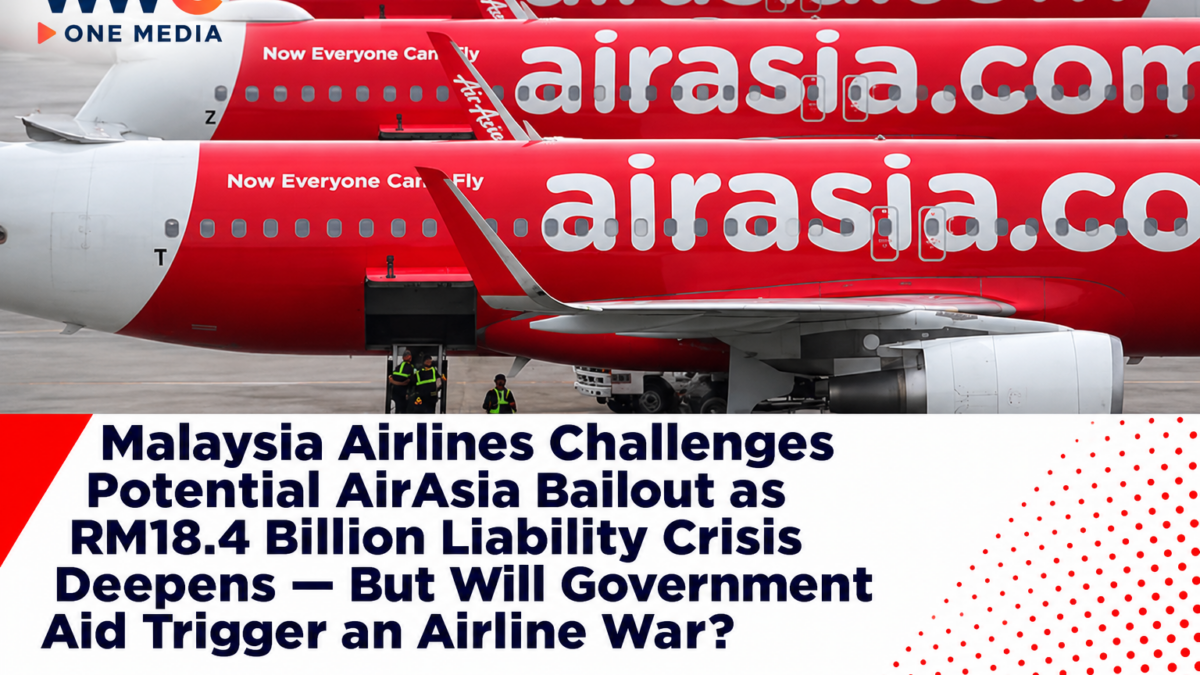
Malaysia’s aviation industry is facing a potentially explosive confrontation over government financial assistance as Malaysia Airlines calls for fair competitive treatment if struggling budget carrier AirAsia receives state support.
The dispute places Prime Minister Anwar Ibrahim’s administration in a difficult position: protecting one of Southeast Asia’s most important low-cost airline networks without giving one carrier an unfair financial advantage over its competitors.
According to a November 12 Bloomberg report, Malaysia Airlines is pushing for a level playing field as speculation continues over possible government assistance for AirAsia, whose finances have come under pressure from soaring jet fuel prices, heavy liabilities and refinancing requirements.
The latest development adds a new dimension to Malaysia’s aviation debate.
What began as a question about whether AirAsia needs financial assistance has become a much broader issue involving competition, taxpayers, aviation connectivity and the government’s responsibility to ensure fair treatment across the industry.
AirAsia reported a second-quarter net loss of approximately RM831 million and held RM18.4 billion in current liabilities at the end of June 2026.
Yet the airline remains critically important to Malaysia’s transportation network, accounting for almost 60% of domestic passenger traffic.
Any serious disruption could affect millions of travelers, thousands of workers and businesses dependent on affordable air connectivity.
As previously reported by WWC ONE MEDIA in its coverage of Malaysia’s contingency discussions with rival airlines, authorities have already explored whether Malaysia Airlines and Batik Air could absorb parts of AirAsia’s domestic operations if its financial difficulties worsen.
Those discussions were contingency planning, not an announced takeover.
Now, Malaysia Airlines’ reported call for equal treatment raises another question: if the government ultimately intervenes, should competing airlines receive comparable opportunities for assistance?
Malaysia Airlines Wants Fair Competition if AirAsia Receives Government Help
Malaysia Airlines’ position highlights the complicated economics of government intervention in the airline industry.
Financial assistance can take several forms, including direct capital injections, government-backed loans, guarantees, preferential financing or relief from certain operating costs.
Each mechanism can affect competition differently.
A government guarantee, for example, may allow an airline to borrow money on more favorable terms than it could obtain independently.
That can reduce financing costs and help the beneficiary maintain routes, preserve aircraft capacity or invest in operations.
Competitors receiving no comparable support could argue that the arrangement changes the competitive environment.
Malaysia Airlines’ reported demand for a level playing field therefore concerns more than whether AirAsia receives public money.
It raises the issue of whether any assistance would be structured transparently, made available under consistent criteria and designed to protect essential air services rather than unfairly favor a particular company.
Importantly, fair treatment does not necessarily require identical financial packages.
Airlines have different business models, financing needs and commercial obligations.
Malaysia Airlines operates as a full-service carrier, while AirAsia has built its business around low-cost travel.
A fair policy could involve consistent eligibility rules, proportionate assistance and safeguards against anti-competitive advantages.
The government’s challenge is to determine whether intervention is necessary and, if so, how to deliver it without unnecessarily distorting Malaysia’s aviation market.
AirAsia’s RM18.4 Billion Liability Burden Intensifies Financial Pressure
The debate has intensified because of AirAsia’s financial position.
According to Reuters, the low-cost airline reported current liabilities of approximately RM18.4 billion as of June 30, 2026, compared with cash and bank balances of approximately RM954 million.
Current liabilities represent obligations generally expected to be settled within one year or the normal operating cycle.
They are not necessarily all payable immediately, and the figure should not be confused with a single overdue debt.
Nevertheless, the size of the liabilities relative to available cash illustrates why refinancing and operating cash flow are important to the company.
AirAsia also posted a second-quarter loss of approximately RM831 million, including substantial foreign-exchange losses.
The result reflected intense pressure from higher operating expenses, particularly aviation fuel.
As examined in WWC ONE MEDIA’s report on AirAsia’s RM18.4 billion liability burden and bailout debate, financial stress has prompted questions over whether the Malaysian government should consider conditional support.
However, the financial figures do not prove that AirAsia is insolvent or preparing to cease operations.
The company continues to operate and has maintained that it can manage its financial challenges through refinancing, cost reductions and operational adjustments.
Jet Fuel Prices Surge 66% as Middle East Conflict Hits Airlines
A major factor behind AirAsia’s financial difficulties has been the sharp increase in aviation fuel costs.
Reuters reported that the carrier’s average jet fuel price reached approximately US$183 per barrel during the second quarter of 2026, a 66% increase from the previous quarter.
The surge followed geopolitical disruptions and conflict involving Iran, which pushed energy prices higher and affected the global aviation sector.
Fuel is among the largest operating expenses for airlines.
When prices rise sharply, carriers must absorb higher costs, increase ticket prices, reduce capacity or find efficiencies elsewhere.
Budget airlines can be particularly sensitive to such changes because their business models emphasize competitive fares and high aircraft utilization.
AirAsia has also faced criticism over its exposure to fuel-price volatility because it did not have hedging arrangements protecting it against the reported spike.
However, rising fuel costs have affected airlines throughout the industry, not just AirAsia.
Malaysia Airlines and other carriers must also manage energy expenses, supply-chain disruptions, currency movements and changing travel demand.
That shared exposure strengthens the argument for industry-wide policy measures rather than assistance designed exclusively around one airline’s balance sheet.
In an earlier analysis, WWC ONE MEDIA examined how soaring fuel prices pressured AirAsia while Tony Fernandes defended the airline’s financial resilience.
The continuing debate demonstrates how geopolitical shocks can quickly become domestic financial and political challenges.
Tony Fernandes Rejects Bailout Claims Despite Funding Discussions
AirAsia co-founder Tony Fernandes has repeatedly rejected suggestions that the airline requires a conventional government rescue.
Reuters reported that Fernandes met officials from Malaysia’s finance ministry in late September.
People familiar with the discussions said possible government backing for AirAsia’s fundraising efforts was among the matters being considered.
Fernandes disputed that characterization, saying his discussions focused on aviation costs, including airport charges and fuel.
He also insisted that the company could navigate the challenging operating environment without state financial assistance.
Nevertheless, he has indicated that AirAsia would not automatically reject help if it were offered.
The distinction is significant.
An airline may insist that it does not need a bailout while still seeking regulatory relief, favorable financing arrangements or assistance in obtaining commercial loans.
These options are not financially equivalent.
A government cash injection directly uses public funds, while a loan guarantee primarily exposes the government to potential future losses if the borrower defaults.
Temporary reductions in airport charges could also affect airport operators and the wider aviation industry.
The precise mechanism would determine who benefits, who bears the financial risks and how competition is affected.
For now, an approved government assistance package has not been established by the verified public statements reviewed for this report.
Anwar Ibrahim’s Government Has Not Approved an AirAsia Bailout
Malaysia’s government has previously sought to clarify speculation about the airline’s financing.
In an October 19 parliamentary response, the Finance Ministry said no agreement or commitment had been made to provide financial support to AirAsia.
The clarification covered potential government guarantees, loans and injections of public money.
The ministry also emphasized that any request for assistance would be evaluated according to national interest, fiscal sustainability and protection of public funds.
Those conditions suggest that government support, if eventually considered, would need to satisfy broader economic and financial criteria.
The issue is especially sensitive because AirAsia is not an ordinary small business facing temporary difficulties.
It operates an extensive domestic and international aviation network and supports thousands of jobs.
But its importance does not automatically mean taxpayers should absorb its financial risks.
The government must consider whether support would preserve services that are difficult to replace, whether the airline has a credible recovery plan and whether private investors and creditors should absorb losses before public money is placed at risk.
Malaysia Airlines’ reported demand for equal treatment adds another consideration.
Even carefully structured assistance could face criticism if competing airlines believe the government is selecting winners and losers.
AirAsia Controls Nearly 60% of Malaysia’s Domestic Aviation Market
AirAsia’s size explains why authorities are paying close attention to its financial health.
According to Malaysia’s Finance Ministry, AirAsia accounted for approximately 41% of the 104.5 million passenger movements recorded at airports operated by Malaysia Airports Holdings in 2025.
Its share of domestic passenger movements was close to 60%.
The airline is particularly important for travel between Peninsular Malaysia and the eastern states of Sabah and Sarawak.
Government figures showed that AirAsia carried approximately 62% of passengers in Sabah and 70% in Sarawak during 2025, using the ministry’s reported coverage definitions.
At certain airports, its share was even higher.
In Sibu and Bintulu, AirAsia accounted for approximately 79% and 77% of passenger movements, respectively.
Such figures illustrate why a serious contraction in AirAsia’s operations could have consequences beyond airline shareholders.
Reduced flight availability could affect tourism businesses, workers, students, families and companies depending on domestic travel.
Other airlines might eventually expand to replace some capacity, but doing so would require additional aircraft, crews, airport slots and commercial planning.
That process would not necessarily happen immediately.
Malaysia therefore faces a difficult policy choice: allowing market forces to determine which airlines survive while ensuring that essential connections are protected.
Government Previously Consulted Malaysia Airlines and Batik Air
The reported disagreement over financial assistance comes after Malaysian authorities explored contingency plans involving rival carriers.
Reuters reported in September that government officials had asked Malaysia Airlines and Batik Air whether they could absorb AirAsia’s domestic routes and passengers if necessary.
The discussions involved officials and industry participants as authorities monitored AirAsia’s financial situation.
According to people familiar with those talks, the two rival carriers indicated that large-scale replacement of AirAsia’s operations would be difficult without access to its aircraft leases.
Both were described as more interested in expanding organically than taking over the entire business.
The distinction matters.
Taking over routes is not the same as acquiring an airline.
And preparing for a possible disruption does not mean authorities have concluded that AirAsia will fail.
Fernandes strongly criticized reports suggesting rivals were being positioned to replace AirAsia.
He argued that the carrier’s aircraft, employees, route network and low-cost operating structure could not simply be replicated overnight.
For a more detailed examination of that potential disruption, WWC ONE MEDIA previously reported on AirAsia’s transformation from a RM1 acquisition into a major budget airline and Malaysia’s contingency planning.
The latest development shifts the discussion toward the conditions under which government intervention could affect competition between those same carriers.
AirAsia Seeks Up to US$1 Billion in International Financing
AirAsia has been pursuing substantial refinancing to strengthen its financial position.
Reuters reported that the airline was seeking up to US$1 billion from international debt markets, alongside approximately RM700 million in local credit facilities.
These financing efforts were primarily intended to restructure existing obligations.
Refinancing differs from raising entirely new equity capital.
A refinancing transaction can extend repayment schedules, replace expensive debt or improve liquidity management without necessarily reducing the total amount borrowed.
Its success depends on factors including lender confidence, interest rates, collateral requirements and the airline’s future cash-generating ability.
AirAsia has also taken steps to reduce costs.
Reported measures include cutting underperforming routes, returning older aircraft to lessors and renegotiating supplier arrangements.
These changes could improve financial performance if fuel prices moderate and passenger demand remains resilient.
However, restructuring can also involve trade-offs, including reduced route frequency or capacity.
The airline must therefore balance cost reductions against the need to maintain its competitive network.
Meanwhile, the possibility of government-supported financing introduces another question: whether such assistance would be available to other carriers facing similar challenges.
Why Malaysia Airlines’ Fairness Demand Matters for Taxpayers
The debate over government assistance is not simply a corporate dispute.
It concerns the allocation of public financial risks.
A poorly designed rescue package could encourage companies to assume that governments will absorb losses when commercial strategies fail.
Economists refer to this problem as moral hazard.
If creditors and shareholders expect repeated public intervention, they may have less incentive to price risks appropriately.
At the same time, refusing all government intervention could create wider economic costs if an essential transportation network experiences major disruption.
The key is to distinguish between protecting the public interest and protecting every existing shareholder or creditor.
A carefully structured assistance program could require commercial interest rates, transparent financial reporting, credible restructuring plans and restrictions on distributions to shareholders.
Other safeguards could include time limits, performance conditions and mechanisms to recover public funds.
Policymakers would also need to assess whether competing airlines should qualify for comparable support under similar circumstances.
The objective should be to preserve competition and essential services rather than guarantee the profitability of any single carrier.
Malaysia’s aviation industry has experience with major government-backed restructuring.
Malaysia Airlines itself underwent an extensive restructuring and privatization exercise in 2014, supported by approximately RM6 billion through Khazanah Nasional.
That history gives the present debate an additional dimension.
The question is not whether Malaysia has previously supported strategically important aviation businesses.
It is whether another intervention can be structured in a way that is transparent, financially responsible and competitively fair.
Could Malaysia’s Airline Dispute Affect Philippine and ASEAN Travelers?
The implications extend beyond Malaysia.
AirAsia operates across Southeast Asia, including markets such as Thailand, Indonesia and the Philippines.
The group plays an important role in connecting regional destinations through relatively affordable fares.
Its financial restructuring could therefore attract attention from airport operators, travel businesses and competitors throughout ASEAN.
However, the reported financing discussions do not establish that AirAsia’s Philippine operations have stopped functioning or that flights will be canceled.
Passengers should not interpret speculation about government financial support as confirmation of an operational shutdown.
The more immediate concern is whether prolonged fuel-price pressure could lead airlines to adjust fares, routes and capacity.
If several carriers face similar cost pressures, regional travelers could experience higher ticket prices or reduced competition on selected routes.
Conversely, successful restructuring could allow AirAsia to maintain its network and preserve its role in regional low-cost aviation.
For Philippine travelers, the practical priority remains monitoring official airline announcements and their own booking status rather than assuming that a potential Malaysian government support package will affect existing flights.
What Happens Next? Three Questions Could Decide Malaysia’s Aviation Future
The dispute now centers on three major uncertainties.
First: Will Malaysia provide financial support to AirAsia?
The government previously stated that no assistance package had been approved. A new decision would require clear disclosure of the financing mechanism, conditions and potential public exposure.
Second: Would competing carriers receive comparable treatment?
Malaysia Airlines’ reported position increases pressure on policymakers to explain how assistance would affect competition and whether other airlines could qualify under similar circumstances.
Third: Can AirAsia complete its refinancing without relying on a government rescue?
The airline continues to defend its resilience and has outlined substantial financing and restructuring plans. Successful private-market funding could reduce the need for direct intervention.
These questions are interconnected.
Government decisions could influence investor confidence, while the airline’s ability to secure financing may determine how much assistance, if any, becomes necessary.
The outcome could also shape how Malaysia approaches future financial difficulties involving strategically important companies.
The Bigger Picture: Malaysia Must Choose Between Rescue and Fair Competition
Malaysia’s aviation sector is confronting a difficult combination of rising costs, financial pressure and uncertainty over public support.
AirAsia’s substantial domestic market share makes it important to the country’s economy and transportation system.
Malaysia Airlines’ call for a level playing field illustrates the risks of helping one major company without considering the competitive consequences.
For Anwar Ibrahim’s government, the objective will be to protect passengers, jobs, connectivity and public finances while maintaining confidence in Malaysia’s aviation market.
That balance will not be easy.
A bailout that appears too generous could provoke criticism from taxpayers and rival airlines.
A refusal to intervene under all circumstances could create risks if AirAsia’s financial condition deteriorates significantly.
And a financing arrangement with poorly defined conditions could leave the government exposed to future losses.
For now, the confirmed picture remains narrower than some of the speculation surrounding the dispute: AirAsia is under financial pressure, the government has previously said no bailout is approved, and Malaysia Airlines is seeking fair treatment if assistance is eventually provided.
Malaysia now faces a decision that could redefine the relationship between the government and the country’s major airlines.
But if AirAsia receives financial backing while its rivals are left to compete without equivalent support, could the effort to save one airline ignite a much bigger battle across Southeast Asia’s aviation industry?