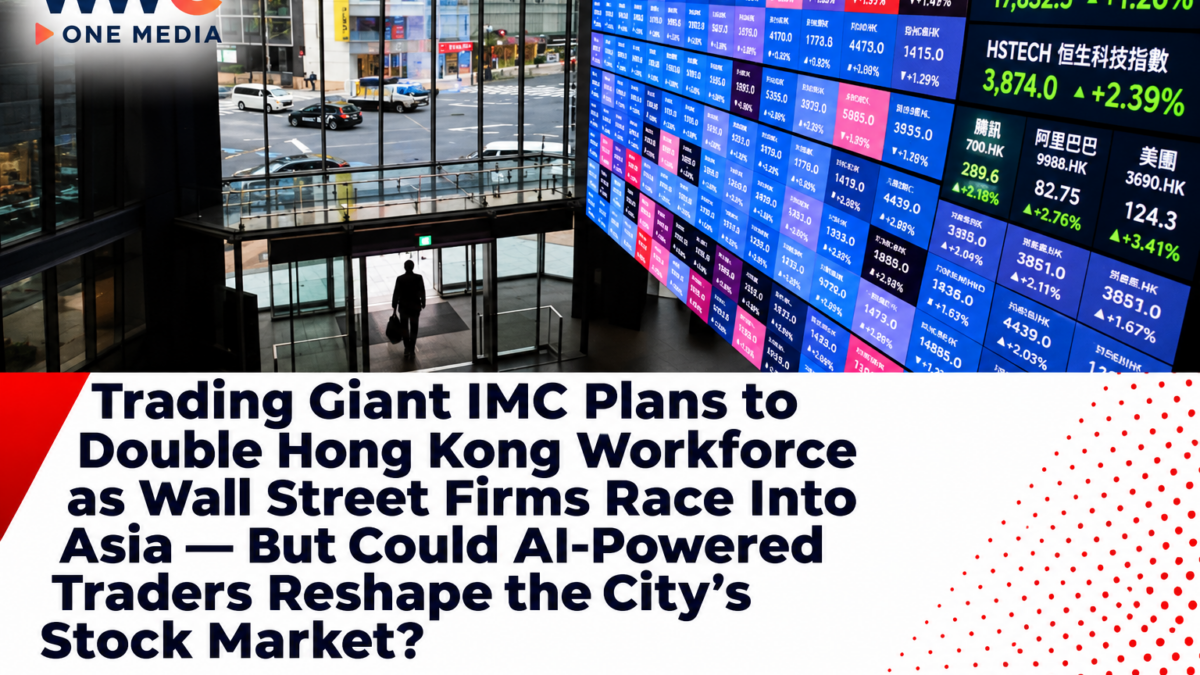
HONG KONG / MANILA, Philippines — November 12, 2026 — Hong Kong’s financial industry is attracting another wave of international investment as Amsterdam-based quantitative trading giant IMC reportedly plans to double its local workforce, intensifying competition among some of the world’s most technologically advanced trading firms.
The expansion, reported by Bloomberg on November 12, comes as high-frequency trading companies, electronic market makers and quantitative investment firms increase their presence across Asian financial markets.
IMC’s move adds to a growing list of international trading businesses investing in Hong Kong, including Citadel Securities, Jump Trading, Jane Street and Qube Research & Technologies.
For the city, the developments represent an important vote of confidence in its position as a major Asian financial center despite ongoing uncertainty surrounding China’s economy, market volatility and competition from Singapore.
But the implications extend well beyond new offices and high-paying finance jobs.
Quantitative trading firms increasingly rely on advanced mathematics, machine learning, artificial intelligence and powerful computing systems to execute complex transactions across global markets.
Their expansion could strengthen market liquidity, deepen Hong Kong’s trading infrastructure and create demand for highly specialized technology workers.
The bigger question is whether Hong Kong is entering a new golden age of algorithmic trading—or whether intensifying competition among financial technology giants could create new risks for investors.
IMC Plans to Double Its Hong Kong Trading Team
Bloomberg reported on November 12 that IMC intends to double its workforce in Hong Kong.
The proposed expansion reflects the firm’s ambition to strengthen its presence in Asian financial markets.
IMC is a global proprietary trading and market-making company that uses its own capital, technology and mathematical models to trade financial instruments.
Unlike traditional asset managers, which primarily invest money on behalf of clients, proprietary trading firms use their own capital to pursue trading opportunities.
Market makers also help facilitate transactions by quoting prices at which they are willing to buy or sell securities.
IMC operates across equities, derivatives, exchange-traded funds and other financial products.
Its approach combines quantitative research, advanced engineering and automated execution technology.
The firm’s Hong Kong office plays an increasingly important role in developing trading strategies for Asia-Pacific markets.
However, the precise number of employees covered by the planned doubling has not been independently verified.
The expansion should therefore be described as a reported workforce target rather than an already completed hiring increase.
IMC Already Expanded Its Hong Kong Office in 2025
The latest development builds on an earlier investment.
On October 28, 2025, IMC officially announced the expansion of its Hong Kong office in Central.
The company said it intended to grow its local team, strengthen its participation in Hong Kong’s financial markets and expand its regional operations.
The office has subsequently become an important center for quantitative research and technology development.
IMC says its Hong Kong researchers work on models supporting trading across equities, futures, options and exchange-traded funds.
The company’s research infrastructure also supports the development of machine-learning systems and more sophisticated trading strategies.
Its expansion is therefore not simply about adding more traders to existing desks.
It also involves recruiting engineers and researchers capable of developing the technology behind modern electronic trading.
IMC’s Global Revenue Surged 40% to $3.12 Billion
The reported Hong Kong expansion follows a period of rapid growth for IMC.
According to eFinancialCareers, citing the firm’s 2025 annual report, IMC’s revenue increased approximately 40% to US$3.12 billion in 2025.
The company recruited more than 450 people during the year, bringing its global workforce to approximately 1,900.
The hiring activity reflected expansion across several financial centers, including London, New York and Hong Kong.
IMC also continued investing in engineering, compliance, risk management and quantitative research.
The figures demonstrate the substantial resources available to leading electronic trading firms.
However, the US$3.12-billion figure represents global revenue for 2025.
It should not be confused with profit, Hong Kong revenue or expected earnings from the latest expansion.
Similarly, the firm’s global workforce cannot be used to calculate its current Hong Kong headcount.
Hong Kong Is Becoming a Major Hub for Quantitative Trading
IMC’s planned hiring increase comes amid a broader wave of investment by quantitative trading firms.
These businesses use mathematical models and technology to identify trading opportunities, manage risk and execute transactions at high speed.
Some strategies seek to capture very small price differences across markets.
Others provide liquidity by quoting continuous buying and selling prices.
Their operations may involve powerful computing infrastructure and connections to exchanges designed to reduce communication delays.
Hong Kong provides access to an extensive ecosystem of financial institutions and trading venues.
Its position as a gateway between mainland China and international investors also makes it attractive for firms seeking exposure to Asian markets.
For IMC, the city offers opportunities to develop strategies covering mainland Chinese securities, regional equities, derivatives and other products.
But its competitors are expanding too.
That creates an increasingly competitive environment for trading opportunities, technology infrastructure and specialist employees.
Citadel Securities Expands Hong Kong Office Space by 40%
One of the clearest examples of the trend is Citadel Securities.
Bloomberg reported on November 9 that the American market maker is expanding its Hong Kong office space by approximately 40%.
The company is adding half a floor at Two International Finance Centre.
Citadel Securities Chief Executive Officer Peng Zhao said Asia had become the firm’s second-largest revenue contributor outside the United States.
The company added nearly 100 employees across Asia during 2026, increasing its regional workforce to approximately 400.
Almost half of those new hires were based in Hong Kong.
Other employees joined operations in Singapore, Sydney and Tokyo.
The expansion reflects growing demand for trading services outside the United States.
Citadel Securities is also seeking additional relationships with international and regional banks.
Its growth creates direct competition with firms such as IMC for trading opportunities and specialized financial technology talent.
However, Citadel Securities and Citadel, the investment-management firm, are distinct businesses.
Their staffing announcements should not be combined or treated as a single company’s recruitment program.
Jump Trading, Jane Street and Qube Also Expand
IMC and Citadel Securities are not the only firms investing in Hong Kong.
In September, Hedgeweek reported that Jump Trading was expanding its office footprint at One International Finance Centre.
The firm reportedly secured approximately 11,000 additional square feet of office space.
Its expansion included plans to recruit quantitative traders and artificial intelligence specialists.
Meanwhile, Jane Street agreed to lease significant office space at the Central Yards development.
Qube Research & Technologies also secured additional space at Two International Finance Centre.
These investments suggest that international trading firms continue to view Hong Kong as an important operational base.
However, larger office leases and recruitment plans do not automatically establish higher future profits.
Trading performance depends on market conditions, execution costs, technology reliability and competition.
Hong Kong’s IPO Revival Creates New Trading Opportunities
One factor attracting international trading firms is Hong Kong’s capital-markets activity.
The city’s equity market has benefited from substantial fundraising by mainland Chinese companies seeking international investment.
According to Reuters reporting on November 11, companies raised approximately HK$753.8 billion through Hong Kong share sales during the first 10 months of 2026.
That represented a 47.5% increase from the corresponding period in 2025.
A stronger market for new share offerings and secondary transactions can create additional opportunities for market makers.
These firms may help investors trade securities by providing liquidity and continuously quoting prices.
However, stronger fundraising activity does not guarantee that individual IPOs will perform well.
As WWC ONE MEDIA reported in its coverage of Hong Kong’s unusually high IPO withdrawal rate, approximately one in four proposed listings had failed to reach completion during 2026, according to Bloomberg data.
The contrast highlights a market with substantial fundraising activity but increasingly selective investors.
For quantitative trading firms, market complexity and trading activity may create opportunities.
But for companies seeking funding, volatility can complicate pricing and investor demand.
China’s AI and Semiconductor Boom Adds Another Dimension
Hong Kong’s financial markets are increasingly influenced by companies involved in artificial intelligence, semiconductors and advanced computing.
Chinese businesses developing graphics processors, memory products and other technologies have been seeking capital through Hong Kong listings.
As WWC ONE MEDIA reported on a US$765-million wave of proposed technology-related IPOs, investors have shown substantial interest in emerging Chinese technology businesses.
The fundraising activity creates a larger and more diverse universe of listed securities.
Quantitative firms can analyze trading patterns, liquidity, volatility and pricing relationships across these instruments.
However, the presence of AI-related companies does not guarantee profitable trading opportunities.
Newly listed shares can experience sudden price changes, limited liquidity and valuation uncertainty.
Market makers must manage those risks carefully.
Artificial Intelligence Is Changing How Trading Firms Operate
IMC’s expansion reflects the growing role of advanced computing in financial markets.
The company says its quantitative researchers use machine learning, large datasets and mathematical models to develop trading strategies.
Its research teams analyze market information, evaluate potential signals and test strategies before they are deployed.
Engineers then help turn those models into reliable systems capable of operating in live markets.
The technology can support functions such as identifying price relationships, improving execution and managing exposure.
But artificial intelligence does not eliminate market risk.
A trading model can perform well during historical testing and still generate losses when market conditions change.
Unexpected volatility, faulty data or operational failures can undermine automated strategies.
That is why risk management and human oversight remain essential.
The growing importance of AI is also changing the skills demanded by financial employers.
Rather than relying exclusively on traditional finance qualifications, firms increasingly recruit people with backgrounds in computer science, mathematics, physics, engineering and statistics.
IMC Is Recruiting Quant Traders, Engineers and Machine-Learning Specialists
IMC’s official careers website provides independent evidence of its Hong Kong recruitment activity.
Available positions include quantitative researchers, quantitative traders, machine-learning engineers and software engineers.
A Hong Kong quantitative trader position involves monitoring live high- to mid-frequency equity strategies across Asia-Pacific markets.
The role requires evaluating transaction costs, trading performance, execution quality and risk.
Other vacancies focus on developing predictive models for commodity futures and options markets.
These positions illustrate the technical requirements of modern financial trading.
Successful applicants may need expertise in programming languages such as Python or C++, statistical analysis, market structure and machine learning.
However, publicly listed vacancies do not establish how many positions will ultimately be filled.
They demonstrate active recruitment rather than completed workforce growth.
IMC Wins Recognition From Hong Kong’s Stock Exchange
IMC has also received recognition for its activity in Hong Kong’s financial markets.
At the 2026 Hong Kong Exchanges and Clearing awards, the company received two honors:
- Top Market Maker — RMB Counter.
- Top Principal Trading Group — Hang Seng Futures and Options.
The awards recognized the firm’s performance and contributions to trading activity during 2025.
IMC described the recognition as evidence of its commitment to the Hong Kong market.
The awards also highlight the range of instruments involved in its trading operations.
Hong Kong’s RMB counter framework supports trading in selected securities denominated in renminbi.
Meanwhile, Hang Seng futures and options provide exposure to important Hong Kong equity indexes.
These markets create opportunities for firms with sophisticated derivatives expertise.
However, awards for past performance do not guarantee future trading profitability.
Wall Street Banks Are Also Rebuilding Their China Businesses
The expansion of quantitative trading firms coincides with renewed investment by international banks.
Reuters reported on November 11 that Japanese investment bank Nomura was considering rebuilding its Hong Kong equity capital-markets operation after an earlier reduction in staffing.
The discussions remain preliminary, with no final decision on the scale or timing of additional hiring.
Other international financial institutions have benefited from improvements in Chinese trading activity.
As WWC ONE MEDIA reported in its analysis of Goldman Sachs and JPMorgan’s mainland securities businesses, both institutions reported significant increases in profit from their Chinese securities operations for 2025.
Goldman Sachs’ mainland securities subsidiary recorded a 194% increase in net profit, while JPMorgan’s comparable business reported a 280% increase.
These figures represent specific mainland subsidiaries, not the banks’ global earnings.
The results nevertheless demonstrate why international firms remain interested in China’s financial markets.
The growth of banks and quantitative trading firms reflects different business models, but both depend partly on the depth and activity of regional financial markets.
Competition for Financial Technology Talent Intensifies
Hong Kong’s emerging trading expansion could create new opportunities for graduates and experienced professionals.
Quantitative firms often compete for people with expertise in probability, machine learning, software engineering and advanced computing.
IMC has also launched a Hong Kong internship program designed to develop future quantitative researchers and technologists.
The company says interns will work on research problems connected with its Asia-Pacific trading operations.
Successful participants may be invited into graduate training programs.
Such initiatives can help strengthen Hong Kong’s pool of financial technology talent.
However, recruitment by a small group of specialist firms does not necessarily mean employment across the entire financial industry is increasing.
The demand is concentrated in highly technical occupations.
Traditional banking and administrative functions may follow different employment trends.
Can Quant Trading Make Hong Kong Markets More Efficient?
Market-making firms can improve financial-market functioning by providing liquidity.
When investors want to buy or sell securities, market makers can help facilitate transactions by quoting prices.
Greater competition among market makers may help narrow bid-ask spreads and improve execution under suitable market conditions.
But high-frequency trading also raises questions about market fairness, technology risks and behavior during periods of extreme volatility.
Automated systems may withdraw liquidity or reduce risk-taking when markets become unstable.
A rapid deterioration in market conditions can therefore still produce sharp price movements.
Regulators must monitor the interaction between automated strategies, exchange infrastructure and market participants.
Hong Kong’s Securities and Futures Commission and Hong Kong Exchanges and Clearing have important roles in maintaining orderly markets.
The growth of quantitative trading makes effective oversight increasingly important.
China’s Market Volatility Remains a Major Risk
Hong Kong’s financial revival is not occurring without setbacks.
Mainland Chinese technology shares have experienced significant volatility as investors question high valuations and the returns expected from artificial intelligence investment.
As WWC ONE MEDIA examined in its coverage of China’s estimated US$480-billion AI stock-market correction, falling technology valuations have shaken investor confidence.
For quantitative trading firms, volatility can create both opportunities and hazards.
Price movements may generate additional transactions and temporary pricing discrepancies.
But sudden market reversals can also create substantial losses.
Sophisticated trading technology does not guarantee that a company can anticipate every market shock.
Risk controls, access to liquidity and effective oversight remain central to profitability.
What the Expansion Means for Hong Kong’s Financial Future
IMC’s reported workforce-doubling plan adds to evidence that Hong Kong continues attracting international financial firms.
The city’s advantages include established exchange infrastructure, access to mainland Chinese markets and a large professional-services ecosystem.
Its growing concentration of quantitative traders and technology specialists could deepen its position as a regional center for electronic trading.
But it also faces competition from Singapore, Tokyo and other Asian financial centers.
Hong Kong’s ability to attract investment will depend on market access, regulatory confidence, talent availability and the commercial opportunities offered by its exchanges.
The expansion decisions of individual firms provide useful signals.
However, they should not be interpreted as definitive proof that Hong Kong has overcome every economic or geopolitical challenge.
What Happens Next for IMC?
The most immediate question is how quickly IMC will implement its reported doubling of Hong Kong staff.
Investors and industry observers will be watching for further company announcements, recruitment activity and any additional office expansion.
The firm has already demonstrated its commitment through its 2025 office expansion, specialist recruitment and 2026 exchange awards.
Its trading operations also stand to benefit from continued development of Asian derivatives and equity markets.
But the precise timing, size and commercial effect of the new staffing target remain to be established.
The broader industry is also expanding rapidly, making competition for experienced quantitative researchers and engineers increasingly intense.
The Bottom Line: Hong Kong’s Quant Trading Race Is Accelerating
IMC’s plan to double its Hong Kong workforce represents another significant development in the city’s increasingly competitive financial technology industry.
The company joins Citadel Securities, Jump Trading, Jane Street and other sophisticated trading firms seeking a larger presence in Asia.
Their investments demonstrate continued demand for financial-market infrastructure, quantitative research and advanced trading technology.
The expansion could create specialized employment opportunities and strengthen liquidity across Asian markets.
But it also raises questions about competition, market volatility, automated trading risks and the sustainability of the technology-driven growth cycle.
Hong Kong is attracting more of the world’s leading quantitative trading firms, but the ultimate test will be whether that investment translates into deeper, more resilient financial markets.
As IMC prepares to double its local team and global rivals expand their trading infrastructure, could Hong Kong become Asia’s next dominant hub for AI-powered finance—or will fierce competition and volatile markets turn the race for trading supremacy into a much riskier contest?