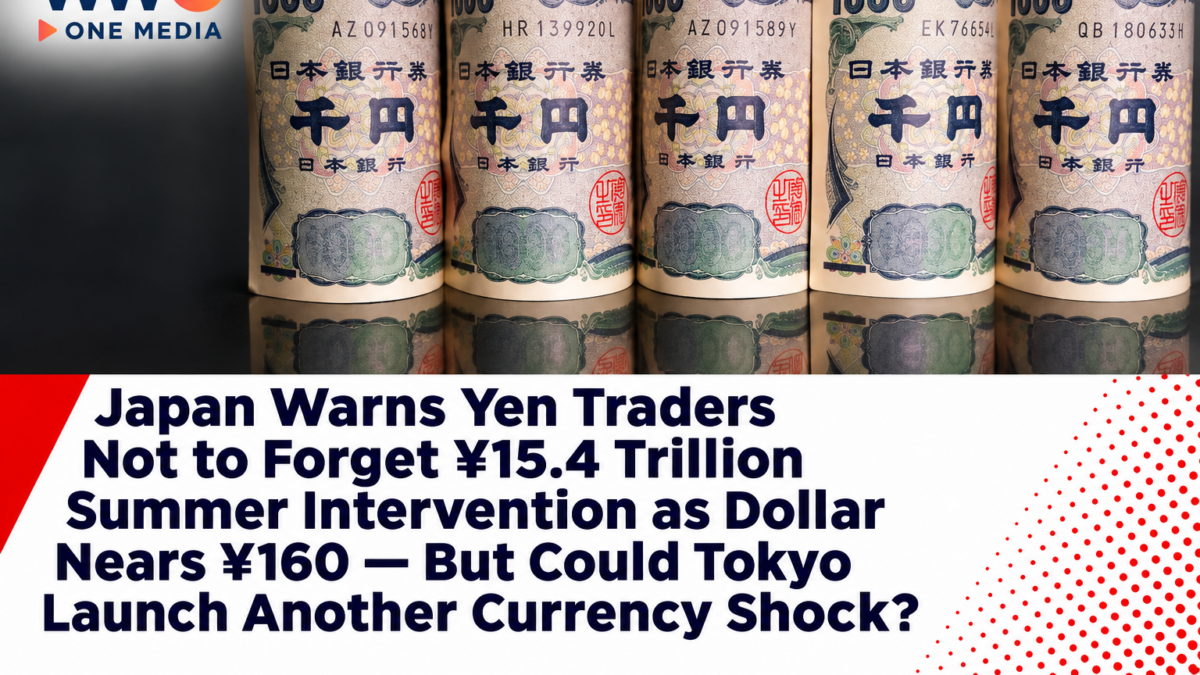
TOKYO, JAPAN / MANILA, PHILIPPINES — November 12, 2026 — Japan’s currency authorities are sending another warning to foreign-exchange traders as the yen approaches the psychologically important level of ¥160 against the US dollar, reviving memories of Tokyo’s record-breaking intervention earlier this year.
The warning comes just days after Japan’s Ministry of Finance disclosed that it spent a staggering ¥15.399 trillion, approximately $97 billion, buying yen and selling US dollars across three trading days between July 30 and August 3, 2026.
The massive intervention was designed to halt a sharp decline in the Japanese currency as it approached ¥164 per dollar, levels not seen in nearly four decades.
Japan’s top foreign-exchange diplomat, Atsushi Mimura, has repeatedly emphasized the government’s vigilance against excessive currency movements and the importance of its cooperation with Washington.
Now, with the yen weakening again, financial markets are asking whether Tokyo will resort to another major operation.
Reuters reported that the dollar traded around ¥159.58 in early Asian trading on November 12, close to the ¥160 level that has repeatedly attracted attention from currency traders.
The renewed pressure follows stronger-than-expected US inflation, rising expectations of further Federal Reserve interest-rate increases and persistent differences between American and Japanese borrowing costs.
The question is whether Japan’s warnings will persuade currency traders to reverse their bets—or whether another extraordinary intervention will be needed to defend the yen.
Japan Reminds Currency Traders of Its Record-Breaking Intervention
The latest warning follows the release of official intervention figures that confirmed the enormous scale of Japan’s summer operations.
On November 9, the Ministry of Finance published the daily breakdown of foreign-exchange intervention between July and September.
The figures revealed three separate operations:
| Intervention date | Yen purchased |
|---|---|
| July 30, 2026 | ¥7.9756 trillion |
| July 31, 2026 | ¥5.5523 trillion |
| August 3, 2026 | ¥1.8714 trillion |
| Total | ¥15.3993 trillion |
The July 30 operation was the largest single-day yen-buying intervention ever conducted by Japanese authorities.
The figures also established that Tokyo intervened on three days, rather than the two days some traders had initially anticipated.
Japan used its foreign-currency resources to purchase yen in the market, attempting to increase demand for the domestic currency and arrest its rapid depreciation.
The scale of the operation demonstrates how seriously Japanese officials viewed the currency’s decline.
The fact that the yen is once again approaching ¥160 has renewed speculation about whether intervention could return.
However, the government has not publicly committed to defending any specific exchange-rate level.
Atsushi Mimura Keeps Speculators Guessing
Japan’s Vice Minister of Finance for International Affairs, Atsushi Mimura, plays a central role in communicating the government’s currency policy.
Known as the country’s top currency diplomat, Mimura has repeatedly warned against excessive exchange-rate movements.
In September, he said Japanese authorities remained on heightened alert despite a temporary recovery in the yen.
He also emphasized that Japan and the United States were maintaining close communication on currency-market developments.
During another interview with Reuters on September 28, Mimura urged financial markets to take the government’s warning seriously.
His remarks followed discussions between senior Japanese and American officials concerning yen weakness.
The latest Bloomberg report places renewed attention on the summer intervention at a time when the currency is again approaching sensitive territory.
For traders, the significance lies in the government’s demonstrated ability to intervene on an enormous scale with relatively little advance warning.
Japan has shown that it can sell dollars and buy yen rapidly enough to force sharp adjustments in speculative positions.
That possibility may discourage aggressive bets against the currency.
However, verbal intervention does not guarantee that the government will conduct another market operation.
Why the Japanese Yen Is Falling Again
The yen’s renewed weakness is closely connected to monetary policy developments in the United States.
On November 10, the US Bureau of Labor Statistics reported that consumer prices rose 0.4% in October, exceeding economists’ expectations of a 0.3% increase.
The inflation surprise strengthened expectations that the Federal Reserve could raise interest rates again.
Higher US interest rates tend to support the dollar by making dollar-denominated assets more attractive to investors.
Japan’s interest rates remain substantially lower than those in the United States.
That difference creates an incentive for investors to borrow or raise money in yen and invest in higher-yielding assets elsewhere.
The strategy is commonly known as the yen carry trade.
When investors engage in these transactions, selling pressure on the Japanese currency can increase.
As WWC ONE MEDIA reported in its November 11 coverage of the US inflation surprise, stronger-than-expected American consumer prices have revived concerns about further Federal Reserve tightening.
The resulting movement in US Treasury yields has also affected Asian financial markets.
For Japan, the challenge is that currency intervention may temporarily interrupt depreciation without eliminating the economic forces driving demand for the dollar.
Tokyo and Washington Made a Rare Joint Intervention
One of the most significant aspects of the summer operation was cooperation between Japan and the United States.
On July 31, the two governments conducted a rare coordinated operation to support the yen.
It marked the first joint US-Japan intervention to strengthen the Japanese currency since 1998.
The move signaled that Washington was prepared to support efforts to address destabilizing yen weakness.
The cooperation is important because Japan’s ability to influence the exchange rate may be strengthened when traders believe American authorities also support currency stabilization.
Japanese Finance Minister Satsuki Katayama subsequently emphasized the importance of continued communication with US Treasury Secretary Scott Bessent.
Mimura has also described the broader relationship between the countries as extending beyond currency matters to economic security and supply-chain cooperation.
However, the July operation does not mean Washington has agreed to participate automatically in future interventions.
Any new coordinated action would require separate policy decisions.
The possibility of cooperation remains an important consideration for financial markets, but it is not a guarantee.
Japan Already Spent More Than ¥27 Trillion Defending the Yen in 2026
Japan’s summer intervention was not an isolated event.
The government had previously spent approximately ¥11.73 trillion supporting the yen during operations in late April and early May.
Combined with the ¥15.399 trillion summer intervention, the total spent on yen-buying operations in those two periods exceeded ¥27 trillion.
That amount surpassed Japan’s previous annual intervention record of approximately ¥15 trillion in 2024.
The unprecedented spending illustrates how difficult it has been for Japanese authorities to stabilize the currency during periods of significant global financial uncertainty.
However, the intervention amounts represent foreign-exchange transactions, not government budget spending in the same sense as public services or infrastructure projects.
Japan sells foreign-currency assets and buys yen, changing the composition of its reserve holdings.
The transactions can influence currency markets but do not necessarily produce permanent changes in the underlying exchange-rate trend.
That distinction is critical when assessing whether another large intervention would be economically effective.
Why ¥160 per Dollar Is Becoming a Major Market Flashpoint
The ¥160 level has become an important psychological reference point for currency traders.
It is a round number that attracts considerable market attention because of Japan’s previous interventions and the yen’s history of sharp movements around similar levels.
Reuters reported the dollar trading at approximately ¥159.58 on November 12.
But Japan has not officially identified ¥160 as a fixed threshold for intervention.
Authorities generally emphasize the speed and disorderliness of exchange-rate movements rather than a particular number.
A rapid and speculative decline may attract a stronger response than a gradual movement driven by economic conditions.
This means traders should not assume the government will intervene automatically when the exchange rate reaches ¥160.
Nor should they conclude that a lack of intervention at that level means Japan has abandoned its currency policy.
The government’s approach appears designed to preserve uncertainty about when and how it might act.
Bank of Japan Faces Pressure to Support the Currency
The Bank of Japan is another important factor in the yen’s outlook.
Japanese interest rates have increased from their historically ultra-low levels, but the difference between US and Japanese rates remains substantial.
Markets are watching whether the central bank will tighten monetary policy further at its December 17–18 meeting.
A higher Japanese policy rate could make yen-denominated assets more attractive and potentially reduce some of the incentive for carry trades.
However, interest-rate increases also affect domestic borrowers, businesses and government financing costs.
The Bank of Japan must therefore balance currency-market developments with domestic inflation, wage growth and economic conditions.
As WWC ONE MEDIA examined in its analysis of Japan’s inflation outlook and the Bank of Japan’s December policy decision, policymakers face the challenge of achieving sustainable price stability while avoiding unnecessary damage to the economy.
The central bank’s decisions could ultimately have a more lasting effect on the currency than temporary intervention.
Japanese Bond Yields Are Also Rising
The weaker yen is occurring alongside renewed volatility in Japan’s government bond market.
Stronger US inflation has pushed global borrowing costs higher, creating pressure on government debt across major economies.
Japan’s benchmark 10-year government bond yield climbed to approximately 2.75% on November 11.
Bond yields and prices move in opposite directions, meaning rising yields generally indicate falling bond prices.
Higher Japanese yields can influence domestic financing costs and investor decisions about government debt.
The market is closely watching whether global interest-rate developments will make it more expensive for Japan to finance its substantial public debt.
As WWC ONE MEDIA reported on the surge in Japanese government bond yields, changing Federal Reserve expectations have added pressure to global bond markets.
The relationship between bonds and currencies is complex.
Higher Japanese yields may support the yen if they attract investment into Japanese assets.
But if yields rise because investors are concerned about inflation or fiscal risks, the effect on the currency can be less straightforward.
Weak Yen Pushes Up Japan’s Import Costs
Currency weakness is particularly important for Japan because the country depends heavily on imports of energy, raw materials and certain food products.
When the yen depreciates, products priced in US dollars can become more expensive in Japanese currency.
That creates additional cost pressure for households and businesses.
On November 12, Reuters reported that Japan’s corporate goods price index rose 7.1% in October from a year earlier, accelerating from 6.8% in September.
The increase was stronger than economists had expected.
More significantly, the yen-denominated import price index rose 24.8% year over year.
The figures underline how exchange-rate weakness can affect Japanese manufacturers and consumers.
Higher import costs may eventually flow into retail prices, depending on business pricing decisions, competitive conditions and domestic demand.
The pressure is especially important when households are already dealing with rising living expenses.
Japan’s currency policy therefore has implications beyond financial-market speculation.
It can affect purchasing power and the broader inflation outlook.
Can Intervention Actually Stop the Yen’s Decline?
Foreign-exchange intervention can be effective in slowing rapid market movements and discouraging speculative positions.
Japan’s summer operations demonstrated that authorities can deploy enormous sums and produce a sharp immediate reaction.
Reuters reported that the yen strengthened significantly after the intervention, recovering from levels near ¥164 per dollar to around ¥155 by August 3.
However, much of that improvement has subsequently reversed.
The currency’s return toward ¥160 illustrates the limitations of intervention when underlying monetary policy conditions continue supporting the dollar.
Investors still face a substantial interest-rate differential between the United States and Japan.
A renewed surge in US inflation or stronger Federal Reserve tightening could maintain pressure on the yen.
Conversely, softer American economic data or additional Bank of Japan rate increases could provide support without direct government intervention.
This makes the future direction of the currency difficult to predict.
Japan can influence trading conditions, but it cannot fully control global capital flows through intervention alone.
Why the Philippines and Other Asian Economies Should Watch
Japan’s currency movements can also affect financial and commercial activity across Asia.
A weaker yen can make travel to Japan more affordable for some foreign visitors, including Filipinos exchanging pesos into yen, depending on the peso-yen exchange rate.
It may also influence the competitiveness of Japanese exports and the cost of imports from Japan.
For Philippine businesses importing Japanese machinery, vehicles and industrial equipment, exchange-rate movements can affect purchasing costs.
However, many transactions involve dollar pricing or other commercial arrangements, so the effects differ by contract.
Japanese monetary policy can also influence regional financial markets because Japan is a major source of international investment capital.
Changes in Japanese interest rates may affect investor appetite for foreign bonds and other assets.
The effect is not necessarily immediate, but sudden currency volatility can spread through global financial markets.
In earlier coverage, WWC ONE MEDIA examined how the yen reacted to warnings from Japan’s currency authorities, emphasizing that currency movements can reflect both intervention concerns and expectations about central bank policy.
The latest developments reinforce that connection.
What Happens Next for the Japanese Yen?
Financial markets are now watching several developments.
The first is whether the dollar breaks decisively above ¥160 against the yen.
The second is whether Japan’s Ministry of Finance strengthens its verbal warnings or takes operational steps that might precede intervention.
The third is the Federal Reserve’s December 8–9 policy meeting, where officials will assess the latest US inflation and economic data.
The fourth is the Bank of Japan’s December 17–18 policy meeting, which could provide fresh guidance on Japanese interest rates.
Investors will also monitor official statements from both Tokyo and Washington.
Still, there is no confirmed announcement of another joint currency intervention.
The July and August operations demonstrate Japan’s willingness to act, but they do not establish when future action might occur.
The Bottom Line: Japan’s Warning Carries a Multitrillion-Yen Message
Japan has already shown that it is willing to spend extraordinary amounts to counter excessive yen weakness.
The ¥15.399-trillion summer intervention stands as one of the most dramatic currency-defense operations in the country’s history.
It also demonstrated the potential importance of cooperation between Japan and the United States.
Now, as the yen approaches ¥160 per dollar, those earlier interventions are again shaping expectations in financial markets.
For traders, the risk is that Tokyo could step in unexpectedly and force a sudden reversal in the dollar-yen exchange rate.
For Japanese households and businesses, the greater concern is that prolonged currency weakness will continue increasing import costs and inflationary pressure.
For the Bank of Japan, the challenge is determining how quickly interest rates can rise without undermining domestic economic stability.
Japan’s warning does not mean another intervention is inevitable. But the government’s previous actions make clear that currency traders cannot safely assume Tokyo will remain on the sidelines.