
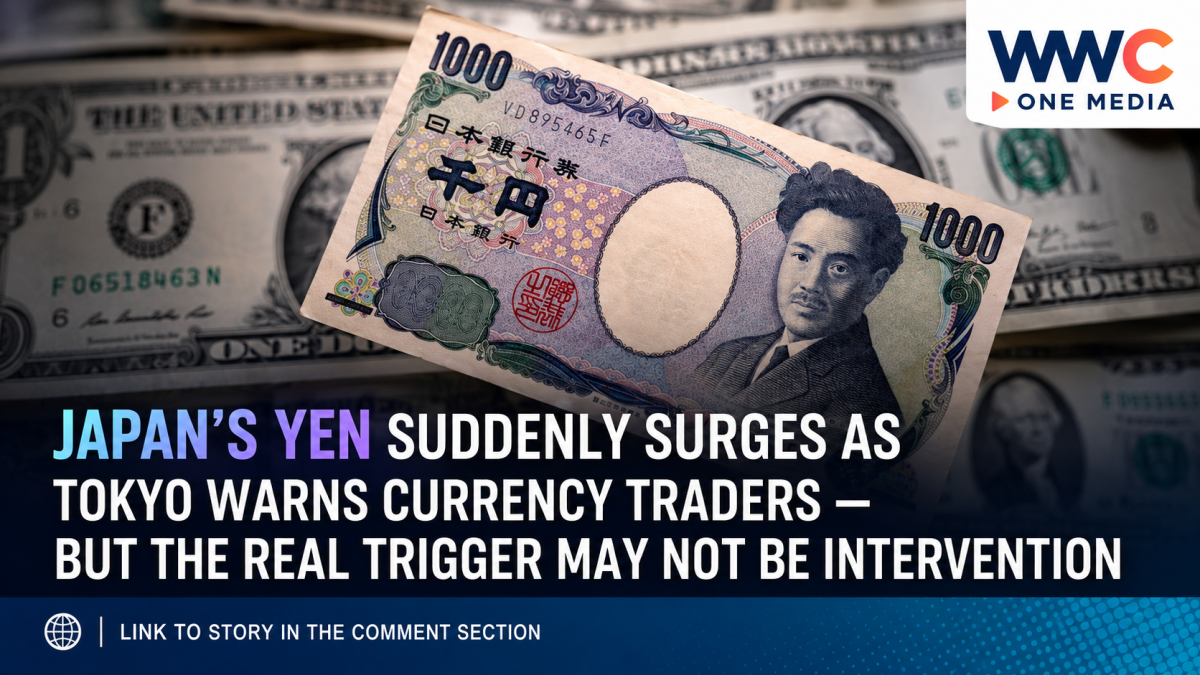
TOKYO — Japan has put global currency traders back on notice after its top foreign-exchange official issued another warning over volatile market moves, sending the dollar lower against the yen and reviving speculation that Tokyo could once again step directly into the market.
But behind the dramatic move in the Japanese currency is a potentially bigger story: investors are increasingly betting that the Bank of Japan may soon raise interest rates again, giving the yen something government intervention alone has struggled to provide — fundamental support.
Japan’s Vice Finance Minister for International Affairs Atsushi Mimura, the country’s top currency diplomat, said Friday that authorities remained alert to movements in foreign-exchange markets.
“We remain in constant contact with U.S. authorities,” Mimura told reporters, according to Reuters.
His comments immediately attracted attention in currency markets. The U.S. dollar fell to around ¥155.305, strengthening the yen and putting traders on guard for the possibility of another yen-buying operation by Japanese authorities.
Yen’s Dramatic Rally Raises Intervention Questions
The warning came after an unusually sharp move in the Japanese currency.
The yen surged more than 2% against the dollar on Thursday, one of its biggest advances in months, after already strengthening during the previous session.
The speed of the move was enough to spark immediate speculation in dealing rooms that Japan’s Ministry of Finance might have intervened again.
But available Bank of Japan data did not show evidence that authorities had conducted a fresh intervention during the move.
Instead, Reuters reported that traders increasingly attributed the rally to changing expectations surrounding Japanese interest rates.
That distinction matters.
Government intervention can move currencies sharply in the short term. A sustained change in interest rates, however, can alter the economic forces that encourage investors to buy or sell a currency for months or even years.
Bank of Japan Rate-Hike Bets Are Changing the Story
The yen received a major boost after Bank of Japan board member Hajime Takata signaled that policymakers should be prepared to adjust interest rates flexibly rather than following a rigid timetable.
The remarks prompted investors to increase bets that the BOJ could tighten monetary policy at its September meeting.
Reuters reported that markets were pricing roughly a 75% probability of a quarter-percentage-point increase following the latest shift in expectations.
The prospect of higher Japanese interest rates is particularly important because the enormous gap between borrowing costs in Japan and the United States has been one of the main forces weighing on the yen.
For years, traders have been able to borrow cheaply in yen and invest that money in higher-yielding currencies and assets — a strategy known as the yen carry trade.
Higher Japanese rates make that strategy less attractive.
And if the interest-rate gap between Japan and the United States continues narrowing, some investors could unwind those trades and buy yen back, creating additional upward pressure on the Japanese currency.
Wall Street Is Starting to Take the Shift Seriously
The Wall Street Journal also reported that the yen’s rapid appreciation had triggered intervention speculation, including discussion over whether Japanese authorities had conducted a so-called rate check — a step that can sometimes precede direct market action.
But the newspaper likewise pointed to growing expectations for a more hawkish Bank of Japan as an important source of yen strength.
The Financial Times reported that the yen gained about 2.1% to roughly ¥155.40 per dollar on Thursday, noting that investors were increasingly positioning for further BOJ tightening.
The FT also highlighted another potential source of support: speculation surrounding possible changes in the investment approach of Japan’s massive Government Pension Investment Fund, although that remains a market theory rather than a confirmed policy shift.
Tokyo Has Already Spent Record Sums Defending the Yen
There is good reason traders are nervous whenever Japanese officials speak.
Tokyo has already demonstrated that its warnings can be followed by enormous amounts of actual money.
Official Japanese Finance Ministry figures show that Japan conducted ¥15.3993 trillion worth of foreign-exchange intervention between July 30 and August 26, an extraordinary campaign aimed at supporting the currency.
Reuters calculated the amount at roughly $96.5 billion, making it a record intervention campaign for the period.
The operation followed a slide that had taken the yen close to ¥164 per dollar, levels not seen in roughly four decades.
Even more unusually, Washington became involved.
Japan and the United States confirmed a rare coordinated yen-buying intervention at the end of July, with both governments indicating that additional action remained possible if currency instability continued.
That cooperation makes Mimura’s latest comment about remaining in “constant contact” with U.S. officials considerably more significant than an ordinary verbal warning.
Why Washington Cares About the Yen
Currency intervention is normally handled cautiously among major economies because governments generally want exchange rates to be determined by markets rather than manipulated to gain trade advantages.
Japan’s case has become different because officials have increasingly framed intervention as a response to excessive volatility and disorderly market movements, not an attempt to engineer an export advantage.
A severely undervalued yen also carries international consequences.
Japan imports large quantities of energy and other commodities priced in dollars. A weaker yen therefore raises import costs, pushes up domestic inflation and reduces household purchasing power.
At the same time, violent moves in Japanese bonds and currencies can spill into international markets because Japan remains one of the world’s biggest pools of investment capital.
Japanese Finance Minister Satsuki Katayama and U.S. Treasury Secretary Scott Bessent recently reaffirmed that orderly yen movements were important for broader financial stability and agreed to continue coordinating closely.
The ¥160 Level Remains a Psychological Flashpoint
There is no officially declared exchange rate that automatically triggers intervention.
Nevertheless, traders have repeatedly treated the area around ¥160 per dollar as an important danger zone because Japanese authorities have become increasingly aggressive when the currency approaches or moves beyond those levels.
The Japan Times has reported that market participants have viewed the ¥160 region as a potential intervention trigger during previous bouts of yen weakness.
That does not mean Tokyo will intervene every time the dollar reaches ¥160.
Japanese officials repeatedly emphasize that they are watching the speed and nature of currency moves, rather than targeting a specific exchange rate.
Still, after spending more than ¥15 trillion during its latest intervention campaign, markets have little reason to dismiss the warnings.
Some Strategists Now See a Much Stronger Yen
The changing monetary-policy outlook has also encouraged some major financial institutions to turn more optimistic on the Japanese currency.
MarketWatch reported that Bank of America strategists have recommended selling the dollar against the yen, with a target near ¥149 per dollar.
The bank cited several potential supports for the yen, including Japan’s external surplus, expectations of higher BOJ interest rates and the possibility that Japanese investors could increasingly favor domestic assets as Japanese yields rise.
That forecast is far from guaranteed.
Oil prices remain an important risk because Japan depends heavily on imported energy. Higher crude prices increase Japan’s import bill and can weaken the yen.
U.S. monetary policy is another major variable.
If American interest rates remain significantly above Japan’s, investors could continue finding dollar-denominated assets more attractive.
But the direction of the interest-rate gap is now becoming almost as important as its absolute size.
The Next BOJ Decision Could Matter More Than Another Intervention
That is why Japan’s latest currency warning may ultimately be less important than what the Bank of Japan does next.
Tokyo has already shown that it is prepared to spend tens of billions of dollars defending the yen.
It has also demonstrated that Washington is willing, under exceptional circumstances, to coordinate with Japan.
But repeated intervention cannot permanently overpower economic fundamentals.
If the BOJ delivers additional rate increases while expectations for U.S. tightening weaken, the forces that pushed the yen toward four-decade lows could begin reversing without authorities having to repeatedly enter the market.
That possibility is what makes the latest yen surge different.
Traders are no longer watching only for Japan’s Ministry of Finance to suddenly start buying yen.
They are now watching to see whether the Bank of Japan is about to give the currency a reason to strengthen on its own.




Leave a Reply