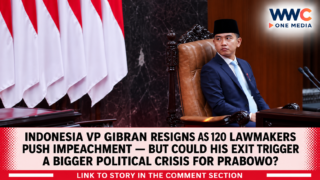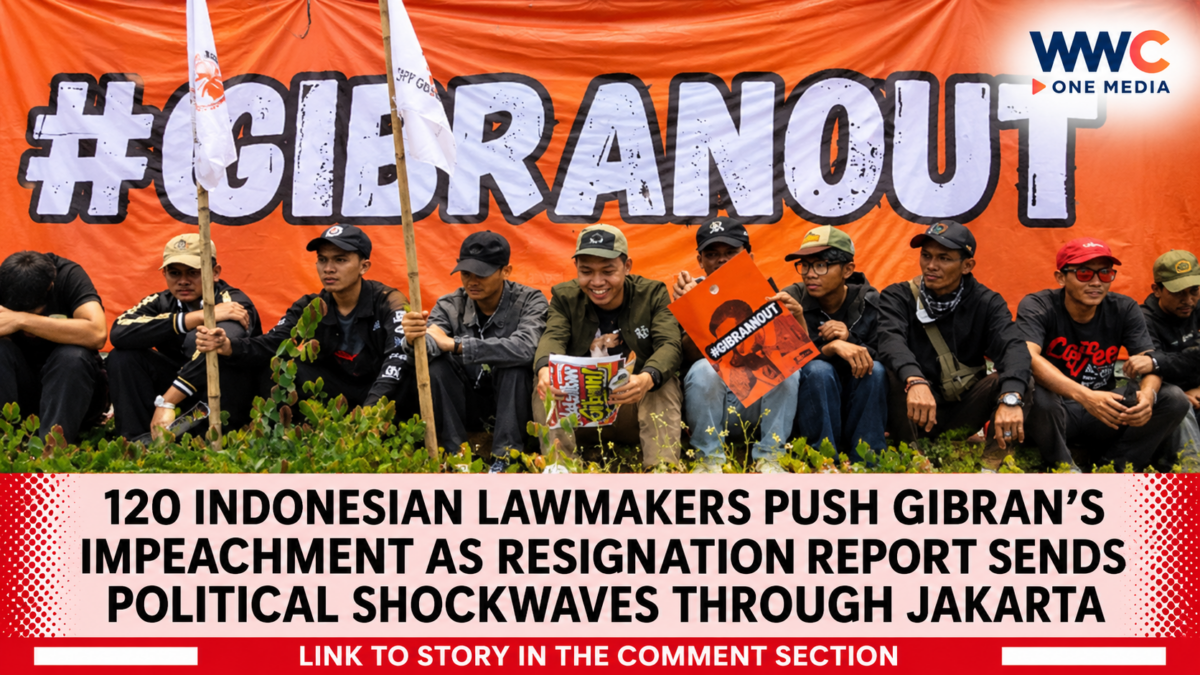
JAKARTA, Indonesia — Indonesia is facing a fresh political crisis after approximately 120 lawmakers from eight political parties signed a petition seeking action against Vice-President Gibran Rakabuming Raka, while a separate resignation announcement has added uncertainty to his political future.
The controversy centres on court decisions questioning whether the education documents Gibran used to qualify for the 2024 presidential election met Indonesia’s legal requirements.
The parliamentary initiative could open the way for impeachment proceedings, but it does not automatically remove him from office.
The situation became even more complicated on November 11, when an aide told Reuters that Gibran had submitted his resignation to President Prabowo Subianto. Parliamentary sources separately told Reuters that he was expected to submit a formal resignation letter to the upper house on Thursday, November 12.
The Associated Press also reported that lawmakers were continuing with their parliamentary initiative because it was not immediately clear whether Prabowo had accepted Gibran’s resignation.
The developments have put Indonesia’s political leadership under intense scrutiny. They also raise questions about the relationship between Prabowo and former president Joko Widodo, widely known as Jokowi, who is Gibran’s father.
What began as a dispute over educational qualifications has now become a potentially consequential test of Indonesia’s courts, Parliament and governing coalition.
120 Lawmakers From Eight Parties Sign Petition Against Gibran
The impeachment push gained momentum on Wednesday, November 11, when approximately 120 members of Indonesia’s House of Representatives signed a petition challenging Gibran’s eligibility to remain vice-president.
The lawmakers came from eight political parties, according to Reuters and The Jakarta Post.
Muhammad Kholid, a lawmaker from the Prosperous Justice Party (PKS) and one of the petition’s signatories, said the court rulings meant Gibran no longer met the requirements for the vice-presidential position.
The petition argues that the findings concerning his education documents raise constitutional questions about his eligibility.
The development is significant because the initiative involves lawmakers from multiple political groups rather than a single opposition faction.
The Associated Press reported that the Indonesian Democratic Party of Struggle (PDI-P), whose parliamentary faction has 110 members, agreed to pursue the House’s constitutional right to express an opinion.
PDI-P faction leader Utut Adianto said the party had reached a unanimous decision to pursue that mechanism.
The party’s support gives the initiative considerable political weight, although the process still requires formal parliamentary action and constitutional review.
The House leadership has scheduled a plenary session for Thursday, November 12, to advance and discuss the proposal.
For context, WWC ONE MEDIA previously reported that Indonesian parties were weighing parliamentary action over Gibran’s education credentials even before the latest petition gained momentum.
Gibran Reportedly Submits Resignation to Prabowo
The parliamentary pressure coincided with a separate development that could reshape the vice-presidential office.
Gibran reportedly expressed his intention to resign during a meeting with Prabowo on November 10.
State Secretary Prasetyo Hadi previously confirmed that Gibran had raised the possibility of stepping down during their discussion.
Reuters reported on November 11 that Gibran’s aide, Budi Arie Setiadi, said the vice-president had tendered his resignation to Prabowo earlier that Wednesday.
Two sources at the parliamentary upper house also told Reuters that Gibran was expected to submit a resignation letter to the chamber on Thursday morning.
However, the status of the resignation remained politically significant because it was not immediately clear whether Prabowo had accepted it.
The Associated Press reported that the House initiative was continuing despite the resignation development.
That means two separate processes are unfolding: a reported resignation and a parliamentary effort that could lead to impeachment.
The distinction matters. A resignation is not the same as an impeachment, and the existence of a petition does not mean Parliament has already removed Gibran.
Reuters reported that Indonesia’s upper house would have to convene to declare a vacancy if the resignation process proceeds. It would then request two replacement candidates from the president, with an election to follow within 60 days.
The next formal steps will determine whether Indonesia is preparing for a change in the vice-presidential office or a prolonged constitutional dispute.
What Did the Courts Find About Gibran’s Education Documents?
The controversy intensified after two separate court developments in October 2026.
The first came from Indonesia’s Constitutional Court, which dismissed a petition seeking to invalidate Gibran’s 2024 election victory.
Although the court rejected the challenge, its reasoning raised questions about the evidence presented concerning Gibran’s overseas education.
The court said it did not find convincing evidence in the proceedings that Gibran possessed a foreign diploma or certificate establishing completion of senior high school or an equivalent qualification.
Indonesia’s election law requires presidential and vice-presidential candidates to have completed senior high school or an equivalent level of education.
However, the Constitutional Court did not remove Gibran through that case. It explained that the election dispute could no longer be handled as a challenge to the election result because he had already been sworn into office.
The second development came from the Supreme Court, which annulled the education-equivalency certificate used in connection with Gibran’s 2024 candidacy and instructed the Education Ministry to withdraw it.
The court findings have become central to the lawmakers’ argument that Gibran may no longer satisfy the constitutional requirements for the position.
But the legal distinction is crucial: the court decisions concerning the documentation did not, by themselves, automatically terminate his vice-presidential tenure.
WWC ONE MEDIA examined the Constitutional Court ruling and why its dismissal of the election challenge did not end the controversy.
Why Gibran’s Educational Background Became a Political Flashpoint
Gibran, 39, is the eldest son of former president Jokowi, who governed Indonesia from 2014 to 2024.
His education history includes studies in Singapore and Australia before he obtained a university degree through the Management Development Institute of Singapore.
The dispute is not simply about whether Gibran attended schools overseas or later completed university studies.
The central issue is whether the documents submitted to Indonesian authorities adequately established that he had completed senior high school or an equivalent qualification required for presidential and vice-presidential candidates.
The Supreme Court’s decision to annul the equivalency certificate has intensified questions about the administrative process used to establish his eligibility.
The controversy also recalls the criticism surrounding Gibran’s selection as Prabowo’s running mate in 2023.
At the time, Indonesia’s Constitutional Court changed the eligibility rules concerning the minimum age for presidential and vice-presidential candidates. The court was then headed by Anwar Usman, Gibran’s uncle, who later faced an ethics sanction over a conflict-of-interest violation.
That earlier controversy had already placed Gibran’s candidacy under public scrutiny.
The latest court decisions have brought the issue back into the national political debate, this time with a direct challenge to the documents used to establish his educational qualifications.
Can 120 Lawmakers Actually Impeach Indonesia’s Vice-President?
The petition is politically significant, but impeachment under Indonesia’s Constitution is not an automatic consequence of lawmakers signing a document.
The country has a constitutional process for removing a president or vice-president from office.
The House of Representatives must first formally express an opinion alleging that the president or vice-president has committed specified constitutional violations or no longer meets the requirements for office.
The matter must then be examined by the Constitutional Court.
If the court confirms the constitutional grounds, the proposal can proceed to the People’s Consultative Assembly (MPR), which has the authority to make the final decision under the constitutional process.
A parliamentary motion or investigation is therefore only an early stage. It does not immediately remove a vice-president.
The House must follow its internal procedures, establish the necessary basis for its position and meet the constitutional voting requirements.
The Associated Press reported that a special parliamentary committee would be established to examine the allegations. If lawmakers determine that there is sufficient basis to proceed, the matter would be referred to the Constitutional Court.
This means that even with approximately 120 lawmakers supporting the initiative, Gibran’s removal is not guaranteed.
The outcome will depend on the evidence, the decisions of the relevant institutions and the political support behind each stage of the process.
Why the Prabowo-Jokowi Relationship Matters
The controversy has also intensified attention on the relationship between Prabowo and Jokowi.
Gibran became Prabowo’s running mate in the 2024 presidential election, a partnership that benefited from the political support of the former president.
Prabowo eventually won the presidency, with Gibran becoming his vice-president.
However, the relationship between the two political camps has since attracted growing scrutiny.
The current controversy could put Prabowo in a difficult position.
If he accepts Gibran’s resignation, the administration would have to manage the process of filling the vacant position while dealing with the political consequences of losing its vice-president.
If he does not accept the resignation or the process remains unresolved, Parliament could continue pursuing its initiative.
Either scenario could affect the relationship between Prabowo’s administration and the political network associated with Jokowi.
Reuters reported that the growing tension between the two camps has become a source of uncertainty for Indonesia’s political establishment.
However, the political implications should not be confused with proof that either Prabowo or Jokowi directed the parliamentary initiative.
The lawmakers’ petition, the court decisions and the reported resignation are separate developments that must be assessed on their own evidence.
A Separate Wiretapping Scandal Adds Pressure to the Government
The Gibran controversy is unfolding alongside another political issue involving allegations of illegal surveillance targeting Prabowo and other prominent figures.
Indonesian authorities have investigated alleged unauthorised wiretapping involving senior police officers.
The controversy intensified after former national police chief Listyo Sigit Prabowo was arrested in connection with the investigation, alongside other senior officers.
Listyo had served as national police chief during Jokowi’s administration and was later appointed to a senior position in Prabowo’s government.
Prabowo subsequently removed him from his presidential chief-of-staff position.
The investigation has attracted attention because of the political relationships surrounding the officials involved.
However, there is no established evidence that the wiretapping investigation and the dispute over Gibran’s educational credentials are part of one coordinated operation.
They remain separate matters, even as both contribute to the wider political uncertainty surrounding the administration.
WWC ONE MEDIA previously examined the surveillance controversy and the questions it raised about security institutions and the presidency.
The wider security situation has also prompted increased attention to public order and demonstrations in Jakarta.
What Happens If Gibran’s Resignation Is Completed?
If Gibran’s resignation is formally processed and the vice-presidential position becomes vacant, Indonesia’s Constitution provides a mechanism for selecting a replacement.
Under the constitutional procedure, the president submits two candidates to the People’s Consultative Assembly, which elects the new vice-president.
The process would create another political challenge for Prabowo because the replacement would have to be considered within the balance of political parties and parliamentary forces.
The reported resignation also raises a separate question: would Parliament continue its impeachment initiative if Gibran leaves office?
The answer may depend on the formal status of the resignation and the legal basis of the parliamentary proceedings.
As of the latest reports reviewed, the petition and the reported resignation were both significant developments, but the final constitutional outcome had not been established.
The two processes should not be treated as interchangeable. A resignation does not mean Parliament has completed impeachment, and an impeachment petition does not prove that a resignation has been accepted.
Indonesia’s Political Future Now Faces a Critical Test
The developments involving Gibran have placed Indonesia at a sensitive political crossroads.
The dispute over his educational qualifications has moved from courtrooms into Parliament, while the reported resignation has raised questions about the future of the country’s second-highest elected office.
For Prabowo, the immediate challenge is to maintain political stability while respecting the constitutional process.
For Gibran, the central issue is whether his resignation will be formally completed or whether he will continue contesting the legal and political challenges to his eligibility.
For Parliament, the decision is whether to pursue a full constitutional process that could ultimately lead to impeachment.
The coming parliamentary proceedings could therefore prove decisive.
Around 120 lawmakers have opened a new front against Gibran, and an aide says he has tendered his resignation. But the biggest question now is whether Indonesia is heading toward a negotiated change in leadership — or a constitutional confrontation that could deepen the political divide between Prabowo and Jokowi.