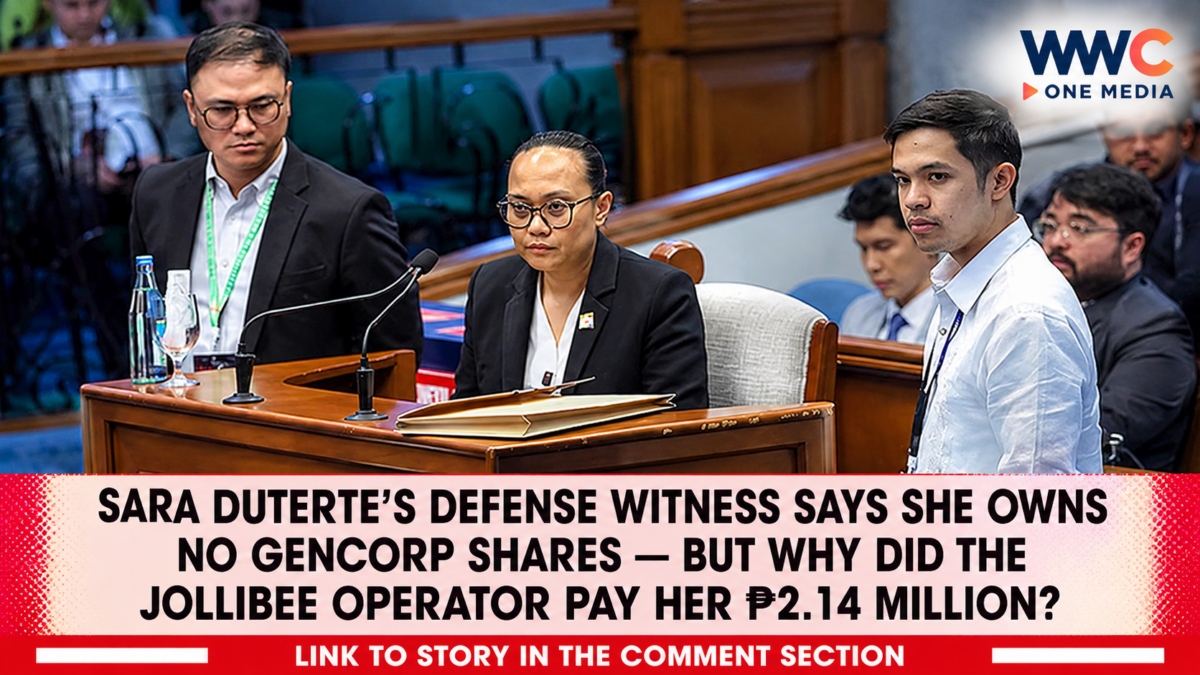
A defense witness in Vice President Sara Duterte’s impeachment trial has denied that she owns shares in GenCorp Industries Inc., despite the company appearing among her declared business interests in her Statements of Assets, Liabilities and Net Worth (SALNs).
But the testimony has opened another question that may prove just as difficult for the defense to explain: if Duterte was not a GenCorp shareholder, why did the company pay her more than ₱2.14 million between 2022 and 2025?
Lawyer Suzette Balucanag-Punay, GenCorp’s in-house counsel and also legal counsel for Metro City Chow Foods Corporation, testified before the Senate impeachment court on November 11 that Duterte’s name did not appear in GenCorp’s General Information Sheets (GIS) from 2022 to 2025.
“She has no stockholdings with GenCorp,” Punay told the court, according to reports from SunStar and GMA News.
She also said Duterte did not hold a corporate position in GenCorp and did not receive dividends because the company had not declared any during the period.
However, Punay subsequently acknowledged that Duterte had what she described as a “loose investment” connected to the Jollibee Times Square branch in Davao City. That arrangement, she said, resulted in payments totaling approximately ₱2.14 million over four years.
The distinction between owning shares in a corporation and having a separate financial interest in one of its business operations is now central to the dispute.
For the House prosecution, the payments raise questions about Duterte’s financial interests and the accuracy of her disclosures. For the defense, the witness’s testimony challenges the prosecution’s claim that the vice president owned 20 percent of GenCorp.
Yet one important detail remains unresolved: Punay admitted that she could not verify the original amount Duterte invested because she had no written records documenting it.
No GenCorp Shares, According to Corporate Records
During Day 42 of the impeachment proceedings, defense counsel presented Punay to explain GenCorp’s corporate records and Duterte’s alleged connection to the company.
Punay said Duterte was not listed as a shareholder in GenCorp’s GIS from 2022 through 2025. She also denied that the vice president held a position in the corporation during those years.
The witness disputed the prosecution’s financial analyst Alex Cabrera’s finding that Duterte owned a 20-percent interest in GenCorp, describing the conclusion as inconsistent with the company’s corporate records.
She also questioned the analyst’s calculations in relation to GenCorp’s paid-up capital, which she said was recorded at ₱1.25 million.
The presiding officer, Senate President Francis “Chiz” Escudero, allowed an objection by private prosecutor Lorna Kapunan to strike Punay’s characterization of the findings from the record.
But the testimony did not end with the denial of share ownership.
Punay acknowledged that Duterte had a financial arrangement connected to one of the company’s Jollibee branches. That admission shifted the questioning from whether Duterte owned GenCorp shares to what kind of investment or financial interest she actually held.
The ₱2.14-Million Question: What Was the Money For?
Punay described Duterte’s arrangement as a “loose investment” involving the Jollibee Times Square branch in Davao City.
According to her testimony, the investment originated from contributions Duterte made to Davao Bounty Times Food Corporation before the restaurant began operating.
Punay explained that the original business arrangement did not proceed as initially intended, and the investment later became associated with the Jollibee Times Square branch operated under the GenCorp business structure.
She said Duterte received a total of approximately ₱2,142,369.14 in returns of capital from 2022 to 2025.
The amounts reported during the proceedings were:
| Year | Reported payment |
|---|---|
| 2022 | ₱337,500.00 |
| 2023 | ₱555,750.00 |
| 2024 | ₱612,419.14 |
| 2025 | ₱636,700.00 |
| Total | ₱2,142,369.14 |
Punay maintained that these payments were returns of capital, not dividends from GenCorp shares.
That distinction matters. A repayment of an investment is not automatically the same as profit or dividend income. The legal and accounting treatment depends on the underlying agreement, the original contribution and the nature of the payments.
However, when questioned about the amount Duterte initially invested, Punay admitted that she could not verify it because she had no written records establishing the original contribution.
That missing documentation became one of the most important points of the hearing.
If the payments were returns of capital, the impeachment court may need to determine what capital was originally contributed, how the arrangement was transferred or carried forward, and what documents support the transactions.
GenCorp Had Not Officially Disputed Duterte’s SALN Declaration
Another significant exchange occurred during cross-examination by private prosecutor Lorna Kapunan.
Duterte declared GenCorp, or its former corporate names, as a business interest in her SALNs from 2022 to 2025.
Kapunan asked Punay whether GenCorp had issued an official statement disputing Duterte’s declaration that she was a shareholder or had a business interest in the company.
Punay answered that no such statement had been issued.
The witness also acknowledged that she knew about Duterte’s SALN declarations but did not consider it her responsibility, as corporate counsel, to inform GenCorp or ask the company to address the disclosures.
This exchange exposed a distinction between two types of records: the company’s official corporate filings and the vice president’s personal financial declarations.
The absence of Duterte’s name from GenCorp’s GIS may support the witness’s position that she was not a registered shareholder. But the company’s lack of an official public statement disputing the SALN declaration does not, by itself, establish that the declaration was accurate or inaccurate.
The court must examine the nature of the relationship Duterte disclosed and the supporting documents.
The question is not simply whether her name appeared in the corporate shareholder list. It is also whether the financial arrangement she had with the business required disclosure and how that interest should be legally classified.
A Separate Company Raises Another Corporate Question
Punay’s testimony also addressed Metro City Chow Foods Corporation, another company Duterte declared in her SALNs.
Unlike her testimony concerning GenCorp, Punay acknowledged that Duterte remained a director and held a 20-percent shareholding in Metro City Chow Foods.
However, the witness said Duterte did not participate in the company’s operations, board meetings, business decisions or management after becoming vice president.
Punay also testified that Duterte did not receive compensation from the company.
She said she had not seen the vice president attend board meetings, company gatherings or activities at the company’s branch.
These statements introduce a separate issue from the GenCorp shareholding dispute.
The absence of active participation, as described by the witness, does not automatically resolve whether a public official’s continued ownership or directorship complied with constitutional restrictions.
Article VII, Section 13 of the Philippine Constitution restricts the President, Vice President and other specified executive officials from holding other offices or employment and from participating in business or having certain financial interests during their tenure, subject to the constitutional provision.
The court must determine how those restrictions apply to the specific corporate arrangements and evidence presented.
Government Contracts Add Another Layer to the GenCorp Dispute
The GenCorp testimony also drew attention to the company’s government transactions.
SunStar reported that GenCorp had secured more than ₱34.2 million worth of contracts from Davao City Hall since 2013.
GMA News separately reported that Senator-Judge Sherwin Gatchalian raised concerns about approximately ₱33 million in Davao City government contracts awarded to GenCorp, while Duterte’s brother, Mayor Sebastian “Baste” Duterte, was leading the local government.
Gatchalian questioned whether the combination of a financial arrangement involving the vice president and government contracts awarded to the company could present a conflict-of-interest concern.
Mayor Sebastian Duterte previously testified that he was unaware of his sister’s connection to GenCorp.
The existence of government contracts does not automatically prove that a prohibited transaction or conflict of interest occurred. The relevant questions include who owned or controlled the company, who participated in the awarding process, whether any official had a prohibited financial interest, and whether applicable disclosure and divestment rules were followed.
Nevertheless, the issue adds significance to the impeachment court’s examination of GenCorp’s corporate records and Duterte’s financial relationship with the company.
The Prosecution’s 20-Percent Ownership Claim Faces a Challenge
The defense witness’s testimony directly challenges the financial analysis presented earlier by prosecution witness Alex Cabrera, a financial forensic expert.
Cabrera had attributed a substantially larger amount of alleged income to Duterte’s supposed 20-percent interest in GenCorp.
Punay disputed that ownership finding, saying the company’s corporate records did not support the claimed shareholding.
The difference between the two sides is significant, but the figures should not be treated as directly interchangeable.
The prosecution’s estimate was based on its financial analysis of an alleged ownership interest and related corporate figures. Punay’s testimony focused on payments she said were actually made to Duterte and characterized as returns of capital.
The ₱2.14-million payment total does not, on its own, disprove every element of the prosecution’s financial analysis. Conversely, the prosecution’s larger estimate does not establish that Duterte actually received that amount.
The senator-judges will have to evaluate the underlying assumptions, corporate records, transaction documents and methodology used by both sides.
For more background on the financial dispute, WWC ONE MEDIA previously examined the prosecution’s broader allegations in Sara Duterte’s Alleged Unexplained Wealth Under the Microscope: What Will the Impeachment Court Uncover?.
Why the GenCorp Testimony Matters to the Remaining Impeachment Charge
The House prosecution has narrowed its case against Duterte to the remaining charge involving alleged unexplained wealth, inaccurate financial declarations and prohibited business interests.
Prosecutors have cited a forensic estimate of at least ₱817.87 million in alleged unexplained wealth and assets between 2022 and 2025. Duterte denies wrongdoing and disputes the prosecution’s conclusions.
The Senate impeachment court has admitted SALNs, bank records, corporate documents and other financial evidence for consideration under the remaining article.
However, the court has emphasized that admitting documents into evidence does not mean it has accepted the truth of every allegation or financial calculation contained in them.
That distinction is essential. The ₱817.87-million figure remains a prosecution allegation, not a final finding of guilt.
The GenCorp testimony is relevant because it places a specific business relationship and a series of payments under scrutiny. It also gives the defense an opportunity to challenge the prosecution’s assumptions about corporate ownership and alleged income.
WWC ONE MEDIA previously detailed the defense’s planned presentation in Sara Duterte’s Impeachment Trial Resumes November 9 as Defense Lines Up 24 Witnesses Against ₱817.87-Million Wealth Allegations — But Can She Save Her Political Future?.
The defense’s first witness had already faced intense questioning over property records and overseas travel, as reported in Sara Duterte Impeachment Trial Turns Tense as Senator-Judges Grill First Defense Witness Over China Trips and Property Records.
The latest hearing has moved the focus from property disclosures to the vice president’s corporate and financial relationships.
What the Senate Impeachment Court Still Needs to Establish
The testimony leaves several important questions for the senator-judges:
- The original investment: How much did Duterte initially contribute to the arrangement connected to Jollibee Times Square?
- The supporting documents: Are there original agreements, accounting entries, receipts or other records establishing the investment?
- The corporate connection: How did the original contribution to Davao Bounty Times become associated with the Jollibee branch operated under GenCorp?
- The payments: Do the checks and accounting records support the ₱2.14-million total and its classification as returns of capital?
- The SALN disclosures: What financial interest did Duterte have, and was it accurately disclosed under the applicable rules?
- The government contracts: Did any prohibited financial interest or official participation exist in connection with GenCorp’s transactions with Davao City?
These are questions raised by the evidence and testimony. They are not findings that Duterte committed an impeachable offense.
The defense has the opportunity to present further documents and witnesses, while the prosecution may challenge the explanations through cross-examination and other evidence.
The Bigger Question: No Shares, But a Financial Interest?
The November 11 hearing illustrates why the distinction between corporate share ownership and other financial interests matters in public accountability cases.
A person may not appear as a registered shareholder yet may still have a separate contractual, investment or financial arrangement connected to a business.
At the same time, receiving money from a company does not automatically establish ownership, unlawful income or a violation of the Constitution.
The legal significance depends on the actual arrangement, the source and purpose of the payments, the documentation supporting them and the restrictions applicable to the public official involved.
For Duterte’s defense, Punay’s testimony challenges the prosecution’s claim that she owned 20 percent of GenCorp.
For the prosecution, the acknowledged ₱2.14 million in payments and the witness’s inability to verify the original investment amount leave questions that still need answers.
The Senate impeachment court must decide how much weight to give the testimony and whether the available records adequately explain the financial relationship.
Sara Duterte’s defense witness says she owned no GenCorp shares—but confirms that the company paid her more than ₱2.14 million. If the money was only a return of capital, can the defense produce the original investment records to prove it?