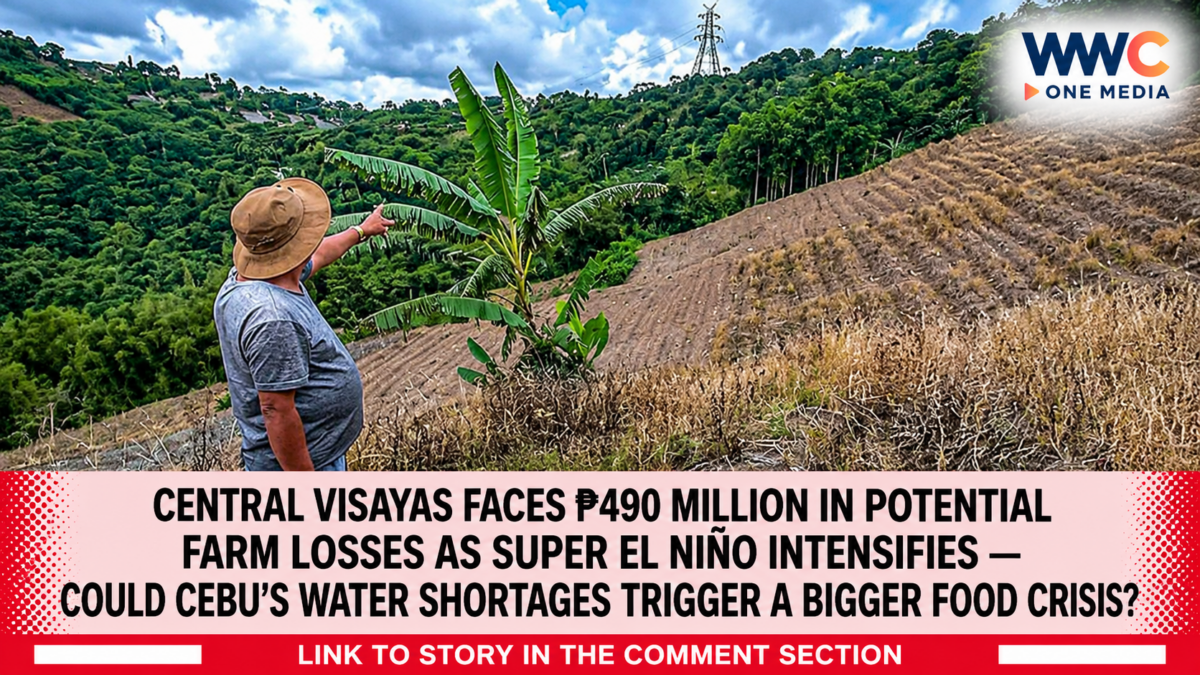
Central Visayas could suffer as much as ₱490 million in agricultural losses if the worsening El Niño phenomenon reaches a worst-case scenario, prompting the Department of Agriculture (DA) to prepare emergency funding, distribute water-storage equipment and urge farmers to shift to crops that can survive with less water.
The warning from the Department of Agriculture in Central Visayas (DA-7) comes as farming communities in Cebu are already reporting water shortages, reduced rainfall and difficulties sustaining vegetable production.
But the ₱490-million figure carries an important distinction: it is a projection of potential damage under a worst-case scenario, not the amount of agricultural losses already confirmed across the region.
DA-7 Field Operations Division Chief Gerry Avila clarified this during a livestreamed media forum on November 10, saying the estimate was based on the agency’s assessments and coordination with local government units (LGUs).
The regional office is also considering a possible ₱291-million emergency response fund, which it may request from the DA central office through the Quick Response Fund if agricultural damage becomes more severe.
However, Avila did not explain how the proposed ₱291-million requirement was calculated or how many farmers could receive assistance.
For farmers who depend on rainfall and limited irrigation, the warning is becoming more urgent. A prolonged dry spell can destroy crops, delay planting schedules, reduce harvests and leave agricultural families without their expected income.
The bigger concern is whether the region can protect its next planting season before water shortages turn into widespread production losses.
₱490 Million Is a Worst-Case Projection, Not Confirmed Damage
DA-7’s latest estimate reflects the potential financial impact of worsening El Niño conditions across Central Visayas.
The agency has been coordinating with LGUs to identify vulnerable agricultural communities, assess water availability and determine what assistance may be needed.
The distinction between projected and recorded damage is critical.
In an earlier report published on October 20, SunStar Cebu said agricultural damage in Central Visayas had already exceeded ₱222 million, affecting approximately 4,000 farmers and 4,246 hectares of agricultural land.
That earlier figure represented damage reported by regional agencies at the time. It should not be added to the new ₱490-million worst-case projection, because the two figures describe different measures and reporting periods.
The October report also identified falling rainfall, declining dam levels and growing pressure on irrigation systems as major concerns.
The latest projection suggests that the financial consequences could become considerably worse if dry conditions persist.
The national picture is also troubling. BusinessMirror reported on November 11 that nationwide agricultural damage from El Niño had reached approximately ₱9.99 billion, affecting 324,327 farmers and 323,419 hectares of agricultural land, based on the Department of Agriculture’s latest bulletin.
That national estimate is separate from the Central Visayas projection and should not be confused with it.
Cebu Farmers Already Struggle to Find Enough Water
The effects of dry conditions are no longer limited to forecasts.
Avila identified Cebu City as among the first local governments to submit agricultural damage assessments, with initial reports dating back to April and May.
The reports involved insufficient water for vegetable production, particularly in upland farming communities.
In response, DA-7 distributed high-density polyethylene (HDPE) pipes and water containers to help farmers access and store whatever water remains available.
Asturias and Tuburan were also identified as areas experiencing reduced rainfall. Dalaguete is among the other farming communities being monitored.
The regional agriculture office is consulting LGUs across Central Visayas to identify vulnerable farms, determine which irrigation systems could experience shortages and establish what support local farmers need.
These measures are particularly important for communities where farming depends on seasonal rainfall, small water sources and irrigation systems with limited storage capacity.
Cebu’s broader water situation adds another layer of concern.
As WWC ONE MEDIA reported in its coverage of Cebu City’s El Niño preparations, Cebu City Braces for El Niño as Water Shortages and Crop Losses Loom, local officials have been examining alternative water sources, irrigation improvements, rainwater harvesting and other measures to protect farms and vulnerable communities.
The agricultural challenge is closely connected to the region’s water security. When households, businesses and farms compete for increasingly limited water supplies, local authorities must carefully manage available resources.
Why Rice and Vegetables Are Particularly Vulnerable
DA-7 is encouraging farmers to reconsider their planting schedules and crop choices as water availability becomes less predictable.
Rice production is particularly vulnerable because the crop requires an adequate and dependable water supply, especially during important stages of growth.
Vegetables with shallow root systems can also suffer during prolonged dry periods because their roots have limited access to moisture deeper in the soil.
Avila said farmers with adequate irrigation may continue planting rice. Those who began their cropping cycle in October may still be able to harvest by December or January, depending on their local conditions.
For farms with limited water, however, DA-7 is recommending rice variety NSIC Rc 418, also known as Sahod Ulan 14, which the agency describes as drought-tolerant.
Farmers who cannot sustain rice production are being encouraged to consider alternatives such as:
- Squash: An alternative vegetable crop that may be suitable for certain areas with limited water.
- Mung beans: A shorter-duration crop that can help farmers adjust their planting plans.
- Cassava: A root crop promoted for marginal farming areas with unreliable water supplies.
- Sweet potato: Another alternative being encouraged in areas where conventional crops may be difficult to sustain.
These alternatives are not guaranteed to succeed under every drought condition. Farmers must still consider soil quality, planting schedules, available moisture, market demand and local agricultural advice.
DA-7 is also promoting mulching, a farming technique that involves covering the soil with dried leaves or other organic materials to reduce evaporation and retain moisture.
Another proposed intervention is the “Gulayan sa Kanal” program, which would allow farmers in vulnerable irrigation areas to grow vegetables along canals and dikes using available irrigation water.
The agency is also coordinating with the National Irrigation Administration to identify irrigation systems that may experience shortages, particularly those serving farms downstream of dams.
Bohol Prepares ₱10 Million Cloud-Seeding Operations
While Cebu faces difficulties in using cloud seeding as a practical intervention, Bohol is preparing its own operations to help increase rainfall and replenish dams.
According to Avila, the Bohol Provincial Government and DA-7 are preparing a combined 82 flight hours for cloud seeding, with an estimated budget of ₱10 million.
The operations will depend on suitable cloud formations and weather conditions.
Cloud seeding involves introducing particles into suitable clouds to encourage the formation of precipitation. It cannot create rain from clear skies, and its effectiveness depends on atmospheric conditions.
Avila said Cebu’s narrow landmass could make the intervention less practical because induced rainfall might fall over surrounding waters instead of agricultural areas.
The proposed operations therefore highlight the importance of tailoring drought interventions to local geography and weather conditions rather than applying the same solution everywhere.
PAGASA Warns Very Strong El Niño Could Continue Into 2027
The growing agricultural risk is connected to the broader climate outlook.
The Philippine Atmospheric, Geophysical and Astronomical Services Administration (PAGASA) began issuing El Niño advisories on June 9, 2026.
By November 4, the weather bureau had announced that a very strong El Niño was present in the tropical Pacific.
The phenomenon increases the likelihood of below-normal rainfall in affected parts of the country, potentially resulting in dry spells, drought and pressure on water resources.
Avila said DA-7 expects the conditions to worsen around March 2027 and potentially persist until May, citing an outlook discussed with PAGASA.
This does not mean every province will experience identical rainfall conditions or that rain will completely disappear. Local weather systems can still bring rainfall, but prolonged deficits can make water supplies increasingly difficult to maintain.
For Cebu, the threat extends beyond farms.
In its recent coverage, Cebu Prepares Water Rationing as Super El Niño Threatens Supply, WWC ONE MEDIA examined preparations for possible water rationing, including emergency deliveries to vulnerable communities and efforts to develop additional water sources.
The situation demonstrates how the same climate event can affect household water access, agricultural production and essential services at the same time.
Farmers Urged to Prepare Livestock and Protect Their Investments
The DA’s preparations also cover livestock raisers, who could face additional problems as temperatures rise and water supplies become more difficult to secure.
The agency is advising livestock owners to maintain sufficient drinking water, provide necessary vitamins and vaccines, and prepare enough animal feed.
Silage production is among the measures being encouraged to help secure feed supplies during periods when pasture and other feed sources become less reliable.
Farmers who experience crop or livestock damage are also being urged to report their losses to their respective LGUs.
The process begins with official Damage and Loss Assessment forms. Local authorities document the affected farms and submit reports for validation before they are forwarded to the DA central office.
Avila said assistance may include agricultural inputs based on verified damage to crops and livestock rather than automatic direct cash payments.
This distinction matters because reporting damage does not guarantee that every farmer will receive the same type or amount of assistance.
The DA also encouraged farmers to enroll in the Philippine Crop Insurance Corporation’s agricultural insurance program to help protect their investments against drought and other covered disasters.
WWC ONE MEDIA previously examined the importance of timely damage reporting in its report, Davao Farmers Warned to Report El Niño Damage Immediately — Could Delayed Reporting Cost Them Government Assistance and Insurance Claims?.
Although that report focused on Davao, the principle is relevant to Central Visayas: early documentation and coordination with local agriculture offices can help authorities assess losses and determine eligibility for available assistance.
National Food Supply Faces Additional Pressure
The potential damage in Central Visayas comes at a time when the Philippines is already confronting broader agricultural challenges.
The Philippine Information Agency reported on October 19 that DA-7 considered the region’s rice, pork, chicken and egg supplies sufficient through December.
However, the region’s rice production remains below its annual consumption requirements.
Central Visayas produced approximately 248,000 metric tons of rice in 2025, while the region requires around 530,000 metric tons annually. Imported rice helps fill the difference.
The regional office also reported that 74,890 metric tons of imported rice from Thailand, Vietnam and Myanmar arrived between August and October 2026, with additional shipments expected.
These figures show why protecting local agricultural production matters even when supplies are currently considered sufficient.
A region that relies on imports to cover a significant share of its rice requirements could become more exposed if domestic production declines while weather-related problems affect other producing areas.
WWC ONE MEDIA examined this wider issue in its report, Philippines May Import Up to 5 Million Tons of Rice — But the Bigger Food-Security Risk Could Come Next.
The article explored the government’s efforts to maintain rice reserves amid weather-related production risks and uncertainty over future harvests.
The concern is not that a food shortage is already inevitable. Rather, continued agricultural losses could make the country’s dependence on imports and emergency supply management more consequential.
Can Irrigation Projects Help Prevent the Next Harvest From Failing?
The Central Visayas situation also highlights the importance of long-term water infrastructure.
Emergency pipes, containers, crop substitutions and cloud seeding can help address immediate problems. But farmers also need dependable irrigation and water storage if they are to maintain production through repeated dry periods.
A recent example from another part of the country is the ₱30.57-million Bulo-Magasusu Small Water Impounding Project in Tabuk City, Kalinga.
As WWC ONE MEDIA reported in ₱30.57-Million Kalinga Irrigation Project Ends Farmers’ 15-Year Wait for Water — But Can It Protect Their Harvests From El Niño?, the facility is expected to provide irrigation for 85 hectares of agricultural land cultivated by 35 farmers.
The project is not a direct solution for Central Visayas, but it illustrates how water storage and irrigation infrastructure can help communities reduce their dependence on rainfall.
For Cebu and Bohol, similar long-term planning may be necessary, particularly in areas where farms depend on small irrigation systems and vulnerable water sources.
The Bigger Question: Will ₱291 Million Be Enough to Protect Central Visayas Farmers?
DA-7’s preparations show that the region is taking the threat seriously.
The proposed ₱291-million emergency response fund, drought-tolerant crop recommendations, water-storage equipment, irrigation monitoring and Bohol’s cloud-seeding preparations are all intended to limit the impact of worsening dry conditions.
But important questions remain unanswered.
The agency has not yet explained the detailed computation behind the proposed emergency funding requirement or identified how many farmers could benefit if the request is approved.
The actual scale of agricultural damage will also depend on rainfall, water availability, crop conditions and the effectiveness of interventions in individual communities.
For farmers, the consequences are immediate: a failed harvest can mean lost income, unpaid production costs and fewer resources for the next planting cycle.
For consumers, prolonged agricultural disruption could eventually put additional pressure on food supply and prices, although the size and timing of any effect will depend on actual production losses and market conditions.
Central Visayas is not yet facing a confirmed ₱490-million agricultural loss under the latest worst-case estimate. But the warning is serious enough to demand preparation before damage becomes irreversible.
The coming months will test whether government assistance, irrigation measures and changes in planting strategies can protect the region’s farms.
Will Central Visayas manage to save its next harvest before El Niño reaches its peak—or could the region’s ₱490-million warning become the beginning of a much larger agricultural and food-security crisis?