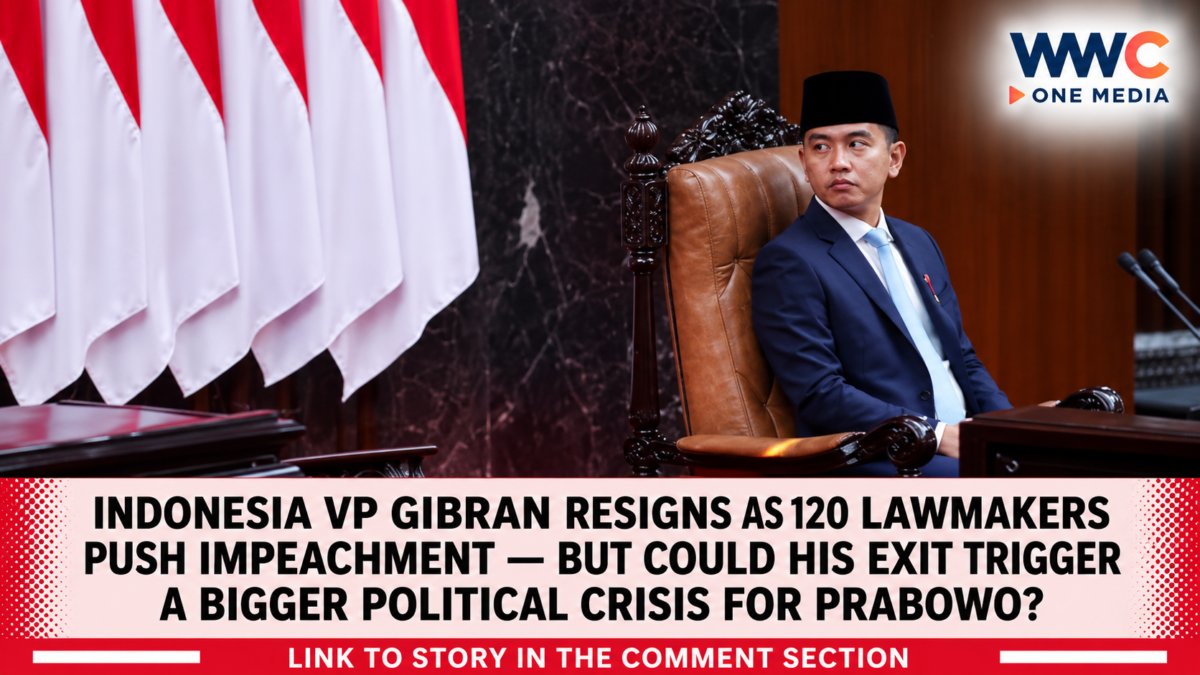
Indonesia is facing a major political shake-up after Vice President Gibran Rakabuming Raka submitted his resignation to President Prabowo Subianto, just as 120 lawmakers moved to challenge his eligibility for office over controversial education credentials.
The development marks a dramatic escalation in a political dispute that has increasingly strained the relationship between Prabowo and former president Joko Widodo, widely known as Jokowi, who is Gibran’s father.
Gibran’s political aide, Budi Arie Setiadi, confirmed on November 11 that the vice president had tendered his resignation to Prabowo.
The confirmation followed an earlier announcement that Gibran had expressed his intention to step down during a meeting with the president on November 10.
According to Reuters, two sources connected to Indonesia’s parliamentary upper house also said Gibran was expected to submit a formal resignation letter to the relevant legislative body on Thursday, November 12.
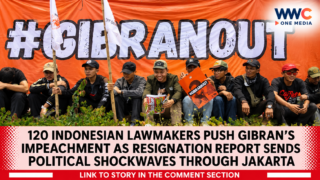
The development comes as 120 lawmakers from eight political parties submit a petition seeking his impeachment, arguing that recent court decisions have undermined the educational qualifications he used to run in the 2024 presidential election.
But Gibran’s departure is not simply a personnel change within Indonesia’s government.
It could reshape the political alliance that helped bring Prabowo to power, weaken Jokowi’s influence and create another major test for Southeast Asia’s largest democracy.
The central question now is whether Indonesia is witnessing the end of Gibran’s vice presidency or the beginning of a much larger political confrontation.
Gibran’s Resignation Confirmed by Aide After Meeting With Prabowo
The resignation controversy began on November 10, when State Secretary Prasetyo Hadi disclosed that Gibran had expressed his intention to resign during a meeting with Prabowo.
The discussion reportedly lasted approximately two and a half hours.
According to Prasetyo, Gibran raised his intention to step down amid developments involving decisions by Indonesia’s Constitutional Court and Supreme Court concerning his educational documents.
However, the president reportedly advised Gibran to continue pursuing legal avenues to establish the validity of his qualifications.
Gibran subsequently described Prabowo as a father figure and acknowledged receiving advice from the president.
The situation changed on November 11, when Gibran’s aide Budi Arie Setiadi confirmed that the vice president had submitted his resignation to Prabowo.
Budi Arie, who also chairs Projo, a political volunteer organisation associated with Jokowi, confirmed the development to journalists.
South China Morning Post subsequently reported that Gibran had handed his resignation letter to Prabowo at Halim Perdanakusuma Airport in Jakarta.
The confirmation represents a significant change from the previous day’s announcement, when Gibran’s resignation was still described as an intention.
However, the submission of the resignation to Prabowo should not automatically be confused with the completion of the constitutional process for filling the vice-presidential vacancy.
The formal legislative steps remain important in determining the legal consequences and timing of his departure.
120 Indonesian Lawmakers Push for Gibran’s Impeachment
Even as Gibran’s resignation moved forward, pressure from Parliament continued to intensify.
Approximately 120 lawmakers representing eight political parties submitted a petition seeking to challenge his eligibility to remain vice president.
The lawmakers argued that Gibran no longer satisfied the constitutional requirements for the position following recent judicial decisions concerning his education credentials.
According to ANTARA, the lawmakers supporting the initiative came from:
- Indonesian Democratic Party of Struggle (PDI-P)
- Golkar Party
- Gerindra Party
- NasDem Party
- National Awakening Party (PKB)
- Prosperous Justice Party (PKS)
- National Mandate Party (PAN)
- Democratic Party
The petition is particularly significant because it includes representatives from parties within Prabowo’s governing coalition.
PDI-P, meanwhile, announced that all 110 of its lawmakers supported invoking Parliament’s constitutional right to express an opinion.
This mechanism can become an initial step toward impeachment proceedings if lawmakers establish grounds for alleging a constitutional violation.
The House leadership scheduled a plenary session for November 12 to consider advancing the proposal.
However, a petition or parliamentary motion does not automatically remove a vice president.
Indonesia’s constitutional framework requires several stages of examination and decision-making before impeachment can be completed.
The resignation and impeachment efforts are therefore separate developments, even though both concern Gibran’s political future.
The Education Scandal Behind Indonesia’s Political Crisis
At the centre of the controversy are two important court developments involving Gibran’s educational qualifications.
The first came on October 6, 2026, when Indonesia’s Constitutional Court dismissed a petition seeking to challenge his eligibility following the 2024 presidential election.
Although the court dismissed the petition, its reasoning raised questions about the evidence presented regarding Gibran’s overseas education.
The court said it had not found convincing documentation establishing that he possessed a foreign diploma or equivalent qualification demonstrating completion of senior high school.
Indonesian election law requires presidential and vice-presidential candidates to have completed senior high school or an equivalent educational level.
The second development came on October 30, when the Supreme Court ruled against the validity of the high-school equivalency certificate used by Gibran in connection with his 2024 candidacy.
The Supreme Court reversed the earlier appellate decision and annulled the certificate.
It also instructed the education authorities to withdraw the document.
The rulings intensified questions about whether the documentation submitted during the election registration process satisfied Indonesia’s legal requirements.
However, there is an important distinction between the two court decisions.
The Constitutional Court dismissed the petition seeking to invalidate Gibran’s election victory, while the Supreme Court addressed the validity of the administrative equivalency certificate.
Neither decision automatically removed Gibran from the vice-presidency.
That distinction is crucial because his removal would require the appropriate constitutional process.
Gibran has maintained that he wants an opportunity to establish the validity of his educational documents through legal proceedings.
Why Gibran’s Candidacy Was Controversial From the Beginning
Gibran, 39, is the eldest son of former Indonesian president Joko Widodo.
Before becoming vice president, he served as mayor of Surakarta, also known as Solo, in Central Java.
His candidacy attracted national controversy in 2023 after Indonesia’s Constitutional Court changed the interpretation of the minimum age requirement for presidential and vice-presidential candidates.
At the time, candidates generally needed to be at least 40 years old.
The court introduced an exception allowing individuals younger than 40 to run if they had previously held or were holding elected public office.
Gibran qualified under that exception because he was serving as mayor.
However, the ruling attracted criticism because the court was then led by Anwar Usman, Gibran’s uncle and Jokowi’s brother-in-law.
The controversy intensified accusations of political favouritism and concerns about the influence of family relationships in Indonesia’s political institutions.
Gibran subsequently joined Prabowo’s presidential ticket, which won the 2024 election.
His current education controversy has now reopened questions surrounding the legal requirements and circumstances of his rise to national office.
Prabowo and Jokowi’s Political Alliance Faces Its Biggest Test
Gibran’s resignation is particularly significant because of the political relationship between Prabowo and Jokowi.
The two leaders once stood on opposite sides of Indonesia’s presidential elections.
Prabowo lost to Jokowi in both the 2014 and 2019 presidential elections before eventually joining his administration as defence minister.
Their political relationship changed ahead of the 2024 election, when Jokowi supported Prabowo’s presidential campaign.
The decision to select Gibran as Prabowo’s running mate helped establish a political alliance between the two influential figures.
However, that relationship has increasingly come under strain.
Differences over government appointments, political influence, economic priorities and the direction of major government programmes have contributed to speculation about a widening divide.
The Gibran controversy now places Prabowo in a difficult position.
If Parliament continues pursuing impeachment proceedings, the president could face pressure from different political groups within his own governing coalition.
If Gibran’s resignation proceeds, Jokowi could also lose an important political position through which his family remains connected to the national administration.
For Prabowo, the challenge is to maintain political stability without allowing the dispute to undermine his governing coalition.
WWC ONE MEDIA previously examined this developing relationship in Indonesia Parties Weigh Parliamentary Inquiry Into Vice President Gibran’s Education Credentials as Prabowo-Jokowi Rift Deepens.
The latest resignation development could make the political divisions discussed in that report considerably more consequential.
Wiretapping Scandal Adds Another Layer to Indonesia’s Political Turmoil
The dispute surrounding Gibran is unfolding alongside a separate investigation involving alleged illegal surveillance targeting Prabowo and other prominent figures.
Indonesian authorities have investigated allegations that senior police officials were involved in a wiretapping operation.
The controversy attracted further attention after former national police chief Listyo Sigit Prabowo was arrested in connection with the investigation.
Listyo had previously served under Jokowi and was regarded as close to the former president.
Prabowo subsequently removed him from his position as presidential chief of staff.
The development intensified speculation about political divisions within the government and the relationship between the current president and his predecessor.
However, the wiretapping investigation and Gibran’s education controversy remain separate matters.
There is no established evidence that the two cases form part of a coordinated political operation.
WWC ONE MEDIA previously reported on the surveillance controversy in Indonesia Considers Presidential Palace Bug Sweeps After Explosive Wiretapping Scandal — Police Generals Accused of Spying on Prabowo.
The overlapping political developments have nevertheless added to the pressure facing Prabowo’s administration.
What Happens If Gibran’s Resignation Takes Effect?
Gibran’s resignation raises an important constitutional question: who would choose Indonesia’s next vice president?
Under Article 8, paragraph 2 of Indonesia’s 1945 Constitution, if the vice-presidential office becomes vacant, the People’s Consultative Assembly, or MPR, elects a replacement from two candidates proposed by the president.
The process is different from a direct nationwide election.
Prabowo would nominate two candidates, and the MPR would elect the person who would serve the remainder of the presidential term.
The constitutional framework provides for the election to take place within 60 days after the vacancy occurs.
This means the replacement would not automatically be selected by the president alone.
The legislative process would also introduce new political negotiations involving the parties represented in the MPR.
Prabowo would need to consider the balance of political support within his coalition while identifying candidates capable of securing the necessary votes.
However, the replacement process should not be treated as already completed.
The resignation must proceed through the applicable constitutional framework before the vice-presidential vacancy and succession process can be finalised.
Could Indonesia’s Political Uncertainty Affect Investor Confidence?
The developments surrounding Gibran are also important beyond the political establishment.
Indonesia is Southeast Asia’s largest economy, with significant influence over regional trade, investment, manufacturing, energy and commodity markets.
Political uncertainty involving the president and vice president can create questions about policy continuity and the stability of government institutions.
Reuters has reported that investor sentiment toward Indonesia has weakened amid concerns about government fiscal policies, economic direction and potential changes in the country’s market outlook.
The political dispute comes as Prabowo’s administration faces scrutiny over major government programmes, including its free school meals initiative.
The administration must also maintain confidence among investors while addressing economic pressures and questions surrounding government spending.
A prolonged leadership dispute could create additional uncertainty if political disagreements begin affecting policymaking and institutional cooperation.
However, it would be premature to attribute specific market movements directly to Gibran’s resignation without further financial evidence.
The broader concern is whether the political dispute will remain contained or develop into a more serious challenge to government stability.
What Happens Next in Indonesia’s Leadership Crisis?
Several developments could determine how the situation unfolds.
First, attention will turn to the formal submission and processing of Gibran’s resignation through the relevant constitutional institutions.
Second, Parliament’s scheduled proceedings on November 12 could clarify whether lawmakers will continue pursuing the impeachment mechanism despite the reported resignation.
Third, the government will need to address the political consequences of a possible vacancy in the vice-presidential office.
The relationship between Prabowo and Jokowi will also remain under scrutiny as their political interests increasingly appear to diverge.
For Gibran, the immediate question is whether he will continue pursuing legal proceedings concerning his education documents even as his resignation moves forward.
For Prabowo, the challenge is considerably larger.
He must preserve political stability, maintain coalition support and manage the consequences of losing the vice president who was central to his 2024 electoral partnership with Jokowi.
The Bottom Line: Gibran’s Resignation Could Change Indonesia’s Political Balance
Gibran Rakabuming Raka’s resignation has become one of the most significant political developments facing Indonesia’s government in 2026.
What began as a dispute over educational documentation has developed into a confrontation involving the judiciary, Parliament, the presidency and two of the country’s most influential political families.
The aide’s confirmation that Gibran submitted his resignation to Prabowo marks a major turning point.
But the formal constitutional consequences, the parliamentary proceedings and the selection of a potential replacement remain critical developments to watch.
The biggest question is no longer simply whether Gibran will leave office.
It is whether his departure will bring an end to Indonesia’s political controversy or expose deeper divisions within the alliance that brought Prabowo to power.
And with 120 lawmakers already challenging his eligibility, the consequences could extend far beyond the vice-presidential office.