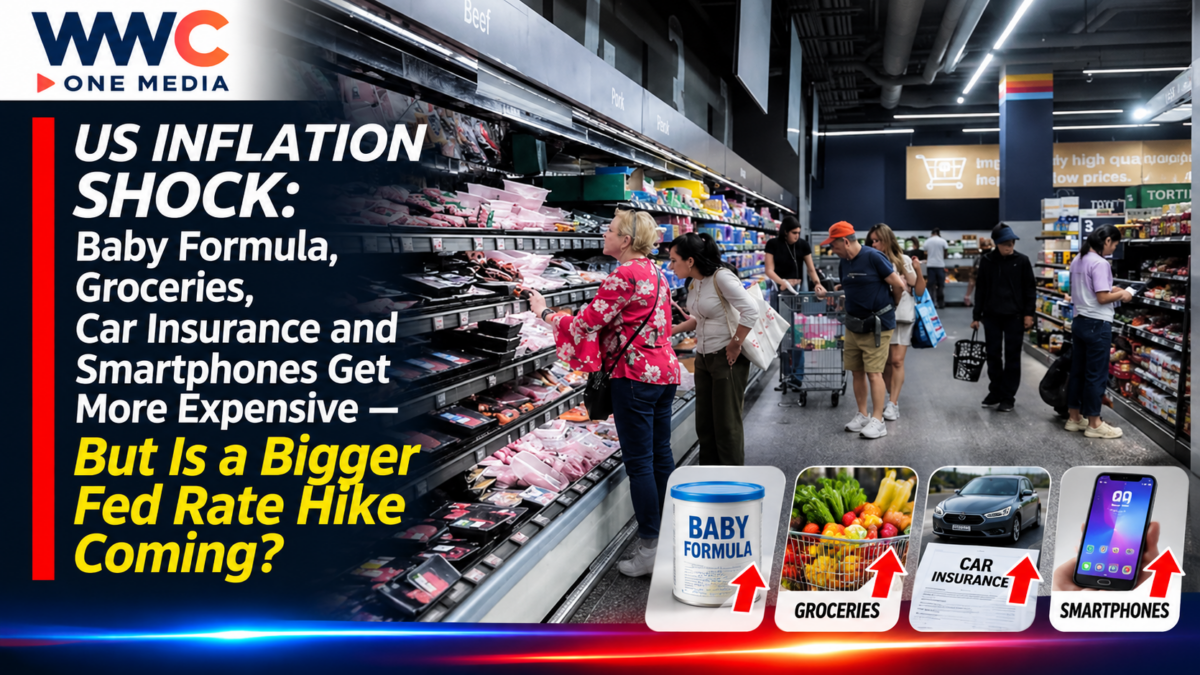
WASHINGTON, D.C. / MANILA, Philippines — November 11, 2026 — American consumers are facing another wave of rising living costs after fresh government data revealed unexpectedly strong price increases across essential groceries, baby formula, public transportation, automobile insurance, healthcare and consumer electronics.
The latest Consumer Price Index (CPI), released by the U.S. Bureau of Labor Statistics on November 10, showed that consumer prices increased 0.4% in October, exceeding economists’ expectations of 0.3%.
Although the monthly inflation rate slowed from September’s 0.6%, the smaller-than-expected improvement has renewed fears that the Federal Reserve may need to raise interest rates more aggressively to control persistent price pressures.
Some of the sharpest increases appeared in categories that households cannot easily avoid.
Public transportation costs climbed 2%, infant food and formula prices recorded their largest monthly increase in the available data, and smartphone prices experienced their biggest monthly jump since the category began being tracked separately in 2020.
The inflation surprise also rattled financial markets, sending U.S. Treasury yields higher while Wall Street stocks declined.
The big question now is whether these price increases represent another temporary shock—or a warning that America’s cost-of-living crisis could worsen before the Federal Reserve brings inflation under control.
US Inflation Hits 0.4% as Economists Underestimate Price Pressures
The October CPI report delivered another setback for hopes that inflation was easing quickly.
According to the Bureau of Labor Statistics, the overall consumer price index increased 0.4% on a seasonally adjusted basis.
Economists surveyed by Reuters had anticipated a smaller 0.3% increase.
Core CPI, which excludes volatile food and energy prices, also increased 0.3%, exceeding the commonly reported forecast of 0.2%.
The figures suggest that inflation remains stubborn across important parts of the American economy.
Food, housing, insurance, healthcare and transportation continue placing pressure on household budgets.
However, an important distinction must be made: October inflation was slower than September’s 0.6% monthly increase.
The concern is not that the headline monthly inflation rate accelerated. It is that prices rose faster than economists expected.
That distinction helps explain why financial markets reacted negatively despite a lower headline reading.
As previously covered by WWC ONE MEDIA in its November 8 inflation forecast, analysts had been watching for a moderation in price pressures following September’s energy-driven inflation surge.
The latest figures show that inflation has not yet eased as much as expected.
Baby Food and Infant Formula Record Historic Price Jump
One of October’s most alarming developments involved baby food and infant formula.
According to the Bureau of Labor Statistics, the combined baby food and formula price index rose 5.1% during the month on an unadjusted basis, marking the largest monthly increase in the available historical series.
Reuters also identified the category as having registered a record increase.
For parents of infants, the price surge could be particularly difficult.
Unlike discretionary purchases such as electronics or entertainment, infant nutrition is an essential expense.
Families relying on formula may have limited flexibility to delay or reduce spending.
The increase was also much larger than broader grocery inflation.
Overall food prices rose 0.5% in October, while food purchased for consumption at home increased 0.4%, both on a seasonally adjusted basis.
The difference is striking, although the figures use different seasonal-adjustment treatments and should not be interpreted as perfectly equivalent measures.
The latest development builds on wider concerns about the affordability of everyday essentials.
In related coverage, WWC ONE MEDIA examined the record 5.1% increase in baby food and formula prices, highlighting the financial consequences for families already managing rising grocery and housing expenses.
The October figures demonstrate how unusually large price movements in individual necessities can create greater hardship than the broader inflation average suggests.
Grocery Prices Rise at Fastest Pace in Six Months
American consumers also paid more for food in October.
The overall food index increased 0.5%, its strongest monthly advance in six months.
Food purchased at grocery stores increased 0.4%, while food consumed away from home, including restaurant meals, became 0.5% more expensive.
The price increases were spread across several grocery categories.
Government data showed the following seasonally adjusted monthly changes:
| Grocery category | October price change |
|---|---|
| Meat, poultry, fish and eggs | +0.5% |
| Dairy products | +0.6% |
| Fruits and vegetables | +0.6% |
| Other food at home | +0.7% |
| Nonalcoholic beverages | -0.3% |
| Cereals and bakery products | 0.0% |
The figures show that not every category experienced higher prices.
However, increases in widely purchased foods can have a significant cumulative effect on household spending.
For families operating on tight budgets, even relatively small monthly increases may become difficult when combined with higher transportation, healthcare and housing expenses.
Public Transportation Costs Jump 2%
Commuters were among the consumers affected by the latest inflation report.
Public transportation prices rose 2% in October from the previous month, according to Reuters.
The increase was driven partly by a sharp rise in intracity transportation costs, including mass-transit fares.
The category recorded its largest monthly increase in six years.
For Americans who rely on buses, trains and other public transportation services, rising fares can place additional pressure on household finances.
Transportation costs are particularly important because commuting is often necessary for employment, education and access to essential services.
Higher fares can also reduce the amount of disposable income available for groceries, utilities and other purchases.
Unlike consumers who can postpone buying new electronics, commuters often have limited alternatives when transportation prices increase.
The broader economic concern is that persistent price increases across essential services can make inflation more difficult to reverse.
Car Insurance Premiums Climb Again
Motorists also faced renewed financial pressure in October.
After a period of easing following several years of substantial increases, motor vehicle insurance prices rose sharply.
Reuters identified automobile insurance as one of the categories experiencing significant upward movement in the latest CPI report.
The increase matters because insurance is generally a recurring expense for vehicle owners.
Premiums can be influenced by repair costs, replacement-part prices, accident claims, vehicle values and insurers’ assessments of risk.
An increase in insurance costs can therefore raise the overall expense of owning a vehicle even when gasoline prices are relatively stable.
For households financing car purchases, insurance premiums add to monthly loan payments, maintenance and fuel costs.
The latest rise demonstrates why consumers may continue experiencing financial pressure even when some individual inflation categories begin to moderate.
Healthcare Services Become More Expensive
Medical care services also recorded their largest monthly price increase in three months.
The category includes services used by households seeking routine treatment, professional consultations and other forms of medical care.
Healthcare inflation can be particularly challenging because patients may have limited control over the timing of necessary treatments.
Rising prices may also create additional pressure on insurance coverage and out-of-pocket spending.
However, healthcare costs differ substantially depending on insurance arrangements, provider networks and the services involved.
A rise in the overall medical care services index should not be interpreted as meaning every patient or every medical service experienced the same price increase.
Nevertheless, the category’s movement reinforces the broader finding that inflation is affecting more than energy and groceries.
Smartphones Record Biggest Monthly Price Increase Since 2020
One of the more surprising developments occurred in consumer electronics.
Smartphone prices posted their largest monthly increase since the Bureau of Labor Statistics began tracking the category separately in 2020.
According to Reuters, smartphone prices have historically recorded more monthly declines than increases.
However, the category has now experienced price increases in four of the past seven months.
The October jump represents a notable reversal for a product category that has often benefited from technological improvements and competitive pricing.
Potential influences on electronics prices include supply-chain costs, import expenses, product mix and manufacturers’ pricing decisions.
However, the CPI release alone does not establish which factors caused October’s unusually large increase.
The development could be relevant to consumers planning to purchase or replace mobile devices.
A higher price index does not mean every smartphone became more expensive, but it signals broader upward pressure within the measured category.
Television Prices Also Record Unusually Large Increase
Television prices followed a similar pattern.
TVs have historically been among the products experiencing long-term price declines, partly reflecting technological improvements and manufacturing efficiencies.
But October brought one of the category’s largest monthly price increases on record, according to Reuters.
That reversal attracted attention because electronics prices have often helped offset inflation elsewhere in the consumer basket.
The unusual movement may reflect changing product prices, promotional patterns or other market conditions.
The available inflation report does not prove that tariffs or supply disruptions were solely responsible.
For consumers, the practical implication is that some products traditionally associated with declining prices are no longer providing the same degree of relief.
Housing and Energy Continue Adding Pressure
Beyond the categories highlighted by Reuters, the October CPI report showed continuing increases in shelter and energy costs.
Shelter prices rose 0.3% during the month and accounted for more than 30% of the increase in the overall consumer price index.
Housing carries significant weight in CPI because accommodation represents a major portion of household spending.
Energy prices increased 0.7% in October, following a much larger 5.2% increase in September.
Gasoline prices rose 1% during October on a seasonally adjusted basis.
Electricity prices increased 0.9%, while fuel oil rose 2%.
The figures show that energy inflation moderated substantially from September but did not reverse.
In previous reporting, WWC ONE MEDIA examined September’s 3.7% annual U.S. inflation rate and the impact of higher gasoline prices.
The latest data indicate that energy remains an important contributor to the cost-of-living outlook, although its monthly impact has changed.
Hot Inflation Report Raises Pressure on the Federal Reserve
The stronger-than-expected inflation report has intensified speculation about the Federal Reserve’s next monetary policy decision.
The central bank aims to bring inflation back toward its 2% objective, measured using the Personal Consumption Expenditures price index.
Although the CPI and PCE indexes use different methodologies, consumer price data provide important evidence for policymakers.
Persistent inflation can encourage the Fed to maintain higher borrowing costs or raise interest rates further.
Higher rates can help restrain spending and credit demand, but they may also increase financing costs for households and businesses.
Mortgage borrowers, car buyers and companies seeking loans may face additional financial pressure when interest rates rise.
According to Reuters, the October CPI release caused financial markets to strengthen expectations of another Fed rate increase in December.
Before the data were released, Federal Reserve Governor Christopher Waller indicated that an unusually strong inflation reading could justify considering a larger interest-rate increase.
However, the Fed has not announced a 50-basis-point December rate hike.
Any decision will depend on incoming data and the Federal Open Market Committee’s assessment of economic conditions.
As WWC ONE MEDIA reported in its coverage of Philadelphia Fed President Anna Paulson’s policy stance, policymakers are debating whether gradual tightening will be enough to contain persistent price pressures.
That debate could become more consequential if upcoming economic indicators continue to exceed expectations.
Wall Street Falls as Bond Yields Surge
The impact of the inflation report was not limited to supermarket shelves and household bills.
Financial markets reacted quickly as investors reconsidered their expectations for U.S. interest rates.
On November 10, Wall Street’s three major indexes closed lower.
The Dow Jones Industrial Average declined 157.86 points, or 0.30%, to 52,231.89.
The S&P 500 fell 0.38% to 7,520.93, while the Nasdaq Composite lost 0.74% to close at 25,065.87.
Treasury yields increased as traders priced in the possibility of tighter monetary policy.
The two-year U.S. Treasury yield, which is particularly sensitive to Federal Reserve expectations, rose approximately 19 basis points.
Higher bond yields can put pressure on equity valuations, particularly those of companies whose market prices depend heavily on expectations of future earnings growth.
Technology shares are often sensitive to changes in borrowing costs and discount rates.
In related coverage, WWC ONE MEDIA has examined how the inflation surprise affected Wall Street and the technology sector.
The market reaction shows that an unexpectedly strong CPI reading can influence not only everyday consumer spending but also investment decisions, financing conditions and global risk appetite.
Why the October Inflation Report Has an Important Data Limitation
An unusual complication affects the interpretation of October’s inflation statistics.
The Bureau of Labor Statistics was unable to publish standard year-over-year inflation readings for many categories because the federal government shutdown in October 2025 prevented normal collection of consumer price data.
That means a complete October 2025 comparison base is unavailable for many CPI series.
The October 2026 report still contains valid monthly inflation measurements.
However, analysts should not treat the October monthly figure of 0.4% as an annual inflation rate.
Likewise, September’s 3.7% year-over-year increase should not be described as October’s annual inflation reading.
This distinction is essential when comparing the latest inflation figures with previous reports.
The lack of standard annual comparisons also means that economists may need to rely more heavily on monthly trends, other available inflation indicators and broader economic evidence.
What US Inflation Could Mean for the Philippines
The latest U.S. inflation data could have implications beyond American households.
Higher Federal Reserve interest rates can influence global financial markets, international capital flows and demand for U.S. dollar-denominated assets.
For the Philippines, tighter U.S. monetary policy may contribute to pressure on the peso, depending on market conditions and investor expectations.
A weaker peso can increase the local-currency cost of imported goods, particularly commodities and products priced in dollars.
These may include petroleum, industrial equipment and certain consumer goods.
Higher U.S. bond yields can also affect financing conditions in emerging markets.
However, the effect is neither automatic nor uniform.
The Bangko Sentral ng Pilipinas makes its own monetary policy decisions based on Philippine inflation, economic conditions and financial stability.
American consumer inflation does not directly determine Philippine inflation.
Still, persistent U.S. price pressures could complicate the international environment facing Philippine consumers, companies and investors.
Could a Bigger Fed Rate Hike Be Coming in December?
The Federal Reserve’s next scheduled policy meeting on December 8–9 will be closely watched.
Investors will be looking for indications of whether policymakers prefer a conventional 25-basis-point increase or believe stronger inflation requires more aggressive action.
But the decision is not settled.
Economic data released before the meeting, including labor market information and other inflation indicators, could alter expectations.
A larger rate hike might signal that policymakers are increasingly concerned about inflation remaining above target.
Conversely, evidence of easing prices or weaker economic activity could support a more gradual response.
For households, both outcomes carry implications.
Persistent inflation reduces purchasing power, while higher interest rates can increase borrowing costs.
The Federal Reserve’s challenge is to balance those risks without unnecessarily damaging employment or economic growth.
The Bottom Line: America’s Cost-of-Living Battle Is Not Over
October’s inflation report revealed an economy where the pace of overall price increases has slowed from September, but important household expenses are still becoming more expensive.
Groceries, transportation, automobile insurance and healthcare services contributed to renewed cost pressures.
Smartphones and televisions also experienced unusual price increases, while baby food and infant formula recorded an especially sharp jump.
The figures reinforce the difficulty of restoring price stability when inflation extends across numerous consumer categories.
For American families, the challenge is immediate: everyday goods and services continue absorbing a larger share of household budgets.
For the Federal Reserve, the challenge is broader: determining whether gradual interest-rate increases can bring inflation under control or whether stronger action will be necessary.
The bottom line is that October’s 0.4% inflation reading was lower than September’s 0.6% but still exceeded expectations—and that surprise has raised the stakes for the Fed’s December meeting.
With families paying more for groceries, infant formula, transportation and healthcare, could another major interest-rate increase finally contain America’s inflation problem—or leave consumers facing an even more difficult financial squeeze?