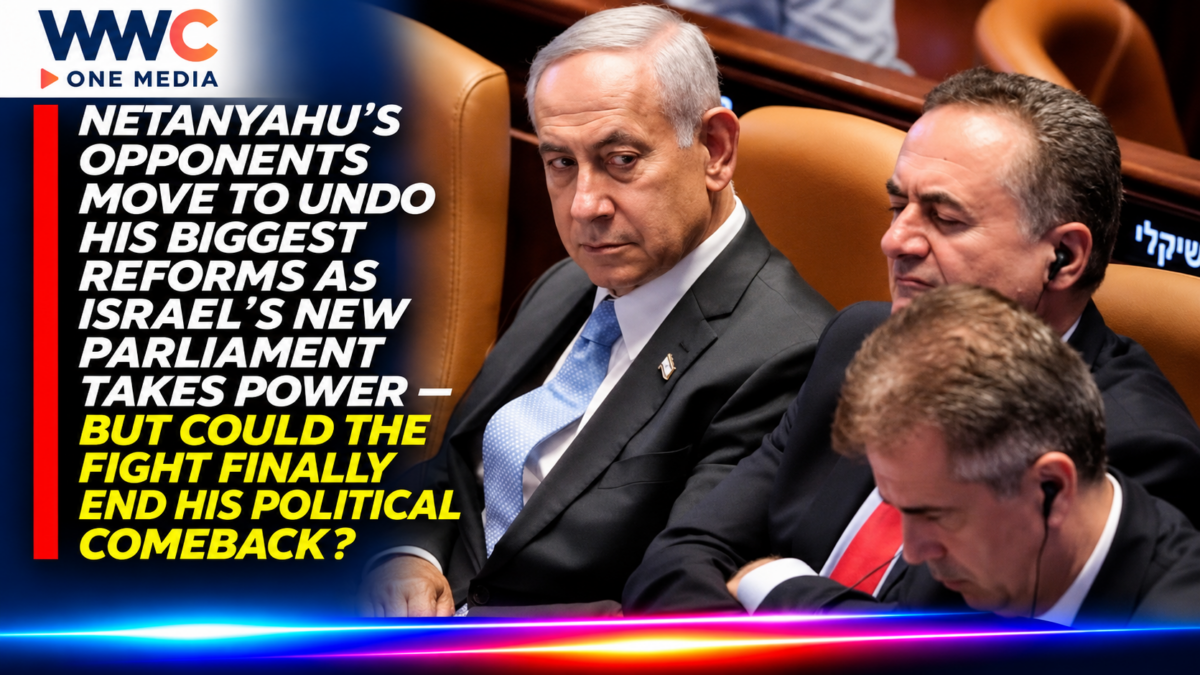
JERUSALEM — November 11, 2026 — Benjamin Netanyahu’s political opponents are moving quickly to dismantle some of the most controversial policies of his government after Israel’s newly sworn-in parliament opened with a series of legislative proposals targeting his political legacy.
The political offensive is being led by former military chief Gadi Eisenkot, whose opposition bloc has begun introducing bills that could reshape Israel’s judiciary, media regulation and system of government.
Among the most consequential proposals are an independent state commission of inquiry into the October 7, 2023, Hamas-led attacks, new term limits for prime ministers and the repeal of major elements of Netanyahu’s judicial overhaul.
The opposition is also seeking to replace Knesset Speaker Amir Ohana, a close Netanyahu ally, with Matan Kahana, a senior member of Eisenkot’s Yashar party.
The developments mark an aggressive opening to Israel’s 26th Knesset, where Netanyahu’s opponents hold a parliamentary majority even though the country has yet to establish a new governing coalition.
But the political transition is far from complete.
Netanyahu remains caretaker prime minister, and Eisenkot still has to negotiate a coalition capable of governing the country.
The biggest question now is whether Netanyahu’s opponents can turn their parliamentary advantage into lasting institutional change—or whether political divisions will prevent them from undoing the policies they have spent years fighting.
Eisenkot’s Bloc Launches Legislative Offensive Against Netanyahu’s Legacy
The first day of the new Knesset on November 10 brought an immediate challenge to Netanyahu’s political record.
Eisenkot’s Yashar party and Yair Golan’s Democrats submitted proposals aimed at reversing several controversial measures introduced by the outgoing government.
According to the Associated Press and The Times of Israel, the proposals include establishing an independent state commission of inquiry into the October 7 attacks, imposing term limits on prime ministers and repealing parts of Netanyahu’s judicial overhaul.
The proposed reversals also target legislation affecting the attorney general’s authority, the composition of the Judicial Selection Committee and the government’s changes to media regulation.
These proposals are significant because they reach beyond ordinary political disagreements. They concern the institutions responsible for overseeing government power, appointing judges, investigating wrongdoing and regulating the country’s media sector.
The opposition’s strategy is to use its parliamentary numbers to advance these measures before the formation of a new government.
However, submitting a bill is only the beginning. Each proposal must still navigate parliamentary procedures, committee discussions and the required votes before it can become law.
October 7 Investigation: Netanyahu Could Face Renewed Questions Over Security Failures
One of the most politically sensitive proposals is the creation of a state commission of inquiry into the October 7, 2023, Hamas-led attack on Israel.
The attack exposed major failures in Israel’s intelligence, military preparedness and national security system.
It killed approximately 1,200 people in Israel and resulted in 251 people being taken hostage, according to widely reported Israeli figures.
The disaster triggered Israel’s military campaign in Gaza and became one of the most consequential events in the country’s modern history.
Since then, families of victims and hostages, opposition politicians and other critics have demanded an independent investigation into how the attack happened and who should be held accountable.
Netanyahu’s government has resisted establishing the type of state commission sought by the opposition, arguing that a panel appointed through the Supreme Court could be biased against the government.
Critics, however, argue that an independent investigation is essential to establish responsibility and prevent similar failures.
Eisenkot’s bloc now wants the new parliament to move forward with an inquiry.
The proposal could place renewed scrutiny on decisions made by Netanyahu’s government before the attack, including intelligence assessments, military readiness and political oversight.
The distinction is important: an investigation would examine responsibility and institutional failures. It would not automatically establish that Netanyahu personally caused or knowingly allowed the attack.
WWC ONE MEDIA previously examined the continuing controversy surrounding allegations that Netanyahu received an advance warning before October 7. The report was disputed by Netanyahu’s office, which strongly denied that he received such a warning.
Read: Netanyahu Faces Political Firestorm Over Report He Was Warned Before October 7 Hamas Attack
Netanyahu’s Judicial Overhaul Faces a Major Reversal Attempt
The opposition’s second major target is Netanyahu’s controversial judicial overhaul.
The proposed changes seek to reverse legislation that critics say weakened judicial independence and gave the political establishment greater influence over the legal system.
The overhaul became one of the most divisive political issues in Israel before the war in Gaza overshadowed much of the domestic debate.
Its opponents argued that the reforms threatened the balance of power between the government, parliament and judiciary.
Supporters of the changes maintained that Israel’s courts had accumulated excessive authority and that elected politicians needed greater influence over judicial appointments and decision-making.
The new proposals seek to reverse several parts of that programme.
One major target is the law changing the composition and powers of the Judicial Selection Committee, which plays a central role in appointing judges.
The previous government’s changes removed the two representatives of the Israel Bar Association and altered the influence of political representatives and judges on appointments.
The opposition argues that reversing these changes would restore greater judicial independence and protect institutional checks and balances.
Another target is legislation affecting the attorney general’s office.
The controversial measure, scheduled to take effect in January 2027, would allow ministers to reject the attorney general’s currently binding legal positions and give the government greater control over appointments and dismissals.
The opposition wants to reverse that change before it takes effect.
The debate is about more than the appointment of judges. It concerns how much power an elected government should have over the institutions responsible for reviewing its decisions.
Media Reform Also Comes Under Fire
The opposition is also targeting Communications Minister Shlomo Karhi’s media overhaul.
The proposed repeal would reverse changes that critics say expand government influence over Israel’s broadcasting and news sector.
The previous government’s reforms sought to restructure media regulation, including rules involving ownership, oversight, journalistic obligations and state advertising.
Critics argue that the changes could weaken independent oversight and increase political influence over broadcasters and news organisations.
Supporters of the reforms have argued that Israel’s media system requires restructuring and that existing regulatory arrangements are outdated.
The opposition now wants to dismantle the measures.
The issue is particularly sensitive because media independence is closely connected to democratic accountability.
A government that has greater influence over media regulation could potentially affect the environment in which political leaders are scrutinised.
However, the proposed repeal does not mean the existing framework has already been abolished. The legislation must still pass through the Knesset.
Prime Ministerial Term Limits Could Change Israel’s Political System
Another major proposal seeks to impose term limits on the office of prime minister.
Netanyahu is Israel’s longest-serving prime minister and has held the position across multiple periods of government.
The proposal would place a new legal limit on how long an individual could serve as head of government.
Supporters argue that term limits could reduce the concentration of political power and prevent a single leader from dominating the political system for extended periods.
But the proposal also raises questions about political accountability and the right of voters to repeatedly elect a leader they support.
The details of the proposed limits, including how many terms would be allowed and whether the measure would apply to a sitting prime minister, remain important issues to watch.
A term-limit bill would also need to survive the legislative process before it could affect future elections.
For Netanyahu, however, the proposal represents another direct challenge to the political system that has allowed him to remain a dominant figure in Israeli politics.
Opposition Wants to Replace Netanyahu’s Ally as Knesset Speaker
The legislative offensive is accompanied by a major institutional power struggle inside parliament.
Eisenkot’s bloc has moved to replace Knesset Speaker Amir Ohana, a senior member of Netanyahu’s Likud party.
The opposition has nominated Matan Kahana, an ally of Eisenkot and a former senior military figure, for the position.
The speaker is more than a ceremonial parliamentary official.
The position carries influence over the Knesset’s legislative agenda, including which proposals are advanced and how parliamentary business is organised.
A speaker backed by the opposition could help accelerate its proposed legislative programme.
The move is therefore strategically important.
By seeking control of the speakership, Netanyahu’s opponents are attempting to strengthen their ability to advance legislation even before a new government takes office.
The Associated Press reported that the opposition had already begun the process of replacing Ohana during the opening parliamentary session.
However, the speaker’s replacement is a separate parliamentary process from the formation of a new government.
Netanyahu’s Opponents Have a Parliamentary Majority—but Coalition Unity Remains Uncertain
The new Knesset has 120 seats, and Netanyahu’s opponents now hold enough parliamentary support to form a majority against his bloc on key votes.
But that does not mean Eisenkot has already secured a governing coalition.
The October 27 election produced a divided political landscape.
Netanyahu’s religious-nationalist bloc won 53 seats, while Eisenkot’s four-party Jewish-led opposition alliance secured 48.
The two Arab-led parties won a combined 19 seats.
Together, Eisenkot’s alliance and the Arab-led parties could potentially command 67 lawmakers.
However, the parties do not agree on every issue, and some Jewish-led opposition figures have expressed reservations about relying on Arab parties for government formation.
The distinction between a parliamentary majority on specific legislation and a stable governing coalition is crucial.
Parties can cooperate to remove a speaker or pass a particular bill without necessarily agreeing to serve together in government.
That political reality could complicate Eisenkot’s effort to become prime minister.
As WWC ONE MEDIA previously reported, Arab-led parties have become important potential partners in the effort to end Netanyahu’s political dominance.
Read: Arab Parties Back Gadi Eisenkot in Bid to Oust Netanyahu as Israel’s Political Deadlock Deepens
Netanyahu Remains Caretaker Prime Minister and Retains National Security Authority
Despite the opposition’s legislative push, Netanyahu has not yet left office.
He continues to serve as caretaker prime minister while Eisenkot attempts to assemble a new government.
That means Israel is entering an unusual political period in which a new parliament can pursue legislation while the outgoing prime minister and his cabinet remain in control of the executive branch.
Netanyahu retains authority over national security and the military, although court-imposed restrictions limit certain aspects of his powers.
This distinction is particularly important because Israel continues to face serious security and diplomatic challenges.
The Gaza conflict, tensions involving Lebanon and the wider confrontation with Iran remain central to the country’s national security agenda.
A parliamentary majority does not automatically transfer executive authority to the opposition.
Until a new government is formed, Netanyahu remains responsible for leading the country’s existing administration.
Eisenkot Has Up to Six Weeks to Form a New Government
Eisenkot’s political challenge is unfolding alongside the legislative offensive.
The former military chief has been given the opportunity to form Israel’s next government following the election.
He initially has 28 days to assemble a coalition, with a possible extension of up to 14 additional days.
That creates a maximum period of approximately six weeks.
If he fails, President Isaac Herzog may give another lawmaker the opportunity to form a government.
Netanyahu could therefore receive another chance to return to the centre of coalition negotiations.
The situation remains politically complicated because Eisenkot’s potential partners disagree over issues including Arab-party cooperation, military service, religious policy and national security.
According to Le Monde, Eisenkot’s allies are also considering ways to attract ultra-Orthodox parties, which could require compromises over military-service legislation.
The negotiations could ultimately determine whether the opposition’s parliamentary majority becomes a functioning government or remains a temporary alliance built around opposition to Netanyahu.
Could a New Government Change Israel’s Policy Toward Gaza and the West Bank?
A change in government could influence Israel’s future military, diplomatic and domestic policies.
However, the current legislative proposals do not automatically signal an immediate change in military operations.
Eisenkot is a former military chief, and his political positions should not be assumed to match those of every party supporting his attempt to form a government.
The composition of any future coalition will be crucial.
Arab-led parties have raised issues involving Palestinian citizens of Israel, public safety and political representation.
Other opposition parties have focused on judicial independence, national security and accountability for the October 7 attacks.
The parties may agree that Netanyahu should no longer lead the government while disagreeing sharply over what should happen next.
The occupied West Bank and the future of Gaza will also remain major challenges.
WWC ONE MEDIA has previously reported on the continuing security situation in the West Bank, including Israeli military operations and their consequences for Palestinian communities.
Read: Israel Launches Massive West Bank Military Operation After Two Soldiers Are Killed
The international debate surrounding Israel’s military campaign in Gaza is another important part of the country’s political environment.
Read: Netanyahu Rejects Gaza Genocide Allegations at UN as Delegates Walk Out During Speech
A future government could adopt different diplomatic positions, but no specific policy reversal should be assumed before a coalition agreement and official decisions are announced.
Why These Proposed Reforms Matter Beyond Netanyahu
The legislative battle is about more than the political future of one prime minister.
It concerns the structure of Israeli democracy and the relationship between elected officials and independent institutions.
The judicial overhaul debate raises questions about the limits of government power.
The proposed media changes concern the independence of journalism and broadcasting.
The October 7 inquiry raises questions about public accountability and national security.
The term-limit proposal challenges the concentration of executive power.
Together, these issues could shape Israel’s political institutions for years.
Even if Netanyahu eventually leaves office, the debate over how much power the government should hold over the judiciary, media and law enforcement will not disappear.
The outcome will depend on whether the new parliament can turn its proposed reforms into legislation and whether a future government is willing to implement them.
The Bottom Line: Netanyahu’s Political Legacy Is Under Attack, but the Reversal Is Not Guaranteed
Israel’s new parliament has opened with a major challenge to Netanyahu’s political legacy.
Eisenkot’s bloc is pushing for an independent October 7 inquiry, judicial reform reversals, prime-ministerial term limits and the repeal of controversial media legislation.
The opposition is also seeking to replace Netanyahu’s ally as Knesset speaker, potentially giving it greater control over the legislative agenda.
These developments demonstrate that Netanyahu’s opponents are not waiting for a new government to begin challenging his policies.
But the proposals remain at the beginning of the legislative process.
Netanyahu is still caretaker prime minister, the new coalition has not been finalised, and political disagreements among his opponents could complicate their plans.
The next six weeks could determine whether Israel enters a new political era or faces another prolonged struggle over who governs the country.