MADRID, Spain — November 11, 2026
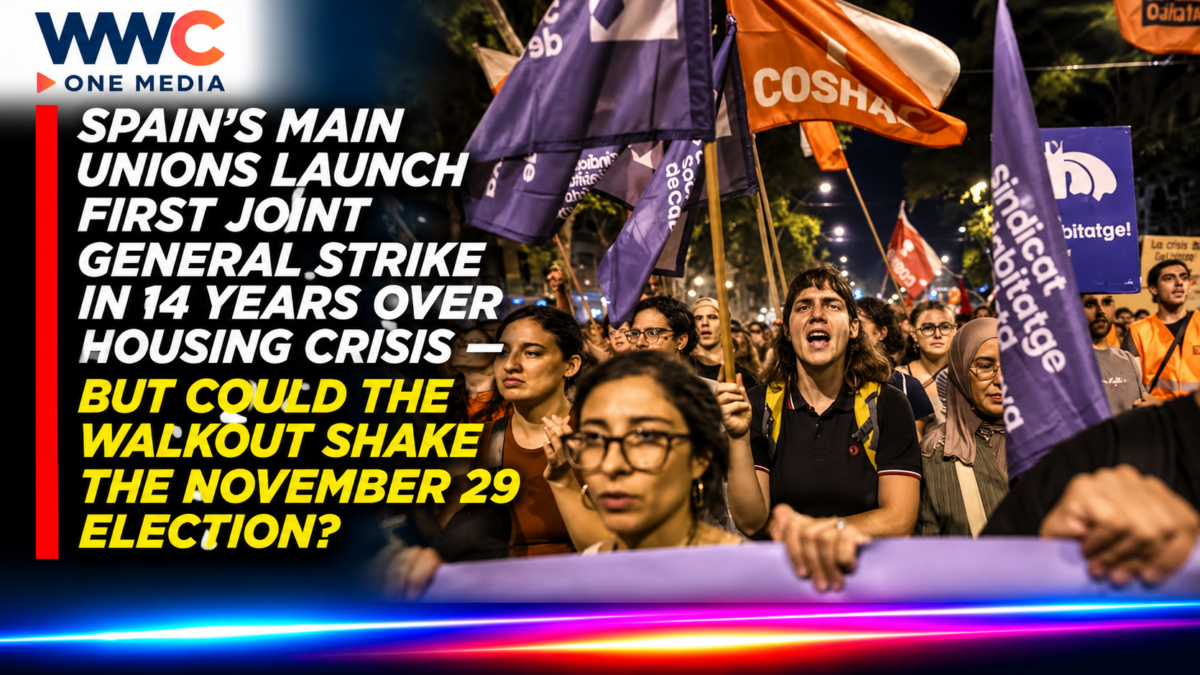
Spain has entered a major day of labor unrest as workers, trade unions and housing activists stage a nationwide 24-hour strike demanding affordable homes, better wages and relief from rising living costs.
The walkout, backed by Spain’s two largest trade union federations, the General Union of Workers (UGT) and Workers’ Commissions (CCOO), is putting the country’s worsening housing crisis at the center of a political battle just 18 days before the November 29 snap general election.
It is the first nationwide general strike jointly backed by the two major unions in 14 years.
The action carries a simple but powerful message: Salaries. Housing. Prices.
Workers argue that earning a salary is no longer enough to guarantee access to decent housing, particularly in major cities where rents and property prices have risen far faster than many household incomes.
The Associated Press reported widespread early stoppages in several important industries, including automotive manufacturing, ports, meat processing, waste collection and energy.
The unions said participation reached 90% in automotive and port operations, 85% in meat processing, 82% in waste collection and 75% in energy. These are figures reported by the unions and should not be interpreted as independently verified national participation rates.
Roadblocks and minor confrontations were also reported during the first hours of the walkout.
But the strike is about much more than workplace conditions.
It reflects a growing frustration among Spaniards who feel that housing has become increasingly inaccessible, even for people with stable employment.
And with a national election approaching, the walkout could become a defining moment for Prime Minister Pedro Sánchez’s government.
Spain’s First Major Joint Union Strike in 14 Years Puts Housing at the Center
The November 11 action brings together labor organizations and housing activists demanding changes that extend beyond traditional salary negotiations.
UGT and CCOO are calling for stronger government intervention in housing, better wages and measures to make rental and homeownership costs more manageable.
Their demands include higher salaries, a permanent supply of protected public housing, limits on rental prices and stronger implementation of Spain’s housing legislation.
Housing campaigners are also pushing for restrictions on tourist apartments, action against property speculation and stronger protection against eviction.
The strike is scheduled as a 24-hour nationwide stoppage, although minimum-service requirements mean that essential services will continue operating.
Transport, schools, healthcare facilities, businesses and industrial operations may experience different levels of disruption depending on the region and employer.
Al Jazeera reported before the walkout that reduced transport capacity and disruption to public services were expected across the country.
The strike’s political significance is also considerable.
The last time UGT and CCOO jointly backed a nationwide general strike was in 2012, during Spain’s austerity crisis.
This time, the central issue is whether ordinary workers can still afford to live in the cities where they work.
Maricarmen Abascal’s Eviction Became the Symbol of Spain’s Housing Emergency
The anger behind the strike intensified following the eviction of 87-year-old Maricarmen Abascal from her longtime Madrid home on September 23.
Images of the elderly woman being removed from the property on a stretcher, surrounded by police and housing activists, triggered widespread public outrage.
According to reporting by Reuters and Al Jazeera, Abascal had lived in the apartment for more than seven decades before being evicted following a dispute involving a proposed rent increase after the property was acquired by an investment fund.
She died days after the eviction.
Her case quickly became a national symbol of the difficulties facing vulnerable renters, older residents and younger households struggling to secure affordable accommodation.
For housing activists, the incident exposed a deeper problem: people who have spent decades building their lives in one home can still face displacement when rental costs become unaffordable.
The protests spread beyond Madrid, with demonstrators calling for stronger tenant protections and greater government intervention.
The case also gave the housing movement a powerful human story at a moment when the issue was becoming increasingly important to Spanish voters.
Spain Has a Housing Shortage of Around 750,000 Homes
The crisis is not simply about landlords charging higher rents.
Spain also faces a serious shortage of homes in the places where people need them.
According to the Bank of Spain, the country has a housing deficit of approximately 750,000 homes. Reuters reported in October that the shortage could exceed one million by 2028 if construction continues to fall behind demand.
The imbalance is particularly serious in major cities, metropolitan areas and popular coastal destinations.
The problem has been compounded by population growth, household formation, construction constraints and the concentration of employment opportunities in expensive urban areas.
When demand grows faster than the available housing supply, competition for rental properties increases.
This can make it increasingly difficult for young professionals, low-income households and families to find accommodation within a reasonable distance of work.
The shortage also affects the broader economy.
Workers who cannot afford housing near employment centers may face longer commutes or be forced to move elsewhere.
Businesses can also struggle to attract employees when housing costs make relocation financially difficult.
In other words, Spain’s housing shortage is not only a social issue. It is becoming a constraint on economic mobility and workforce participation.
Rents Have Nearly Doubled While Young Workers Struggle to Keep Up
One of the most striking aspects of Spain’s housing crisis is the widening gap between housing costs and income.
The Associated Press reported that average rents have almost doubled over the past decade.
Al Jazeera cited figures showing an average monthly rent of approximately €1,176, compared with an average monthly salary of around €1,190 for young people, based on data from the Spanish Youth Council.
That comparison illustrates the pressure facing younger renters.
Although the figures represent national averages and do not describe every household, they show how difficult it can be for a young worker to cover housing costs without sharing accommodation or receiving family support.
Euronews reported another major imbalance: Spanish house prices increased by 84.6% between 2015 and 2025, while average wages rose by just 27.85%.
The result is a market where having a job does not necessarily mean being able to buy a home.
Many younger Spaniards remain in shared apartments or continue living with their parents because saving for a deposit and paying a mortgage have become increasingly difficult.
The crisis has therefore become a generational issue as well as an economic one.
Tourist Apartments and Property Speculation Are Major Targets
Housing activists argue that Spain needs to address the way residential properties are used, not simply build more homes.
One of their major demands is action against tourist apartments.
In popular destinations such as Barcelona and Madrid, housing campaigners argue that properties converted into short-term tourist accommodation reduce the supply available to local residents.
They also want stronger action against property speculation and investment practices they believe contribute to rising housing costs.
Their proposals include limiting tourist rentals, increasing the supply of protected housing and strengthening rental protections.
However, the debate is complicated.
Tourism is an important source of employment and economic activity for Spain. Restrictions on short-term rentals could affect property owners, tourism businesses and local economies.
The government therefore faces the difficult task of balancing the interests of residents, landlords, investors and the tourism industry.
The challenge is to make housing more accessible without creating policies that unintentionally reduce the supply of available rental properties.
Sánchez’s Government Faces a Major Political Test
The housing crisis has become especially difficult for Prime Minister Pedro Sánchez because his minority government has struggled to secure parliamentary support for its proposed solutions.
The administration has attempted to introduce emergency measures aimed at strengthening tenant protections and limiting evictions.
However, Parliament rejected two housing decrees, exposing the government’s limited ability to pass major legislation without broader political support.
The political deadlock helped trigger Sánchez’s decision to bring forward the general election to November 29.
For the prime minister and his Socialist Party (PSOE), housing offers an opportunity to challenge the opposition over an issue affecting millions of households.
Sánchez has praised collective action and argued that many of Spain’s social protections were achieved through workers’ movements.
But the government is also facing criticism over its record.
Opposition parties argue that Sánchez has been in power since 2018 and should be held accountable for the housing shortage and rising costs.
That creates a difficult political situation.
The prime minister wants housing to become a central election issue, but voters may agree that the problem is serious while still questioning whether his government has done enough to address it.
Why Spain’s Opposition Is Calling the Strike Political
The conservative People’s Party (PP) and far-right Vox have criticized the timing of the walkout, arguing that it is intended to benefit Sánchez’s political coalition before the November 29 election.
The opposition describes the strike as an electoral maneuver rather than a purely labor-related action.
The PP’s preferred approach emphasizes increasing housing construction and encouraging private developers to expand supply.
Vox has also opposed greater government intervention in the rental market.
Their argument is that excessive regulation could discourage property owners from offering homes for rent and reduce the number of available properties.
The government and housing activists counter that increasing construction alone will not immediately protect tenants who are already facing unaffordable rents or eviction.
The disagreement reflects one of Spain’s most important policy questions: how can the country protect renters while also encouraging developers and landlords to increase housing supply?
Both affordability and availability matter.
Without additional homes, rent restrictions may not solve the underlying shortage. But without protections, vulnerable renters may continue facing immediate financial pressure while new construction takes years to complete.
Could the Strike Help Sánchez Win the November 29 Election?
The timing of the general strike gives it significance beyond its immediate economic impact.
The walkout places housing affordability at the center of the national conversation shortly before voters head to the polls.
For Sánchez, the protest offers an opportunity to focus attention on tenant protections, social policy and the cost of living.
For the opposition, it provides another opportunity to criticize the government’s record and argue that its housing policies have failed.
The Associated Press reported that political analysts believe the strike could benefit the Left if it remains peaceful and keeps housing at the center of the campaign.
But there is also a potential political risk.
If demonstrations descend into serious violence or widespread property damage, the opposition could use those images to reinforce its message about public disorder.
The outcome is therefore not guaranteed.
The strike could strengthen public pressure for housing reform, but it could also deepen political divisions ahead of the election.
The November 29 result will ultimately depend on a much wider range of issues than the success or failure of one day of industrial action.
A Separate Rail Strike Adds to Spain’s Disruption
The housing walkout is taking place against an already difficult week for Spain’s transport system.
On November 10, train drivers staged a separate strike demanding greater investment in railway maintenance following two deadly train crashes this year.
Reuters reported that the two incidents killed a total of 115 people.
The government approved safety measures after negotiations with the train drivers’ union Semaf.
The union postponed a planned November 12 strike until November 23, while further disruptions remain scheduled for November 17 and November 23.
The railway dispute is separate from the November 11 housing strike.
However, the overlapping labor actions highlight the range of pressures confronting the government, from public infrastructure and safety to wages and housing affordability.
The combined disruption could also complicate travel and business operations across Spain during an already politically sensitive period.
Spain’s Housing Crisis Reflects a Wider European Problem
Spain is not alone in facing rising housing costs and growing frustration among renters.
Across Europe, younger workers and lower-income households have struggled to keep up with property prices and rental increases.
The problem has become especially visible in major cities where employment opportunities attract more people than the available housing stock can accommodate.
The UK’s housing debate offers one comparison.
WWC ONE MEDIA previously examined Britain’s first-time buyer housing scheme and the problem of new homes exceeding affordability limits.
The issue illustrates how government assistance can still fail to reach buyers when available properties are priced beyond the scheme’s limits.
The Philippines faces a different but related challenge.
WWC ONE MEDIA reported on the proposal to turn 80,000 unsold Metro Manila condominiums into more affordable homes.
The proposal highlights a housing paradox: existing residential inventory can remain unsold while many families continue to struggle to secure decent accommodation.
Australia is also experiencing housing affordability pressures.
WWC ONE MEDIA examined how mortgage applications and household repayment difficulties are affecting Australia’s housing market.
Although these countries have different housing systems, they share a common challenge: the gap between what households earn and what it costs to secure a home.
What Happens After Spain’s November 11 General Strike?
The immediate question is whether the walkout will maintain pressure on political leaders and translate public frustration into concrete policy changes.
Several developments will be important to watch.
1. The scale of participation
The number of workers taking part, alongside turnout at demonstrations in Madrid, Barcelona and other cities, will help indicate the strength of public support.
2. Transport and public-service disruption
The impact on schools, healthcare, public transport and businesses will vary depending on minimum-service arrangements and regional participation.
3. The government’s next housing proposals
Sánchez’s administration is expected to continue pushing for tenant protections and other measures designed to address housing affordability.
4. The opposition’s election strategy
The PP and Vox are likely to emphasize construction, housing supply and criticism of government intervention.
5. The November 29 election
The election will determine whether Sánchez’s attempt to make housing a defining campaign issue can secure another term for his coalition.
The strike itself cannot determine the result, but it has made housing one of the country’s most important political questions.
The Bigger Picture: Spain’s Housing Crisis Is Now a Test of Political Power
Spain’s nationwide general strike reveals how deeply housing affordability has become connected to wages, social protection and political confidence.
Workers are demanding more than higher salaries. They want a housing market where earning a living still makes it possible to secure a decent place to live.
The eviction and subsequent death of Maricarmen Abascal gave the movement a powerful human symbol, while the estimated 750,000-home shortage demonstrates that the problem extends far beyond one individual case.
For Pedro Sánchez, the walkout offers an opportunity to put housing at the center of the November 29 election.
For the opposition, it creates another chance to challenge the government’s record and promote a different approach to solving the shortage.
But the most important test will not be which political side wins the argument on strike day.
It will be whether Spain can build enough affordable homes, protect vulnerable renters and prevent housing costs from pushing another generation out of the market.
Spain’s workers have taken their housing demands to the streets. But will the November 11 strike force political leaders to deliver real change—or will the housing crisis become the issue that decides who governs Spain next?