SYDNEY, AUSTRALIA — November 11, 2026 | WWC ONE MEDIA | Global Business, Retail Industry & Economic News
Australia’s oldest department store chain is preparing for one of the most dramatic restructurings in its nearly two-century history, with 19 stores set to close and thousands of employees facing an uncertain future.
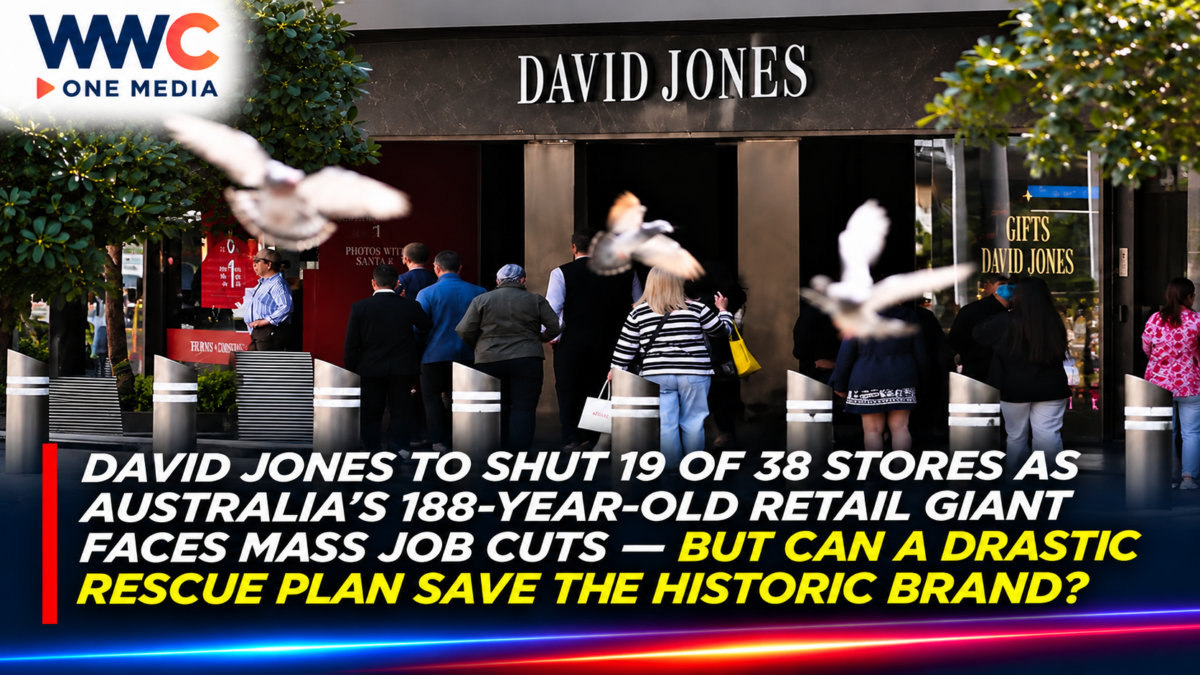
David Jones, the iconic Australian retailer founded in 1838, will shut half of its 38-store network as receivers attempt to rescue the financially distressed business following its collapse into voluntary administration last week.
The announcement, confirmed by receiver FTI Consulting on Wednesday, November 11, represents a major turning point for the department store, which has struggled with mounting financial losses, expensive property leases, weakening retail conditions and competition from online shopping.
The affected stores are expected to stop trading by the end of 2026, although individual final trading dates have not yet been confirmed.
Importantly, the 19 locations will continue operating in the immediate term while the restructuring process and employee consultations proceed.
According to reporting from Bloomberg, ABC News Australia, The Guardian and SmartCompany, the closures form part of an urgent effort to reduce operating costs and give the retailer a more financially sustainable future.
David Jones employs approximately 6,000 people across Australia and New Zealand. While the exact number of jobs that will disappear has not been disclosed, FTI Consulting has acknowledged that the closures will have a significant impact on employees.
The development raises a critical question for Australia’s retail industry: Can one of the country’s most recognizable department store brands survive by becoming significantly smaller, or is this the beginning of the end for an institution that has operated since 1838?
David Jones Confirms 19 Store Closures in Major Restructuring Plan
The decision follows the appointment of FTI Consulting as receiver, with the firm assuming operational control on behalf of secured lender Hilco.
FTI described the restructuring as urgent, explaining that closing underperforming locations was necessary to improve the retailer’s financial position.
In its November 11 announcement, the receiver confirmed that staff associated with the 19 affected stores would enter an immediate consultation process.
The closures cover several major Australian shopping centres, including locations operated by Scentre Group, Stockland and Vicinity.
According to The Guardian, David Jones management has acknowledged that its existing store portfolio is no longer appropriate for the company’s financial circumstances.
Chief executive Erica Berchtold reportedly told suppliers that the business could not continue operating in its previous structure.
The strategy is therefore focused on reducing the physical footprint, concentrating resources on stronger locations and improving the retailer’s chances of attracting new investment.
However, the closures also mean that numerous shopping centres will lose one of their major department store tenants just before the Christmas shopping season.
Complete List: Which 19 David Jones Stores Are Closing?
The 19 stores identified by FTI Consulting are spread across Australia and New Zealand.
The confirmed list is:
New South Wales — 7 stores
- Green Hills
- Hornsby
- Macarthur Square
- Macquarie Centre
- Parramatta
- Warringah Mall
- Wollongong Central
Victoria — 3 stores
- Glen Waverley
- Highpoint
- Malvern Central
Western Australia — 3 stores
- Carousel
- Garden City
- Hay Street Mall
Queensland — 2 stores
- Robina Town Centre
- Sunshine Plaza
South Australia — 2 stores
- Marion
- West Lakes
Australian Capital Territory — 1 store
- Woden
New Zealand — 1 store
- Newmarket
The closures represent 19 out of 38 locations, effectively cutting David Jones’ existing store network in half.
ABC News Australia and The Guardian independently reported the same 19-location list.
The closures do not mean that every remaining David Jones location is guaranteed to survive permanently. The future network will depend on the outcome of the restructuring and sale process.
Around 6,000 Employees Face Uncertainty as Job Cuts Loom
The restructuring places thousands of retail workers under pressure.
David Jones currently employs approximately 6,000 people across its Australian and New Zealand operations.
Although the company has not announced a definitive redundancy figure, the closure of half its store network is expected to affect a substantial number of employees.
FTI Consulting said the changes would have a material impact on many individual members of the David Jones team.
Employee consultations are now underway.
Workers at affected locations face questions about redundancy arrangements, possible transfers, final working dates and employment entitlements.
However, it is important to distinguish between employees working at stores scheduled to close and the retailer’s entire workforce.
The announcement does not establish that all 6,000 employees will lose their jobs.
Some staff may be offered opportunities at surviving locations, depending on operational requirements and the restructuring arrangements.
For many employees, the uncertainty is particularly difficult because the announcement comes during the busiest period of the retail calendar.
November and December are traditionally important months for department stores, with Black Friday promotions and Christmas shopping generating significant customer activity.
Why Did David Jones Collapse After 188 Years?
David Jones was founded in Sydney in 1838 by Welsh immigrant David Jones.
Over nearly two centuries, the retailer became one of Australia’s most recognizable department store brands.
Its stores developed a reputation for fashion, beauty products, luxury goods, homewares and premium shopping experiences.
For generations of Australian families, David Jones became associated with Christmas shopping, weddings, graduations and important family occasions.
However, its long history could not protect it from the changing economics of modern retail.
The business has faced several structural challenges:
1. Competition from online retailers
Online marketplaces have changed how consumers compare prices, purchase clothing and shop for household products.
Customers increasingly expect convenience, competitive pricing and rapid delivery without visiting large department stores.
2. Rising operating expenses
Large department stores require substantial expenditure on rent, staffing, utilities, inventory and property maintenance.
When sales weaken, these fixed costs can place significant pressure on profitability.
3. Changing luxury retail strategies
Many international brands have expanded their own boutiques and direct-to-consumer operations, reducing their dependence on traditional department store distribution.
4. Pressure on household spending
Consumers facing higher living costs may prioritize essential purchases and become more selective about discretionary spending.
5. An oversized physical store network
The cost of maintaining numerous large retail locations has become increasingly difficult to justify when some stores cannot generate sufficient revenue.
The combination of these challenges has made the existing David Jones business model increasingly difficult to sustain.
Unpaid Rent and Failed Rescue Negotiations Accelerated the Crisis
One of the most significant developments preceding the administration was David Jones’ deteriorating relationship with major landlord Scentre Group, the operator of Westfield shopping centres.
David Jones occupied space in 17 Westfield locations across Australia and New Zealand.
Scentre Group previously disclosed that the retailer had paid rent only through September 30, 2026.
The missed payments exposed the extent of the retailer’s financial difficulties.
Reports also indicated that discussions over a potential restructuring arrangement failed to produce an agreement that would allow the existing business to continue under its previous structure.
The breakdown of those negotiations contributed to the retailer’s entry into voluntary administration on November 5.
Reuters reported that David Jones was struggling with rising costs, sluggish retail sales, supply-chain pressures and long-running competition from online retailers.
The situation also highlighted the financial exposure facing shopping centre operators.
Large department stores traditionally function as anchor tenants, attracting customers who also visit surrounding shops, restaurants and other businesses.
When an anchor tenant closes, landlords may face the challenge of finding replacement tenants for substantial retail spaces.
For commercial property operators, the David Jones restructuring therefore represents more than the loss of a single retailer.
Who Controls David Jones Now?
David Jones is currently operating under a dual insolvency arrangement involving two separate professional firms.
FTI Consulting — Receiver
FTI Consulting has assumed operational control on behalf of secured lender Hilco.
Its responsibilities include overseeing the business, implementing the store restructuring and protecting the interests of the secured lender.
McGrathNicol — Voluntary Administrator
McGrathNicol was appointed voluntary administrator on November 5.
The firm is responsible for assessing the retailer’s financial position, dealing with creditors and exploring potential options to sell or recapitalise the business.
The distinction is important because receivership and voluntary administration are not identical legal processes.
While FTI is overseeing the operational restructuring, McGrathNicol is working through the broader administration and potential sale process.
According to Bloomberg’s November 11 reporting, the ultimate future of David Jones may not be determined until well into 2027.
The first creditors’ meeting is scheduled for November 17, 2026.
Could David Jones Survive With Only 19 Stores?
Despite the scale of the closures, the restructuring does not automatically mean the end of the David Jones brand.
A smaller department store network could potentially offer a more sustainable operating model.
Instead of maintaining dozens of expensive locations, a future owner could concentrate on stores with stronger sales, better customer traffic and more attractive lease arrangements.
Retail analysts have suggested that flagship stores could play an important role in any future business model.
The objective may be to transform David Jones into a more selective premium retailer rather than a traditional department store operating an extensive network.
A smaller footprint could also allow the business to concentrate investment on customer experience, premium merchandise, digital shopping and more profitable product categories.
However, restructuring alone cannot guarantee survival.
The company will still need sufficient working capital, reliable suppliers, commercially viable leases and a strategy capable of attracting customers.
A potential buyer must also decide whether David Jones has enough brand value to justify the cost of rebuilding its operations.
What Happens to David Jones Customers and Gift Cards?
The restructuring also raises practical questions for shoppers.
With 19 stores scheduled to close, customers may be concerned about existing purchases, returns, refunds, gift cards and online orders.
The important distinction is that the affected locations are expected to continue trading in the immediate term.
Their final closure dates are still subject to the restructuring process.
Customers should monitor official David Jones announcements for information about individual stores and any changes to customer policies.
Gift card holders should also pay attention to official guidance from the administrator and retailer.
Voluntary administration does not automatically establish that every gift card has been cancelled.
However, customers with unused balances should not assume that the existing redemption arrangements will remain unchanged throughout insolvency proceedings.
For unresolved orders, refunds or faulty products, shoppers should retain receipts and transaction records and seek guidance through the retailer’s official customer service channels.
David Jones’ Collapse Reflects a Wider Global Retail Crisis
The restructuring comes as traditional retailers worldwide reconsider the economics of maintaining large physical store networks.
Store closures are increasingly becoming part of corporate turnaround strategies, although the circumstances differ significantly between companies.
In the United States, Starbucks announced plans to close approximately 250 North American coffeehouses as part of its broader restructuring strategy.
WWC ONE MEDIA previously examined the decision in Starbucks to Close 250 North American Stores in Second Major Wave of Closures.
The comparison demonstrates how even internationally recognized brands are reviewing individual store performance and redirecting resources toward stronger locations.
In the United Kingdom, discount retailer Poundland has also faced a major financial restructuring.
As detailed in WWC ONE MEDIA’s report on Poundland’s struggle to protect more than 600 stores, the retailer’s financial difficulties have raised questions about ownership, supplier payments and the future of thousands of employees.
The situations are not identical.
Starbucks’ store closures are part of a corporate turnaround, while David Jones and Poundland are confronting more serious financial restructuring challenges.
Nevertheless, they illustrate a broader retail-industry trend: store numbers alone do not guarantee profitability.
Australia’s Weak Consumer Confidence Adds Another Challenge
The timing of David Jones’ restructuring is particularly difficult for Australia’s retail industry.
The country is facing elevated borrowing costs and pressure on household budgets.
The Reserve Bank of Australia raised its benchmark cash rate to 4.85% on November 3, 2026, marking its fifth rate increase of the year.
Meanwhile, the Westpac–Melbourne Institute Consumer Sentiment Index fell to 78.2 in November, its lowest level in four years.
Weak consumer confidence can make shoppers more cautious about discretionary purchases, including fashion, accessories and premium household products.
WWC ONE MEDIA explored these developments in Australia’s Consumer Confidence Crashes to Four-Year Low as Interest Rates Hit 4.85%.
Although consumer confidence alone does not determine retail sales, it provides an important indication of how households perceive their financial circumstances.
For a retailer dependent on discretionary purchases, an extended period of financial uncertainty could make recovery more difficult.
The wider economic picture also matters.
Australia’s household spending increased 0.6% in September to approximately A$82.6 billion, according to official figures reported by Reuters and Bloomberg.
That suggests consumer expenditure has remained resilient in aggregate, but stronger headline spending does not necessarily mean households have more disposable income.
Higher prices for essential goods can increase total expenditure even when consumers reduce purchases elsewhere.
This distinction is important when assessing the prospects of premium department stores.
What Happens Next? The Search for a Buyer Could Decide David Jones’ Future
The immediate priority is to stabilize operations and determine whether the business can attract a buyer or fresh financial support.
McGrathNicol is pursuing options for a potential sale or recapitalisation.
FTI Consulting is implementing the store closures and overseeing the remaining operations.
Several possible outcomes remain:
- A new investor could acquire the business and operate a smaller department store network.
- An existing owner or financial investor could attempt to recapitalise the retailer.
- A buyer could acquire selected assets, brands or profitable locations.
- The business could undergo further restructuring if the current plan does not produce a sustainable financial position.
- Liquidation remains a possible outcome if a viable rescue cannot be achieved, although it has not been announced as the final decision.
The first creditors’ meeting on November 17 will be an important milestone in the administration process.
Expressions of interest and negotiations with potential buyers will also help determine whether David Jones can continue operating under new ownership.
For employees, suppliers, landlords and customers, the coming months could prove decisive.
The Bigger Question: Can an 188-Year-Old Retail Icon Survive the Modern Shopping Era?
David Jones has survived almost two centuries of economic change, technological development and shifting consumer preferences.
But its latest crisis demonstrates that history and brand recognition cannot compensate indefinitely for an unsustainable operating model.
The closure of 19 stores marks a major reduction in the retailer’s physical presence.
Approximately 6,000 employees face uncertainty, while suppliers and commercial landlords must assess their exposure to the restructuring.
The remaining business still has valuable brand recognition, established customer relationships and potentially attractive flagship locations.
But a successful turnaround will require more than simply shutting underperforming stores.
It will require a commercially viable business model, renewed supplier confidence, adequate financing and a compelling reason for customers to continue shopping at David Jones.
Australia’s oldest department store is now fighting to preserve its future by abandoning half of its existing retail network.
As 19 stores prepare to close and thousands of workers await answers, will a new buyer save David Jones by transforming it into a smaller premium retailer — or will the collapse of this 188-year-old institution become one of Australia’s biggest retail failures?