BEIJING / SHANGHAI / MANILA — November 11, 2026 | WWC ONE MEDIA | Global Business, China Economy, Financial Markets and Government Bonds
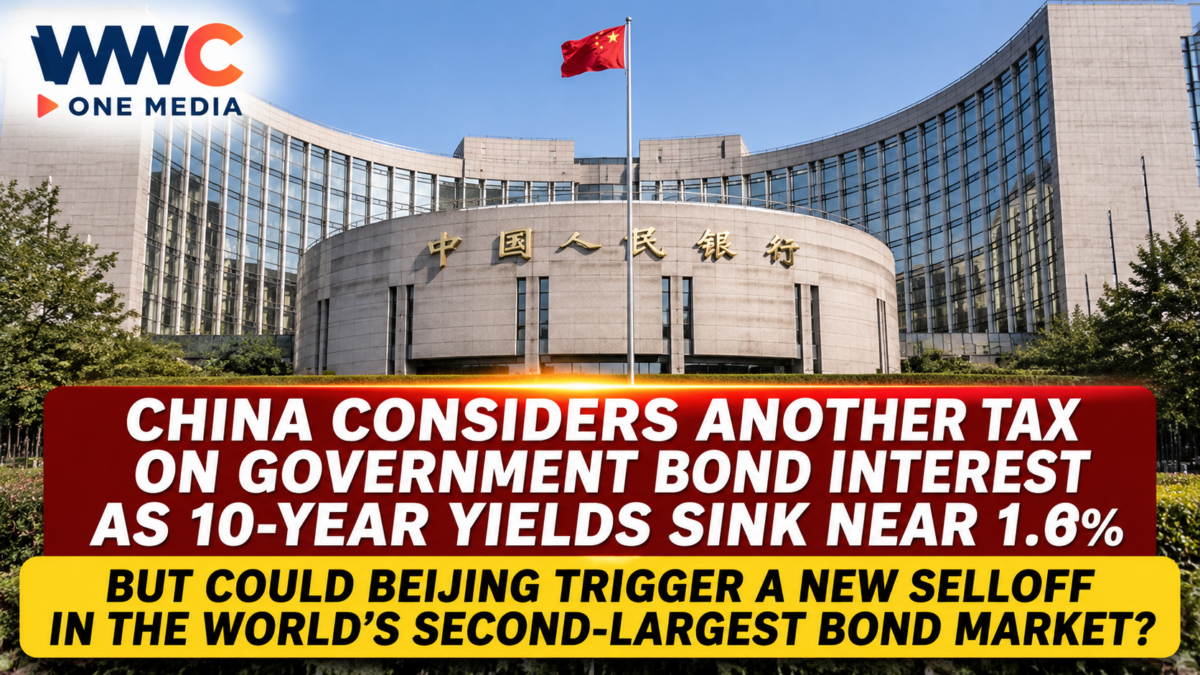
China is reportedly exploring another change to the taxation of government bond interest as borrowing yields hover near record lows, raising fresh questions about the direction of the world’s second-largest bond market.
According to Bloomberg’s November 11 report, Chinese authorities have been sounding out market participants about a possible tax on interest income earned from government securities.
The discussions come as investors pour money into Chinese bonds amid weak domestic demand, uncertainty over the property sector and limited attractive investment alternatives.
China’s benchmark 10-year government bond yield recently fell to a record low of approximately 1.565%, according to Caixin Global.
Official ChinaBond data subsequently placed the 10-year government yield curve at 1.5965% on November 10.
A further tax on bond income could alter the returns investors receive from those securities, potentially weakening demand and increasing market yields.
But the policy has not been finalized.
Beijing has not publicly confirmed the precise rate, coverage or implementation schedule of the latest proposal described by Bloomberg.
The possible change comes just over a year after the government reinstated value-added tax on interest from newly issued government and certain financial bonds.
As China struggles to stimulate its economy while keeping borrowing costs low, could another bond-tax change improve the market’s balance—or risk undermining one of Beijing’s most important sources of affordable financing?
China Consults Market Participants on Possible Bond Tax
Bloomberg reported that Chinese officials have been discussing a potential tax on government bond interest with market participants.
The reported discussions suggest that policymakers are examining whether changes to the after-tax returns on government debt could influence investor behavior.
However, the proposal remains preliminary.
No independently verified official announcement establishes that a new tax has been approved as of November 11.
That is an important distinction for investors.
A tax proposal can affect market expectations before it becomes law.
But the ultimate financial consequences depend on the details.
Investors need to know whether any change would affect existing securities, newly issued bonds, particular types of institutions or foreign buyers.
The tax rate and implementation date would also influence the market response.
Without those details, predicting the precise increase in yields would be speculative.
Chinese Government Bond Yields Fall Near Record Lows
The possible tax discussions come during an extraordinary period for Chinese fixed-income markets.
On November 6, Caixin Global reported that the yield on China’s benchmark 10-year government bond fell to approximately 1.565%.
The decline followed increased demand for relatively stable investments as domestic equities weakened.
The People’s Bank of China’s monetary-policy changes also influenced market conditions.
On November 10, the official ChinaBond government yield curve showed:
| Maturity | Annualized yield |
|---|---|
| 1-year | 1.1775% |
| 3-year | 1.2382% |
| 5-year | 1.3097% |
| 7-year | 1.4186% |
| 10-year | 1.5965% |
| 30-year | 2.0363% |
These yields illustrate how inexpensive government borrowing has become in China compared with several major international markets.
However, low yields do not automatically indicate strong economic confidence.
They can also reflect weak credit demand, expectations of monetary easing and a shortage of attractive alternative investments.
Why a Bond Tax Could Push Yields Higher
Bond prices and yields generally move in opposite directions.
When investors buy bonds aggressively, their prices rise and their market yields fall.
When demand weakens, prices may decline and yields may rise.
A tax on interest income changes the return investors retain after paying applicable taxes.
If an investor receives less income after tax, a higher pre-tax yield may be required to make a newly issued bond equally attractive.
For example, consider a hypothetical bond paying 1.60% annual interest.
A 6% tax applied to that interest would reduce the simplified after-tax return to approximately 1.504%.
That is an illustration of the arithmetic, not the announced terms of Bloomberg’s newly reported proposal.
Actual taxation would depend on investor eligibility, tax rules and how a bond’s price and yield are calculated.
A tax could encourage investors to seek higher yields on affected securities.
But the result is not guaranteed.
Demand for government bonds can remain strong if economic uncertainty is high or other investments appear less attractive.
China Already Changed Bond Interest Taxes in August 2025
The latest discussions need to be understood in the context of an earlier policy change.
On July 31, 2025, China’s Ministry of Finance and State Taxation Administration announced the reinstatement of value-added tax on interest income from certain bonds.
The measure took effect on August 8, 2025.
It covered newly issued central-government bonds, local-government bonds and specified financial-institution bonds.
Bonds issued before the effective date, including qualifying subsequent reopenings, retained their exemption until maturity.
Reuters reported that the change ended a longstanding tax preference originally introduced to encourage the development of China’s bond market.
Under the 2025 framework, different categories of investors could face different effective tax treatments.
The policy should not be confused with a universal tax applying identically to every bondholder.
The November 2026 proposal is therefore not China’s first move toward taxing bond interest.
The central unresolved question is what additional change Beijing is now considering and how it would interact with the rules already in force.
Why Beijing May Want to Change Investor Behavior
China’s government bond market has expanded considerably over recent decades.
Government debt is widely held by domestic financial institutions, including banks and investment funds.
Those institutions use bonds for income generation, liquidity management and balance-sheet stability.
During periods of weak private-sector borrowing demand, financial institutions may increase their holdings of government securities.
That can push yields lower.
However, heavy bond buying can also reflect the challenges facing the broader economy.
Banks may prefer holding government securities to extending additional loans when businesses are reluctant to borrow or credit risks appear elevated.
Policymakers face a complicated decision.
They want an efficient government debt market capable of financing public expenditure.
But they also want financial resources to support productive business investment and household economic activity.
A tax change could influence investment preferences, although there is no guarantee it would cause banks to increase private lending.
The PBOC’s Policy Shift Adds Another Layer of Complexity
The People’s Bank of China has recently adjusted its monetary-policy framework.
Caixin reported that the central bank shifted its primary operating benchmark from the seven-day reverse-repurchase rate to an overnight rate beginning November 2.
The new benchmark was set at 1.25%, compared with the previous seven-day rate of 1.40%.
However, the change in benchmark should not automatically be interpreted as a conventional 15-basis-point interest-rate cut.
It involved a change in the policy reference rate and operating framework.
The adjustment came as Chinese funding costs were already declining.
Bloomberg separately reported that yields on one-year negotiable certificates of deposit issued by top-rated Chinese lenders fell to approximately 1.39% in early November.
This illustrates the broader low-interest-rate environment in which the bond-tax discussion is taking place.
Any new tax could interact with liquidity injections, monetary-policy expectations and investor demand.
That makes the ultimate market response difficult to forecast.
China’s Bond Yields Are Moving in the Opposite Direction From America
One of the most important developments in global financial markets is the growing divergence between China and the United States.
American Treasury yields have risen amid inflation concerns and expectations of tighter Federal Reserve policy.
Chinese government yields, by contrast, remain near historically low levels.
The difference reflects contrasting economic conditions.
The United States is grappling with persistent inflation risks.
China faces weaker domestic demand, property-sector difficulties and pressure to support economic activity.
In related coverage, WWC ONE MEDIA examined the widening China–US government bond yield gap and the possibility of growing pressure on international capital flows.
The difference matters because investors compare returns across markets.
Higher US yields can make American securities relatively more attractive.
However, international capital movement also depends on currency expectations, hedging expenses, regulatory restrictions and risk tolerance.
The yield difference alone does not guarantee that money will leave China.
US Treasury Selloff Highlights the Global Contrast
On November 10, American government bonds experienced a sharp selloff following stronger-than-expected inflation figures.
The US two-year Treasury yield jumped approximately 18 basis points.
The benchmark 10-year yield briefly crossed 5%.
In related reporting, WWC ONE MEDIA examined how unexpectedly strong US inflation reversed a recent flight into Treasury bonds and increased expectations of further Federal Reserve tightening.
For Chinese policymakers, the contrast creates a difficult environment.
Keeping domestic borrowing costs low supports economic activity.
But a persistent gap with international interest rates can affect the relative appeal of yuan-denominated assets.
A further bond-interest tax might modestly influence Chinese yields, but it would not necessarily eliminate the difference with American rates.
The tax’s ultimate effect would depend on its structure and the response of financial institutions.
Foreign Investors Already Have Separate Tax Exemptions
International investors should be particularly careful when interpreting headlines about Chinese bond taxation.
On January 15, 2026, Chinese authorities announced an extension of tax exemptions for qualifying overseas institutional investors.
Under the published policy, interest income earned by qualifying overseas institutions from the Chinese bond market remains exempt from corporate income tax and value-added tax from January 1, 2026, through December 31, 2027.
Certain exceptions and qualifications apply, including rules concerning institutions with establishments in China.
The continuation of these exemptions is part of Beijing’s effort to encourage foreign participation in its bond market.
As a result, the existence of a possible new domestic bond-interest tax does not establish that foreign institutional investors will immediately lose their existing exemptions.
Any change would require examination of the final tax provisions.
That distinction could materially affect the attractiveness of Chinese government bonds to international asset managers.
China’s Panda Bond Market Could Also Feel the Effects
China’s low borrowing costs have attracted foreign issuers seeking to raise money in yuan.
These securities are commonly known as panda bonds.
They are issued in China’s domestic market by overseas governments, companies and other institutions.
Indonesia is among the countries exploring greater use of the market.
On November 10, Bloomberg reported that Indonesia had begun marketing another panda-bond transaction after an earlier successful issuance.
In related reporting, WWC ONE MEDIA examined Indonesia’s plans to raise up to approximately US$1.5 billion through Chinese bonds and the attraction of comparatively low yuan borrowing costs.
The potential effect of a Chinese tax change would depend on whether particular securities and investors are covered.
It would be premature to conclude that all panda bonds will face higher financing costs.
Nevertheless, the prospect of changing returns in China’s bond market is relevant to foreign borrowers considering future issuances.
Low Government Yields Do Not Mean Every Chinese Borrower Is Safe
Another important distinction concerns sovereign debt and corporate credit risk.
Chinese government bonds have benefited from strong demand and low benchmark yields.
But some Chinese companies face substantially higher borrowing costs or difficulty refinancing debt.
The country’s prolonged property-sector downturn continues affecting developers and government-linked businesses.
In related coverage, WWC ONE MEDIA examined renewed pressure in China’s high-yield dollar bond market as financial difficulties involving Zhuhai Huafa raised concerns about troubled borrowers.
That episode concerns offshore corporate debt, not the tax treatment of domestic Chinese government bonds.
The distinction is important.
A low sovereign benchmark yield does not guarantee that a financially stressed company can borrow at a similar rate.
Corporate bond yields also incorporate the issuer’s credit risk, debt structure, expected recovery rates and market liquidity.
China’s Property Crisis Remains a Major Financial Challenge
The wider economic environment helps explain why government bonds have attracted demand.
China’s property downturn has weighed heavily on confidence and financial conditions.
Some developers and government-linked companies continue facing refinancing difficulties.
In another report, WWC ONE MEDIA examined the financial pressure on Zhuhai Huafa Group following concerns about its debt obligations and credit outlook.
These problems can influence banks’ willingness to extend credit and investors’ preferences for perceived safety.
If households and businesses remain cautious, demand for private borrowing may stay weak.
Meanwhile, banks and funds may continue purchasing government securities.
That can keep sovereign yields low even when economic growth is under pressure.
For policymakers, the challenge is encouraging productive investment without introducing unnecessary instability into financial markets.
Could a New Bond Tax Actually Increase Government Borrowing Costs?
A tax on interest income could raise government revenue.
But it might also increase the yield investors demand on newly issued bonds.
That creates a potential trade-off.
Suppose a government introduces a tax that reduces the effective income investors receive.
Investors may respond by demanding higher interest rates on future issuance.
If that happens, the government could collect additional tax revenue while paying higher borrowing costs.
The net fiscal effect would depend on the size of both changes.
The actual result would also depend on whether existing bonds are exempt, which investors are affected and how the market adjusts.
There is no independently verified estimate establishing the fiscal effect of Bloomberg’s newly reported November proposal.
Analysts previously estimated that China’s 2025 VAT change could generate significant additional revenue.
Those historical projections should not be attributed automatically to a different tax measure now reportedly under discussion.
What the Debate Means for Asian Investors
China’s bond market is important for international investors, banks and sovereign borrowers.
Changes in government yields can influence regional financial conditions and the relative appeal of yuan assets.
For investors in the Philippines and elsewhere in Asia, the immediate lesson is to distinguish between several separate issues.
The first is the yield quoted on a bond.
The second is the investor’s effective return after taxes and costs.
The third is the currency exposure associated with holding a foreign security.
Even a bond offering stable interest payments can produce losses when sold before maturity if market prices have declined.
Likewise, a low coupon does not automatically mean the investment is unattractive.
Expected currency movements, inflation and the availability of alternative assets all matter.
Any Chinese tax reform would need to be evaluated within that broader investment context.
Five Questions Investors Should Watch
1. Will China announce a formal policy?
Bloomberg reports consultations, but final government rules have not been independently verified.
2. Which bonds and investors would be affected?
Coverage is crucial to understanding the potential market impact.
3. Will existing exemptions remain in place?
The treatment of older bonds and qualifying foreign institutions could significantly influence demand.
4. How will Chinese government yields respond?
Investors may demand greater pre-tax returns, but monetary conditions and safe-asset demand could offset that pressure.
5. Will the PBOC adjust liquidity conditions?
Central-bank operations may influence market rates independently of any tax changes.
The Bottom Line: China Is Considering a Sensitive Change at a Critical Moment
China’s reported examination of another bond-interest tax comes during a period of historically low government borrowing yields.
The benchmark 10-year government yield recently fell to approximately 1.565%, while official market data placed it near 1.60% on November 10.
The environment reflects strong demand for government securities, weak private credit demand and continued economic uncertainty.
Beijing already reinstated value-added tax on interest income from certain newly issued bonds in August 2025.
It also extended relevant exemptions for qualifying overseas institutional investors through 2027.
The November 2026 discussions appear to concern a possible further policy adjustment, but the full details remain unconfirmed.
For investors, the most important issue is not merely whether a tax is introduced.
It is how that tax changes the balance between returns, borrowing costs and demand for Chinese government debt.
For policymakers, the challenge is equally complex.
Any additional revenue or improvement in market structure must be weighed against the risk of disrupting affordable financing.
China is reportedly considering another change to government bond-interest taxation just as yields hover near historic lows and global markets face growing interest-rate uncertainty. But if Beijing reduces the returns investors keep from its bonds, will the policy encourage a healthier financial market—or could it trigger a selloff that makes government borrowing more expensive at precisely the wrong time?