TOKYO, JAPAN / NEW YORK / MANILA — November 11, 2026 | WWC ONE MEDIA | Global Financial Markets, Japanese Economy, Bonds and Central Banking
Japan’s government bond market came under renewed selling pressure on Wednesday as hotter-than-expected US inflation data rattled investors, drove American Treasury yields toward 5% and revived fears that the Federal Reserve could raise interest rates more aggressively.
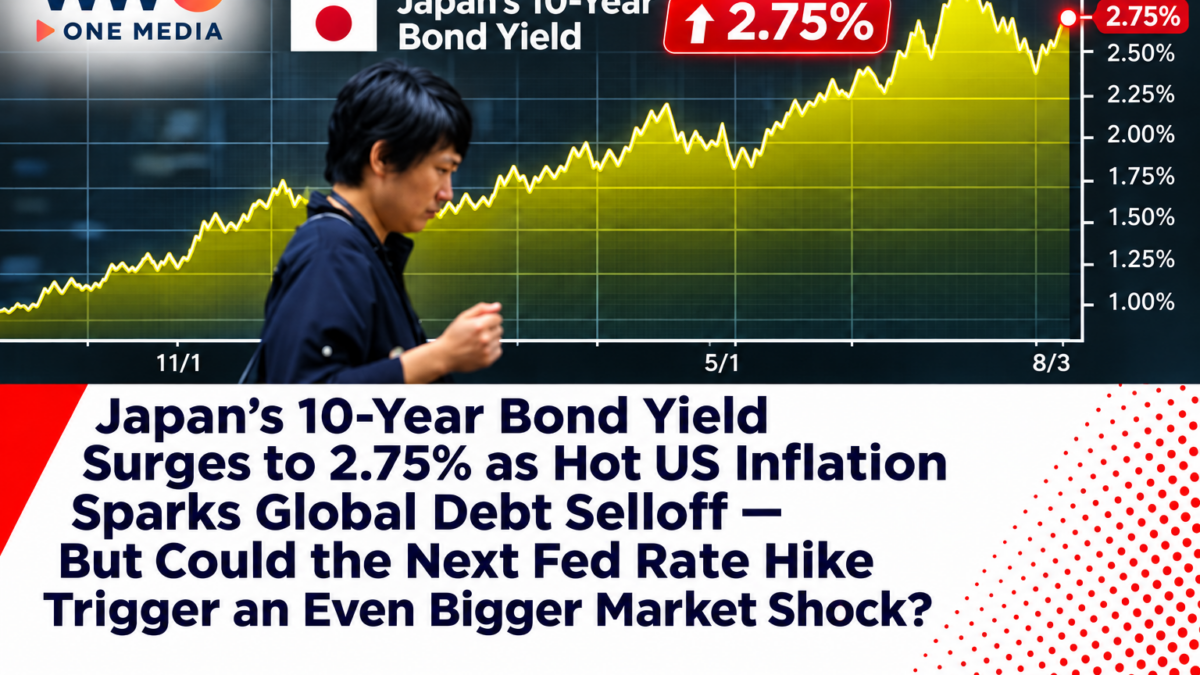
The yield on Japan’s benchmark 10-year government bond rose approximately 5.9 basis points to 2.754% in early trading on November 11, extending a three-session increase as selling spread across global debt markets.
The move followed a sharp reversal in US Treasuries on November 10, when investors abandoned earlier expectations that weakening technology stocks and falling oil prices would allow American interest rates to decline.
Instead, stronger inflation data and hawkish comments from Federal Reserve officials triggered a sudden repricing of government bonds.
The US 10-year Treasury yield briefly crossed the psychologically important 5% level, while the two-year yield jumped roughly 18 basis points in its largest daily increase since April 2025.
Japan is particularly vulnerable to changes in global borrowing conditions because its central bank is already moving away from decades of exceptionally low interest rates.
The Bank of Japan currently maintains a policy rate of 1.25%, and investors are increasingly considering another increase in December.
As higher US interest rates ripple through Asia, can Japan’s bond market absorb the pressure—or could simultaneous tightening by the Federal Reserve and Bank of Japan unleash another wave of international financial volatility?
Japanese Government Bond Yields Jump as Global Investors Sell Debt
Japan’s bond market reacted quickly to the sudden deterioration in US Treasury prices.
According to November 11 market reporting, the benchmark 10-year Japanese government bond yield increased to approximately 2.75%, marking a third consecutive session of rising yields.
The 30-year yield climbed around three basis points to 3.906% during early trading.
The two-year yield also increased, reaching approximately 1.835%.
These movements reflect investors demanding higher returns to hold government debt.
Bond prices and yields generally move in opposite directions.
When investors sell existing fixed-rate bonds, their market prices decline. Because the promised payments remain fixed, the effective yield available to a new purchaser rises.
That relationship is central to understanding the latest market turmoil.
A jump in yields does not mean Japan missed a debt payment.
It means the market value and pricing of its government securities have changed.
For the Japanese government, however, persistently higher yields can eventually increase the cost of issuing and refinancing debt.
US Inflation Report Triggers a Global Bond Selloff
The immediate catalyst came from the United States.
Official US consumer price data showed headline inflation rising 0.4% in October from September, exceeding the 0.3% increase economists had expected.
Core inflation, which excludes food and energy, increased 0.3%, also above expectations.
The figures challenged hopes that inflation was easing quickly enough to permit a less restrictive Federal Reserve policy.
Federal Reserve Governor Christopher Waller subsequently signaled that a larger-than-usual interest-rate increase could be considered if inflation remained stubborn.
Dallas Fed President Lorie Logan also expressed support for further monetary tightening.
Investors responded by selling Treasury securities.
The yield on the two-year Treasury jumped approximately 18 basis points, reflecting changing expectations about US monetary policy.
The benchmark 10-year Treasury yield briefly moved above 5%.
These moves quickly spread to other developed bond markets.
In related reporting, WWC ONE MEDIA examined the 18-basis-point jump in US two-year Treasury yields and how the inflation surprise disrupted investors’ recent flight into government debt.
The episode demonstrates why even government bonds considered relatively safe from credit default can experience significant market-price volatility.
Why US Treasury Yields Affect Japan
The US Treasury market is one of the world’s most important reference points for interest rates.
Its yields influence the relative attractiveness of investments across international markets.
When American yields rise sharply, global investors reassess whether bonds issued elsewhere offer sufficient returns.
That can create selling pressure in Japan, Europe and other economies even when their domestic economic conditions have not changed dramatically.
Japanese institutions are also major participants in international fixed-income markets.
Banks, pension funds, insurers and investment managers regularly compare returns across Japanese government securities and overseas bonds.
Differences in yields, currency movements and hedging expenses influence how they allocate capital.
However, the relationship is not mechanical.
Japanese government bond yields do not always rise by the same number of basis points as US Treasuries.
Domestic inflation, Bank of Japan policy, investor demand and government debt issuance remain important.
The November 11 selloff is best understood as the interaction of a sudden US inflation shock with Japan’s already changing monetary environment.
Bank of Japan’s Next Rate Decision Adds to Market Anxiety
Japan is no longer operating under the ultra-low interest-rate conditions that characterized much of the previous decade.
The Bank of Japan increased its policy rate to 1.25% in September 2026, its highest level in more than three decades.
The central bank held that rate at its October 29–30 policy meeting.
However, a summary of the meeting discussions released on November 10 showed that some officials favored faster monetary tightening.
Those comments strengthened expectations that another rate increase could occur in December.
A potential quarter-percentage-point increase would take the policy rate to 1.50%.
That remains a market expectation, not an announced decision.
In related coverage, WWC ONE MEDIA examined the Bank of Japan’s increasingly divided discussions over a possible December rate increase and the risks for the yen and global markets.
The central bank must weigh several competing considerations.
Higher rates can help restrain persistent inflation.
But they can also raise borrowing costs and weaken demand in an economy where household spending remains an important concern.
Governor Kazuo Ueda’s comments ahead of the December policy meeting will therefore receive close attention.
Weak Demand at Japan’s 30-Year Bond Auction Adds Pressure
The latest rise in Japanese yields also follows a poorly received auction of 30-year government bonds on November 10.
Government bond auctions allow Japan’s Ministry of Finance to borrow money by issuing securities to investors.
Demand at these auctions can provide useful information about investors’ willingness to finance the government at prevailing yields.
When demand is weaker than expected, investors may require higher returns to absorb additional debt.
That can place pressure on prices in the secondary market.
Japan’s 30-year securities are particularly sensitive to long-term interest-rate expectations and investor demand from institutions such as life insurers.
The November 10 auction added to caution already building after the US inflation report.
Investors are now monitoring the five-year Japanese government bond auction scheduled for November 12.
A stronger auction could indicate that some buyers consider current yields attractive.
A weak result could reinforce concerns about market demand.
Neither outcome alone would establish that Japan faces a sovereign debt crisis.
Japan’s Debt Burden Makes Rising Interest Rates Especially Important
Japan has one of the largest government debt burdens among advanced economies.
For decades, exceptionally low interest rates helped the country manage its substantial public borrowing.
That environment is changing.
Higher market yields mean new government bonds may need to offer greater returns.
As older securities mature and are refinanced, the government’s borrowing costs can gradually increase.
The effect is not instantaneous because existing fixed-rate debt generally retains its original contractual interest payments until maturity.
But sustained increases in yields can create significant long-term fiscal pressure.
Japan’s Finance Ministry has reportedly considered using an assumed interest rate of 3.8% in its fiscal 2027 budget calculations, compared with 3.0% for fiscal 2026.
Kyodo reporting indicated that total debt-servicing costs, including interest and redemption expenses, could reach approximately ¥36.64 trillion in fiscal 2027.
The government’s fiscal challenge is therefore broader than one day’s market movement.
Tokyo must manage its existing liabilities while funding public services, infrastructure and economic development.
Prime Minister Takaichi Faces a Difficult Fiscal Balancing Act
Prime Minister Sanae Takaichi has emphasized investment-led economic growth, including support for strategically important industries.
Her policy agenda includes measures intended to strengthen Japanese competitiveness in semiconductors, artificial intelligence and other advanced technologies.
However, investors are concerned about how additional spending will affect public finances.
Higher bond yields can make government investment programs more expensive to finance.
They can also intensify questions about future taxation and borrowing.
In related reporting, WWC ONE MEDIA examined Takaichi’s assurances that Japan can pursue economic growth while maintaining fiscal responsibility, even as long-term bond yields reached unusually high levels.
The government faces a difficult balancing act.
Restricting spending could help reassure bond investors.
But excessive restraint might weaken growth.
Increasing spending could support particular industries, but investors may demand higher yields if they become concerned about future debt issuance.
The market will ultimately judge the credibility of Japan’s fiscal plans by their financing requirements and expected economic results.
Higher Japanese Yields Could Change the Global Flow of Investment
Japan is a major investor in international financial markets.
Japanese institutions hold substantial foreign bonds and other overseas assets.
Changes in domestic yields can influence whether these investors prefer local or international securities.
According to Reuters, Japanese investors became net buyers of foreign bonds in October for the first time in three months.
They purchased a net ¥493.9 billion of foreign debt securities during the month.
The purchases followed a decline in US Treasury yields and concerns about highly valued AI-related stocks.
That provides useful context for the November reversal.
Only weeks earlier, falling US yields had supported demand for bonds.
The November 10 inflation shock abruptly changed the market outlook.
If Japanese yields continue rising, some investors may find domestic government securities relatively more attractive.
But a large-scale repatriation of Japanese capital is not guaranteed.
Currency hedging expenses, portfolio requirements, risk management and relative returns will determine whether such flows occur.
Berkshire Hathaway’s Japan Bond Offering Shows Corporate Borrowing Costs Are Changing
Japan’s interest-rate shift also affects private companies raising money in the country’s debt market.
Berkshire Hathaway, the US investment conglomerate associated with Warren Buffett and now led by chief executive Greg Abel, has returned to Japan’s yen-denominated bond market.
The company has marketed debt at wider credit spreads than those associated with its previous offerings.
Corporate borrowing costs generally depend on government bond yields plus additional compensation for credit risk and other factors.
Even financially strong companies can face higher financing expenses when benchmark rates increase.
That could influence investment decisions, refinancing plans and the relative attractiveness of corporate bond offerings.
However, the borrowing cost faced by Berkshire Hathaway is not identical to the cost of financing the Japanese government.
Credit spreads, maturity and individual issuance terms all matter.
Higher Bond Yields Are Attracting Japanese Savers
The selloff also has another side.
Higher yields can make newly issued government securities more attractive to investors seeking fixed-income returns.
The Financial Times reported on November 11 that Japanese households were purchasing government bonds at a record pace.
Retail issuance reached approximately ¥2.03 trillion in November, about twice the previous month’s level.
The increase reflects Japanese savers’ growing interest in alternatives to low-interest bank deposits.
For years, households had little incentive to shift money into government bonds offering extremely low yields.
That calculation changes as bond returns improve.
However, the higher yields available on new securities do not erase losses experienced by existing holders when market prices fall.
Investors must distinguish between buying a new bond at an attractive yield and selling an older bond after its market value has declined.
The growing appetite among retail investors also does not mean institutional bond-market volatility has disappeared.
Why a 3% Yield Still Matters in Japan
In September 2026, Japan’s benchmark 10-year government bond yield reached 3% for the first time in approximately three decades.
That milestone reflected mounting concern about inflation, fiscal policy and monetary tightening.
The yield subsequently declined as global investors sought safer assets during periods of stock-market volatility.
By November 11, it was again rising, reaching approximately 2.75% in early trading.
The earlier 3% level remains relevant as a point investors may monitor.
But it should not be confused with the latest market quotation.
Yields can move substantially between trading sessions.
For investors, the important question is whether the present rebound reflects a short-lived international reaction or the beginning of another sustained increase in Japanese borrowing costs.
That cannot be determined from a single trading day.
Could Higher Japanese Rates Trigger a Yen Carry-Trade Unwind?
Japan’s historically low interest rates have helped support investment strategies involving borrowing yen and purchasing higher-yielding assets elsewhere.
These are commonly known as yen carry trades.
The potential profit depends on interest-rate differences and currency movements.
If Japanese borrowing costs rise or the yen strengthens sharply, some carry trades may become less profitable.
Investors could then reduce or close positions.
Large, simultaneous unwinds can increase volatility in currencies, bonds and other financial markets.
However, the November 11 bond selloff does not establish that a systemic carry-trade unwind is already occurring.
Japanese bond yields, Federal Reserve policy and yen movements are important factors, but actual market outcomes depend on investor positioning and leverage.
A gradual adjustment may be absorbed without a major disruption.
A sudden unexpected policy change could create greater pressure.
That uncertainty is one reason global investors are watching both the Federal Reserve and Bank of Japan closely.
What the Selloff Means for Philippine Investors
The US and Japanese bond markets influence financial conditions throughout Asia.
When major developed-market yields rise, international investors may reassess returns available from emerging-market assets.
That can affect demand for government debt, corporate bonds and equities.
For the Philippines, higher US Treasury yields can influence the attractiveness of dollar-denominated investments and the movement of international capital.
Changes in the dollar and yen can also affect exchange rates, import costs and financial-market sentiment.
However, Philippine government bond yields do not automatically follow Japanese yields.
Local inflation, the Bangko Sentral ng Pilipinas’ policy decisions and the government’s financing requirements remain crucial.
For Filipino investors holding bond mutual funds or unit investment trust funds, rising yields elsewhere can contribute to changes in portfolio valuations.
The effect depends on the securities held, their maturities and how the fund is managed.
A higher bond yield can be attractive to new investors while creating mark-to-market losses for existing holders.
This distinction is especially important during periods of rapidly changing interest-rate expectations.
Five Market Indicators Investors Should Watch
1. US Treasury yields
Another sustained move above 5% in the US 10-year yield could increase pressure across global fixed-income markets.
2. Bank of Japan policy signals
The central bank’s December 17–18 meeting will help clarify whether further Japanese rate increases are imminent.
3. Japanese government bond auctions
Demand at upcoming auctions may reveal how investors are responding to higher yields.
4. Yen exchange-rate movements
Large currency changes could influence inflation expectations and international investment strategies.
5. Japan’s fiscal outlook
Government spending plans and future debt-servicing requirements will remain important for long-term investor confidence.
None of these indicators independently guarantees a financial crisis.
Together, however, they help explain whether markets are facing temporary volatility or a more persistent change in borrowing conditions.
The Bottom Line: Japan Is Caught Between US Inflation and Its Own Interest-Rate Transition
Japan’s government bond selloff on November 11 reflects two powerful market forces.
The first is the sudden increase in US Treasury yields after American inflation exceeded expectations.
The second is Japan’s continuing transition toward higher domestic interest rates.
The benchmark 10-year Japanese government bond yield climbed to approximately 2.75%, while longer-term securities also experienced selling pressure.
The Bank of Japan is considering the need for additional monetary tightening, and investors are increasingly focused on the possibility of a December rate increase.
Meanwhile, the Japanese government faces growing pressure to manage its debt-servicing costs.
Higher yields can improve returns for new bond investors.
But they can also raise future borrowing expenses and generate market losses for investors holding existing securities.
The effects extend beyond Japan because of the country’s importance in international capital markets.
The critical question is whether these developments will unfold gradually or trigger abrupt adjustments in investment portfolios.
Japan’s bond yields are climbing again as the US Treasury market reels from stronger inflation and renewed Federal Reserve rate-hike fears. But with the Bank of Japan preparing for another possible tightening decision and Tokyo facing increasingly expensive government debt, could the latest selloff mark the beginning of a much larger transformation in Asia’s financial markets—or is the worst of the volatility still ahead?