MANILA, PHILIPPINES — November 11, 2026 | WWC ONE MEDIA | Philippine News, Government Benefits, Emergency Loans and Disaster Assistance
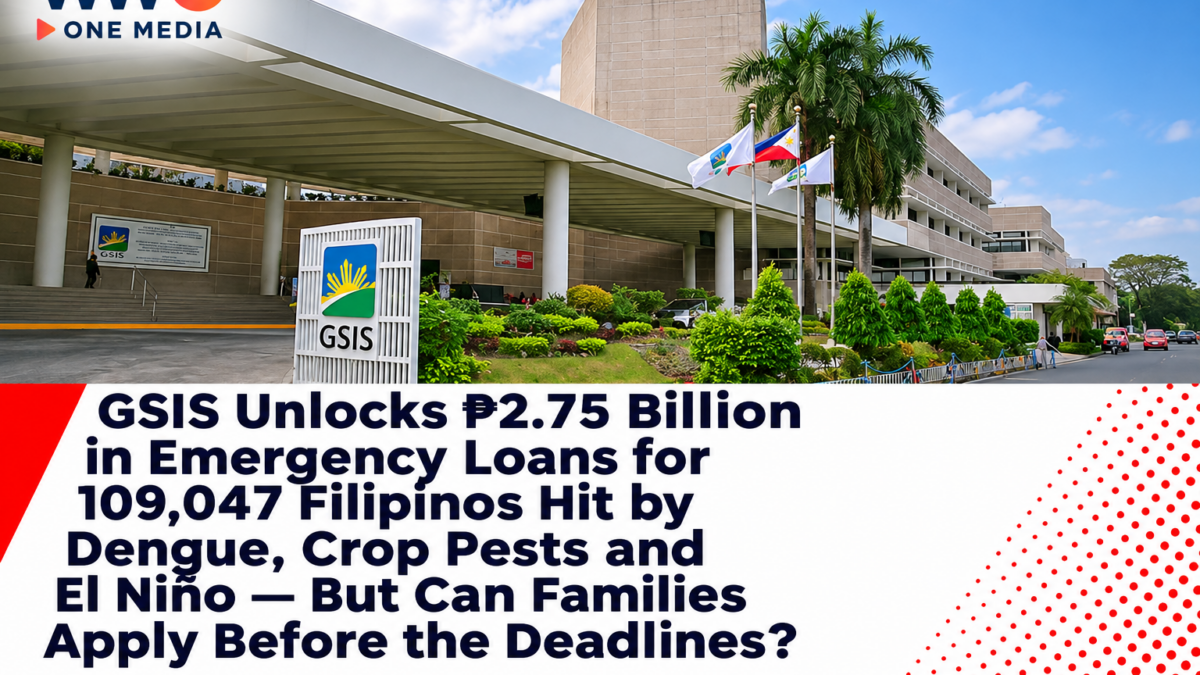
More than 109,000 government workers and pensioners across calamity-affected areas of the Philippines could receive much-needed financial assistance after the Government Service Insurance System (GSIS) earmarked ₱2.75 billion in emergency loans for communities struggling with crop pest infestations, rising dengue infections and El Niño-related dry spells.
The state pension fund announced the assistance on November 10, opening another opportunity for qualified members to borrow money for urgent household and recovery expenses.
According to GSIS, the program covers 109,047 potentially eligible active members and old-age and disability pensioners residing or working in areas covered by qualifying calamity or public health emergency declarations.
Eligible borrowers without existing emergency loan balances may borrow up to ₱20,000.
Those with outstanding emergency loans may apply for up to ₱40,000, although their previous loan balance must first be deducted. The maximum net cash amount available under this renewal arrangement is ₱20,000.
The loans carry a 6% annual interest rate and are payable over three years.
But the biggest concern for affected households may be the application deadlines.
With some filing periods ending as early as November 12, will government employees and pensioners have enough time to secure assistance before the opportunity closes?
GSIS Allocates ₱2.75 Billion as Disasters Hit Philippine Communities
GSIS president and general manager Jose Arnulfo “Wick” Veloso said the emergency lending facility reflects the institution’s continuing commitment to members and pensioners facing calamities.
The assistance is intended to help affected households repair damaged property, meet expenses associated with illness and recover from disrupted livelihoods.
The program responds to different emergencies affecting several provinces.
Some communities are experiencing agricultural damage caused by crop pests.
Others have been affected by dengue-related public health emergencies.
Meanwhile, prolonged dry conditions associated with El Niño are creating serious challenges for agricultural communities.
These problems can affect household finances even when government employees continue receiving their regular salaries.
Medical expenses, damage to homes and support for family members whose livelihoods have been disrupted can quickly create financial pressure.
GSIS emergency loans are intended to provide another source of credit during such situations.
However, the ₱2.75-billion allocation does not mean that the entire amount has already been distributed or that all 109,047 people have borrowed money.
The figure represents funding made available for eligible applicants.
Actual releases will depend on applications, qualification and approval.
Which Provinces and Cities Are Covered?
GSIS has announced application periods for members and pensioners in several calamity-affected localities.
The November 2026 deadlines are:
| Province or locality | Application deadline |
|---|---|
| Cavite | November 12, 2026 |
| Capiz | November 13, 2026 |
| Rodriguez, Rizal | November 16, 2026 |
| Camarines Norte | November 20, 2026 |
| Camarines Sur | November 20, 2026 |
| Naga City | November 20, 2026 |
| Agusan del Sur | November 28, 2026 |
| Las Nieves, Agusan del Norte | November 28, 2026 |
The different deadlines reflect separate local calamity declarations and application periods.
For example, qualified members in Cavite have until November 12 under the applicable emergency loan window, while applicants in Agusan del Sur and Las Nieves have until November 28.
GSIS also maintains emergency loan programs for other qualifying calamity-affected areas under separate announcements.
Applicants should confirm whether their particular municipality or city is covered.
Residency or employment in a province mentioned in an announcement does not automatically establish that every individual qualifies for the loan.
GSIS Offers ₱20,000 to New Borrowers and Up to ₱40,000 for Renewals
The amount borrowers can access depends on their existing emergency loan status.
For members without an outstanding emergency loan:
Qualified applicants may borrow up to ₱20,000.
The amount actually credited may reflect applicable deductions under GSIS rules.
For members with an existing emergency loan:
Qualified applicants may apply for a gross loan of up to ₱40,000.
However, the outstanding balance of the previous emergency loan must first be paid from the proceeds.
The maximum net cash amount available is ₱20,000, subject to applicable deductions.
This distinction is particularly important.
A borrower should not assume that approval of a ₱40,000 renewal means receiving ₱40,000 in fresh cash.
Part of the amount is intended to settle an existing obligation.
The program also should not be confused with a government cash grant.
Emergency loans must be repaid.
How Much Are the Monthly Payments?
GSIS has announced a three-year repayment period with an annual interest rate of 6%.
According to the agency’s published terms, the monthly amortization amounts are:
| Gross loan amount | Published monthly amortization | Repayment period |
|---|---|---|
| ₱20,000 | ₱655.56 | 36 months |
| ₱40,000 | ₱1,311.11 | 36 months |
A ₱20,000 loan would involve scheduled payments totaling approximately ₱23,600 over 36 months, based on the published installment.
For a ₱40,000 gross loan, the scheduled payments would total approximately ₱47,200.
These are calculations based on the announced monthly amortizations.
The actual net proceeds can differ because of the deduction of previous emergency loan balances and applicable insurance charges.
GSIS describes its emergency loan interest as computed in advance under its published product terms.
Borrowers should review the official loan disclosure and confirm the amount to be credited before accepting the transaction.
Who Can Apply for the Emergency Loan?
Active government employees must satisfy several eligibility requirements.
They must reside or work in an area covered by the applicable calamity declaration.
They must also have paid and remitted the required premium contributions equivalent to at least three months within the prescribed six-month period.
Applicants must not be on leave without pay and must meet GSIS requirements concerning loan delinquencies and pending administrative or criminal cases.
After deducting mandatory obligations, active members must retain a net take-home pay of at least ₱5,000.
Old-age and disability pensioners may also qualify.
For pensioners, the remaining monthly pension after loan deductions must be at least 25% of the basic monthly pension.
These rules are designed to limit access to qualified borrowers while maintaining repayment safeguards.
Meeting one condition alone does not guarantee approval.
GSIS will still evaluate the applicant’s status and compliance with the applicable requirements.
How to Apply Through the GSIS Touch Mobile App
GSIS says applications may be submitted through its official GSIS Touch mobile application.
The digital process allows eligible members and pensioners to request assistance without necessarily visiting a GSIS office.
Applicants should use the official application, complete the required loan request and follow the instructions provided for verification and submission.
Once approved and processed, loan proceeds are credited directly to the borrower’s registered ATM account.
Applicants should keep their registered account information current and review the loan amount and deductions before completing the process.
GSIS has not guaranteed that every application will be approved instantly.
Processing and release remain subject to verification, eligibility and operational requirements.
Government workers and pensioners should also be cautious about unofficial intermediaries offering guaranteed approval or requesting sensitive account information.
The safest approach is to use GSIS’s official channels.
Dengue Outbreaks Add Pressure to Family Finances
The emergency loan allocation comes as some Philippine communities deal with increased dengue infections.
Medical treatment, transportation, diagnostic tests and missed work can create unexpected household expenses.
In previous reporting, WWC ONE MEDIA examined a 14% increase in dengue cases over a two-week period, prompting the Department of Health to call for stronger hospital preparedness.
That report documented changing dengue trends at the national level.
However, a nationwide increase during a particular period does not mean every municipality is experiencing a declared public health emergency.
GSIS eligibility depends on the applicable local declarations and the borrower’s qualifications.
For affected households, an emergency loan may help address short-term financial needs.
But medical treatment and dengue prevention remain separate priorities.
The availability of a loan should not be interpreted as a substitute for seeking timely medical care.
El Niño Is Threatening Farmers’ Livelihoods
The GSIS announcement also comes as worsening El Niño conditions affect farming communities.
Prolonged dry spells can damage crops, reduce available irrigation water and disrupt local income.
Families dependent on agriculture may face financial difficulties even when one household member works in government.
The reported emergency cash assistance and the new GSIS loans serve different purposes.
DSWD emergency assistance is provided under applicable social welfare programs and eligibility rules.
GSIS emergency loans are credit products that borrowers must repay.
The amounts should not be combined and described as a single cash assistance program.
For affected communities, the two responses illustrate the need for both immediate household support and longer-term economic recovery.
Crop Pests and Agricultural Disruptions Create Additional Risks
Crop pest infestations are another reason for the latest GSIS lending allocation.
Agricultural pests can destroy or reduce harvests, affecting farmers’ earnings and the supply of food products.
When crop damage occurs alongside drought, the financial effects may become more severe.
Farmers can face additional expenses for pest control, irrigation, replacement seeds and land preparation.
Even households whose main income comes from government employment may support relatives affected by agricultural losses.
But GSIS emergency loans are available only to qualified members and pensioners.
They are not a general agricultural lending facility open automatically to every farmer.
The government operates separate financing programs for eligible agricultural producers.
In related coverage, WWC ONE MEDIA examined how 50 Pampanga farmers received access to ₱35,000 each in zero-interest emergency financing under the Department of Agriculture’s AGRI-RECOVER program.
The AGRI-RECOVER program differs from the GSIS emergency loan in its target beneficiaries, interest terms and administering agency.
Farmers seeking assistance should verify which program they qualify for rather than assume all calamity lending schemes offer identical conditions.
Government Disaster Loans Are Becoming an Important Recovery Tool
The latest allocation follows previous GSIS emergency lending announcements.
In October 2026, GSIS announced ₱1.69 billion in loans for approximately 68,506 members and pensioners affected by a water crisis, dengue outbreaks and El Niño-related conditions.
Earlier in September, the state pension fund announced additional emergency lending for communities hit by tropical cyclones and the southwest monsoon.
These announcements demonstrate the recurring need for financial assistance following natural disasters and public health emergencies.
However, figures from different announcements should not automatically be added together.
Some programs cover overlapping areas or beneficiaries, and funding allocations may change as assistance windows are expanded or renewed.
The November ₱2.75-billion announcement should therefore be reported as the latest allocated facility, not necessarily as an entirely separate amount on top of every previous announcement.
Why Emergency Credit Matters After Disasters
Disasters can create financial pressure long after the immediate emergency has passed.
Storms may damage homes, farms and roads.
Drought can reduce income from agriculture.
Illness can increase medical expenses and temporarily prevent household members from working.
These costs can force families to use savings or borrow money.
In earlier reporting, WWC ONE MEDIA examined nearly ₱12 billion in Philippine storm damage to agriculture and infrastructure, highlighting the financial consequences for affected communities.
That assessment concerned a separate period of tropical cyclone and monsoon damage.
It is not the financial value of the crop pest, dengue and El Niño emergencies covered by the latest GSIS announcement.
The broader economic connection is that natural disasters can simultaneously create immediate household expenses and reduce the income available to repay them.
Loans may help bridge short-term financing gaps.
But additional borrowing can also increase financial obligations.
Borrowers should therefore consider whether their expected income or pension can support the required monthly payments.
Government Workers Also Have Separate Year-End Benefits
The emergency loan announcement comes during November, when eligible government employees are also receiving annual compensation benefits.
The Department of Budget and Management has announced funding for year-end bonuses and cash gifts for qualified public-sector personnel.
In a related report, WWC ONE MEDIA examined the ₱82.998-billion allocation for government workers’ year-end bonuses and ₱5,000 cash gifts.
Those benefits are separate from the GSIS emergency loan program.
The year-end bonus and cash gift are employment-related benefits for qualified personnel under applicable government rules.
The GSIS emergency loan is a repayable borrowing facility subject to calamity-related eligibility requirements.
Receiving a year-end bonus does not automatically qualify a government employee for a GSIS emergency loan.
Likewise, obtaining an emergency loan does not mean the borrower has received an additional salary bonus.
Clear distinctions help employees make informed financial decisions.
Loan Redemption Insurance Provides an Additional Safeguard
GSIS says the emergency loan includes redemption insurance.
Under the published conditions, the outstanding loan balance may be deemed fully settled if the borrower dies while payments are current.
This benefit can provide financial protection for the borrower’s family.
However, the insurance feature is subject to applicable terms and conditions.
It should not be interpreted as blanket cancellation of a loan under every circumstance.
GSIS’s general emergency loan guidance also identifies a loan redemption insurance charge that may be deducted from proceeds.
Borrowers should review their loan disclosures to understand the insurance cost, coverage and actual cash amount they will receive.
Five Things Applicants Should Check Before the Deadline
1. Confirm your locality is covered.
Eligibility depends on working or residing in an area covered by the relevant calamity or emergency declaration.
2. Check your GSIS membership or pension status.
Active members must satisfy premium-contribution and employment requirements. Pensioners must meet the applicable remaining-pension threshold.
3. Review existing emergency loan balances.
Borrowers seeking renewal should understand that their previous balance will be deducted before additional cash is released.
4. Calculate the monthly repayment.
GSIS has published monthly amortizations of ₱655.56 and ₱1,311.11 for gross loans of ₱20,000 and ₱40,000, respectively.
5. Submit through official GSIS channels before the applicable deadline.
The earliest announced deadlines are November 12 in Cavite and November 13 in Capiz.
The Bottom Line: Billions in Loans Are Available, but Time and Eligibility Matter
The Government Service Insurance System has allocated ₱2.75 billion in emergency loans for more than 109,000 potentially eligible members and pensioners affected by crop pests, dengue infections and El Niño-related dry conditions.
The program provides access to gross loans of up to ₱20,000 for qualified borrowers without outstanding emergency loans.
Those renewing existing emergency loans may apply for up to ₱40,000, but previous balances must first be settled from the proceeds.
The maximum net cash available under the renewal structure is ₱20,000, subject to the applicable deductions.
The loans carry 6% annual interest and are payable over 36 months.
Applications are processed through GSIS Touch, with deadlines varying by locality.
For affected households, the program could provide support during a difficult period.
But borrowers must understand that the assistance is a loan rather than a grant, and not all government employees automatically qualify.
The immediate priority is confirming eligibility and filing before the appropriate deadline.
GSIS has made ₱2.75 billion in emergency credit available to 109,047 potentially eligible members and pensioners facing calamity-related financial pressure. But with application windows already closing in some areas, will the people who need the money most be able to secure assistance in time—or could thousands miss the deadline before receiving help?