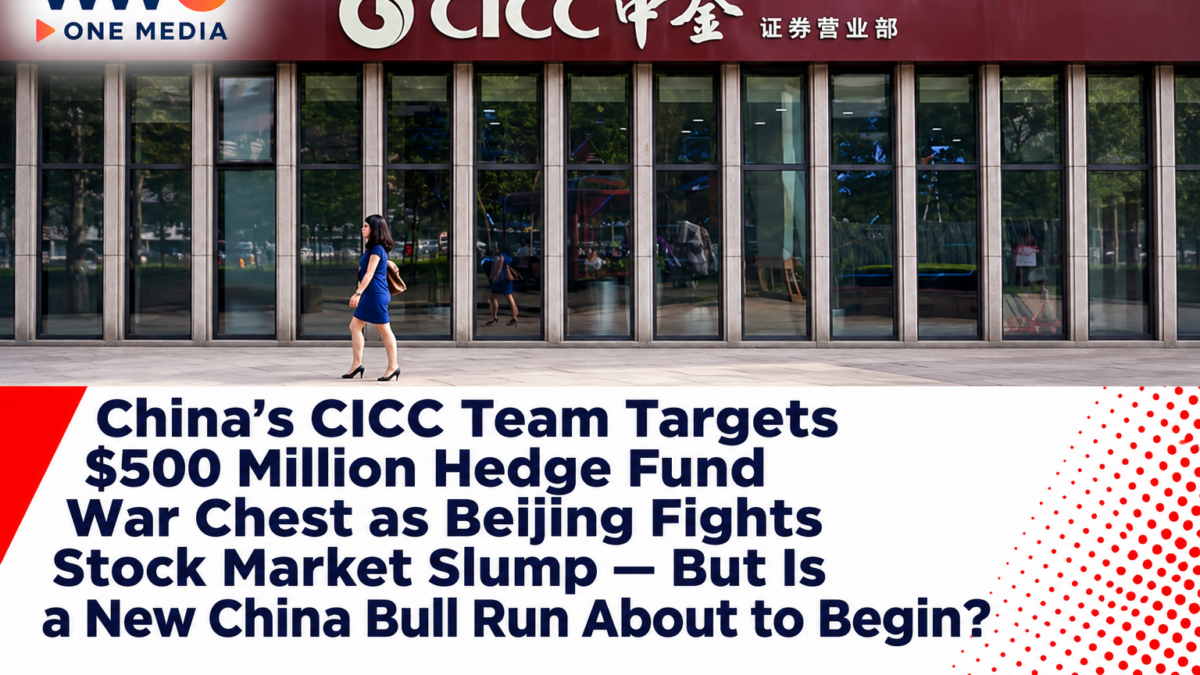
HONG KONG / SHANGHAI / MANILA — November 11, 2026 | WWC ONE MEDIA | Global Business, Hedge Funds, China Economy and Financial Markets
China’s investment industry is searching for its next big opportunity as a team associated with one of the country’s leading investment banks seeks to raise US$500 million for a fund of hedge funds, betting that a revival in Chinese financial markets could attract fresh investor capital.
The fundraising initiative, reported by Bloomberg on November 11, comes at a critical moment for the world’s second-largest economy.
After a turbulent period marked by plunging technology stocks, weak investor confidence and concerns over artificial intelligence valuations, China is attempting to rebuild momentum in its financial markets.
Beijing has stepped up efforts to stabilize share prices, support liquidity and encourage investment in strategically important industries.
Meanwhile, some institutional investors are beginning to revisit Chinese assets after years of difficult returns and geopolitical uncertainty.
The proposed $500 million fund reflects interest in capturing opportunities that may emerge from this changing environment.
But the timing also raises a serious question.
Is China’s financial recovery creating an opportunity for professional money managers—or are investors preparing to make another expensive bet on a market that has repeatedly disappointed them?
CICC-Linked Team Seeks $500 Million for China-Focused Hedge Fund Strategy
Bloomberg reported that a team connected to China International Capital Corporation, commonly known as CICC, is seeking investors for a fund-of-hedge-funds initiative linked to expectations of a Chinese market recovery.
CICC is one of China’s best-known investment banks, with operations spanning investment banking, securities trading, research, asset management and wealth management.
The proposed fundraising target is approximately US$500 million.
However, a fundraising target is not the same as assets already committed or collected.
The publicly accessible reporting reviewed for this article does not establish the final investor commitments, subscription timetable, management fees, portfolio allocations or the fund’s eventual launch date.
These details matter because investment funds can take considerable time to secure commitments from institutional investors.
Some fundraising efforts exceed their initial targets, while others close below their intended size.
The initiative should therefore be treated as a proposed investment vehicle rather than an operating fund with confirmed performance.
It also should not be confused with other $500 million investment funds announced by unrelated Chinese investment firms.
What Is a Fund of Hedge Funds?
Unlike a conventional mutual fund that typically invests directly in stocks or bonds, a fund of hedge funds allocates capital among multiple underlying hedge fund managers.
Each selected manager may follow a different investment strategy.
These can include:
- Equity long-short investing, which combines positions expected to rise with positions designed to benefit from price declines.
- Market-neutral trading, which attempts to reduce exposure to the overall direction of markets.
- Event-driven investing, which seeks opportunities arising from corporate restructurings, mergers and other developments.
- Quantitative strategies, which use statistical models and systematic trading.
- Macro investing, which focuses on currencies, interest rates, government bonds and broader economic conditions.
A fund-of-hedge-funds structure can provide diversification across managers and strategies.
It may also allow investors to access specialized managers that would otherwise be difficult to evaluate or invest in individually.
However, the structure introduces additional costs.
Investors may pay fees at both the overarching fund level and the underlying hedge fund level.
They may also face limited transparency, redemption restrictions, leverage and liquidity risk.
Diversification does not guarantee positive returns.
A fund invested across several hedge funds can still suffer substantial losses if their strategies respond similarly to a market shock.
The proposed CICC-linked vehicle’s precise allocation strategy could not be independently established from the accessible reporting.
It would therefore be premature to claim that the fund will invest a specific percentage in Chinese technology, property, equities or derivatives.
China’s Stock Market Recovery Becomes a Major Investment Opportunity
The proposed fundraising effort comes as China’s financial markets attempt to recover from a sharp downturn.
The country’s technology shares have experienced substantial volatility following an earlier surge driven by artificial intelligence, semiconductor manufacturing and robotics.
Investors initially poured money into businesses expected to benefit from Beijing’s push for technological independence.
But enthusiasm weakened as valuations increased and questions emerged about future corporate earnings.
By early November, Chinese authorities had intensified efforts to stabilize the market.
The Financial Times reported that approximately US$11.5 billion flowed into nine exchange-traded funds commonly associated with state-backed market intervention on November 3.
The purchases focused substantially on technology-oriented indexes.
China’s Shanghai STAR 50 Index and Shenzhen ChiNext Index subsequently recorded strong daily gains.
However, a short-term rebound does not establish a lasting recovery.
Investors remain concerned about corporate profitability, domestic consumption, property-sector weakness and geopolitical tensions.
For hedge fund managers, volatility can create trading opportunities.
But the same market movements can also generate substantial losses if positioning or timing proves incorrect.
China’s $480 Billion AI Stock Rout Remains a Major Warning
The renewed interest in Chinese assets follows an exceptionally painful correction in the country’s technology sector.
Chinese semiconductor, robotics and AI-related stocks experienced significant valuation declines as investors reassessed their future growth prospects.
In related coverage, WWC ONE MEDIA reported on the estimated $480 billion decline in the market capitalization of China’s major AI-focused stock index and the losses suffered by investors during the selloff.
The downturn exposed the risks of concentrating investment capital in highly valued technology companies.
Businesses involved in artificial intelligence may have substantial long-term opportunities.
But promising technology does not automatically justify any stock-market valuation.
Investors must assess earnings, operating expenses, cash flow and the competitive environment.
The recent correction could create opportunities for investment managers seeking undervalued companies.
However, falling prices alone do not guarantee that assets are attractively valued.
Some businesses may continue facing weak financial performance even after large share-price declines.
For a prospective hedge fund investor, manager selection and risk controls may therefore be as important as the direction of the overall Chinese stock market.
Beijing’s Market Intervention Creates Both Hope and Risk
Chinese authorities have been attempting to restore confidence through liquidity support, financing facilities and other measures.
The People’s Bank of China launched another round of its securities, funds and insurance-company swap facility in early November.
Applications under the third round exceeded 100 billion yuan, according to Chinese financial reporting.
Participating financial institutions can use eligible assets to obtain highly liquid collateral and support investment activity under the program’s rules.
CICC and China Galaxy Securities were among the firms reported to have begun deploying funds through the facility.
However, this central-bank program is separate from the reported $500 million fund-of-hedge-funds fundraising initiative.
The fact that CICC participates in the securities swap facility does not establish that the proposed hedge fund vehicle is financed by that facility.
The distinction is important.
Beijing’s market support can improve liquidity and influence investor sentiment.
But government intervention cannot guarantee that every participating company or investment strategy will become profitable.
In some cases, heavy reliance on policy support may reinforce concerns that market prices are not being driven primarily by sustainable improvements in corporate earnings.
For institutional investors, the challenge is distinguishing temporary stabilization from a genuine long-term recovery.
Goldman Sachs and JPMorgan Show Why Foreign Investors Are Reconsidering China
Despite China’s financial-market difficulties, some major international banks have benefited from recovering activity in the country’s securities industry.
Goldman Sachs and JPMorgan Chase reported substantial increases in profits from their mainland Chinese securities businesses in 2025, according to Chinese financial reporting.
The improved results reflected stronger trading activity and changes in market conditions.
The performance demonstrates that financial institutions can benefit from market activity even when the wider economy faces difficulties.
Investment banks generate revenue from trading, financing, advisory work and other services.
Their earnings do not always move in the same direction as stock indexes.
For a fund of hedge funds, this is a relevant distinction.
Professional managers may pursue opportunities arising from price discrepancies, market volatility and changing economic expectations.
However, the ability to generate returns under difficult conditions depends on individual strategies and execution.
Past profits earned by major investment banks do not establish that the proposed CICC-linked fund will succeed.
China’s Private Equity Market Shows Signs of Selective Recovery
The wider Chinese investment industry has also shown evidence of improving fundraising and dealmaking.
According to figures cited by DealStreetAsia, China’s private equity deal volume nearly tripled to 1,209 transactions during the first half of 2026.
Transaction value increased approximately 86% from the previous year to US$94.8 billion.
Technology, industrials and healthcare were among the leading investment sectors.
Meanwhile, commitments to China-focused US-dollar funds increased 122.5% to approximately US$6.7 billion.
But the number of newly closed US-dollar funds declined, suggesting that capital was becoming concentrated among selected managers.
These figures concern private equity rather than hedge funds.
The two investment categories use different strategies and face different liquidity conditions.
Nevertheless, the numbers suggest that some investors are returning to Chinese assets selectively.
The emerging pattern is not a wholesale return to the investment enthusiasm seen before China’s earlier financial-market difficulties.
Investors are increasingly demanding stronger management records, better investment terms and clearer evidence of returns.
For managers seeking new capital, demonstrating investment discipline may be more important than presenting an optimistic view of China’s economy.
Hong Kong’s IPO Troubles Could Create Another Challenge
China’s investment recovery is also being tested in Hong Kong.
The city remains an important international fundraising gateway for mainland Chinese companies.
But recent listings have encountered greater investor resistance.
Some companies have postponed transactions, while others have experienced disappointing trading debuts.
In related reporting, WWC ONE MEDIA examined Hong Kong’s unusually high IPO withdrawal rate, with roughly one in four deals failing to reach completion in 2026.
These conditions may influence investment opportunities for hedge fund managers.
Some strategies can benefit from volatile pricing and changing investor demand.
Others depend on strong capital-market activity, new listings and sufficient liquidity.
A prolonged downturn could therefore affect different managers in different ways.
Investors considering a fund-of-hedge-funds product need to understand which strategies the fund will pursue and how those strategies respond to different market environments.
The existence of market volatility is not, by itself, proof of attractive investment returns.
Chinese Chip Stocks Show Why Investors Remain Selective
The contrast between optimism and caution was visible in Hong Kong’s semiconductor IPO market on November 10.
Two Chinese chip-related companies raised approximately US$301 million through separate listings.
But their initial trading performances differed sharply.
One opened slightly below its offering price, while the other recorded a strong initial gain.
For professional asset managers, such differences can create opportunities for company-specific research and security selection.
But identifying a promising industry does not automatically identify a profitable investment.
Companies within the same industry can have very different balance sheets, customer relationships and earnings prospects.
A disciplined investment strategy must therefore evaluate individual businesses rather than assume that every Chinese technology stock will benefit equally from a market recovery.
CICC’s Role in China’s Capital Markets
China International Capital Corporation has established itself as a major participant in China’s investment-banking and asset-management industry.
Its operations connect domestic companies seeking financing with institutional investors across international markets.
The Financial Times reported earlier in 2026 that CICC had strengthened its position in technology-related investment banking, particularly transactions involving semiconductor and artificial intelligence businesses.
The bank has also sought to expand its international wealth-management activities.
According to its 2026 financial reporting, CICC serves thousands of institutional clients and maintains extensive research coverage across mainland China, Hong Kong and other international markets.
The reported fund-of-hedge-funds fundraising effort would fit into a wider investment environment in which professional managers are seeking ways to attract capital from investors interested in China’s potential recovery.
However, the accessible Bloomberg headline identifies a CICC-linked team rather than establishing that the investment bank itself has formally guaranteed the proposed fund.
That distinction is important for evaluating the product.
Investors should verify the actual fund manager, legal entity, investment adviser, custody arrangements and regulatory status before treating the proposed investment as an officially sponsored or guaranteed CICC product.
Could China’s Recovery Be a Hedge Against Expensive US Technology Stocks?
One reason international investors are reconsidering Chinese markets is the concentration of global portfolios in American technology companies.
The artificial intelligence investment boom has attracted enormous amounts of capital to US semiconductor, cloud-computing and software businesses.
But rising valuations have raised questions about future returns.
Some investors are exploring other markets to reduce dependence on a relatively small group of American technology stocks.
Chinese equities may offer different valuation characteristics and industry exposure.
However, investment in China introduces additional risks.
These include regulatory uncertainty, geopolitical tensions, currency movements and the potential effects of US restrictions on sensitive technology investments.
Moreover, China also has a substantial AI-related investment sector.
Its stocks may therefore decline alongside American technology shares during a broader correction.
A China-focused hedge fund strategy is not automatically a hedge against losses in US technology.
The degree of protection depends on the investments held, the use of short positions, leverage and the manager’s overall risk controls.
What the $500 Million Fund Could Mean for Asian Investors
The proposed fundraising effort reflects wider changes in how Asian investment opportunities are evaluated.
Investors in Hong Kong, Singapore and other financial centers have increasingly sought diversified approaches to Chinese markets.
Some prefer direct investment in listed companies.
Others use managed funds, private-market investments or alternative strategies.
Funds of hedge funds may appeal to institutions seeking access to multiple specialist managers without constructing and monitoring every underlying investment relationship themselves.
However, the structure is generally more complex than an ordinary index-tracking ETF.
Institutional investors must evaluate management fees, portfolio transparency, liquidity restrictions and the possibility that underlying strategies become highly correlated during a market crisis.
For Philippine investors, access would depend on the fund’s legal structure, distribution arrangements and eligibility requirements.
The reported CICC-linked initiative has not been established as a product available to ordinary Philippine retail investors.
Nor has the accessible reporting confirmed its minimum subscription amount or final investment terms.
Five Major Risks Investors Should Watch
1. China market volatility
A temporary rebound could reverse if economic growth, corporate earnings or investor confidence deteriorate.
2. Hedge fund manager performance
Underlying managers may fail to deliver positive returns even during favorable market conditions.
3. Layered investment fees
A fund-of-hedge-funds structure can involve fees at multiple levels, reducing net investor returns.
4. Limited liquidity and transparency
Some hedge funds impose redemption restrictions, while investors may not receive complete real-time information about portfolio positions.
5. Geopolitical and regulatory uncertainty
US-China relations, investment restrictions and domestic financial-market policies could affect available strategies and returns.
These considerations do not make fund-of-hedge-funds investments inherently unsuitable.
They demonstrate why such products require careful evaluation rather than investment decisions based solely on expectations of an economic recovery.
The Bottom Line: China Is Attracting Fresh Investment Interest, but Its Recovery Remains Uncertain
The reported effort by a CICC-linked team to raise US$500 million for a fund of hedge funds highlights renewed interest in China’s financial markets.
Beijing has intensified measures intended to stabilize equities, improve liquidity and support economically important industries.
Some investment banks have reported stronger earnings, while parts of the private equity market have experienced a recovery in activity.
But the broader picture remains mixed.
China’s technology stocks have experienced substantial losses.
Hong Kong’s IPO market faces heightened scrutiny.
Investors remain concerned about the property sector, domestic demand and the sustainability of AI-related valuations.
Against that backdrop, professional fund managers are seeking opportunities in markets that may be recovering but remain highly unpredictable.
The proposed US$500 million fundraising target shows the scale of the ambition—not that investors have already committed the money or that the strategy has been proven successful.
For China-focused investors, the essential question is whether recent improvements can develop into sustainable earnings and stronger market confidence.
A CICC-linked team is seeking US$500 million to capitalize on China’s potential financial-market revival. But after a painful technology stock rout, renewed government intervention and growing competition for investor capital, could the proposed fund position its backers for the next Chinese bull market—or expose them to another costly false recovery?