PARIS, FRANCE / MANILA, PHILIPPINES — November 11, 2026 | WWC ONE MEDIA | World News, European Politics and 2027 French Presidential Election
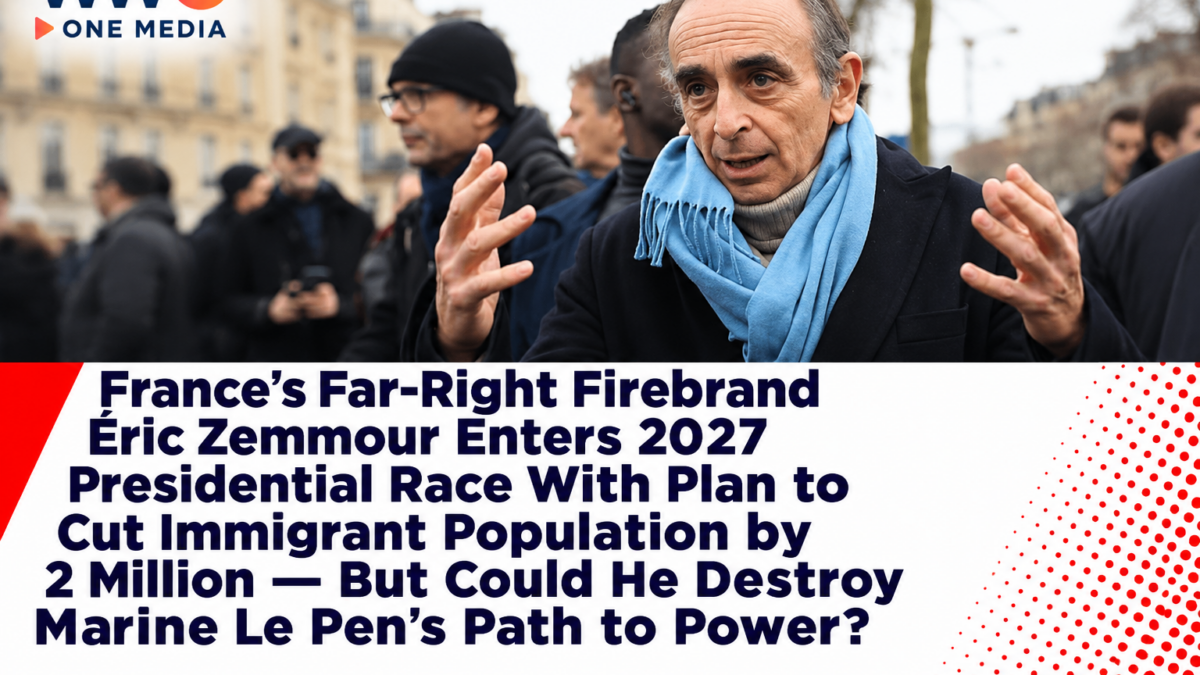
France’s already explosive presidential election has taken another dramatic turn after far-right politician Éric Zemmour officially confirmed his candidacy for the 2027 presidency, promising sweeping immigration restrictions and a major transformation of the country’s economic policies.
The 68-year-old former journalist and television commentator announced his decision during an interview on French broadcaster TF1 on Tuesday, November 10, setting the stage for another confrontation with Marine Le Pen and the country’s increasingly divided political establishment.
According to Bloomberg, Reuters, Le Monde, Euronews and AFP, Zemmour intends to campaign on reducing immigration, deporting certain foreign nationals and cutting public expenditure and taxes.
One of his most controversial proposals is to reduce France’s immigrant population by two million people over a five-year presidential term.
But the political reality facing Zemmour is far less encouraging than his ambitions.
The leader of the far-right Reconquête! party won just 7.07% of the first-round vote in the 2022 presidential election.
Recent polling suggests he could receive only 3% to 4% in 2027, while Marine Le Pen has emerged as the dominant candidate on the French far right.
Yet even a candidate with modest polling support could influence the outcome of a closely contested election.
Zemmour may have little chance of winning the presidency outright, but could his candidacy divide France’s nationalist electorate enough to alter the country’s political future?
Éric Zemmour Confirms Second Presidential Campaign on French Television
Zemmour officially confirmed his candidacy during TF1’s evening news broadcast on November 10.
He argued that France needed a dramatic change in political direction to reverse what he described as national decline.
His campaign will focus heavily on immigration, national identity, government spending and taxation.
Zemmour also proposes a sharp reduction in the number of foreign nationals living in France.
Among his announced proposals is the removal of certain foreign nationals who have been unemployed for more than six months, alongside measures targeting foreign criminals.
These policies represent campaign proposals rather than laws currently in force.
They would face substantial legal, constitutional, administrative and human-rights scrutiny if a future government attempted to implement them.
The announcement ends months of uncertainty over whether Zemmour would personally lead Reconquête! into the next presidential contest.
However, his declaration does not yet guarantee his appearance on the final ballot.
French presidential candidates must obtain at least 500 qualifying endorsements from elected officials before their candidacies can be validated.
Zemmour Wants to Reduce France’s Immigrant Population by 2 Million
The centerpiece of Zemmour’s latest campaign is a highly restrictive immigration program.
During his announcement, he promoted what he calls “negative immigration,” meaning policies intended to reduce the number of immigrants residing in France.
He has also advocated remigration, a term used by some nationalist movements to describe policies aimed at encouraging or compelling migrants to leave.
Zemmour argues that immigration has fundamentally changed French society and that the government must prioritize national identity and sovereignty.
His critics contend that his proposals are discriminatory and could undermine civil liberties and protections afforded under French and European law.
The proposed reduction of two million immigrants over five years would represent a significant demographic and administrative undertaking.
It is unclear how such a target could be achieved while respecting all applicable legal protections, including individual circumstances, family rights and international obligations.
The economic consequences would also require careful examination.
Foreign-born workers contribute to sectors including healthcare, hospitality, agriculture, construction and other services.
A large reduction in the immigrant workforce could affect labor availability, tax revenue and business operations.
Conversely, supporters of tighter immigration policies argue that restrictions could reduce pressure on certain public services and strengthen enforcement of residency requirements.
The net economic effects would depend on which policies were implemented, whom they affected and how employers and households responded.
Zemmour’s 2022 Election Defeat Remains a Major Obstacle
Zemmour entered France’s 2022 presidential contest after building a national following through journalism, television appearances and political commentary.
His campaign attracted attention with its confrontational rhetoric on immigration and national identity.
At one point, he appeared capable of challenging Marine Le Pen for leadership of France’s nationalist electorate.
But that momentum did not translate into a place in the presidential runoff.
Zemmour received approximately 7.07% of the first-round vote.
Le Pen advanced to the second round against President Emmanuel Macron.
The outcome established an important political difference between the two.
Le Pen commanded a much larger electoral coalition, while Zemmour appealed to a narrower segment of voters.
That challenge has become more difficult as the 2027 election approaches.
A recent Harris Interactive survey placed Zemmour at approximately 3.6%, with Le Pen leading the first round by a substantial margin.
These figures indicate that Zemmour enters the race as an outsider.
However, political surveys are snapshots of voter intentions rather than election results.
Campaign events, economic developments and changes in the candidate field could alter voter preferences before April 2027.
Marine Le Pen Dominates the Far Right — But Could Zemmour Split Her Vote?
The biggest strategic question surrounding Zemmour’s candidacy is its potential impact on Marine Le Pen.
Le Pen leads the National Rally, a far-right party that has spent years expanding its electoral appeal.
Her political strategy has generally emphasized economic security, immigration restrictions, national sovereignty and efforts to broaden the party’s support beyond its traditional base.
Zemmour takes a more confrontational approach, particularly on immigration and identity.
Both candidates appeal to parts of the nationalist electorate.
That creates the possibility of competition for overlapping voters.
France’s presidential election uses a two-round system.
A candidate who fails to secure an outright majority in the first round may face another candidate in a runoff.
If several candidates compete for similar voters, their support may become divided during the first round.
But the actual electoral consequences depend on how many voters switch between candidates and which other contenders remain competitive.
Zemmour’s candidacy could weaken Le Pen’s first-round total if he attracts voters who would otherwise support her.
Alternatively, he could mobilize voters who would not have supported Le Pen at all.
His presence could also influence campaign debate without materially altering the final outcome.
At this stage, there is insufficient evidence to conclude that Zemmour will prevent Le Pen from reaching the runoff.
Le Pen’s Legal Position Adds Another Layer of Uncertainty
Le Pen’s candidacy has also been shaped by legal proceedings involving the misuse of European Parliament funds.
An earlier conviction created questions about her eligibility to seek the presidency.
However, subsequent legal developments have affected her electoral position.
Recent reporting indicates that Le Pen is campaigning as the leading National Rally candidate, although legal and political uncertainty remains surrounding the final outcome of relevant proceedings.
National Rally president Jordan Bardella remains an important figure in the party’s succession and electoral planning.
The relationship between Le Pen and Bardella has attracted attention as the party prepares for the possibility of taking power.
Nevertheless, Zemmour’s decision represents a separate challenge.
He is not running under the National Rally banner.
His Reconquête! party is competing to establish its own place in the French right-wing political landscape.
For Le Pen, that could require additional effort to consolidate voters who share parts of Zemmour’s agenda but question his electability.
Sarah Knafo Emerges as a Powerful Figure Inside Reconquête!
Zemmour’s decision also raises questions about the future of Sarah Knafo, his political partner and a member of the European Parliament.
Knafo has gained prominence through her media appearances, policy advocacy and political organizing.
Her growing popularity prompted speculation that she might become Reconquête!’s presidential candidate instead of Zemmour.
According to Le Monde, some members of the party had viewed her as a potentially more effective standard-bearer.
Her economic messaging, including criticism of taxation and government spending, has attracted attention beyond the party’s traditional supporters.
But Zemmour ultimately chose to lead the campaign himself.
Knafo is expected to remain an influential figure in his political operation.
The decision may provide continuity for Reconquête!’s existing supporters.
However, it also means the party will again be led by the candidate who struggled to build a sufficiently broad electoral coalition in 2022.
Macron Cannot Run Again as France Prepares for a Political Reset
The 2027 presidential election will mark the end of Emmanuel Macron’s current presidency.
Macron is constitutionally barred from seeking a third consecutive presidential term.
That creates an unusually open contest for control of the Élysée Palace.
Potential successors come from across France’s political spectrum.
They include Le Pen on the far right, Jean-Luc Mélenchon on the left, former prime minister Édouard Philippe in the center-right, and several other figures seeking to build broader electoral alliances.
However, the center remains fragmented.
Different candidates are competing to inherit parts of Macron’s electoral coalition, while left-wing parties disagree about how closely to coordinate their campaigns.
Zemmour’s entrance further expands an already crowded field.
The contest is taking place amid economic uncertainty, public dissatisfaction and difficult debates over immigration, security and government spending.
In related coverage, WWC ONE MEDIA examined the nationwide unrest that resulted in more than 2,400 reported arrests and raised questions about Macron’s ability to restore public confidence before the 2027 election.
The protests highlighted divisions over living costs, public services and the government’s handling of disorder.
Different political movements have attempted to interpret that unrest through their own priorities.
Zemmour is seeking to convert concerns about national identity and public security into electoral support.
But the strength of those issues relative to economic concerns remains uncertain.
France’s Protest Movement Could Reshape the Presidential Campaign
France has experienced significant demonstrations over wages, education, public services and other social issues.
The protests have created challenges for the government while giving opposition parties opportunities to criticize its record.
National Rally has emphasized public order and stronger law enforcement.
Left-wing politicians have focused on purchasing power, social protections and the conduct of security forces.
Zemmour’s campaign is likely to emphasize immigration and national identity as central explanations for France’s difficulties.
However, the causes of the protests cannot be reduced to a single issue.
Public dissatisfaction reflects several competing concerns, including economic insecurity and attitudes toward government policy.
Those developments form part of the environment in which presidential candidates must compete.
For Zemmour, success would require expanding beyond voters already sympathetic to his immigration agenda.
The challenge is persuading voters concerned primarily about household finances, healthcare, education and public services that his proposed policies would improve their circumstances.
France’s Debt Problems Could Become Another Major Campaign Battleground
Immigration may dominate Zemmour’s political identity, but France’s public finances are another critical election issue.
The country faces substantial government debt, continuing budget deficits and pressure to restore fiscal credibility.
Investors have become increasingly concerned about whether French political leaders can agree on meaningful spending and taxation reforms.
The European Central Bank has also emphasized that national governments must address their own fiscal challenges.
Zemmour has promised substantial cuts to public spending and taxes.
But the financial credibility of that agenda will depend on the details.
Reducing taxes while simultaneously lowering government deficits generally requires sufficient spending reductions, additional economic growth or alternative revenue sources.
Voters and financial markets will therefore need to assess whether his proposals can achieve their stated objectives.
Other presidential contenders face similar questions.
France’s next president will inherit a challenging fiscal environment regardless of political affiliation.
Could a Far-Right Victory Change France’s Relationship With Europe?
The outcome of France’s presidential election matters beyond its borders.
France is a founding member of the European Union, a major economy within the eurozone and a nuclear-armed member of NATO.
Its president plays a major role in foreign policy, European diplomacy and national defense.
Different candidates offer contrasting approaches to immigration, European cooperation, economic regulation and international security.
A Zemmour presidency could lead to efforts to introduce much stricter migration policies and a different relationship between national sovereignty and European institutions.
However, French presidents operate within constitutional and institutional constraints.
Parliament, domestic courts, the Constitutional Council, European law and international agreements all influence what governments can implement.
A candidate’s campaign promises therefore cannot automatically become law.
The same principle applies to Le Pen and other presidential contenders.
The economic implications for European trade, investment and bond markets would depend on the actual policies pursued.
For European investors, political uncertainty could become increasingly important as the campaign progresses.
France’s Financial Markets Are Already Watching the 2027 Election
France’s growing political fragmentation has contributed to uncertainty in its sovereign bond market.
Investors are monitoring whether the next government will adopt policies capable of controlling debt and budget deficits.
A sharp increase in government borrowing costs could make fiscal consolidation more difficult.
Higher yields can increase the cost of refinancing existing debt and issuing new bonds.
Political instability can therefore influence the economic choices available to the next president.
The next administration will need to address the country’s financial position while responding to public demands for better services and lower living costs.
Zemmour’s program could appeal to voters seeking a dramatic reduction in government spending.
But investors will want detailed evidence that his tax and budget proposals are achievable.
The same scrutiny will apply to the policies presented by Le Pen, Mélenchon and other candidates.
Why the 2027 French Election Matters to the Philippines and Asia
France’s presidential election also has implications for its international partners.
France maintains economic, diplomatic and security relationships throughout the Indo-Pacific.
The country has overseas territories in the region and participates in efforts involving maritime security, climate policy and regional cooperation.
Its government also plays a role in European Union trade policy.
For the Philippines, political changes in Paris could influence future cooperation involving European investment, defense, climate initiatives and broader diplomatic relations.
However, Zemmour’s candidacy does not itself change any existing agreement between France and the Philippines.
The potential consequences will depend on who wins the election and which policies are ultimately adopted.
The most immediate significance is the uncertainty surrounding the leadership of one of Europe’s most influential countries.
Five Questions That Could Decide Zemmour’s Political Future
1. Can Zemmour improve on his 2022 result?
His 7.07% first-round vote in 2022 remains considerably higher than his current polling range.
2. Will his candidacy weaken Marine Le Pen?
The outcome depends on voter transfers and whether his campaign attracts people who would otherwise support National Rally.
3. Can his immigration proposals withstand legal scrutiny?
His proposed reduction of two million immigrants would face complex constitutional, European and human-rights questions.
4. Can Reconquête! build a broader electoral coalition?
The party must attract voters beyond its established nationalist base to become a serious contender.
5. Will France’s economy overshadow immigration?
Debt, inflation, employment, taxation and public services could prove equally important in determining the election result.
The Bottom Line: Zemmour Is Back, but France’s Far-Right Battle Is Far From Settled
Éric Zemmour’s return to the French presidential race adds another unpredictable element to an already crowded election.
His campaign will once again emphasize immigration restrictions, national identity and sweeping political change.
But his challenge is formidable.
After winning just over 7% in 2022, Zemmour now faces polls suggesting significantly weaker support.
Marine Le Pen has become the dominant figure on the far right, while Jean-Luc Mélenchon and several centrist contenders compete for the remaining places in the presidential race.
Zemmour’s strongest potential influence may therefore come from the voters he attracts rather than his own prospects of reaching the Élysée Palace.
A relatively small shift in first-round support can matter in a closely contested election.
France must also confront serious questions about its finances, social divisions and future relationship with Europe.
Those challenges will remain regardless of which political figure wins.
Éric Zemmour is once again campaigning to fundamentally change France’s immigration policies and political direction. But with Marine Le Pen dominating the polls and his own support stuck in single digits, could the controversial far-right candidate unexpectedly become the deciding factor in who controls France after Emmanuel Macron?