China’s Trade Surplus Blows Past $1 Trillion Despite Trump’s Tariffs as Exports Surge 35% — But Is Washington Losing Its Trade War?
HONG KONG / BEIJING — November 11, 2026 — WWC ONE MEDIA | Global Business and Economy
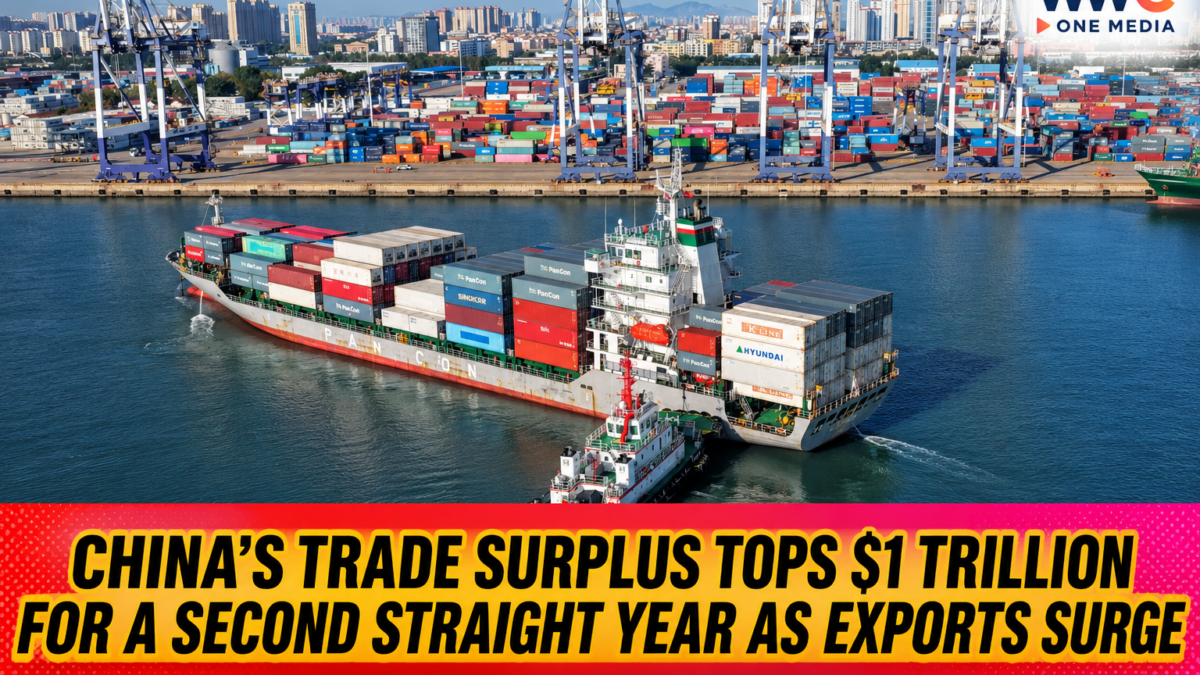
President Donald Trump’s trade tariffs have not stopped China’s export machine. Instead, the world’s second-largest economy has delivered another extraordinary trade performance, pushing its merchandise trade surplus beyond $1 trillion for a second consecutive year.
Fresh customs figures released on November 10 show that China’s trade surplus reached approximately $1.04 trillion between January and October 2026, putting the country on track to potentially surpass last year’s record of nearly $1.2 trillion.
The latest numbers reveal just how difficult it has been for Washington to reduce China’s influence in international commerce.
Chinese exports jumped 35.2% in October compared with the same month last year, supported by growing international demand for semiconductors, automobiles and other high-tech products. Imports also accelerated, increasing 41.6%, suggesting that China’s trade performance is becoming more complicated than simply exporting more while purchasing less.
But behind the impressive figures is a growing economic imbalance.
China continues to depend heavily on overseas customers to support its manufacturing sector, while weak domestic consumption and excess industrial capacity remain significant challenges.
The developments are raising questions about the effectiveness of Trump’s trade strategy, the future of US-China economic relations and whether China’s export-driven growth can remain sustainable.
China’s Trade Surplus Crosses $1 Trillion for the Second Consecutive Year
The latest customs data confirms that China’s international trade performance remains remarkably strong despite years of escalating trade tensions with the United States.
According to figures reported by the Associated Press, China recorded a $1.04 trillion merchandise trade surplus during the first 10 months of 2026.
That means the country crossed the trillion-dollar threshold a month earlier than it did in 2025.
October exports reached approximately $412.3 billion, increasing 35.2% year over year. Imports climbed to approximately $307.1 billion, representing a 41.6% increase.
Despite the faster growth in imports, China’s monthly trade surplus narrowed to $105.3 billion in October, compared with $133.5 billion in September.
The distinction is important.
A trade surplus represents the difference between the value of goods a country exports and imports. China’s cumulative surplus can continue growing even when its monthly surplus becomes smaller.
The figures also demonstrate that Trump’s tariffs have not eliminated China’s ability to sell products internationally.
Instead, Chinese manufacturers have continued expanding their presence in overseas markets while strengthening their positions in industries that are increasingly important to the global economy.
Trump’s Tariffs Have Not Stopped China’s Export Machine
When Trump returned to the White House, his administration placed renewed emphasis on tariffs and trade restrictions designed to protect American industries and reduce dependence on Chinese manufacturing.
The strategy was intended to make imported Chinese products more expensive and encourage businesses to consider alternative suppliers.
However, China’s latest trade figures suggest that the impact has been more complicated.
Although trade between Washington and Beijing experienced serious disruptions during the previous tariff escalations, Chinese manufacturers have increasingly pursued customers outside the American market.
Southeast Asia, Europe, Latin America and Africa have become important destinations for Chinese products.
This diversification has helped manufacturers maintain export momentum even when shipments to the United States face additional costs and regulatory obstacles.
Reuters previously reported that China’s exporters were redirecting more shipments toward non-US markets as American tariffs intensified.
The broader development is significant because trade restrictions against one country do not necessarily eliminate demand for its products elsewhere.
Companies may adjust their supply chains, establish overseas production facilities or develop new distribution relationships to maintain access to international customers.
That does not mean tariffs have had no economic impact. Rather, it shows that the effectiveness of tariffs depends on how businesses and competing economies respond.
The AI Boom Is Giving Chinese Manufacturers Another Advantage
One of the biggest forces behind China’s export performance is the global race to build artificial intelligence infrastructure.
Demand for AI-related equipment has created opportunities for manufacturers supplying semiconductors, electronics, networking components and other industrial products.
According to the Associated Press, China’s semiconductor exports increased 137.1% in value during October compared with the previous year.
Automobile exports also expanded substantially, rising 37.6%.
These figures demonstrate that China’s export growth is no longer limited to traditional manufactured products.
The country has developed extensive industrial capabilities across electronics, automotive production, batteries and other technology-related sectors.
The international expansion of AI infrastructure has provided additional demand for products connected to data centers and computing systems.
Reuters reported on November 10 that the global investment race in AI infrastructure helped strengthen Chinese high-tech exports, offsetting some of the weakness in domestic economic activity.
However, this creates a potential vulnerability.
If global investment in AI infrastructure slows, demand for certain semiconductor and electronics products could weaken. A correction in the technology sector could also affect prices and shipping volumes.
China’s export performance is benefiting from a powerful international technology cycle, but its continuation is not guaranteed.
China’s Trade With the United States Remains a Major Point of Tension
Despite the impressive overall trade numbers, the economic relationship between China and the United States remains complicated.
According to the latest AP report, China’s exports to the United States increased 32.9% in October compared with the same month last year.
However, this growth must be interpreted carefully.
The comparison comes after a period when US-China trade was heavily disrupted by higher American tariffs, creating a relatively low base for year-over-year growth.
Reuters separately reported that China’s trade surplus with the United States narrowed slightly to approximately $32.71 billion in October, compared with $34.01 billion in September.
For the first 10 months of 2026, China’s cumulative trade surplus with the United States stood at approximately $266.5 billion, according to the AP report.
These figures are not the same as China’s overall $1.04 trillion global trade surplus.
The distinction matters because the overall surplus includes trade with all international partners, not just American buyers.
Europe is another important source of trade friction.
China’s October exports to the European Union increased 24.3% year over year, while its cumulative trade surplus with the bloc exceeded $310 billion during the first 10 months.
European governments have become increasingly concerned about the competitiveness of Chinese manufacturing and the growing imbalance in bilateral trade.
These developments indicate that the debate surrounding China’s trade surplus is no longer exclusively an American concern.
China’s Biggest Economic Problem May Be Inside Its Own Borders
Although strong exports are supporting China’s economic performance, the country’s domestic economy continues to face significant challenges.
Weak household consumption, uncertainty surrounding the property market and excess industrial capacity remain important concerns.
A country can manufacture enormous quantities of products and still experience economic difficulties if its domestic consumers are not purchasing enough to absorb production.
This imbalance can encourage companies to seek customers abroad, potentially intensifying competition in international markets.
Economists cited by the Associated Press have warned that China’s manufacturing overcapacity and aggressive price competition could become increasingly difficult to sustain.
Businesses are facing pressure to compete through lower prices, sometimes at the expense of profitability and product quality.
For smaller manufacturers, this can create an uncomfortable situation in which increasing production does not necessarily translate into stronger earnings.
The problem also has international consequences.
When Chinese manufacturers seek additional customers overseas, competing producers in other countries may face greater pricing pressure.
This is one reason why governments in Europe and North America have become more concerned about the effects of China’s expanding industrial capacity.
China’s challenge is therefore not simply maintaining export growth.
It must also strengthen domestic demand and create a more balanced economic structure.
Europe Is Becoming Another Front in the Global Trade Dispute
The European Union is increasingly concerned about the growing volume of Chinese products entering its markets.
Chinese automobiles, industrial equipment, electronics and other manufactured goods have strengthened their positions in international commerce.
European manufacturers argue that the competitive environment has become more difficult as Chinese producers benefit from enormous production capacity and aggressive pricing.
The European Union has already pursued measures involving Chinese electric vehicles and other strategically important industries.
These restrictions create another potential obstacle for China’s exporters.
However, the European market remains commercially important, and the latest figures show that Chinese exports to the region continue to expand.
The situation presents a difficult balancing act.
European governments want to protect domestic industries without creating unnecessary disruption to international supply chains.
Beijing, meanwhile, wants continued access to foreign markets while resisting measures it considers discriminatory.
As China’s trade surplus expands, the pressure for further negotiations and possible trade restrictions is likely to remain elevated.
Why the Latest Numbers Matter for the Philippines
The growing trade confrontation between Washington and Beijing also matters to the Philippines.
The Philippine economy is closely connected to international supply chains, particularly in electronics, semiconductors, manufacturing and imported industrial components.
Changes in US-China trade policies can influence where multinational companies establish factories, purchase raw materials and distribute finished products.
If additional restrictions are introduced, some businesses may consider shifting production or sourcing activities toward Southeast Asian economies.
The Philippines could potentially benefit from investment diversification, particularly in electronics manufacturing and other export-oriented industries.
However, this opportunity is not automatic.
The country must remain competitive in infrastructure, logistics, workforce development, electricity costs and investment regulations.
There are also potential risks.
Disruptions in international trade could increase the cost of imported materials, affect export demand and create uncertainty for companies operating across multiple markets.
The Philippines should therefore monitor developments in the world’s two largest economies while strengthening its own manufacturing and export capabilities.
China’s growing trade surplus is not necessarily an immediate economic benefit or threat to every Philippine business. Its impact will depend on the industries involved and the direction of international investment.
Is Trump Losing the Trade War Against China?
China’s latest trade figures present a difficult challenge for Trump’s economic strategy.
The United States has used tariffs and other trade restrictions to pressure Beijing and encourage changes in international manufacturing patterns.
Yet China has continued generating enormous export revenues, reaching a $1.04 trillion trade surplus before the end of October.
This does not automatically mean Washington has lost the trade war.
Tariffs can affect individual industries, encourage alternative sourcing and change the profitability of particular trade relationships.
They can also influence investment decisions and create leverage during negotiations.
But the latest figures demonstrate that reducing China’s global manufacturing influence is considerably more complicated than simply increasing import duties.
China’s exporters have diversified their customer base, benefited from strong demand for technology products and continued competing in international markets.
At the same time, Beijing faces its own economic challenges, including weak household demand, industrial overcapacity and the possibility of stronger foreign trade restrictions.
The outcome will depend on more than the size of China’s trade surplus.
It will also depend on productivity, domestic consumption, technology leadership, investment and the ability of both governments to manage their economic relationship.
The Bigger Question: Can China’s Export Boom Last?
China’s $1.04 trillion trade surplus is an extraordinary achievement, but it also highlights the growing imbalance between its manufacturing strength and domestic economic demand.
The country has demonstrated that American tariffs alone cannot quickly eliminate its international competitiveness.
However, its dependence on foreign customers creates vulnerabilities whenever global demand weakens or governments introduce additional restrictions.
For Washington, the challenge is developing a trade strategy that strengthens American industries without creating unnecessary costs for businesses and consumers.
For Beijing, the priority is maintaining export momentum while encouraging stronger domestic consumption and reducing dependence on overseas demand.
For the rest of the world, the consequences could be significant.
A stronger Chinese export industry can provide affordable products and expand access to technology. But it can also intensify competition, increase pressure on domestic manufacturers and create new geopolitical disagreements.
The latest numbers show that the US-China trade conflict is far from settled.
China has crossed another trillion-dollar milestone, and its manufacturers continue to expand into international markets despite Washington’s pressure.
But with domestic demand still struggling and trade restrictions becoming a growing concern, the next phase of China’s economic expansion could be more difficult than the last.
China has shown that Trump’s tariffs cannot easily stop its export machine. But as the world’s second-largest economy becomes increasingly dependent on international buyers, could the very trade surplus that demonstrates its economic strength eventually become its biggest weakness?