WASHINGTON, D.C. / SANTA CLARA, CALIFORNIA / MANILA — November 11, 2026 | WWC ONE MEDIA | US Politics, Artificial Intelligence, Global Technology and Financial Markets
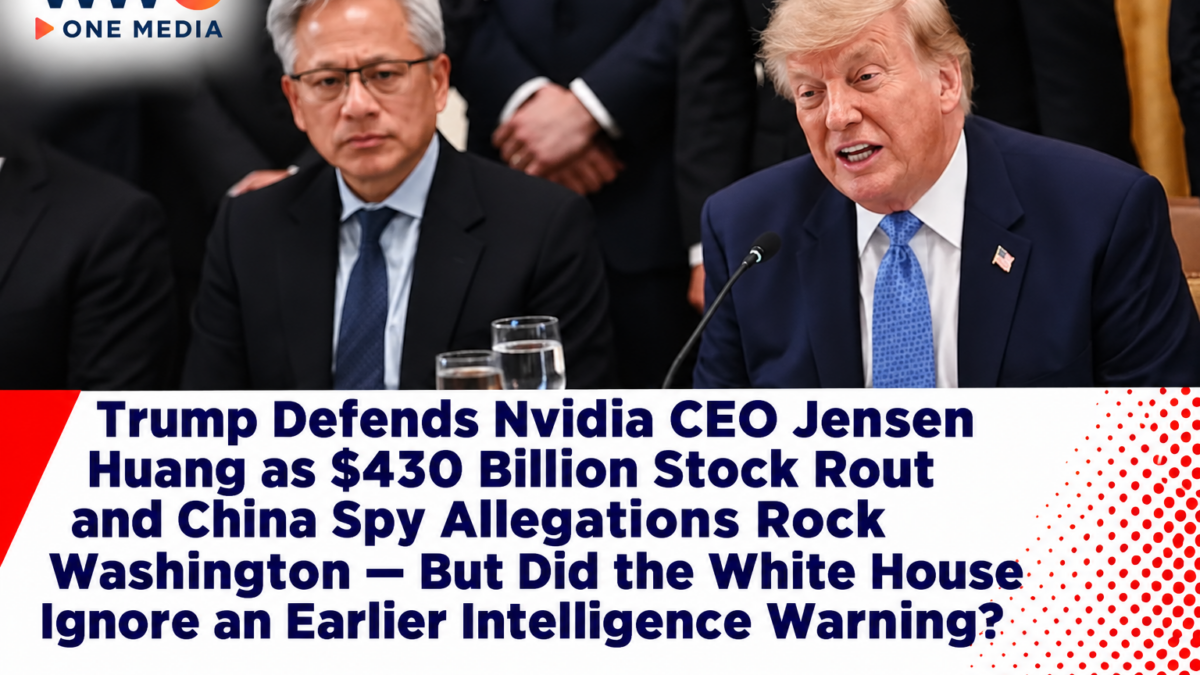
President Donald Trump’s close relationship with Nvidia chief executive Jensen Huang is facing intense political scrutiny after reports that US intelligence officials repeatedly warned the administration about the technology billionaire’s relationship with a woman suspected of gathering information for China.
The controversy has placed one of America’s most influential technology executives, the White House and the country’s sensitive artificial intelligence export policies at the center of an escalating national-security debate.
And the financial consequences are already substantial.
Nvidia has lost approximately US$430 billion in stock market value over two trading sessions, according to Reuters, as investors react to allegations involving Huang, suspected Chinese intelligence activity and questions about the company’s overseas semiconductor business.
The crisis intensified after The New York Times reported that Secretary of State Marco Rubio personally briefed Trump about the intelligence concerns aboard Air Force One during a May 2026 trip to China.
The reported briefing has raised new questions because Trump initially suggested he had not been aware of the allegations at that time.
Meanwhile, Nvidia’s independent directors have launched an investigation, the Federal Bureau of Investigation is examining the matter according to Trump, and lawmakers are demanding answers about American technology exports.
At stake is more than the reputation of a billionaire chief executive.
Nvidia’s advanced AI processors are central to the global technology industry and an important focus of Washington’s strategic competition with Beijing.
Trump insists Huang is an honorable executive who helped build one of America’s most successful companies. But as reports of intelligence warnings and multibillion-dollar chip transactions emerge, could the president’s close relationship with the Nvidia founder become a major political liability?
Trump’s Close Relationship With Jensen Huang Comes Under Fire
Jensen Huang has become one of the most influential technology executives in Washington.
The Nvidia co-founder has developed close ties with Trump since the president returned to the White House in January 2025.
Their relationship has included personal meetings, high-profile political events and discussions about US semiconductor policy.
According to Reuters, Huang has maintained direct access to the president.
A Reuters journalist observed Huang’s name appearing on Trump’s telephone in December 2025, illustrating the unusually close communication between the two.
In May 2026, Huang accompanied Trump on a presidential trip to China aboard Air Force One.
He also attended a White House state dinner for Chinese President Xi Jinping in September.
The following month, Trump awarded Huang the National Medal of Science, one of America’s most prestigious scientific honors.
Nvidia has also reportedly committed US$25 million toward Trump’s planned White House ballroom project.
Taken individually, meetings between a president and a major technology executive are not unusual.
The government routinely consults leading companies on economic policy, national security and industrial development.
But Huang’s extensive access has attracted renewed attention because Nvidia stands to benefit from decisions governing the export of advanced AI chips to China.
The investigation involving Huang has intensified questions about whether the administration maintained sufficient separation between political relationships and national-security decision-making.
There is no established finding that Trump’s relationship with Huang resulted in an unlawful policy decision.
What Did Trump Know About the Alleged Chinese Intelligence Operation?
The central political controversy concerns when Trump first learned about US intelligence suspicions involving Alice Huang, a Chinese businesswoman formerly associated with Singapore-based Megaspeed International.
Alice Huang is not related to Jensen Huang.
According to The New York Times, US intelligence officials assessed that she was collecting information for China’s Ministry of State Security.
That assessment remains an allegation in public reporting rather than a criminal finding established in court.
The Times reported that Trump received an intelligence warning about the relationship in late 2025.
A subsequent report published November 10 said Rubio briefed the president again during his May 2026 trip to China.
According to the report, Rubio delivered the warning before Jensen Huang joined the presidential delegation.
The disclosure challenges Trump’s statement during a November 9 news conference that he had not known about the allegations at the time of the trip.
Asked whether intelligence officials might have discussed the matter previously, Trump acknowledged the possibility but said it had not made a significant impression on him.
The White House disputed the Times’ account without providing a detailed public explanation of the alleged briefings.
This creates two distinct questions.
First, what intelligence information was presented to the president?
Second, how did the administration evaluate that information when making decisions involving Nvidia and Chinese access to advanced semiconductors?
Neither question has been fully resolved publicly.
Trump Personally Calls Huang and Defends Nvidia CEO
Despite the growing controversy, Trump has continued publicly defending Huang.
On November 9, the president told reporters that he had spoken directly with the Nvidia chief executive.
Trump said he asked Huang whether he had known the woman was allegedly involved in Chinese intelligence.
According to Trump’s account, Huang denied having such knowledge.
The president said he believed him.
Trump also praised Huang’s achievements and expressed confidence that the executive would emerge from the controversy without serious consequences.
His comments followed earlier remarks supporting Huang’s continued leadership.
In related coverage, WWC ONE MEDIA reported on Trump’s defense of Nvidia’s chief executive, the FBI-related statements and the possibility of tighter US restrictions on advanced AI chip exports.
Trump’s support is politically significant because the allegations concern an executive whose company is deeply involved in the competition between the United States and China for AI leadership.
However, a president’s expression of confidence is not a substitute for an independent investigation.
The relevant legal and national-security questions must be determined through evidence.
Who Is Alice Huang, and Why Does Megaspeed Matter?
Alice Huang has been identified in news reporting as a former executive associated with Megaspeed International, a Singapore-based business involved in AI computing infrastructure.
Megaspeed has participated in commercial arrangements involving Nvidia processors.
The company has attracted scrutiny because US authorities are concerned that advanced AI chips purchased through international intermediaries could ultimately become accessible to restricted Chinese customers.
According to reporting by The New York Times and Reuters, intelligence officials suspected Alice Huang of collecting information for Beijing.
China has rejected the accusations.
No public judicial finding establishes that Alice Huang worked as a Chinese spy.
Likewise, Jensen Huang’s acknowledged relationship with her does not establish that he knowingly assisted intelligence gathering or illegal semiconductor transfers.
That distinction is especially important because the controversy combines private conduct, corporate dealings and national-security allegations.
These matters require separate factual assessments.
The reported commercial relationship between Megaspeed and Nvidia also raises questions about how technology companies screen overseas customers, monitor equipment and comply with US export restrictions.
The $7.5 Billion Nvidia Chip Shipment Allegations
The controversy intensified when reports linked businesses associated with Alice Huang to substantial purchases and shipments of advanced Nvidia processors.
According to Reuters’ November 10 coverage of reporting by The Information, a network of companies allegedly helped facilitate at least US$7.5 billion in chip shipments connected to Chinese customers.
The reporting also referred to approximately 240,000 Nvidia processors obtained through associated business arrangements.
Some of those chips reportedly reached major Chinese technology companies.
However, the reported dollar value and processor count should not automatically be interpreted as the value or volume of proven illegal shipments.
Investigators would need to determine the destination of each relevant transaction, the applicable export rules, the identity of the end users and whether required authorizations were obtained.
The United States restricts exports of certain advanced AI processors because of concerns that the technology could strengthen China’s military and intelligence capabilities.
Companies operating data centers or computing services outside China can create additional regulatory challenges because customers may access computing power without directly purchasing the underlying hardware.
Those arrangements are not inherently illegal.
The critical questions involve compliance with applicable export controls and restrictions on end users.
In a separate investigation, WWC ONE MEDIA examined reported contact between Nvidia’s legal team and a Trump administration official during an inquiry into suspected chip diversion involving Megaspeed, including questions about approximately 50,000 initially unaccounted-for processors.
Those reported discrepancies and government contacts have increased pressure for transparency.
But the existence of an investigation, unexplained inventory differences or communications with regulators does not independently establish criminal misconduct.
Nvidia’s China Export Policies Become a Political Flashpoint
The relationship between Trump and Huang has coincided with important changes in US semiconductor export policy.
In April 2025, the Trump administration moved away from certain planned restrictions affecting Nvidia chip sales to China following a dinner involving Huang at Trump’s Mar-a-Lago residence.
In December 2025, Trump announced that Nvidia could sell its H200 AI processors to approved Chinese customers under conditions that included a proposed 25% government fee.
These decisions attracted significant attention because advanced computing technology is central to both countries’ economic and national-security strategies.
Huang has consistently argued that American technology companies should be allowed to compete in international markets while protecting the most sensitive US technologies.
Supporters of that approach contend that maintaining American companies’ presence in global markets can strengthen their commercial and technological leadership.
Critics argue that broader access to powerful US chips could accelerate Chinese AI development and undermine the purpose of export restrictions.
The reported intelligence warnings have sharpened this debate.
Lawmakers are now questioning whether officials considered all relevant information before making decisions benefiting Nvidia’s China business.
However, a policy decision favorable to a company is not, by itself, evidence of corruption or improper influence.
Establishing wrongdoing would require evidence showing that officials violated applicable laws or knowingly disregarded their responsibilities.
Trump’s Nvidia Stock Disclosures Raise Additional Questions
The political scrutiny has also extended to Trump’s financial disclosures.
Reuters reported that the president disclosed purchasing up to US$1.6 million in Nvidia stock and selling up to US$1 million during the summer of 2026.
The transactions were disclosed around the time Trump presented Huang with the National Medal of Science in October.
The White House said independent third-party financial institutions managed the president’s investment portfolio.
Those disclosures do not establish that Trump personally directed the transactions or traded using nonpublic information.
However, they add another dimension to public discussion about the relationship between the administration and the semiconductor industry.
Nvidia’s share price can be sensitive to government export decisions, AI policy announcements and international trade developments.
The appropriate questions concern financial disclosure requirements, potential conflicts of interest and whether relevant ethical safeguards were followed.
There is no verified finding that the disclosed transactions involved insider trading.
Democrats Demand Answers From Commerce Department
The controversy has triggered calls for greater scrutiny from Democratic lawmakers.
Members of the House Foreign Affairs Committee have asked Commerce Secretary Howard Lutnick to provide information about the administration’s handling of the alleged intelligence concerns.
The lawmakers want to know whether Commerce Department officials were aware of the reported intelligence linking Alice Huang to Chinese efforts to obtain Nvidia processors.
They also want details about any communications between Commerce officials and Secretary of State Marco Rubio.
Their letter requests answers by December 1.
Separately, Senator Chris Coons has called for scrutiny of Huang, Nvidia and the administration’s decision-making.
Senate Democratic leader Chuck Schumer has criticized Trump’s reported handling of the intelligence warnings and renewed calls for stricter AI chip-export controls.
For lawmakers, the central concern is whether national-security warnings received appropriate attention when the government evaluated technology exports.
The congressional requests do not establish that Nvidia violated the law or that administration officials knowingly enabled espionage.
But they could lead to additional hearings, document requests and public testimony.
Nvidia Launches Independent Board Investigation
Nvidia’s board has opened a formal investigation into whether Jensen Huang was targeted by a foreign intelligence operation.
The company appointed independent directors to oversee the review.
According to Reuters, the directors retained Joon H. Kim, a former acting US attorney and partner at Wachtell, Lipton, Rosen & Katz, to conduct an independent investigation.
The company has said it has no reason to believe corporate secrets or information affecting national security were compromised.
Huang remains chief executive and has pledged to cooperate.
The investigation must address potential vulnerabilities involving corporate security, executive disclosures and interactions with customers.
It may also examine whether relevant internal procedures were followed.
The outcome remains uncertain.
Investigators could find insufficient evidence of a security compromise, recommend improvements to corporate procedures or identify issues requiring additional action.
Until their findings are disclosed, no definitive conclusion about wrongdoing can be justified.
Nvidia Loses Approximately $430 Billion in Market Value
Financial markets have reacted sharply to the controversy.
Nvidia shares fell approximately 4.3% on November 9, closing at US$178.67.
The decline erased roughly US$190 billion from the company’s stock market capitalization during that session.
Reuters reported that Nvidia’s cumulative market-value losses across two trading sessions reached approximately US$430 billion.
Those figures represent changes in the company’s market valuation, not losses of an equivalent amount of cash from its bank accounts.
They also should not be attributed exclusively to the spy allegations.
Technology stocks have faced broader volatility as investors reassess AI infrastructure spending, company valuations and interest-rate expectations.
Nevertheless, the investigation has introduced an additional source of uncertainty involving one of the world’s most influential technology leaders.
In related reporting, WWC ONE MEDIA examined Nvidia’s approximately US$190 billion single-session market-value decline and the growing debate over succession planning if Huang were ever unable to continue as chief executive.
The market reaction highlights the degree to which investors associate Nvidia’s success with its founder.
But the investigation has not established that Huang will leave the company.
Why Jensen Huang Is So Important to the Global AI Industry
Jensen Huang co-founded Nvidia in 1993 and has led the company for more than three decades.
Under his leadership, Nvidia evolved from a graphics processor manufacturer into a central supplier of chips and computing systems used in artificial intelligence.
Its products support AI development across major technology companies and specialized computing providers.
Nvidia’s commercial influence extends through cloud infrastructure, semiconductor manufacturing, software and enterprise technology.
Huang has played a central role in the company’s technical direction and relationships with important customers.
This creates significant key-person risk for investors.
An unexpected leadership change could raise questions about strategy, product development and relationships with major technology partners.
However, Nvidia also has extensive engineering teams, senior executives and established commercial platforms.
Its future performance cannot be attributed entirely to one individual.
The critical question is whether the board can preserve confidence in the company’s management while independently examining the allegations.
Beijing Rejects the Allegations
China’s Foreign Ministry has denied accusations involving a Chinese intelligence operation targeting Nvidia’s chief executive.
Spokesperson Guo Jiakun described the claims as unsupported and rejected suggestions that Beijing had engaged in the alleged activity.
The Chinese government’s response is significant because the controversy has emerged amid an already sensitive period in US-China relations.
Washington and Beijing disagree over semiconductor export controls, technology restrictions and national-security policy.
China has criticized American restrictions on advanced chips.
The United States argues that certain controls are necessary to protect sensitive technological capabilities.
China’s denial must be considered alongside the public statements from US officials, Nvidia and other parties.
The central intelligence allegations have not been independently established through publicly available court findings.
Could Trump’s Relationship With Huang Change US-China Trade Policy?
The political controversy arrives as Washington prepares for further high-level engagement with Beijing.
Trump has indicated that he does not intend to raise the allegations directly with Xi Jinping during their anticipated meeting.
The president has also indicated that Huang will not accompany him on the next China trip.
Any significant change in semiconductor policy would affect companies far beyond Nvidia.
American chipmakers, cloud providers, Taiwanese manufacturers, South Korean suppliers and technology businesses across Southeast Asia are connected to the global AI supply chain.
Stricter export restrictions could affect chip sales and computing infrastructure development.
Conversely, more permissive rules could create additional commercial opportunities while intensifying national-security concerns.
However, neither outcome is guaranteed.
The ultimate policy response will depend on the evidence uncovered, the administration’s decisions and congressional action.
Why Singapore and the Philippines Should Pay Attention
The controversy has particular relevance for Southeast Asia because of the region’s growing role in AI infrastructure.
Singapore is an important commercial and financial center for technology businesses operating across borders.
Malaysia and other neighboring countries are attracting substantial investment in data centers and advanced computing facilities.
The involvement of Singapore-based Megaspeed has drawn attention to the challenges of verifying where powerful AI processors are deployed and who ultimately controls the computing services they provide.
For the Philippines, the immediate implications are primarily indirect.
Changes to US semiconductor export policy could influence regional technology investment, cloud-computing availability and the economics of AI infrastructure projects.
The country’s expanding IT and business-process outsourcing sector is also increasingly exposed to changes in global AI development.
However, there is no confirmed evidence that the Nvidia investigation has disrupted Philippine semiconductor production, local AI services or existing data-center operations.
Any direct impact would depend on future policy decisions and commercial responses.
Five Questions That Could Decide the Outcome
1. What did Trump know, and when was he briefed?
The New York Times reports that intelligence warnings reached the president before and during his May 2026 China trip. The administration disputes aspects of that account.
2. Was Nvidia’s corporate information compromised?
The board is investigating. Nvidia says it has no reason to believe sensitive information was exposed.
3. Did any chip shipments violate US export restrictions?
Reported transactions involving Megaspeed and associated businesses require examination of end users, destinations and applicable licensing requirements.
4. Will Congress demand stricter export controls?
Lawmakers are requesting information and considering stronger oversight, but the final policy outcome is uncertain.
5. Can Nvidia restore investor confidence?
Market sentiment will depend on investigative findings, governance decisions, financial performance and the company’s ability to maintain its competitive position.
The Bottom Line: Trump’s Nvidia Alliance Faces Its Biggest Political Test
The scrutiny surrounding Donald Trump and Jensen Huang has transformed an executive’s personal controversy into a broader debate about national security, corporate influence and US technology policy.
Trump has defended the Nvidia founder and expressed confidence in his explanation.
But reporting that intelligence officials warned the president about the relationship has raised questions about how the administration responded to possible security risks.
The controversy has also brought renewed attention to Nvidia’s access to policymakers, changes in semiconductor export rules and alleged multibillion-dollar chip transactions involving businesses associated with a woman suspected of Chinese intelligence activity.
For now, the central allegations remain disputed.
There is no established finding that Trump knowingly assisted espionage, that Jensen Huang knowingly provided sensitive information to China or that every chip shipment discussed in the reporting violated US law.
Nvidia’s independent investigation continues, and lawmakers are seeking further explanations.
The consequences could extend beyond the personal reputations of the people involved.
They may influence how Washington regulates advanced AI technology, oversees corporate relationships and balances commercial interests against national-security concerns.
Trump has repeatedly defended Jensen Huang as one of America’s most successful technology leaders. But as intelligence warnings, congressional inquiries and billions of dollars in market losses place their relationship under a microscope, will the White House’s support withstand the investigation—or could the controversy trigger a major reckoning over who influences America’s AI policy?