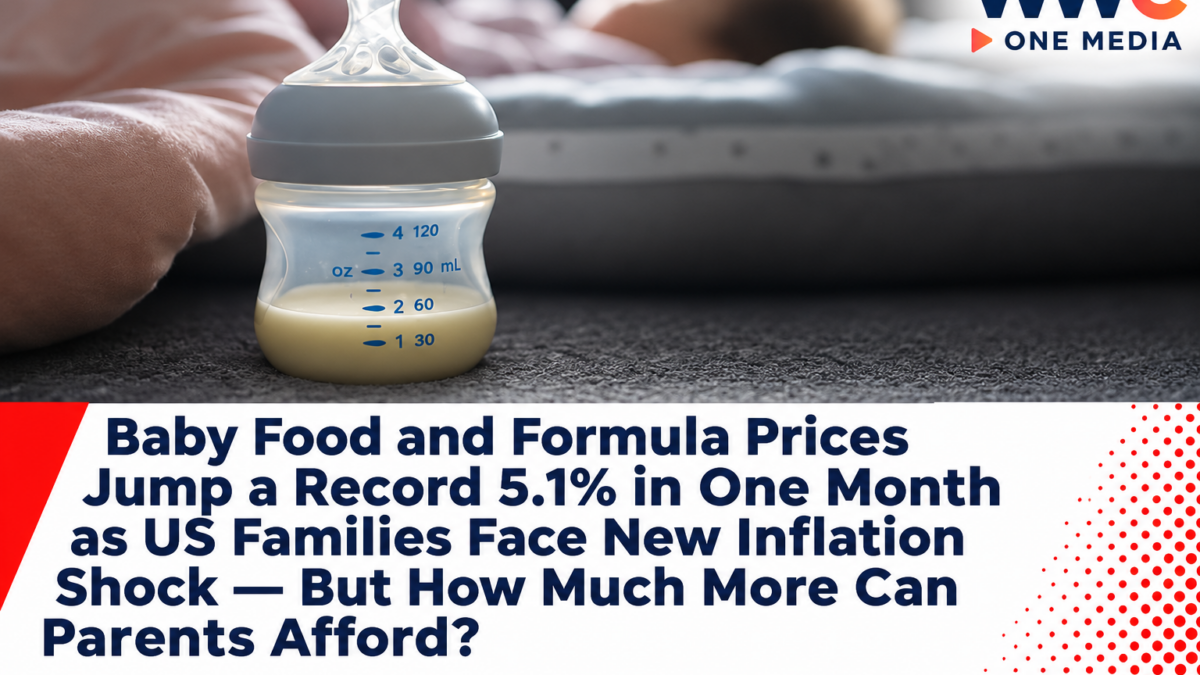
WASHINGTON, D.C. / MANILA, PHILIPPINES — November 11, 2026 — American parents are confronting another painful cost-of-living shock after prices for baby food and infant formula recorded their largest monthly increase in the available US government inflation data.
According to the Bureau of Labor Statistics, the combined baby food and formula price index surged 5.1% in October 2026, dramatically outpacing the increase in overall grocery prices.
The record jump comes as families struggle with higher food costs, persistent inflation and the possibility of additional Federal Reserve interest-rate increases.
Bloomberg highlighted the extraordinary increase in its November 10 report, while Reuters independently identified baby food and formula among the categories experiencing historically large price increases.
The figures expose an uncomfortable reality: while many purchases can be postponed when prices rise, food for infants is an essential household expense.
Parents who depend on formula cannot simply stop feeding their babies when supermarket prices become less affordable.
For households already managing rent, electricity, transportation and childcare expenses, the latest increase could add to an already difficult financial situation.
But the official numbers also require careful interpretation.
The 5.1% figure refers to a national price index combining baby food and infant formula. It does not mean every brand, container size or retailer increased prices by the same percentage.
Nor has the government established that the jump was caused by one specific manufacturer, tariff or supply disruption.
America’s latest inflation report shows that the cost of feeding babies is rising unusually quickly. But will this prove to be a temporary price shock—or another warning that essential household expenses are becoming increasingly difficult for working families to afford?
Baby Food and Formula Prices Surge a Record 5.1%
The most significant finding came from the October Consumer Price Index report, released November 10.
The Bureau of Labor Statistics recorded a 5.1% increase in its baby food and formula category.
Its detailed historical table identified the rise as the largest monthly advance in the available series.
The jump was particularly striking because broader grocery inflation was much smaller.
Overall food prices rose 0.5% during October.
Food purchased for consumption at home increased 0.4%.
The combined baby food and formula category therefore experienced a price increase far greater than the overall food indexes.
An important technical detail is that the baby food and formula figure comes from a category reported on a not-seasonally-adjusted basis.
The broader headline CPI and food figures commonly quoted in news reports are seasonally adjusted.
That means the figures are useful for describing the scale of the jump but should not be interpreted as perfectly identical measurements.
The official result nevertheless confirms that parents experienced an unusually sharp price movement in this essential category.
Why a 5.1% Increase Can Hurt Parents So Much
Baby formula and infant food are not ordinary discretionary purchases.
Families with infants must provide appropriate nutrition according to their children’s ages and medical needs.
For babies receiving formula, the product can represent a substantial recurring household expense.
A sharp price increase can therefore affect the family budget immediately.
Consider a hypothetical household that previously spent $200 a month on formula and baby food.
If the cost of the exact same basket increased by 5.1%, the monthly bill would rise to $210.20.
That is an additional $10.20 in one month.
For a household spending $300, the same percentage increase would add $15.30.
These are illustrations of how the reported inflation rate works, not estimates of the actual costs faced by every family.
Individual expenses depend on the baby’s age, product requirements, brand, retailer and feeding needs.
The impact can be more difficult for low-income households, where essential expenses consume a larger share of available income.
The Increase Reverses Recent Monthly Declines
The October result is even more notable when viewed alongside the previous months.
The BLS category recorded a 1.4% decline in August and a further 1.0% decline in September.
October’s 5.1% increase therefore reversed those recent decreases and pushed the price index higher.
This illustrates why monthly price movements can be volatile.
A single category may decline for several months and then experience a sudden increase.
That does not automatically mean every manufacturer changed its pricing strategy simultaneously.
Changes in retail promotions, available products, store pricing and the composition of sampled purchases can influence measured movements.
The index does not, by itself, identify which factor caused October’s increase.
For consumers, however, the immediate concern is the price paid at the checkout counter.
Even when earlier declines provided some relief, a sharp subsequent increase can quickly consume those savings.
US Grocery Inflation Adds to the Financial Pressure
The baby food and formula surge occurred during a broader increase in food prices.
According to the October CPI report, the food index rose 0.5%.
Food purchased at home increased 0.4%.
Food purchased away from home, including restaurant meals, also rose 0.5%.
The Washington Post and Reuters reported that grocery prices increased at their fastest pace in several months.
Families were also paying more for categories such as dairy products and fresh produce.
These pressures matter because parents must purchase groceries for the entire household, not just infants.
A rise in formula costs may arrive alongside higher spending on vegetables, dairy, transportation and utilities.
As WWC ONE MEDIA previously reported on September’s 3.7% annual US inflation rate and the pressure of rising energy and everyday expenses, household budgets have already been strained by the cumulative effects of inflation.
The October numbers show that important price pressures remain.
But the September annual rate and October monthly price changes refer to different reporting periods and should not be presented as interchangeable.
October Inflation Exceeds Economists’ Expectations
The broader economic picture is also troubling.
The Bureau of Labor Statistics reported that overall consumer prices rose 0.4% in October.
That was lower than September’s 0.6% monthly increase.
However, economists had expected an October increase of approximately 0.3%.
Core inflation, excluding food and energy, increased 0.3% during the month.
The data suggested that underlying inflation remained more persistent than financial markets anticipated.
Before the report, economists had been looking for signs that price pressures were beginning to ease.
As WWC ONE MEDIA examined in its preview of the November 10 CPI announcement, expectations centered on a softer monthly headline reading.
The actual 0.4% result exceeded that forecast.
For households, the difference is important because a slower rate of inflation does not mean prices are returning to previous levels.
It generally means they are increasing less quickly.
October’s baby food and formula result demonstrated how individual essentials can still become much more expensive even when headline inflation moderates.
Why the Government Cannot Provide a Normal October Annual Inflation Rate
The October inflation report includes an unusual data limitation.
Because of the 2025 federal government shutdown, the Bureau of Labor Statistics did not collect all the information normally required to calculate standard year-over-year changes for October 2026.
As a result, many annual comparisons are unavailable.
This is particularly important when assessing baby food and formula.
The official October result establishes a 5.1% monthly increase.
It does not establish a corresponding 5.1% annual increase.
Economists have produced estimates of overall annual inflation using alternative methods, but those estimates should not be confused with complete official BLS year-over-year figures.
For accurate reporting, the baby food and formula increase should be described as a record monthly movement in the available data.
The distinction prevents readers from drawing misleading conclusions about how much prices changed over an entire year.
What Is Driving the Increase in Baby Formula Prices?
The latest CPI data show how much the category’s measured prices changed.
They do not provide a definitive explanation for the entire increase.
Several potential influences may affect the broader market for infant formula and baby food.
These include ingredient costs, manufacturing expenses, transportation, packaging, retailer pricing and promotional discounts.
Trade policies and imported inputs may also affect some producers.
However, the size and timing of each influence would need to be established using additional industry evidence.
It would be inaccurate to claim that one particular company, tariff or commodity price caused the record October jump without supporting data.
This is a central distinction between reporting a price increase and explaining its cause.
The first can be established through the BLS release.
The second requires evidence about producers, retailers and supply chains.
For now, the verified conclusion is that the combined category experienced a record monthly increase while the broader US food market was also under inflationary pressure.
America’s Infant Formula Market Has Faced Supply Challenges Before
The latest inflation news follows several years of scrutiny of the US infant formula industry.
In 2022, the country experienced a major formula shortage after manufacturing disruptions and supply-chain problems affected availability.
The crisis exposed vulnerabilities in a market where a relatively small number of manufacturers supplied a large share of national demand.
The federal government subsequently examined ways to strengthen supply resilience and improve competition.
But the October 2026 price increase should not automatically be described as a new nationwide shortage.
A rapid price increase can occur without a comparable collapse in product availability.
Likewise, shortages can occur without every product increasing in price by the same amount.
The evidence needed to establish a new shortage would include inventory levels, retailer availability, production interruptions and distribution data.
The BLS price index alone cannot answer those questions.
Still, the experience of 2022 explains why many parents remain sensitive to changes in infant formula pricing and availability.
Federal Investigators Previously Examined Formula Pricing and Competition
The US Government Accountability Office published a detailed review of the infant formula market in January 2025.
Its investigation examined the competitive bidding system used by the federal Women, Infants, and Children nutrition program, known as WIC.
The GAO found that the system significantly reduced government formula costs through manufacturer rebates.
It also found that obtaining a WIC contract caused a modest average increase in certain retail prices of the winning brand.
According to the report, products specified in winning contracts experienced an estimated average price increase of 1.7%, equivalent to roughly 30 cents for a typical 12-ounce container of powder formula.
That finding concerned the period examined in the GAO study.
It does not explain the record 5.1% increase in October 2026.
However, it illustrates how pricing, competition and government purchasing arrangements interact in the infant formula market.
The challenge is maintaining affordable access while ensuring reliable supply and sufficient competition.
WIC Provides Crucial Support to Families With Infants
One of the most important programs protecting vulnerable families is the Special Supplemental Nutrition Program for Women, Infants, and Children.
WIC helps eligible low-income pregnant and postpartum women, infants and children younger than five obtain nutritious foods and related support.
According to the US Department of Agriculture, WIC served approximately 6.9 million people per month during fiscal year 2025.
The program supported an estimated 41% of US infants during that fiscal year.
For participating families, the program can help reduce direct spending on approved infant formula and other eligible foods.
USDA also reports that manufacturer rebates are an important part of keeping WIC costs manageable.
In fiscal 2025, formula rebates totaled approximately $1.6 billion.
Those rebates help the program support more eligible participants within its available funding.
However, WIC eligibility and approved products depend on federal requirements and state program arrangements.
Families should not assume every formula brand or specialty product is automatically covered.
The recent price surge underscores why reliable nutrition assistance remains important for households facing financial hardship.
A New FDA Formula Proposal Adds Another Industry Development
The infant formula industry is also confronting potential regulatory changes.
On October 29, the US Department of Health and Human Services announced that the Food and Drug Administration had proposed an update to infant formula nutrient requirements.
The proposal is part of a broader review of standards that have not undergone a comparable comprehensive update since 1998.
The first phase addresses nutrients including iodine, manganese, vitamin A and vitamin D.
The agency also released new testing information concerning chemical contaminants in sampled products.
These developments concern formula safety and nutritional standards.
They should not be presented as an established cause of the October price jump.
The proposed rule is not yet a final regulatory requirement.
Its eventual financial effects would depend on the final requirements, implementation timetable and how manufacturers respond.
The broader issue is that policymakers must balance safety, nutritional quality, product availability and affordability.
For parents, all four considerations matter.
Higher Interest Rates Could Add Another Burden for Families
The inflation report has also increased expectations that the Federal Reserve will raise interest rates in December.
Federal Reserve officials have expressed concern that inflation remains above the central bank’s longer-term 2% target.
Philadelphia Fed President Anna Paulson has supported additional gradual monetary tightening.
Other officials have discussed the possibility that more aggressive action could become necessary if inflation remains persistent.
As WWC ONE MEDIA reported on Paulson’s comments and the October CPI surprise, policymakers face a difficult balance between reducing inflation and avoiding unnecessary economic disruption.
Higher interest rates can affect consumer borrowing costs.
That matters to households already struggling with essential expenses.
However, a Federal Reserve rate increase does not directly determine the price of baby formula.
Monetary policy affects broader economic conditions, while individual retail prices also depend on supply, competition and business decisions.
Household Borrowing Makes Inflation More Difficult to Manage
The latest price increases come as American consumer borrowing remains elevated.
Federal Reserve data showed that consumer credit increased approximately $27.8 billion in September 2026.
Revolving credit, a category dominated by credit cards, accounted for a substantial portion of that increase.
As WWC ONE MEDIA reported on the sharp growth in US consumer credit, higher borrowing balances are prompting questions about household financial resilience.
The data do not establish that families borrowed specifically to purchase infant formula.
But they provide wider context for the pressures facing consumers.
A household carrying credit card debt may face interest expenses in addition to rising grocery bills.
If borrowing becomes more expensive, that can further reduce the amount available for essential purchases.
However, an increase in outstanding credit alone does not prove that borrowers are unable to repay.
A complete assessment would require information about income, savings, delinquency rates and other household finances.
The central concern is that persistent increases in necessities can leave financially vulnerable families with fewer options.
How Families Can Manage Formula Costs Without Compromising Infant Nutrition
Parents may seek less expensive products when grocery costs increase.
But infant feeding requires particular care.
For families using formula, any substitute must be appropriate for the baby’s nutritional and medical needs.
Parents should not dilute formula with extra water to make it last longer.
Doing so can create serious health risks for infants.
Homemade formula recipes and ordinary animal or plant milks should not be used as substitutes for appropriate infant formula without qualified medical advice.
Families concerned about affordability can ask healthcare professionals about suitable alternatives, compare the cost per prepared volume of appropriate products and check eligibility for WIC or other assistance.
For babies using specialty or medically prescribed formula, product changes should be discussed with the child’s clinician.
The objective is to reduce unnecessary spending while maintaining safe, adequate nutrition.
A lower-priced product is not a good bargain if it is inappropriate for the infant.
Could Higher Formula Prices Affect Other Countries?
The October price surge is a US inflation finding.
It does not establish that formula prices in the Philippines, Canada, Europe or other countries increased by the same percentage.
International markets have different manufacturers, import arrangements, retail pricing systems and exchange rates.
However, global companies may share ingredients, packaging suppliers and distribution networks across markets.
That means some changes in international manufacturing and transportation costs can affect multiple countries.
The extent of those effects varies.
For the Philippines, imported infant products may be sensitive to exchange rates, shipping costs and local retail conditions.
But those influences must be measured using Philippine prices and data rather than inferred directly from the US CPI.
The lesson for parents and policymakers is broader: affordable infant nutrition depends on reliable supply, transparent pricing and appropriate support for vulnerable households.
What Happens Next for Baby Food and Formula Prices?
The immediate question is whether October’s record increase will persist.
Future inflation reports will show whether the category continues rising, stabilizes or experiences a reversal.
Economists and consumer advocates will also monitor grocery prices more broadly.
Manufacturing costs, transport expenses and product availability could provide clues about future movements.
Regulators may continue examining formula standards and market competitiveness.
WIC programs will remain important for eligible families.
For retailers and manufacturers, there may be pressure to explain pricing decisions and preserve affordable options.
However, the available October data do not justify a precise prediction about November or December formula prices.
A single record monthly increase is important.
It is not enough to prove that prices will continue rising at the same rate.
The next several months will be critical in determining whether families face a temporary disruption or a more sustained affordability problem.
The Bigger Picture: America’s Inflation Crisis Is Reaching the Nursery
The latest inflation report illustrates why the cost of living remains a major concern for American households.
Overall consumer prices increased 0.4% in October.
Grocery prices rose 0.4%.
But the combined baby food and infant formula category recorded an extraordinary 5.1% monthly jump.
The figures show that individual essential products can experience much sharper price movements than the overall inflation rate.
For parents, the distinction is more than statistical.
A rise in the cost of infant food can immediately affect household spending decisions.
Families still need to pay for housing, transportation, healthcare and other necessities.
Those with limited income may have less flexibility to absorb unexpected increases.
The federal government provides assistance through WIC, while regulators continue examining formula safety and competition.
But the broader affordability challenge remains.
Baby food and infant formula prices have recorded their largest monthly increase in the available US inflation data, leaving parents confronting another unexpected rise in essential expenses. But with household budgets already stretched and the Federal Reserve weighing additional interest-rate increases, will prices stabilize before families feel more pressure—or could America’s cost-of-living crisis become even harder for parents with young children?