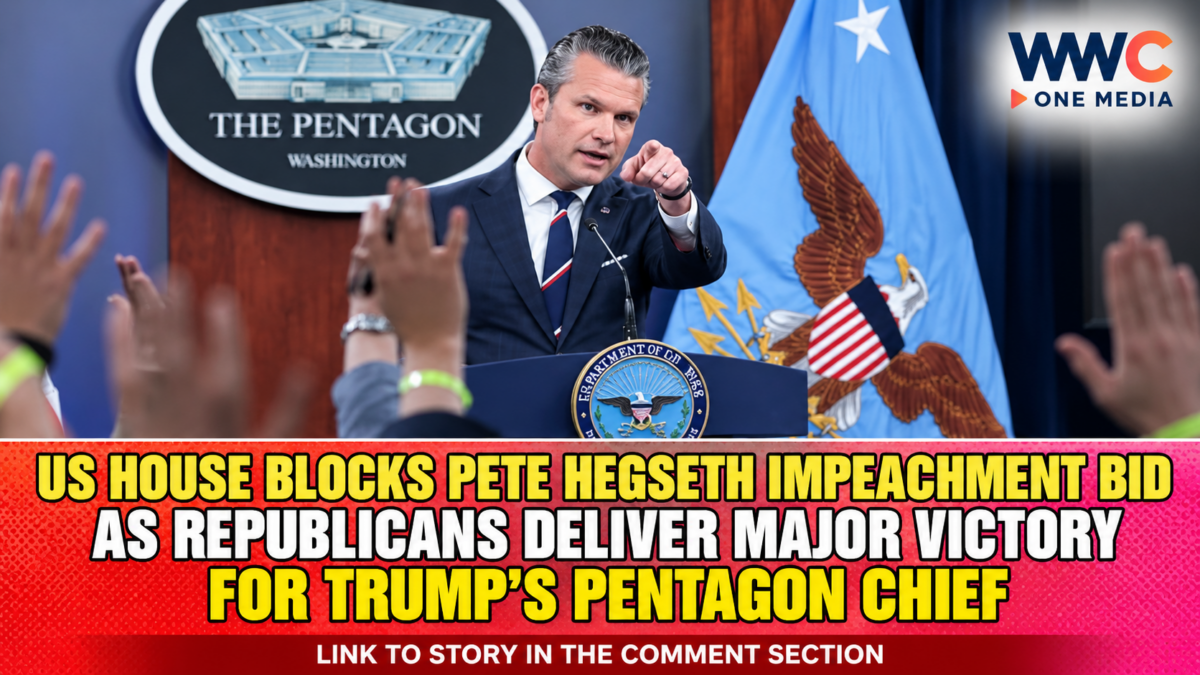
WASHINGTON, D.C. — US Defense Secretary Pete Hegseth has survived an attempt to impeach him after House Republicans voted to block a resolution accusing him of abusing his authority over the Iran war and several controversial American military operations.
The November 10 vote gave Hegseth a significant political reprieve, but it did not settle the legal and constitutional questions surrounding his leadership of the Pentagon.
The House voted 211–204 to refer eight articles of impeachment introduced by Republican Representative Thomas Massie of Kentucky to the Republican-controlled House Judiciary Committee. The procedural move effectively stopped the resolution from advancing to a full impeachment vote during the current congressional session.
Massie was the only Republican to oppose the referral. Eleven Democrats, including former House Speaker Nancy Pelosi, did not vote.
The outcome came just days after Democrats secured control of Congress in the November 3 midterm elections, setting up a potentially difficult period for President Donald Trump and his administration when the new Congress takes office in January 2027.
For Hegseth, the vote represents a major victory. For his critics, however, the decision may have delayed a political confrontation rather than ended it.
Republicans Block Impeachment Resolution in 211–204 Vote
Massie introduced eight articles of impeachment against Hegseth on November 9, arguing that the defense secretary had committed serious abuses of authority through his handling of military operations.
Rather than voting directly on whether Hegseth should be impeached, House Republicans supported sending the resolution to the Judiciary Committee.
The motion passed 211–204, largely along party lines.
Massie had hoped to attract support from Republicans concerned about the administration’s military decisions and the growing public opposition to the Iran conflict. But no other Republican joined him in voting against the referral.
The absence of 11 Democrats also became a significant part of the political discussion. Had enough of those lawmakers participated, the outcome could have been different.
Republican leaders maintained control of the procedural process, preventing the impeachment resolution from reaching a direct vote on its merits.
The distinction matters: the House did not conduct a trial or determine whether the allegations against Hegseth were true. It voted to refer the resolution to a committee, effectively stopping the immediate impeachment push.
Hegseth Calls Impeachment Push a Political Spectacle
Before the vote, Hegseth strongly rejected the allegations during a Pentagon news conference.
He described the impeachment effort as a political spectacle driven by personal resentment and opposition to the administration’s policies.
Hegseth argued that disagreements over military strategy should not be treated as grounds for removing a Cabinet official through impeachment.
He also defended the administration’s military decisions, insisting that American forces had been given lawful orders.
President Trump quickly celebrated the House result, declaring that the impeachment effort had failed and praising Hegseth’s performance.
The president’s support remains politically important. Hegseth has become one of Trump’s most visible allies in the administration’s military campaign, and his survival of the House vote strengthens the president’s position for now.
However, political support does not resolve the underlying allegations. Those questions remain contested and could return through congressional investigations or a new impeachment effort.
What Are the Eight Impeachment Charges Against Pete Hegseth?
Massie’s resolution contains eight articles covering the Iran war, civilian protection, military operations and the alleged misuse of government authority.
The accusations include:
- Military action against Iran: Massie alleges that Hegseth participated in launching military operations without the congressional authorization required under his interpretation of the Constitution.
- Continuing the Iran conflict: The resolution challenges the administration’s decision to continue hostilities despite congressional efforts to restrict or end American involvement.
- War Powers Resolution violations: Massie argues that the administration exceeded legal limits governing military operations conducted without congressional authorization.
- Failure to protect civilians: The resolution alleges that Hegseth failed to uphold legal safeguards intended to reduce civilian casualties during military operations.
- Strikes against suspected drug-trafficking vessels: Massie questions the legality of lethal American operations against vessels suspected of transporting illegal drugs in the Caribbean and eastern Pacific.
- Retaliation against Senator Mark Kelly: The resolution alleges that Hegseth used his official position to retaliate against the Democratic senator after Kelly and other lawmakers released a video reminding military personnel that they must refuse unlawful orders.
- The operation involving Venezuela’s Nicolás Maduro: Massie challenges Hegseth’s role in the US operation that resulted in the capture of Venezuelan President Nicolás Maduro.
- Military operations in Yemen: The final article questions the legal authority for American military action against Iran-aligned Houthi forces.
These are allegations contained in Massie’s impeachment resolution, not established findings of criminal wrongdoing. Hegseth has rejected the accusations, and the House’s procedural vote did not determine their truth.
Why the Iran War Has Become a Political Liability for Trump
The conflict with Iran is at the centre of the impeachment controversy.
Critics argue that the administration has continued military operations without sufficient congressional approval and that the conflict has created serious humanitarian, economic and security consequences.
The War Powers Resolution of 1973 is particularly important to the dispute. The law establishes reporting requirements and generally limits the period in which US forces may remain in hostilities without congressional authorization, subject to specified exceptions and procedures.
Massie argues that Hegseth’s actions violated those restrictions. The administration disputes that interpretation and maintains that its military decisions were lawful.
The disagreement reflects a longstanding constitutional struggle over the division of war-making authority between Congress and the president.
The president serves as commander in chief, while Congress has constitutional powers involving declarations of war, military funding and legislation. The precise limits of those powers have been contested across successive administrations.
The political pressure has intensified following the midterm elections, when voters delivered a major rebuke to Republicans. Public frustration over the Iran conflict has become one of the issues confronting the Trump administration.
WWC ONE MEDIA previously examined congressional efforts to restrict Trump’s authority to continue military operations against Iran:
Democrats Could Reopen the Hegseth Investigation in January
Although the impeachment effort has been blocked for now, Democrats are preparing to take control of Congress in January 2027.
That change could give them greater control over congressional committees, hearings, subpoenas and investigations involving the Pentagon.
Democratic lawmakers have indicated that Hegseth’s leadership and the administration’s military decisions will remain under scrutiny.
Possible areas of investigation include the legal basis for the Iran war, civilian casualties, military operations involving suspected drug-trafficking vessels, the Venezuela operation and the treatment of military officials who have been removed from senior positions.
Democrats could also introduce a new impeachment resolution once the next Congress begins.
However, a renewed effort would not guarantee Hegseth’s removal. Any impeachment resolution would still need to pass the House, followed by a Senate trial if the House adopts the articles.
WWC ONE MEDIA has reported on the incoming Democratic majority’s plans for investigations into the Trump administration, including its handling of the Iran conflict:
The new congressional majority could increase pressure on Hegseth even without immediately pursuing impeachment. Hearings and demands for documents could keep the Pentagon chief at the centre of Washington’s political battles.
What Impeachment Would Actually Mean for Hegseth
The House’s decision to block the resolution does not mean Hegseth has been cleared of every allegation.
Under the US Constitution, the House has the sole power to impeach federal officials. Impeachment requires a simple majority vote and formally brings charges against an official.
Removal from office is a separate process.
If the House impeaches a Cabinet secretary, the Senate must consider the charges. Conviction requires a two-thirds majority of senators present, making removal considerably more difficult than securing a House impeachment vote.
Only two Cabinet secretaries have previously been impeached in US history.
Secretary of War William Belknap was impeached in 1876 amid a corruption scandal, although he was acquitted by the Senate. Homeland Security Secretary Alejandro Mayorkas was impeached in 2024 over allegations involving border enforcement, but the Senate dismissed the charges.
Hegseth would have become the first US defense secretary to be impeached had Massie’s effort advanced successfully.
The historical significance of the case explains why the procedural vote attracted national attention. It was not simply a dispute over one Cabinet member; it involved the constitutional limits of military authority and Congress’s responsibility to oversee the executive branch.
For additional background on the allegations that preceded the vote, WWC ONE MEDIA covered Massie’s original effort to bring eight impeachment articles against the Pentagon chief:
Hegseth’s Political Future Could Depend on the Next Congress
The House vote has given Hegseth breathing room, but the political environment surrounding the Pentagon is changing.
Republicans will soon lose control of Congress, while Democrats are preparing to use their new majority to scrutinise the administration’s military decisions.
That shift could complicate the Pentagon’s relationship with lawmakers, particularly as the administration seeks major increases in defense spending and continues to defend its strategy toward Iran.
The incoming majority may also examine personnel decisions, including the removal of senior military officers and the administration’s approach to military accountability.
WWC ONE MEDIA has previously reported on growing Republican criticism of Hegseth, showing that questions about his leadership have not come exclusively from Democrats:
For now, Hegseth remains in office and retains Trump’s backing. But the House vote has not erased the questions raised by Massie’s resolution, nor has it prevented Democrats from pursuing further scrutiny when they take control.
The Pentagon chief has survived an immediate impeachment challenge. Whether he can withstand the investigations and political pressure expected in 2027 may prove to be a much bigger test.