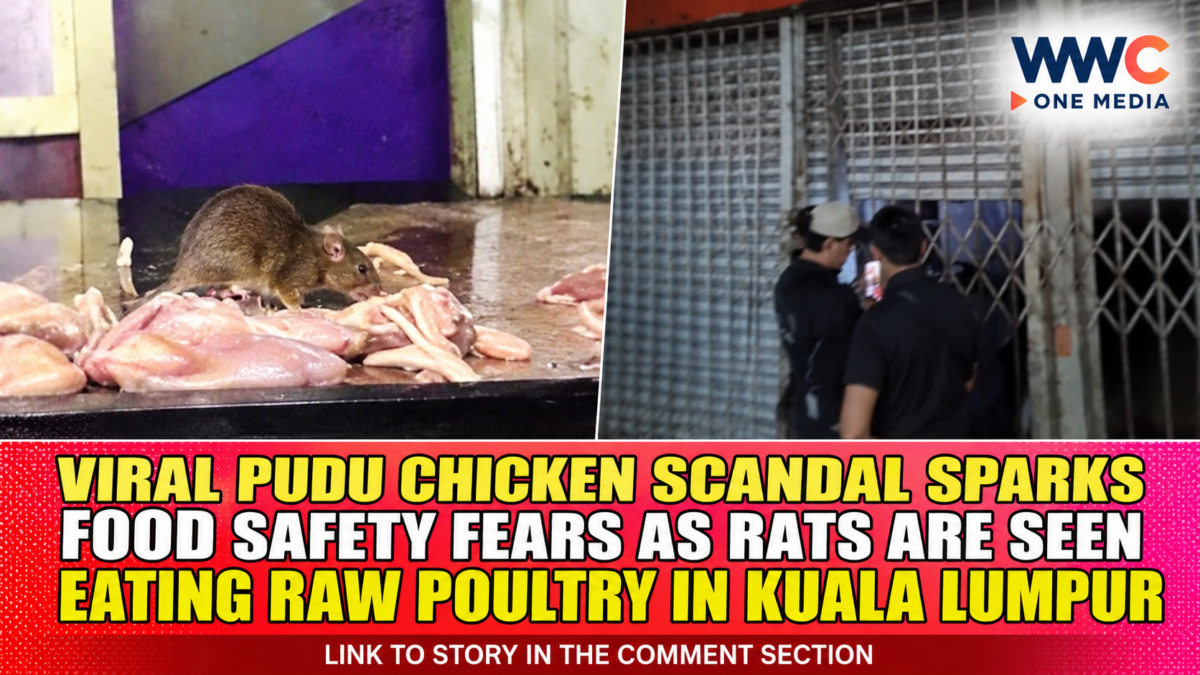
A disturbing video allegedly showing rats eating raw chicken inside a business premises in Kuala Lumpur’s Pudu district has triggered widespread public outrage, raising serious questions about food hygiene, pest control and the safety of poultry being sold to consumers.
The footage, which circulated on social media in November 2026, reportedly shows several rats moving around large black water containers holding hundreds of raw chickens. Some of the rodents appear to be feeding directly on the poultry.
The incident gained further attention after social media users shared the footage and Malaysian content creator Zarif Syarafuddin conducted a livestream showing conditions inside the premises. The recordings prompted concerns that potentially contaminated chicken could already have been purchased or distributed before the incident came to light.
The allegations have not, by themselves, established how much poultry may have been affected, whether any contaminated products reached customers or whether the business violated specific food-safety requirements. Those questions require investigation by the relevant authorities.
Nevertheless, the images have intensified calls for an urgent inspection of the premises and closer monitoring of businesses handling raw poultry.
Rats Allegedly Seen Feeding on Chicken Inside Large Water Containers
According to reports from Malaysian media, the controversy began after footage shared on Threads showed rats inside containers holding raw chicken at a premises believed to be in the Pudu area.
The video reportedly showed the animals moving between the poultry and feeding on the meat.
Zarif Syarafuddin later visited the location with several companions and broadcast footage through TikTok Live. The livestream allegedly showed large quantities of raw chicken stored in black containers, with rodents visible around the same area.
Reports also described workers closing the premises’ doors after noticing people recording the conditions.
A man seen during the livestream reportedly identified himself as a runner collecting chicken supplies for another party. However, this alone does not establish where the poultry was being delivered or whether any affected stock had entered the wider distribution network.
That uncertainty is central to the public concern. If poultry exposed to rodents was subsequently sold or distributed without proper inspection and disposal, the potential consequences could extend beyond the premises itself.
Why Rat Contamination Is a Serious Food Safety Risk
Rats are more than an unpleasant sight in a food-handling environment. They can carry pathogens and contaminate food through their saliva, urine, faeces and direct contact.
One particularly serious concern is leptospirosis, a bacterial infection commonly associated with exposure to water or soil contaminated by infected animal urine. The disease can cause fever, muscle pain and other symptoms, and severe cases may lead to kidney or liver complications.
Rodents can also spread other organisms that cause foodborne illness. Raw poultry already requires careful handling because harmful bacteria can be present even when the meat looks and smells normal.
If chicken is exposed to rodents or other pests, washing it is not a reliable way to make it safe. Potentially contaminated food must be handled and assessed under appropriate food-safety procedures.
Consumers should also avoid handling suspicious raw poultry with bare hands and should prevent raw meat or its juices from contacting other food, utensils and kitchen surfaces.
Kuala Lumpur Authorities Have Been Increasing Restaurant Inspections
The Pudu incident comes amid wider scrutiny of food hygiene in Kuala Lumpur.
In October 2026, Kuala Lumpur City Hall (DBKL) Health and Environment Department director Dr Noor Halizam Ismail said officers monitor social media for videos showing rats, cockroaches and other possible hygiene violations at food premises.
She explained that authorities do not necessarily wait for formal complaints before responding to visible public-health concerns. Officers can be alerted through internal communication channels and sent to investigate.
DBKL reported that it had closed 194 food premises up to September 30, 2026. The city authority had closed 616 premises in 2024 and another 442 in 2025. Those previously closed establishments were subsequently allowed to reopen after follow-up inspections confirmed that the required corrective work had been completed.
The inspections cover areas that customers rarely see, including food-storage rooms, refrigerators, floors, drains, grease traps, exhaust systems and spaces beneath sinks.
Inspectors also check whether food handlers have completed the required training and received typhoid vaccinations, as well as whether businesses maintain effective pest-control arrangements.
For further context on how Kuala Lumpur is responding to unhygienic food premises, see WWC ONE MEDIA’s report:
Seven Premises Ordered Closed During a Separate Kuala Lumpur Inspection Operation
The wider enforcement picture is also concerning.
During an October operation in Pudu and Bukit Bintang, DBKL officers inspected 14 food premises, issued 15 compounds and ordered seven establishments to close.
Inspectors reportedly found several hygiene problems, including uncovered food and ice stored near toilets, rat droppings in food-storage areas, poorly maintained grease traps and rotting food waste.
In one premises previously ordered to close, officers reportedly found that conditions had deteriorated rather than improved.
The findings demonstrate why an attractive dining area does not necessarily mean a kitchen is safe. Contamination risks can remain hidden in storage spaces, preparation counters, drains and other areas that customers never see.
WWC ONE MEDIA has also reported on food-safety concerns in Singapore after authorities investigated a coffeeshop over food-preparation practices:
Food Premises Can Face Immediate Closure Under Malaysian Law
Malaysia has legal provisions allowing authorities to act against food businesses that present serious hygiene or public-health risks.
Under Section 11 of the Food Act 1983, an authorised health officer may order a food premises to close for up to 14 days when its sanitary conditions are unsatisfactory and it is likely to be hazardous to health.
DBKL also has enforcement powers under the Licensing of Food Establishments (Federal Territory of Kuala Lumpur) By-Laws 2016. These provisions allow action against premises suspected of being, or likely to become, a source of infection.
A closure does not automatically mean a business can reopen as soon as it has cleaned the premises. Inspectors must return and assess whether the required corrective measures have been completed.
Repeated violations may also place a business’s operating licence at risk.
A previous case in Pandan Indah illustrates how seriously authorities can treat visible rodent contamination. In December 2022, a restaurant was ordered to close for 14 days after a video showed a rat eating fried chicken inside a food warmer. Health authorities also issued six compound notices for food-safety and hygiene violations.
The local council subsequently moved to revoke the restaurant’s licence.
The case provides a reminder that viral footage can lead to enforcement action when inspections establish that food-safety requirements have been breached.
The Halal Question Requires a Separate Official Assessment
The Pudu footage has also prompted online questions about the halal status of the poultry.
However, food hygiene and halal certification are related but distinct matters. A video showing possible pest contamination does not, by itself, establish whether chicken was slaughtered according to Islamic requirements or whether a particular product carries valid halal certification.
The distinction is especially important because a separate controversy involving a poultry-processing premises in Pudu had already attracted attention.
In October 2026, Malaysia’s Department of Islamic Development (JAKIM) said an inspection of a poultry-slaughtering premises linked to an earlier viral controversy found that the facility did not possess a Malaysian Halal Certification. JAKIM also clarified that the premises was registered under a different entity, rather than the poultry supplier named in public allegations.
That earlier matter involved separate allegations and should not automatically be treated as proof about the premises shown in the latest rat video.
Any determination about halal status must come from the relevant authorities and their inspection of the actual premises, operator and products.
For more coverage of food contamination concerns in the region, WWC ONE MEDIA previously reported on a Hong Kong woman’s discovery of a live newborn rat inside takeaway noodles, which prompted a food-safety investigation:
Food Safety Concerns Extend Beyond One Viral Video
The Pudu controversy is not an isolated reminder of how quickly public confidence can be damaged by questions about restaurant hygiene.
Across the region, viral videos showing rodents, insects and questionable food-handling practices have repeatedly triggered investigations and calls for stronger enforcement.
In Singapore, the National Environment Agency has also stressed the importance of cleanliness and proper waste management in food establishments. Its enforcement and public-hygiene initiatives reflect a broader regional challenge: keeping food preparation areas safe as cities expand their restaurant, takeaway and delivery industries.
WWC ONE MEDIA has previously examined Singapore’s efforts to improve cleanliness in dining areas through its coverage of the country’s tray-return rules:
For businesses handling raw poultry, the responsibilities are particularly important. Meat must be stored at appropriate temperatures, protected from pests, separated from waste and handled using properly sanitised equipment.
Effective pest control also requires more than occasional extermination. Businesses must identify entry points, remove food sources that attract rodents, maintain clean storage areas and regularly monitor for signs of infestation.
Authorities Must Establish Whether Contaminated Chicken Reached Consumers
The biggest unanswered question is whether any of the poultry seen in the viral footage had already been sold, collected or distributed before the recording was made.
The footage has prompted fears that contaminated chicken could have reached other retailers or food businesses, but there is currently no verified evidence establishing that this happened.
An official investigation would need to determine the identity and licensing status of the premises, inspect its storage and handling practices, identify the affected stock and establish whether any poultry had entered the supply chain.
If contamination is confirmed, authorities may need to trace the products, arrange for their removal and take appropriate enforcement action.
Consumers who have concerns about food purchased from a potentially affected supplier should avoid consuming suspicious products and contact the relevant Malaysian health authorities for guidance.
The incident has placed renewed attention on the responsibility of poultry suppliers, food retailers and regulators to protect consumers before contaminated products reach their kitchens.
The viral footage has raised alarming questions, but the most important answers must come from evidence gathered by investigators.
Until authorities establish what happened inside the Pudu premises and whether any affected chicken reached customers, the public-safety concerns surrounding the case will remain unresolved.