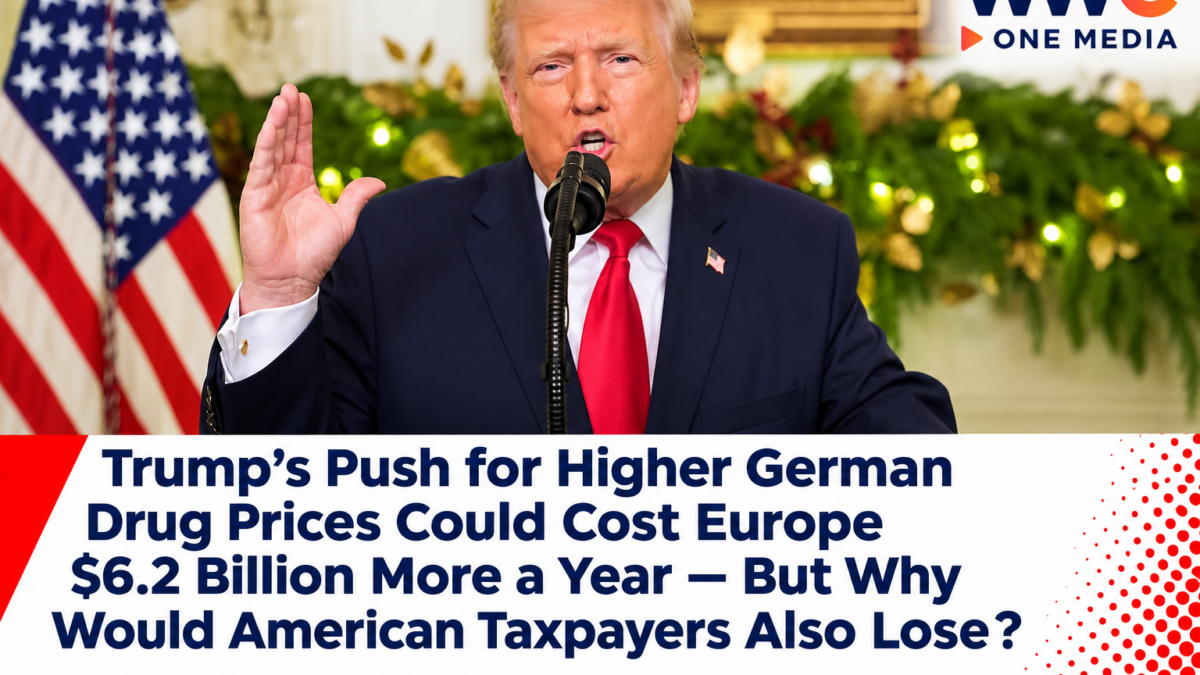
BERLIN, GERMANY / WASHINGTON, UNITED STATES — November 11, 2026 — President Donald Trump’s campaign to make European countries pay more for prescription medicines is facing a major economic challenge after a new study warned that increasing German drug prices could leave both German and American healthcare systems worse off.
The research, commissioned by Germany’s National Association of Statutory Health Insurance Funds and conducted by researchers associated with Harvard Medical School, found that a 25% increase in German pharmaceutical prices could add approximately €5.5 billion, equivalent to $6.2 billion, to Germany’s annual drug spending.
But the surprise lies in what could happen across the Atlantic.
Instead of producing savings for American taxpayers, higher German prices could reduce projected annual savings in the US Medicaid program by approximately $301 million.
The findings challenge a central argument behind Washington’s international pharmaceutical-pricing strategy: that wealthy countries such as Germany should pay more for innovative medicines so American patients can pay less.
The Trump administration believes US patients have shouldered a disproportionate share of the global cost of developing new medicines.
Germany, however, argues that its system of negotiating and controlling pharmaceutical prices is essential to keeping healthcare affordable.
The latest research suggests the proposed solution could produce the opposite of its intended outcome.
If Germany raises drug prices but American healthcare costs also increase, who actually benefits from the policy—and who ultimately pays the bill?
Harvard-Linked Study Warns of a Multibillion-Dollar Drug-Cost Shock
The research was led by Thomas J. Hwang, a pharmaceutical pricing and regulation expert affiliated with Harvard Medical School and Brigham and Women’s Hospital.
The analysis examined what could happen if Germany increased its medicine prices by 25%.
The scenario resembles the scale of pharmaceutical-pricing concessions associated with a previous agreement between the United States and the United Kingdom.
Researchers estimated that the German increase would raise annual spending by the country’s statutory health insurance funds by approximately €5.5 billion.
That represents a substantial potential burden for a healthcare system already dealing with rising expenditure and financing pressure.
The researchers also examined the interaction between higher German prices and America’s international reference-pricing framework.
Their modeling indicated that annual projected savings for US Medicaid would decline by approximately $301 million.
This is an important distinction.
The study did not find that Germany has already raised all medicine prices by 25%.
Nor did it document that the United States has already lost $301 million.
These figures represent estimated outcomes under a modeled policy scenario.
Nevertheless, they challenge the claim that higher European prices will necessarily lower American healthcare costs.
Why Trump Wants Germany to Pay More for Medicines
The Trump administration has argued that American consumers pay disproportionately high prices for patented medicines compared with patients in other wealthy countries.
Its position is that foreign healthcare systems use aggressive price negotiations and government purchasing power to obtain cheaper drugs.
Washington believes those practices leave American patients, insurers and public programs carrying an unfair share of the financial burden associated with pharmaceutical innovation.
The administration wants other wealthy countries to contribute more to the economic rewards available for new medicines.
Supporters argue that higher prices overseas could give drugmakers greater flexibility to reduce prices in the United States without undermining their overall revenue.
They also contend that strong pharmaceutical revenues help support research, development and investment.
However, there is no automatic mechanism requiring companies to pass all additional foreign revenue to American patients.
Whether American consumers benefit depends on the precise pricing agreements, reimbursement rules and company decisions involved.
That uncertainty is central to the latest German study.
The Hidden Contradiction in America’s Drug-Pricing Strategy
Trump’s policy involves two approaches that may work against each other.
The first is diplomatic and trade pressure on countries such as Germany to increase the prices paid for medicines.
The second is a most-favored-nation pricing framework intended to reduce selected American drug prices by linking them to prices paid in other wealthy countries.
Under international reference pricing, American authorities may examine prices across a group of countries and use a low-priced market as the benchmark.
Germany is one of the countries included in the relevant comparison.
Here is the problem.
If German prices increase, Germany may simply cease to be the lowest-priced country in the reference basket.
American pricing calculations can then rely on another country where medicines remain cheaper.
For example, Denmark or France could become the relevant benchmark.
That means the United States may achieve little additional benefit from pressuring Germany to raise its prices.
Under some models, American savings could actually become smaller.
Meanwhile, German insurers would still face the full cost of the domestic increase.
The researchers argue that this creates an internal inconsistency between Washington’s international trade strategy and its reference-pricing objectives.
Why Germany’s Drug Prices Matter to American Healthcare
Germany plays an important role in international pharmaceutical pricing.
It has a large healthcare market, an established regulatory system and significant demand for innovative medicines.
New medicines often become available in Germany relatively early compared with some other European markets.
That makes German pricing data useful when international authorities compare the cost of recently introduced treatments.
However, Germany is not necessarily the lowest-priced country in these comparisons.
The new research found that it is already among the more expensive markets included in the US reference-pricing basket.
That matters because raising prices in an already relatively expensive market may not change the lowest available international benchmark.
Instead, it can increase German expenditure without producing the intended reduction in American drug spending.
This explains why the study challenges the assumption that higher German prices would transfer pharmaceutical costs away from US patients.
Germany Faces an Additional €5.5 Billion Annual Bill
The largest estimated financial burden in the study falls on Germany.
Its statutory health insurance system covers the vast majority of residents and plays a major role in financing prescription medicines.
Statutory insurers negotiate and reimburse medicine costs under rules designed to balance patient access, medical effectiveness and affordability.
A widespread 25% increase in pharmaceutical prices could create significant additional spending.
The research estimated that cost at €5.5 billion annually.
For Germany, that would represent a difficult development at a time when public authorities are attempting to stabilize healthcare financing.
Higher drug expenditure could increase pressure on insurance contributions, government budgets or other healthcare spending.
However, the way additional costs would ultimately be distributed would depend on Germany’s financing rules and policy responses.
The study does not establish that every German patient would immediately experience a 25% increase in pharmacy charges.
Its central estimate concerns spending by statutory insurers.
US Medicaid Savings Could Fall by $301 Million
The potential American impact may appear smaller than Germany’s, but it is politically important.
Medicaid provides healthcare coverage to eligible low-income Americans and other qualifying populations.
The program is financed jointly by federal and state governments.
The Trump administration’s pharmaceutical agreements include provisions intended to bring selected Medicaid medicine prices closer to those paid internationally.
If the international benchmark rises, the amount saved through reference pricing may decline.
The latest study estimated that increasing German prices by 25% would reduce projected annual Medicaid savings by about $301 million.
That is not the same as saying every Medicaid prescription would become more expensive by 25%.
Nor does it mean the federal government would necessarily pay a new $301 million bill immediately.
The figure measures the estimated reduction in savings compared with a baseline scenario.
Still, it raises a difficult question for Washington.
If raising prices overseas makes its own reference-pricing framework less effective, the administration may be pursuing contradictory objectives.
The Study Was Commissioned by German Health Insurers
The research’s funding and commissioning arrangements are important to disclose.
Germany’s National Association of Statutory Health Insurance Funds initiated the study and supplied aggregated prescription data.
The organization also paid fees to the study’s lead author.
That matters because the association has a direct financial interest in preventing higher medicine costs for German insurers.
However, the research team stated that it conducted the analysis independently and retained control over its findings.
The appropriate editorial approach is to consider both facts.
The study has been produced by researchers with relevant expertise, but its conclusions should be evaluated alongside its assumptions, methodology and the interests of the commissioning organization.
It is a modeled analysis, not a completed natural experiment showing what happened after Germany increased prices.
Other researchers and policymakers may reach different conclusions about the effects on pharmaceutical investment and international negotiations.
Germany and the US Are Already Fighting Over Pharmaceutical Trade
The controversy extends beyond academic research.
In June 2026, the Office of the United States Trade Representative launched an investigation under Section 301 of the Trade Act of 1974 into Germany’s pharmaceutical-pricing policies.
The investigation examined whether Germany’s approach disadvantaged American commerce by keeping prices for innovative medicines too low.
Section 301 investigations can provide a basis for trade measures, including tariffs, if the applicable statutory findings and procedures are satisfied.
But launching an investigation does not automatically mean tariffs have been imposed.
Germany has defended its right to regulate medicine prices through its public healthcare system.
Berlin argues that affordability and financial sustainability are legitimate public-policy objectives.
The dispute has therefore developed into a broader disagreement over whether one country should use trade pressure to influence another country’s domestic healthcare reimbursement rules.
German Chancellor Friedrich Merz Faces Difficult Negotiations
Germany’s government is now confronting pressure from two directions.
Washington wants higher prices for some medicines.
German health insurers want to contain expenditure.
Chancellor Friedrich Merz’s administration must also consider the importance of the pharmaceutical industry to Germany’s economy.
German and American officials are expected to continue discussions in mid-November.
According to Bloomberg, Germany’s Health Ministry said the talks would help explain the country’s pharmaceutical-pricing system.
Berlin is also coordinating with European Union partners over the US trade investigation.
The result could have consequences beyond Germany.
If Washington successfully pressures one major European economy to change medicine prices, other countries could face similar demands.
But any EU-level trade response would involve separate European institutions and legal procedures.
The negotiations remain unresolved.
The United Kingdom Provides a Controversial Precedent
The Trump administration has already reached a pharmaceutical-pricing arrangement involving Britain.
Under the agreement, the United Kingdom accepted changes expected to increase the financial returns available to drugmakers.
The arrangement included adjustments to rebate obligations associated with the National Health Service.
Washington, in return, agreed to provide temporary protection against certain pharmaceutical tariffs.
The agreement followed industry warnings that the British market had become unattractive for investment.
Drugmakers argued that low prices and substantial rebates were discouraging research, launches and commercial expansion.
However, critics contend that increasing public payments to pharmaceutical companies does not automatically guarantee better access or lower medicine costs elsewhere.
The new German study uses a 25% price-increase scenario partly to examine the implications of a similar approach.
Germany has not agreed to duplicate Britain’s arrangement.
Pharmaceutical Companies Warn Europe Could Lose Investment
Drug manufacturers have long argued that European governments should pay more for innovative treatments.
Their concern is that low reimbursement prices can weaken incentives to introduce new medicines and invest in local research or manufacturing.
The European Federation of Pharmaceutical Industries and Associations has warned that the continent risks losing investment to more commercially attractive markets.
Reuters reported that Eli Lilly and Boehringer Ingelheim have scaled back planned investments in Germany worth billions.
Those decisions add weight to the industry’s argument that pricing policies can influence where companies allocate capital.
But the relationship is not necessarily straightforward.
Investment decisions also depend on labor costs, taxes, research capabilities, regulation, manufacturing infrastructure and expected demand.
It would be inaccurate to conclude that low German drug prices alone caused every pharmaceutical investment reduction.
The broader dispute concerns how governments balance affordability against incentives for innovation.
Pfizer’s Drug-Pricing Agreement Shows the Stakes
A related controversy involves the Trump administration’s agreement with Pfizer.
Documents obtained through litigation revealed provisions connecting international pricing with potential revenue-sharing arrangements involving the US Department of Health and Human Services.
The relevant financial details remain partly redacted.
As WWC ONE MEDIA reported in its investigation of Pfizer’s international drug-pricing agreement, the arrangement included mechanisms under which some additional revenue generated through higher overseas prices could be shared with the US government.
The disclosure demonstrates how American pharmaceutical policy increasingly connects domestic prices with commercial developments abroad.
But it does not establish that higher German medicine prices would automatically reduce American costs.
The extent of any benefit depends on the applicable agreements and the amount ultimately passed on to public programs or consumers.
That uncertainty reinforces the importance of the latest research.
Another Study Warns Drugmakers May Delay European Launches
There is also concern that international reference pricing may produce unexpected consequences for patients outside the United States.
Research published in The Lancet in September examined how a most-favored-nation pricing framework might influence pharmaceutical revenues and market behavior.
The analysis suggested that manufacturers could face incentives to raise prices or change product-launch strategies in countries used as international benchmarks.
A separate industry-data analysis reported by The Wall Street Journal found that launches of new medicines across European markets had declined after the introduction of the US pricing policy.
The reported decline was 27% over the period examined.
However, the finding should not be interpreted as definitive proof that US policy caused the entire reduction.
Company decisions may also reflect regulatory, commercial and clinical factors.
Nevertheless, the reports raise another important concern.
A policy designed to reduce prices in one country can influence when medicines are made available in another.
Patients could face delayed access even where a new treatment has already received regulatory approval.
American Healthcare Costs Remain a Major Political Issue
The debate is occurring against a backdrop of expensive medical care in the United States.
Americans generally pay more for many patented prescription medicines than patients in other wealthy economies.
Insurance arrangements, negotiated rebates, pharmacy-benefit managers and differences between list prices and net prices complicate comparisons.
The broader healthcare system is also becoming increasingly expensive.
As WWC ONE MEDIA examined in its report on America’s growing healthcare economy and rising patient costs, rising medical expenditure can place pressure on insurers, employers, government budgets and households.
Prescription medicine is only one component of healthcare spending.
Hospital services, insurance administration, labor costs and other medical expenses also contribute.
A pharmaceutical-pricing policy therefore needs to be assessed by its actual effect on patients’ payments and public spending.
A headline agreement promising lower prices does not by itself establish the total savings achieved.
CVS Controversy Shows How Complicated Drug Pricing Has Become
US pharmaceutical costs are also influenced by the structure of the country’s healthcare industry.
Major companies can operate pharmacies, insurance businesses and prescription-benefit management services.
These relationships have attracted political scrutiny because of concerns about market power and pricing transparency.
In related coverage, WWC ONE MEDIA examined CVS Health’s proposed separation of approximately 9,000 retail pharmacies from its wider healthcare business.
The CVS restructuring is separate from the German drug-pricing study.
However, it illustrates why reducing American medicine costs is more complicated than persuading foreign governments to pay higher prices.
Drug manufacturers determine list prices.
Insurers set coverage arrangements.
Pharmacy-benefit managers negotiate rebates and formularies.
Governments establish payment rules for public programs.
Patients may face different costs depending on their insurance coverage.
Changing one element of that system does not automatically resolve the others.
The Global Fight Over Affordable Medicines Is Growing
The pricing debate also highlights the substantial differences between wealthy and developing healthcare markets.
New medicines can be financially inaccessible to patients without insurance or public reimbursement.
The contrast is especially striking for some specialty treatments.
For example, WWC ONE MEDIA reported on a generic version of the long-acting HIV prevention medicine lenacapavir.
Under a licensing arrangement, the generic product is expected to become available at approximately $40 per person annually in eligible lower-income markets.
That differs dramatically from the reported US list price for the branded treatment.
The prices apply to different markets, products and reimbursement conditions, so they should not be treated as identical purchasing situations.
The example nevertheless demonstrates how intellectual-property arrangements, licensing, competition and national healthcare policies can produce very different medicine prices.
For policymakers, affordability and innovation remain competing priorities that must be balanced.
Could the US–Germany Dispute Affect the Philippines?
The conflict does not directly establish changes to Philippine medicine prices.
The Philippines has its own regulatory, procurement and healthcare-financing systems.
The Philippine Food and Drug Administration evaluates medicines under domestic requirements.
Public procurement and PhilHealth reimbursement policies are governed by Philippine rules.
Nevertheless, international pricing developments can influence multinational pharmaceutical companies’ commercial strategies.
Changes in pricing, licensing and launch decisions in major markets may eventually affect how companies approach smaller markets.
But those effects are uncertain and would depend on the specific medicine and company.
It would be inaccurate to claim that the new German study predicts a particular price increase for Filipino patients.
The broader policy lesson is that internationally linked drug-pricing systems can produce unintended consequences.
Governments must consider not only the price paid in one country, but also the effects on access, innovation and healthcare spending elsewhere.
What Happens Next?
The immediate focus will be the next round of discussions between American and German officials.
Washington is expected to continue pressing its argument that other wealthy countries should pay more for innovative medicines.
Germany will defend its ability to control spending through statutory health insurance.
The outcome of the Section 301 investigation may also shape the negotiations.
Trade pressure could increase if the administration moves toward additional measures.
However, no final tariff outcome should be assumed without an official decision.
Researchers may also examine whether the study’s findings hold under different pricing assumptions.
A 25% increase is one scenario.
The financial impact of a smaller or larger change could differ.
Pharmaceutical companies will continue assessing whether European pricing policies affect future investment and product launches.
For patients, the most important outcome will be whether the negotiations produce medicines that are both affordable and available.
The Bigger Picture: Higher Prices May Not Deliver Lower Costs
The Trump administration has identified a genuine problem in international healthcare: Americans often pay more for prescription medicines than patients in other wealthy countries.
But determining how to reduce that gap is considerably more complicated.
Washington believes higher foreign prices could create room for American discounts while preserving drugmakers’ incentives to innovate.
The pharmaceutical industry argues that greater European payments are necessary to sustain investment and improve access to new treatments.
German insurers warn that raising prices would increase costs for employers, taxpayers and the healthcare system.
Now, a new Harvard-linked study suggests the policy could undermine the United States’ own savings goals.
Under its hypothetical 25% increase, Germany’s annual pharmaceutical spending would rise by approximately €5.5 billion.
At the same time, projected annual US Medicaid savings would decline by about $301 million.
The findings do not prove that every possible international pricing agreement would fail.
They do, however, demonstrate that higher foreign prices do not automatically create lower American costs.
Donald Trump wants Germany to pay more for prescription medicines so Americans can pay less. But with a new study warning that higher German prices could add $6.2 billion to Europe’s annual healthcare bill while shrinking US Medicaid savings, is Washington’s drug-pricing strategy about to backfire—or could pharmaceutical companies emerge with the biggest financial gains while patients on both sides of the Atlantic pay more?