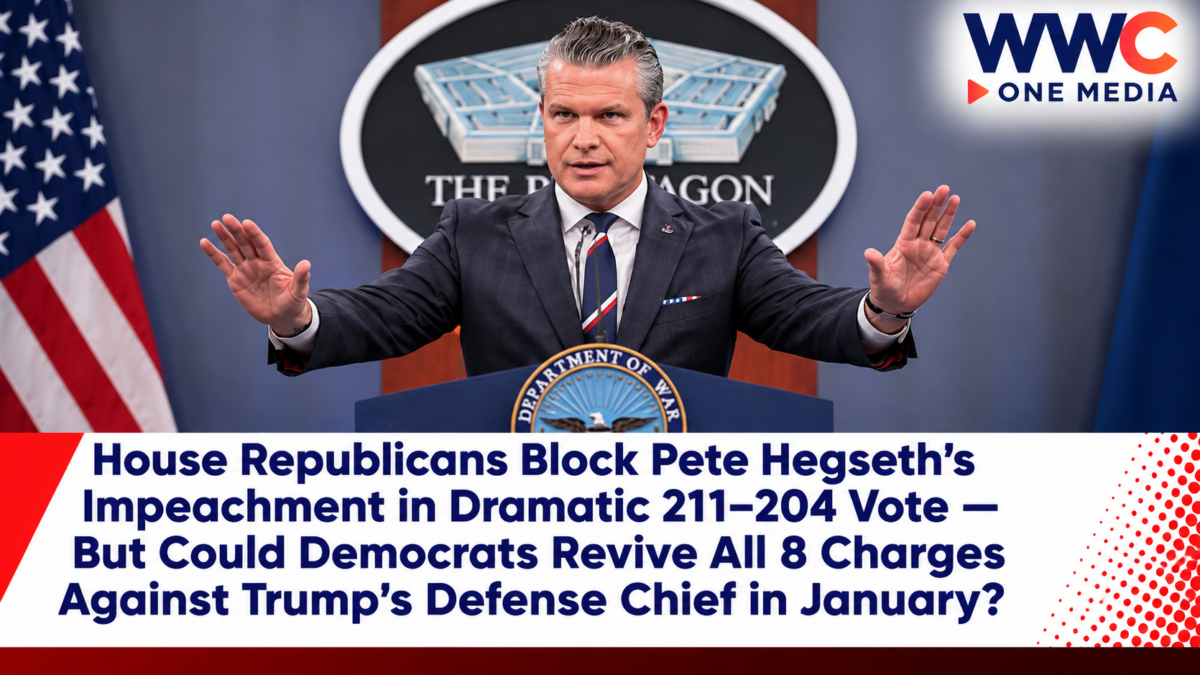
WASHINGTON, D.C. — November 11, 2026 — US Defense Secretary Pete Hegseth has survived an extraordinary impeachment showdown after House Republicans blocked an attempt by one of their own members to bring eight articles of impeachment against him over the Iran war and other controversial American military operations.
In a closely watched vote on November 10, the Republican-controlled House of Representatives voted 211–204 to refer the impeachment resolution to the Judiciary Committee, preventing the chamber from moving directly toward a vote on whether to impeach President Donald Trump’s Pentagon chief.
The surprise challenge came from Kentucky Republican Thomas Massie, a frequent critic of the administration’s military intervention in Iran.
Massie was the only Republican to oppose the referral motion. All 203 Democrats who voted joined him, while an independent lawmaker sided with 210 Republicans to advance the motion.
But the result exposed a potentially consequential detail: 18 representatives did not vote, including 11 Democrats.
Had all 11 Democrats been present and opposed the referral, with every other vote unchanged, the motion would have failed.
Instead, Hegseth emerged with a significant short-term political victory.
President Trump celebrated the result, while Hegseth rejected the allegations as an attempt to undermine US military leadership.
Yet the confrontation may be far from over.
Democrats are preparing to take control of both the House and Senate in January 2027 after their sweeping midterm election victory, potentially giving them another opportunity to pursue impeachment proceedings.
The question now is whether Republicans have permanently shielded Trump’s defense chief—or merely postponed a political battle that could return under a Democratic-controlled Congress.
House Votes 211–204 to Block Hegseth Impeachment
The official congressional record confirms that the House voted on November 10 to refer House Resolution 1655 to the Judiciary Committee.
The vote occurred shortly after 6 p.m. Eastern Time.
The final breakdown was:
- 211 representatives supported referring the resolution.
- 204 representatives opposed referring it.
- 18 representatives did not vote.
- No member voted present.
Among Republicans, 210 supported the referral and only Massie opposed it.
All 203 Democrats who participated voted against the motion, while the chamber’s independent member supported referral.
The result meant Massie’s impeachment proposal would not proceed directly to a substantive House vote.
Referring the resolution to a committee is a procedural action.
It is not equivalent to holding an impeachment trial, dismissing every accusation on its merits or determining that an official acted lawfully.
However, the practical effect was substantial.
Because Republican leaders continue controlling the House until the current Congress ends, the referral makes it unlikely that Massie’s resolution will advance before January.
What Were the Eight Articles of Impeachment?
Massie’s resolution outlined eight accusations involving Hegseth’s leadership of the Pentagon.
The charges focused heavily on the war in Iran but also raised questions about military operations elsewhere and alleged retaliation against a US senator.
The articles addressed the following issues:
- Allegedly initiating hostilities against Iran without the congressional authorization Massie believes was constitutionally required.
- Continuing the Iran conflict despite congressional action concerning withdrawal.
- Allegedly exceeding the time limits established under the War Powers Resolution.
- Allegedly weakening civilian-casualty safeguards during military operations.
- Authorizing lethal strikes against suspected drug-trafficking vessels in the Caribbean and eastern Pacific.
- Allegedly retaliating against Senator Mark Kelly over his participation in a video discussing unlawful military orders.
- Participating in the operation that captured former Venezuelan President Nicolás Maduro.
- Conducting military operations in Yemen that Massie argues lacked appropriate authorization.
These are allegations contained in a congressional impeachment resolution.
They are not criminal convictions, court judgments or established findings that Hegseth violated the law.
The defense secretary denies wrongdoing.
In earlier reporting, WWC ONE MEDIA examined the eight impeachment allegations and the constitutional questions raised by Massie’s resolution.
The November 10 procedural vote represents the next development in that dispute.
Thomas Massie Says the Iran War Violates Congressional Authority
The central disagreement concerns the constitutional division of war powers.
The US Constitution gives Congress authority to declare war, control federal military appropriations and exercise other legislative powers concerning the armed forces.
The president serves as commander in chief.
Massie argues that the administration’s military operations against Iran have continued without the necessary congressional authorization.
He also invoked the War Powers Resolution of 1973.
That law establishes procedures and time limits for certain military hostilities conducted without specific congressional authorization, subject to its terms and contested interpretations.
Massie said the Iran war had continued for 256 days without the authorization he believes is required.
The administration disputes his interpretation and maintains that its military operations are lawful.
The constitutional and statutory questions are complex.
Presidents from both major political parties have historically disputed aspects of the War Powers Resolution and the limits of congressional control over military deployments.
The House’s referral vote did not settle those legal questions.
It prevented an immediate vote on Massie’s impeachment charges.
Iranian School Strike Intensifies Questions About Civilian Casualties
One of the most serious allegations concerns civilian harm.
Massie’s resolution accused Hegseth of weakening military systems intended to prevent or reduce civilian casualties.
It cited a deadly American missile strike involving a school in Minab, Iran.
News reporting has described large numbers of civilian deaths, including children, although reported casualty figures vary.
The resolution argues that changes to Pentagon civilian-protection resources contributed to the circumstances surrounding the attack.
But establishing responsibility for a specific military strike requires detailed evidence concerning targeting decisions, intelligence, operational procedures and command responsibility.
The allegations should therefore not be presented as an independently proven causal finding.
The Department of Defense has defended its operations and rejected the impeachment effort.
The dispute could nevertheless become a major subject of congressional oversight in 2027.
Investigations could seek military records, testimony and explanations of the administration’s targeting and civilian-protection policies.
Allegations Over Strikes on Suspected Drug Boats Add Another Controversy
The impeachment proposal also challenged US military strikes against vessels suspected of involvement in drug trafficking.
The operations have taken place in waters near Latin America, including the Caribbean and eastern Pacific.
Massie alleged that some strikes amounted to unlawful killings.
His resolution also raised concerns about the treatment of survivors.
The administration argues that its operations are legitimate national-security and counternarcotics actions.
The legal status of the strikes has become a subject of debate among lawmakers and international-law specialists.
Important questions include the authority to use lethal military force, the identification of targets and the obligations owed to individuals who survive an attack.
The House did not resolve these disputes during the November 10 vote.
The referral leaves the underlying allegations unanswered in the impeachment process.
Senator Mark Kelly Dispute Raises Questions About Military Authority
Another impeachment article involves Arizona Democratic Senator Mark Kelly, a retired Navy captain and former astronaut.
Kelly participated in a video reminding military personnel of their responsibility to refuse unlawful orders.
Massie alleged that Hegseth subsequently used Pentagon authority to punish or intimidate the senator over his speech.
The accusation raises questions about military discipline, political expression and civilian oversight of the armed forces.
Hegseth disputes the accusation that his actions constituted impeachable misconduct.
The House vote did not establish whether any unlawful retaliation occurred.
Nevertheless, the controversy could become part of future congressional inquiries into the defense secretary’s leadership.
Pete Hegseth Fires Back at Massie During Pentagon News Conference
Hours before the House vote, Hegseth delivered a forceful defense of his leadership at a Pentagon news conference.
The defense secretary rejected the impeachment resolution as a politically motivated effort.
He accused Massie of attempting to damage the administration and undermine American military personnel.
Hegseth argued that the charges concerned disputed military and policy decisions rather than impeachable offenses.
He also defended the administration’s operations against Iran and other targets.
The Pentagon subsequently celebrated the House’s vote as a victory.
For Hegseth, the immediate result was politically significant.
Republican lawmakers chose not to advance impeachment despite growing criticism of the war and the party’s recent election defeats.
But their support for the procedural motion should not be treated as unanimous endorsement of every Pentagon decision.
Some Republican lawmakers have criticized aspects of Hegseth’s leadership while declining to support impeachment.
Donald Trump Defends His Pentagon Chief
President Trump publicly supported Hegseth before and after the vote.
Trump has praised the defense secretary’s performance, particularly his role in military operations involving Iran and Venezuela.
The president also criticized Massie’s effort to remove him.
Vice President JD Vance separately defended Hegseth and characterized the impeachment attempt as an inappropriate response to policy disagreements.
The administration’s position is that the defense secretary has been carrying out lawful orders in support of American national security.
Republican leaders faced a politically sensitive situation.
Supporting impeachment could have exposed divisions inside the party just days after major electoral losses.
But openly defending the Pentagon’s leadership also risked angering voters frustrated by the duration and cost of the Iran war.
The referral motion allowed most Republicans to avoid casting a direct vote on whether Hegseth should be impeached.
Just Seven Votes Separated the Two Sides
The narrow margin has become one of the most politically significant details of the confrontation.
The referral passed by seven votes, 211 to 204.
According to the official House Clerk’s record, 18 lawmakers did not vote.
Among them were 11 Democrats and seven Republicans.
If every absent Democrat had opposed referral while all other votes remained unchanged, the final result would have been 211 in favor and 215 against.
But that is a hypothetical calculation.
It does not prove the House would necessarily have proceeded to impeach Hegseth.
Defeating the referral motion would only have cleared one procedural obstacle.
Lawmakers would still have needed to consider the impeachment resolution itself.
A direct impeachment vote could have produced a different alignment.
The distinction matters because the November 10 roll call concerned whether to send the proposal to committee, not whether Hegseth was guilty of any of the allegations.
Republicans’ Midterm Defeat Changes the Political Calculation
The impeachment confrontation unfolded one week after Democrats secured control of both chambers of Congress in the November 3 midterm elections.
The results represented a major setback for Republicans.
The continuing Iran conflict, rising energy costs and dissatisfaction with the administration’s economic policies became prominent campaign issues.
Democratic lawmakers are now preparing to exercise stronger congressional oversight when the new Congress convenes.
In related reporting, WWC ONE MEDIA examined the growing Republican revolt against Hegseth as the Iran war became an increasingly costly political issue for Trump.
The November 10 vote shows the limits of that rebellion.
Despite criticism from some party members, Republicans largely united to protect the defense secretary from an immediate impeachment proceeding.
Whether that unity can continue after Democrats assume control of Congress is another question.
Hakeem Jeffries Signals the Impeachment Battle Could Return
House Democratic leader Hakeem Jeffries supported Massie’s impeachment effort.
He accused Hegseth of abusing his authority and undermining national security.
Senate Democratic leader Chuck Schumer also supported the effort.
The incoming Democratic majority could introduce new impeachment articles or pursue further investigations in 2027.
However, the existing resolution does not automatically become an active impeachment proceeding in the next Congress.
Legislative procedures and the expiration of the current Congress matter.
Democrats would need to use the appropriate processes to revive or replace the effort.
The new majority could also conduct hearings before deciding whether to pursue formal impeachment.
As WWC ONE MEDIA reported on the five major areas in which Democrats are preparing to challenge Trump’s administration, the Iran war and Pentagon oversight are expected to become major priorities.
That could place Hegseth under substantially greater scrutiny even without an immediate impeachment vote.
Could Democrats Actually Remove Hegseth From Office?
The answer depends on two distinct constitutional stages.
The House of Representatives can impeach a federal official by a simple majority vote.
Impeachment is the equivalent of bringing formal constitutional charges.
It does not automatically remove the official.
The Senate must then consider the charges.
Conviction and removal require a two-thirds vote of senators present.
That is a significantly higher threshold.
Even with Democrats controlling the Senate in January, removal would likely require substantial Republican support.
Consequently, an impeachment proceeding could succeed in the House but fail to secure a Senate conviction.
That would not be unprecedented.
Former Homeland Security Secretary Alejandro Mayorkas was impeached by the House in 2024, but the Senate dismissed the charges.
The process is both constitutional and political.
Its outcome depends on the evidence presented and lawmakers’ judgments about whether the alleged conduct warrants removal.
Could Hegseth Become the First Impeached US Defense Secretary?
If a future House votes to impeach Hegseth, the proceeding would be historically significant.
Two US Cabinet secretaries have previously been impeached.
In 1876, Secretary of War William Belknap was impeached over corruption allegations. He was later acquitted by the Senate.
In 2024, Homeland Security Secretary Alejandro Mayorkas was impeached over his handling of immigration policy, but the Senate dismissed the charges.
No US defense secretary has been impeached in the modern history of the department.
The November 10 referral prevented Hegseth from becoming the next Cabinet official to face that constitutional process.
But the question could return if Democrats decide to pursue the matter in 2027.
The Iran War Continues Driving American Political Divisions
Beyond the impeachment resolution, the underlying Iran conflict remains one of the most consequential political and economic challenges facing Washington.
The war has lasted more than eight months.
Military operations, civilian casualties, disrupted shipping and higher energy prices have all generated domestic controversy.
The administration argues that its actions are necessary for national security.
Critics question the strategy, legal authority and costs.
In another report, WWC ONE MEDIA examined Trump’s defense of the Iran war following the Democrats’ congressional victory.
That political context helps explain why Hegseth has become such a prominent target.
As defense secretary, he is responsible for managing the department carrying out the administration’s military policies.
But responsibility for national-security decisions is shared across multiple institutions and officials.
Congressional investigation would need to distinguish presidential decisions, departmental actions and the responsibilities of military commanders.
Why the Latest Vote Matters Beyond Washington
The impeachment fight has implications for US foreign policy and America’s international partners.
Major allies monitor the political stability of the American defense establishment.
Disputes over military strategy can affect expectations about future operations, defense spending and congressional oversight.
For countries in Asia, including the Philippines, American military leadership is relevant because the United States remains a major security partner.
However, the House’s referral vote does not change existing US defense agreements with the Philippines.
It also does not directly alter American military deployments or create new obligations for Philippine authorities.
The immediate consequence is domestic: Hegseth remains in office, and the House has halted this attempt to proceed with impeachment.
Any broader foreign-policy consequences will depend on future decisions by the administration and Congress.
What Happens Next?
Several developments will determine whether the controversy intensifies.
First, the House Judiciary Committee can determine how to handle the referred resolution under the current Congress.
Second, Democrats will take control of the House in January 2027, potentially creating a new route for hearings or impeachment proceedings.
Third, lawmakers could seek testimony about the Iran war, civilian-casualty safeguards and other military operations.
Fourth, the administration may continue defending Hegseth while challenging the factual and legal basis of the allegations.
Fifth, congressional attitudes could shift depending on developments in the Iran conflict and public opinion.
Massie, who lost his Republican primary, is preparing to leave Congress in January.
That means any renewed impeachment effort would require other lawmakers to take responsibility for advancing it.
The immediate political victory belongs to Hegseth and Republican leaders.
The longer-term outcome remains unresolved.
The Bigger Picture: Republicans Saved Hegseth — But Only for Now
The November 10 vote reveals a Republican Party still willing to protect a central figure in Trump’s administration despite serious disagreements over the war in Iran.
By referring the impeachment resolution to committee, Republicans prevented an immediate confrontation over eight allegations against the defense secretary.
Massie failed to secure a direct impeachment vote.
But the narrow margin exposed the importance of attendance, party discipline and congressional procedure.
The result also demonstrated that the defense secretary’s opponents include a Republican lawmaker, not just Democrats.
The allegations themselves remain contested.
Hegseth denies wrongdoing.
Trump continues defending him.
And the House has made no substantive finding establishing the truth of the impeachment charges.
But Democrats are preparing to take control of Congress, bringing the possibility of stronger oversight and another impeachment push.
House Republicans have blocked Thomas Massie’s eight-article impeachment effort against Pete Hegseth by a narrow 211–204 vote. But with 11 Democrats absent, the Iran war still dividing Washington and a new Democratic majority preparing to take power in January, has Trump’s defense chief escaped his biggest political threat—or is a far more dangerous congressional showdown still ahead?