WASHINGTON, D.C. — November 11, 2026 — President Donald Trump’s plan to build a towering triumphal arch near Arlington National Cemetery is facing a new legal challenge from one of America’s most prominent political families.
Nine relatives of the late President John F. Kennedy’s brothers, Robert F. Kennedy and Edward M. Kennedy, filed a motion in federal court on November 10 seeking to join existing lawsuits against the administration’s proposed 250-foot Independence Arch.
The family argues that the monument would permanently alter the historic landscape surrounding Arlington National Cemetery, obstruct important views and cast shadows across gravesites associated with the Kennedy family, including the memorial surrounding JFK’s eternal flame.
The filing adds another complication to Trump’s ambitious effort to reshape the appearance of the nation’s capital.
A federal judge has already ordered a temporary halt to construction, while veterans, preservationists and local governments challenge the project’s legality.
The Kennedy relatives are now asking the court to invalidate the project’s authorization and prevent construction.
But the controversy is no longer simply a debate over architecture.
At its center is a constitutional question: Can the president authorize a monument of this scale in a nationally significant memorial area without specific congressional approval?
Kennedy Family Files Legal Challenge Against Trump’s Arch
The new legal action involves nine members of the extended Kennedy family.
They include Rory Kennedy, Maxwell Kennedy, Christopher G. Kennedy, Kerry Kennedy, Courtney Kennedy, Kathleen Kennedy Townsend, Joseph P. Kennedy II, Joseph P. Kennedy III and Edward M. Kennedy Jr.
The relatives are represented by Democracy Defenders Fund, with attorneys including Norman Eisen and Steve Jonas.
Their November 10 motion asks the court to allow them to intervene in litigation challenging the administration’s plans.
A motion to intervene is a request by parties who are not already involved in a case to participate because they believe the outcome could affect their interests.
It does not automatically make them parties to the litigation.
The court must determine whether intervention is appropriate.
The family argues that it has a distinct interest in preserving the historic character and setting of the Kennedy gravesites at Arlington.
According to their proposed complaint, the arch would permanently interfere with the experience of visiting the memorials.
They also contend that the administration exceeded its legal authority in advancing the project.
Why JFK’s Eternal Flame Is at the Center of the Dispute
The Kennedy gravesites are among Arlington National Cemetery’s most recognizable memorial locations.
President John F. Kennedy was buried there following his assassination in 1963.
His grave is marked by an eternal flame, which has become an enduring symbol of his presidency and national remembrance.
Former first lady Jacqueline Kennedy Onassis is also buried at the site.
Nearby are the graves of Robert F. Kennedy, Edward M. Kennedy and Ethel Kennedy.
The relatives challenging the arch say these gravesites were designed to preserve meaningful views toward Washington’s historic monuments.
According to their filing, a massive structure at Memorial Circle would intrude upon those views.
They also argue that the monument would cast shadows over important burial areas, affecting the atmosphere of a place traditionally associated with reflection and remembrance.
The family considers the proposed changes a serious intrusion into a memorial landscape with national significance.
However, the claimed effects on the cemetery are disputed by federal officials.
The Proposed Monument Would Stand 250 Feet Tall
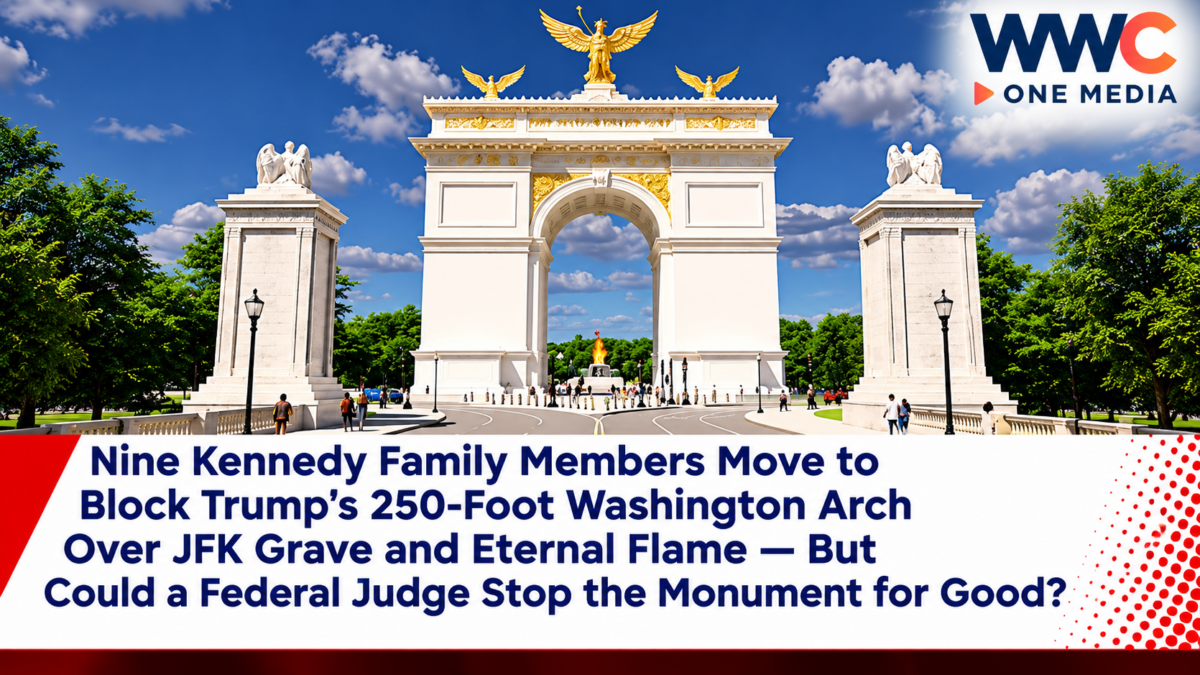
The Independence Arch is intended to rise approximately 250 feet, or 76 meters.
Its proposed location is Memorial Circle, near the Virginia end of Arlington Memorial Bridge, between the Lincoln Memorial and Arlington National Cemetery.
The site occupies a prominent position along one of the capital region’s best-known ceremonial routes.
The arch is associated with Trump’s broader plans to mark the United States’ 250th anniversary and develop major national monuments.
Supporters of the project present it as an ambitious tribute to American history, military service and national identity.
The administration has promoted the structure as a gateway connecting the capital with Arlington National Cemetery.
Critics argue that its enormous scale would compete visually with existing landmarks rather than complement them.
They also question whether the monument belongs in a setting already defined by carefully established historic views.
That disagreement is central to the legal battle.
Could the Arch Cast a Shadow Over Kennedy’s Grave?
One of the strongest arguments advanced by Kennedy family members concerns the project’s potential effects on sunlight and historic views.
The Washington Post reported that its own analysis estimated the proposed arch could briefly shade JFK’s eternal flame on approximately 18 days per year.
The analysis suggested shadows could reach the wider JFK memorial on about 50 days annually.
It also found that shadows could affect parts of the cemetery on substantially more days.
However, the Interior Department disputes the newspaper’s findings.
According to the department’s assessment, the affected cemetery area would be considerably smaller, with impacts primarily occurring shortly after sunrise.
These conflicting assessments should not be presented as settled facts.
The precise effects depend on the monument’s final design, location, dimensions and the assumptions used in shadow modeling.
The Kennedy family argues that even limited changes to the memorial setting could be significant.
Federal officials dispute the scale of the alleged harm.
The court may need to evaluate the evidence before determining whether these concerns justify further restrictions.
Federal Judge Temporarily Blocks Construction
The Kennedy family’s intervention attempt follows an important court decision.
US District Judge Tanya Chutkan ordered a 14-day pause on construction after opponents challenged the administration’s authority to proceed.
The temporary order prevents the administration from beginning the project during the specified period.
It is not a final judgment on whether the arch can ever be built.
The court’s decision followed a National Capital Planning Commission vote approving the project.
Opponents argue that administrative approvals cannot substitute for congressional authorization where federal law requires it.
The administration disputes the challenges to its authority.
The immediate legal question concerns whether construction can proceed before the broader claims are resolved.
For the Kennedy family and other opponents, preventing initial work is particularly important because excavation and construction could create changes that would be difficult to reverse.
Did Trump’s Administration Bypass Congress?
The legal dispute involves the authority of the executive branch over monuments and memorials.
The Kennedy relatives contend that the federal government did not obtain the necessary congressional authorization for a structure of this size and significance.
Their proposed complaint also challenges the agencies’ approval process.
Among the issues raised are alleged failures to comply with applicable legal procedures and alleged deficiencies in evaluating historic and environmental effects.
The National Park Service and Department of the Interior are among the government entities named in the filing.
The family alleges that officials improperly authorized the project despite objections and findings about its effects on established historic views.
However, these are legal allegations.
They should not be presented as final findings of wrongdoing.
The court must determine whether the relevant approvals complied with the law.
The administration is entitled to defend its actions and the basis for the monument.
Veterans and Preservationists Were Already Fighting the Project
The Kennedy family is not the first group to challenge the Independence Arch.
Earlier litigation involved military veterans and a historic preservation expert.
Opponents argued that the monument could disrupt the character of Arlington National Cemetery and interfere with the ceremonial significance of surrounding landmarks.
Local governments have also raised concerns about planning, transportation and the approval process.
The legal objections extend beyond aesthetics.
They include questions about public authority, administrative procedure and the preservation of historic federal spaces.
The Kennedy relatives’ filing introduces another dimension: the personal relationship between living family members and the gravesites of prominent national figures.
Their argument is that the effects would not be limited to the general public’s experience of the area.
They say the monument would also permanently change how descendants visit and remember their relatives.
Why Robert F. Kennedy Jr. Is Not Part of the Lawsuit
One politically significant detail is the absence of Robert F. Kennedy Jr. from the group seeking to intervene.
Kennedy serves as Trump’s secretary of health and human services and has had public disagreements with members of his extended family.
The Associated Press reported that he did not join the November 10 filing.
That absence should not automatically be interpreted as his formal legal position on the arch.
The filing represents the nine named family members.
It does not establish that the entire Kennedy family unanimously supports or opposes the monument.
The distinction matters because political families often contain different personal and policy views.
In this case, the legal action is being brought by specific descendants who say their interests are affected by the project.
The Dispute Is Part of Trump’s Wider Washington Makeover
The Independence Arch is one of several high-profile construction and renovation initiatives associated with Trump’s presidency.
The administration has promoted projects involving federal landmarks, public spaces and government buildings.
These include work around the White House and the National Mall.
In related reporting, WWC ONE MEDIA examined Trump’s November 4 appearance at the White House ballroom construction site shortly after the US midterm elections.
During that appearance, the president discussed the design and construction of the ballroom, emphasizing the importance of creating an impressive national setting.
Supporters view such projects as investments in civic infrastructure and national symbolism.
Critics question their costs, timing, transparency and effects on historic buildings.
The Independence Arch presents a particularly difficult debate because of its proximity to Arlington National Cemetery.
The concerns involve not only architectural preferences but also the character of a military burial ground.
Trump’s Reflecting Pool Renovation Also Drew Attention
Another recent project involved the Lincoln Memorial Reflecting Pool.
The president highlighted a major renovation of the site shortly before the November 3 midterm elections.
As WWC ONE MEDIA reported in its coverage of Trump’s $16-million Reflecting Pool makeover, the president used the event to emphasize improvements to the capital’s public spaces.
The Reflecting Pool project is separate from the proposed Independence Arch.
But the controversies share a broader theme.
Presidential construction projects can become politically sensitive when they affect places with deep historical and symbolic importance.
The arch’s location is especially significant because it would alter views between Arlington and the Lincoln Memorial area.
That has helped turn the dispute into a national debate over preservation and executive authority.
Another Kennedy Memorial Has Faced a Trump-Era Court Fight
The Independence Arch controversy also follows litigation involving the John F. Kennedy Center for the Performing Arts.
In September, a federal judge blocked an attempt to add Trump’s name to the Kennedy Center without congressional approval.
As WWC ONE MEDIA reported on the Kennedy Center ruling and subsequent renovation plans, that case raised separate questions about the authority to alter a memorial established by Congress.
The two disputes concern different properties, laws and administrative actions.
A ruling in one case does not automatically determine the outcome of the other.
Nevertheless, the Kennedy Center dispute provides context for the current controversy.
Both involve efforts to change nationally prominent spaces associated with American history.
Both have also raised questions about the legal limits of executive or institutional authority.
For the Kennedy descendants opposing the arch, the issue is preserving a memorial setting rather than determining how a new building should be named.
The Political Battle Could Intensify in Congress
The court fight comes immediately after a major shift in American politics.
Democrats won control of Congress in the November 3 midterm elections, according to election reporting.
The new congressional balance could bring additional scrutiny of executive projects, including the arch and other construction initiatives.
In related coverage, WWC ONE MEDIA examined the five areas where Democrats are preparing to challenge the Trump administration through congressional oversight.
Congressional committees may request records, question agency officials and examine the use of public resources.
However, the election results do not decide the outcome of the Kennedy family’s court action.
The judiciary must independently evaluate the legal arguments.
Future congressional decisions could affect the project, but any such actions would require the applicable legislative procedures.
At present, the immediate barrier to construction is the judicial order.
What the Trump Administration Says the Arch Would Represent
The administration’s stated objective is to create a prominent national monument marking American history and honoring military service.
Promotional materials describe the arch as a ceremonial entrance to Arlington National Cemetery.
The design includes monumental architectural features intended to make it a distinctive landmark.
Supporters believe the project could provide a new symbol of national achievement.
But critics argue that a monument’s intended message does not resolve questions about its location, scale or legal authorization.
The same structure can be viewed by supporters as patriotic and by opponents as an inappropriate alteration to a historic landscape.
Those differing perspectives are central to the public debate.
What remains for the court is whether the federal government’s decisions satisfy applicable law.
The court is not simply being asked to choose which architectural style it prefers.
How Much Would the Independence Arch Cost?
The proposed structure’s height and elaborate design suggest a substantial construction undertaking.
However, the reviewed reporting does not establish a verified final project cost or a complete financing arrangement.
It would therefore be inappropriate to assign a specific dollar value to the monument without official supporting documentation.
Construction costs would depend on design specifications, engineering requirements, materials, site preparation and transportation arrangements.
Legal delays could also affect the schedule and potentially the cost.
But no final financial impact from the Kennedy family’s intervention has been established.
Any future cost claims should be distinguished from official budget approvals and actual expenditures.
For taxpayers and policymakers, financial transparency is likely to remain part of the broader discussion.
What Happens Next in the Kennedy Family’s Lawsuit?
Several decisions remain unresolved.
First, the federal judge must decide whether the nine Kennedy relatives can formally intervene.
Second, the court must consider the request for longer-lasting restrictions on construction.
Third, the broader lawsuits will address the administration’s authority and compliance with applicable approval requirements.
Fourth, the parties may present competing evidence concerning sightlines, shadows and effects on the cemetery.
Finally, the administration may seek to defend or revise the project depending on future court decisions.
The temporary construction pause is an important development, but it does not represent a final resolution.
A longer injunction would have different legal consequences from a short-term order maintaining the existing conditions while the case proceeds.
For now, the arch remains proposed rather than completed.
The Bigger Picture: A Fight Over National Memory and Presidential Power
The Kennedy family’s legal challenge has transformed the Independence Arch controversy into a broader debate about American history, national memorials and the authority of the presidency.
For Trump, the proposed 250-foot monument is part of an ambitious effort to leave a visible architectural legacy in Washington.
For the nine Kennedy relatives seeking to intervene, it threatens a cemetery landscape that has carried personal and national meaning for generations.
Veterans, preservationists and local governments have raised their own objections.
The administration maintains that the project would honor the country’s history and military service.
The dispute therefore involves competing ideas about how national remembrance should be expressed.
But beneath those disagreements lies a legal question that may prove decisive: whether the monument received the authorization required by federal law.
Nine Kennedy descendants are asking a federal court to stop President Trump’s 250-foot Independence Arch before construction begins, arguing that it would permanently alter the views and surroundings of JFK’s eternal flame and other Arlington gravesites. But with a judge already ordering a temporary halt and congressional authority now under scrutiny, will the monument become a defining landmark of Trump’s presidency—or a major legal defeat before its first foundation is laid?