Honda’s Motorcycle Sales Hit Record 11.9 Million as Profits Jump 66% — But Its Electric Car Business Is Costing Billions
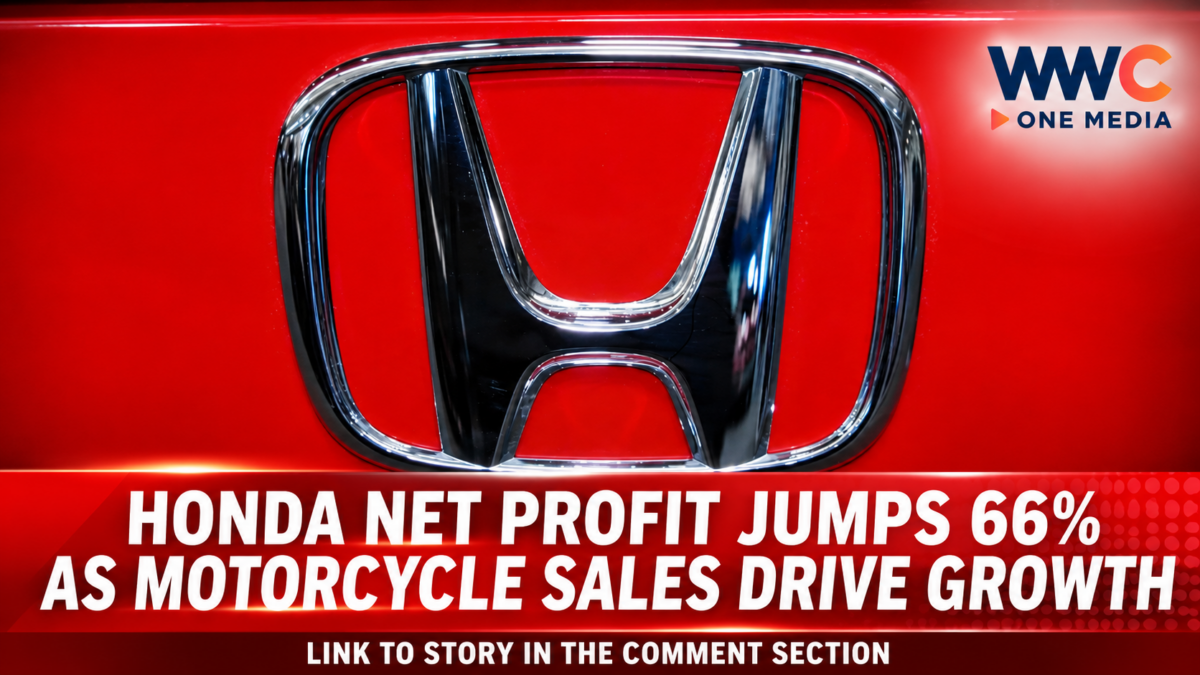
TOKYO, Japan — November 10, 2026 — Honda is proving that motorcycles remain one of its strongest competitive advantages, with record sales helping the Japanese automotive giant deliver a 66% increase in first-half net profit.
But behind the impressive earnings is a more complicated story.
While demand for Honda motorcycles continues to grow in major markets such as India and Brazil, the company is still struggling with expensive electric-vehicle restructuring, declining automobile sales and intensifying competition in the global automotive industry.
Honda Motor Co. reported net profit of ¥516.76 billion ($3.3 billion) for the six months ended September 30, 2026, up from ¥311.83 billion during the same period last year.
Revenue also increased 13.2% to approximately ¥12.04 trillion, supported by strong motorcycle demand and favorable currency movements.
The latest results, reported by The Associated Press on November 10, highlight the importance of Honda’s motorcycle division in sustaining the company’s financial performance.
However, a separate Reuters report published the same day revealed another challenge: Honda recorded an additional ¥484.8 billion in electric-vehicle restructuring charges during the July-to-September quarter.
The company is now raising its full-year operating profit forecast while simultaneously reducing its global automobile sales expectations.
For Honda, the message is becoming increasingly clear: motorcycles and hybrids are supporting the business today, while its electric-car strategy still needs significant adjustments.
Honda Motorcycle Sales Reach a Record 11.9 Million Units
One of the biggest highlights of Honda’s latest financial results is its motorcycle division.
The company sold approximately 11.9 million motorcycles during the first six months of its fiscal year, compared with nearly 10.8 million units during the same period last year.
That represents an increase of approximately 10%.
The performance established a record for Honda’s fiscal first-half motorcycle sales.
Demand was particularly strong in India and Brazil, where affordable and practical motorcycles remain important transportation options for millions of consumers.
Honda’s motorcycle business has long benefited from its extensive distribution networks, established manufacturing operations and strong brand recognition in emerging markets.
These advantages give the company an important source of revenue while its automobile division navigates a difficult transition toward electrification.
The latest figures also demonstrate why motorcycles remain strategically important to Honda.
Unlike the expensive and capital-intensive development of new electric cars, Honda’s motorcycle operations already have established products, manufacturing facilities and customer bases across multiple countries.
The division is therefore helping support the wider company during a period of automotive restructuring.
Profits Rise 66% Despite Electric-Vehicle Costs
Honda’s first-half financial performance improved substantially compared with the previous year.
According to its November 10 financial disclosure, the company recorded:
- ¥516.76 billion: Net profit attributable to owners of the parent, up 65.7%.
- ¥12.04 trillion: Sales revenue, up 13.2%.
- ¥648.74 billion: Operating profit, up 48.1%.
- 11.9 million: Motorcycle sales during the first half.
- 1.57 million: Automobile sales during the same period.
The improvement came despite significant expenses associated with Honda’s electric-vehicle strategy.
The company reported that EV-related losses reduced operating profit by ¥484.8 billion during the first half.
This distinction is important.
Honda’s higher net profit does not mean its electric-car business has recovered. Instead, its overall financial performance reflects contributions from different business operations, including motorcycles, automobiles and financial services, alongside foreign-exchange effects and restructuring expenses.
The results show how a strong motorcycle business can help offset pressure elsewhere in a diversified automotive company.
Honda’s Electric-Car Strategy Continues to Cost Billions
Honda’s electric-vehicle ambitions have encountered significant financial difficulties.
Earlier in 2026, the company announced a major reassessment of its automobile electrification strategy.
It canceled development and planned launches of three electric models intended for North American production.
Honda also announced substantial expected losses associated with its EV investments and changes in the automotive market.
In May, Reuters reported that Honda recorded its first annual loss in nearly 70 years as a publicly listed company, following more than $9 billion in EV-related restructuring charges.
The company also abandoned its previous target of making battery-electric vehicles account for 20% of new vehicle sales by 2030.
Its previous ambition to transition entirely to electric and fuel-cell vehicle sales by 2040 was also withdrawn.
The November 10 Reuters report adds another important development.
Honda recorded ¥484.8 billion in EV-related charges during the July-to-September quarter, while maintaining its full-year restructuring-cost estimate at ¥520 billion.
Reuters estimated that Honda’s cumulative EV restructuring burden now exceeds $12 billion when the previous financial year’s charges are included.
This is among the largest EV restructuring setbacks experienced by an established global automaker.
Nevertheless, Honda has not abandoned electric vehicles altogether.
The company says it intends to remain flexible and expand EV production when market conditions and customer demand justify further investment.
Why Honda Is Betting More Heavily on Hybrid Cars
As electric-vehicle demand and policy conditions change, Honda is placing greater emphasis on hybrid vehicles.
Hybrid technology combines a conventional combustion engine with an electric motor and battery system.
Unlike fully battery-electric vehicles, conventional hybrids do not need to be plugged into charging stations.
This can make them attractive to motorists who want improved fuel efficiency without depending entirely on public charging infrastructure.
Honda’s North American strategy increasingly reflects this shift.
According to Reuters, hybrid vehicles accounted for approximately half of Honda’s global retail sales of 823,000 vehicles in the second quarter, while U.S. hybrid sales increased 9%.
The company is also planning a major manufacturing investment in Ohio.
Honda announced a $3-billion investment to build a new automobile production plant capable of producing approximately 240,000 hybrid vehicles annually.
Production is targeted to begin in 2029.
The project forms part of a wider plan to increase Honda’s North American vehicle production capacity from approximately 1.67 million units to 1.91 million units by 2029.
The investment signals that Honda still sees substantial opportunities in the American automobile market, particularly as demand for hybrid vehicles remains relatively strong.
Honda Expands Motorcycle Manufacturing in Brazil
Honda’s motorcycle business is not only generating strong sales but also attracting additional manufacturing investment.
The company plans to expand motorcycle production at its Manaus facility in Brazil.
According to the Associated Press, Honda aims to increase the plant’s annual production capacity from approximately 1.6 million motorcycles to 2.3 million by 2029.
The expansion is significant because Brazil is one of Honda’s important international motorcycle markets.
A larger production capacity could help the company respond to regional demand while strengthening its manufacturing presence in Latin America.
The development also highlights an important difference between Honda’s two major business segments.
While the company is reassessing expensive automobile electrification projects, it is continuing to expand production in a motorcycle business that is already delivering strong demand.
The contrast suggests Honda is prioritizing investments where it sees clearer commercial opportunities and more predictable customer demand.
Falling Automobile Sales Raise Another Concern
Despite its strong overall financial results, Honda’s automobile business is facing pressure.
The company sold approximately 1.57 million automobiles globally during the first half of fiscal 2026, down from 1.68 million units in the same period last year.
The decline reflects challenges in several important automotive markets.
Competition in China remains particularly difficult, where domestic manufacturers have rapidly expanded their electric and hybrid vehicle offerings.
Chinese brands are competing aggressively on price, software capabilities, vehicle features and development speed.
Honda and other Japanese automakers are being forced to reconsider how they compete in a market where established brand recognition alone may no longer guarantee growth.
Reuters reported on November 10 that Honda reduced its full-year global automobile sales forecast by approximately 7%, to 3.16 million vehicles, primarily because of weaker sales in China.
This creates an important challenge for Honda.
The company must strengthen its hybrid business and improve automobile profitability while maintaining a competitive position in markets where Chinese manufacturers are becoming increasingly influential.
Honda Raises Its Full-Year Operating Profit Forecast
Despite the pressure on its automobile business, Honda has become more optimistic about its operating profit outlook.
The company raised its full-year operating profit forecast to ¥780 billion, up from its previous projection of ¥650 billion.
That represents an increase of approximately 20%.
Honda cited favorable foreign-exchange movements, stronger hybrid demand in North America and efforts to reduce the financial impact of U.S. tariffs.
However, the improved forecast should not be confused with a complete recovery.
Reuters reported that operating profit for the July-to-September quarter fell 39% year over year to ¥118 billion, missing the analyst consensus of ¥250 billion.
The company is therefore facing a mixed financial picture.
Its first-half net profit increased substantially, but quarterly operating performance weakened as EV restructuring expenses continued to weigh on earnings.
Honda also reduced its global vehicle sales forecast, highlighting the continuing difficulties in its automobile operations.
What Honda’s Strategy Means for the Global Automotive Industry
Honda’s latest results reflect a wider change taking place across the global automotive industry.
Several established manufacturers are reassessing the pace of their electric-vehicle investments as consumer demand, government incentives, production expenses and competitive conditions evolve.
The transition to electric mobility remains an important long-term industry objective.
However, automakers are increasingly recognizing that customers in different countries do not necessarily adopt new technologies at the same pace.
Some markets have developed strong demand for fully electric vehicles.
Others continue to rely heavily on gasoline-powered cars, conventional hybrids and motorcycles.
Honda’s strategy reflects this market-by-market approach.
Its motorcycle business remains important in emerging economies, while hybrid vehicles are becoming a major part of its North American strategy.
At the same time, the company intends to maintain flexibility in its future electric-vehicle development.
This approach could help Honda avoid committing excessive capital to products before customer demand and market conditions are sufficiently established.
What Honda’s Performance Could Mean for the Philippines
Honda’s performance is also relevant to the Philippine automotive and motorcycle markets.
Motorcycles remain an important form of transportation in the Philippines, where they are widely used for commuting, delivery services, small businesses and provincial mobility.
Honda is one of the country’s established motorcycle brands, competing in a market where affordability, fuel efficiency, reliability and maintenance costs influence purchasing decisions.
The company’s strong motorcycle business in other markets demonstrates the continuing commercial importance of two-wheeled transportation.
At the same time, the Philippines is experiencing rapid growth in electrified vehicle demand.
WWC One Media previously reported that Philippine electrified-vehicle sales increased significantly during the first eight months of 2026, even as overall vehicle sales experienced pressure.
Read our report: Philippine Vehicle Sales Plunge 18% in August as Bad Weather Disrupts Market, While EV Demand Surges.
The country is also seeing growing competition from Chinese electric-vehicle manufacturers.
Companies such as BYD are expanding their presence as consumers explore alternatives to conventional gasoline-powered vehicles.
Read our report: BYD Philippines Nearly Doubles Sales to 28,399 Units — But One Type of Vehicle Is Driving Almost 80% of the Boom.
Honda’s experience offers an important lesson for the Philippine market.
The transition to electrified transportation does not necessarily mean that every customer will immediately move toward fully electric vehicles.
Hybrid cars, motorcycles and other affordable transportation options may continue to play important roles while charging infrastructure and consumer purchasing power develop.
The Bottom Line: Honda’s Motorcycle Business Is Winning, but Its Auto Strategy Still Needs Fixing
Honda’s latest results reveal two very different stories inside the same company.
Its motorcycle division is experiencing record demand, with 11.9 million units sold during the first half of the fiscal year.
That performance helped support a 66% increase in net profit and strengthened Honda’s financial position despite continuing difficulties in its automobile business.
But the electric-vehicle restructuring remains expensive, automobile sales have declined and competition in China continues to challenge the company’s global ambitions.
The company’s growing commitment to hybrid manufacturing in North America and motorcycle production in Brazil shows where it currently sees stronger opportunities.
For investors and automotive industry observers, Honda’s next challenge will be turning its improved earnings into sustainable long-term growth.
The company has demonstrated that motorcycles and hybrids can support its business while the EV market continues to evolve.